How to Format SD Card to FAT32 on Windows 11/10
Q: You can't format a partition as FAT32 directly from the Windows File Explorer, but you can use the Command Prompt or PowerShell to format a drive as FAT32. To do this, open the Command Prompt or PowerShell as an administrator, type `format /FS:FAT32 X:`, replacing `X:` with the drive letter of the partition you want to format, and press Enter. This will format the partition as FAT32. Alternatively, you can also use the built-in `Diskpart` utility to format the partition as FAT32. To do this, open the Command Prompt or PowerShell as an administrator, type `diskpart`, and press Enter.
Why You Cannot Format SD Card to FAT32 in Windows
You may fail to format an SD card to FAT32 in Windows 11/10 due to the file system mechanism, which doesn't support formatting SD cards larger than 32GB to FAT32. This may also be caused by the SD card being write-protected or having exceeded its storage capacity.
FAT32 is the oldest of the three file systems available to Windows, with FAT32, exFAT, and NTFS being the options. Despite its age, FAT32 has the advantage of being market-standard, offering great compatibility with both Windows and macOS, which is why many flash drives come pre-formatted with it. However, it also has some limitations.
- A FAT32 drive can't save Individual files over 4GB.
- A FAT32 drive's maximum volume size limit is 8TB.
- Native Windows tools cannot create or format an SD card, USB flash drive, or any disk partition larger than 32GB to FAT32.
The regular Windows format tool does not offer the option to format a removable disk larger than 32GB with the FAT32 file system, which can be a problem when you need to format an SD card to FAT32 so it can be recognized and used normally. However, there is a way to get around this limitation.
How to Format SD Card to FAT32 in Windows 11/10 (2GB, 8GB, 16GB, 32GB, 64GB, 128GB, 256GB...)
Due to the limitations of Windows' default programs, people can't fully utilize their SD cards. Luckily, Qiling Partition Master can overcome this limitation, making it a reliable solution for those who need to use their SD cards fully.
Qiling Partition Magic has been serving the market for over a decade, providing customers with the best disk and partitioning experience. The program allows users to format all-size SD memory cards, including SDHC and SDXC, to FAT32 in Windows 11/10, and also offers features such as resizing partitions, converting FAT32 to NTFS without formatting, migrating OS to HDD/SSD, and converting between GPT and MBR. This comprehensive software offers a wide range of practical features for managing storage devices.
To format an SD card to FAT32 in Windows 11/10, follow these steps: First, insert the SD card into your computer and open File Explorer to find it. Right-click on the SD card and select "Format" from the context menu.
Step 1. Launch Qiling Partition Master, select the partition on your external hard drive, USB, or SD card you want to format, and choose the "Format" option from the menu.
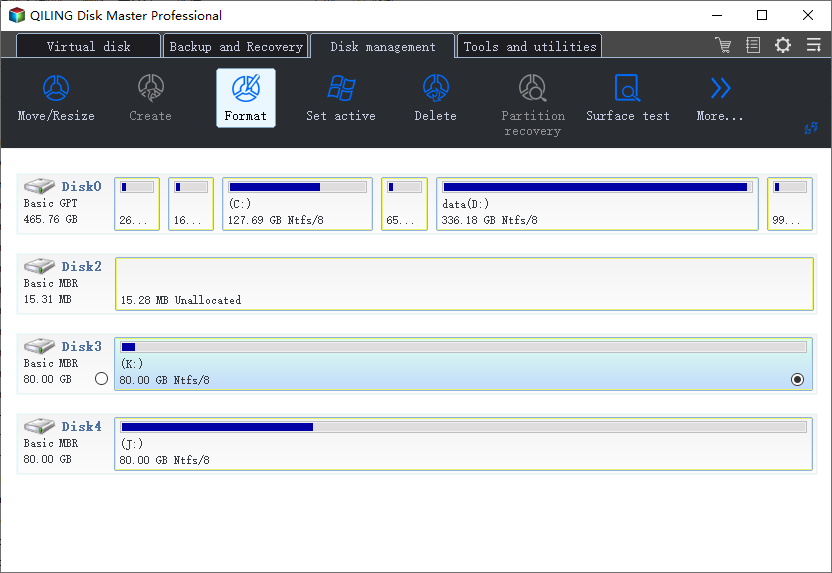
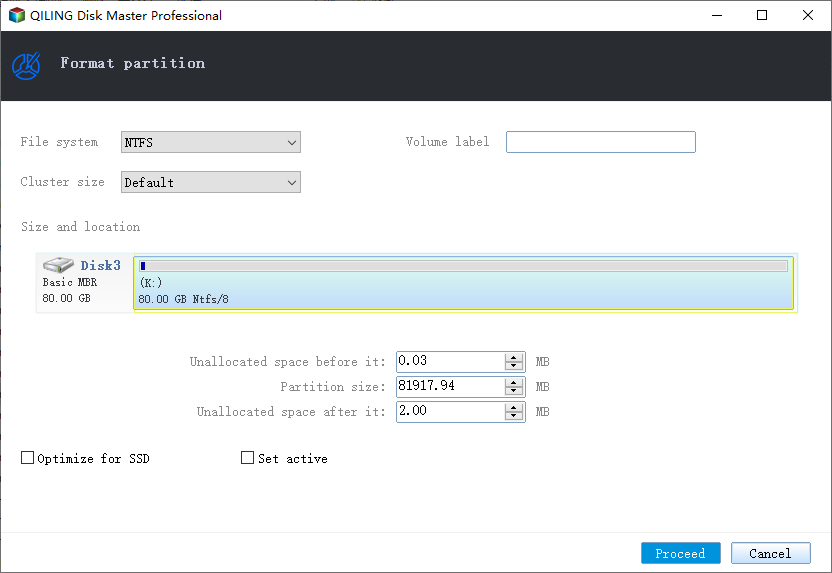
Step 2. Assign a new partition label, file system (NTFS, FAT32, EXT2, EXT3, EXT4, exFAT), and cluster size to the selected partition, then click "Proceed".
Step 3. To start formatting your external hard drive, USB, or SD card, click "OK" in the Warning window. This will initiate the formatting process.
You can successfully format an SD card to FAT32 in Windows 11/10 with ease by following the steps, which can also be used to format a USB flash drive. Just try it whenever you need. Good luck!
Format SD Card to FAT32 - FAQs
1. What's the best FAT32 format tool?
Qiling Partition Master is an all-in-one solution for formatting and reformatting internal and external drives in Windows 11/10/8.1/8/7/XP/Vista. It can easily overcome the limitations of Windows Disk Management, making it the best free FAT32 formatter tool you can trust.
2. How do I format a 128gb SD card to FAT32 for free?
Step 1. Launch Qiling Partition Master, right-click the 128gb SD card you intend to format and choose Format.
Step 2. Enter the Partition label, choose the FAT32 file system, and set the cluster size according to your needs, then click OK.
3. Should I format SD card to FAT32 or NTFS?
When deciding which file system to use for an SD card or USB drive, consider two key factors: portability and file size limits. FAT32 is widely supported, but has limitations, including a 4GB file size cap and a 2TB partition size maximum. In contrast, NTFS has no file size limit and can handle larger partition sizes, making it a better choice for storing large files or partitioning larger drives.
Related Articles
- How Can I Check USB Health and Fix USB Errors on Windows 11 and Mac
- RAID 0 vs RAID 1, Comparison and How-to Setup Guide [2022 New]
- Access GPT Protective Partition Without Losing Data
- Easy Ways to Clean a Disk and Improve Its Performance
- Best PC Clear And Optimizer for Windows 10 & 11
Apart from built-in tools, which is the best PC cleaner and optimizer for Windows 10 or 11 computer? You can find the best PC cleaner for Windows PC from this article. - Deep PC Cleaning: Make the Computer Run Faster!
No one wants to use a slow computer. If you're looking for a deep PC cleaning service, this guide can help, this article explains how to clean your PC from the outside and inside.
Products
Articles & Tutorials
- Data Recovery
- Data Backup
- File Recovery
- File Backup
- System Backup and Restore
- Disk and Partition Clone
- Technical articles
- Mobile articles
- Disk Master Help
- Windows Data Recovery Tutorials
- Windows Secure Delete Tutorials
- Windows Partition Management Tutorials
- Windows File Backup and Restore Tutorials
- Windows System Backup and Restore Tutorials
- Windows Disk Backup and Restore Tutorials
- Windows Clone Tutorials