There Are No Fixed Disks to Show
Fix the DiskPart message There are no fixed disks to show. Check BIOS detection, drivers, cables, boot media, and protect data before repair.
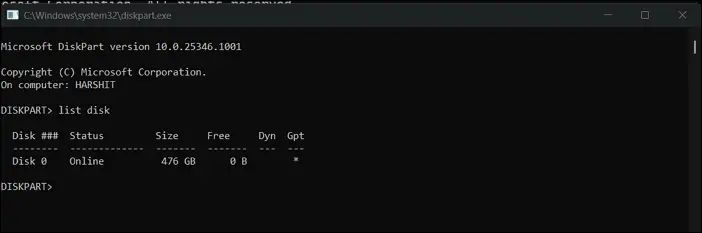
What This Problem Usually Means
The message usually appears in WinRE, Windows Setup, or DiskPart when no internal fixed disk is visible. It may be a driver issue, disabled storage controller, loose SSD, wrong BIOS mode, failed disk, or boot media that lacks the right driver.
What to Check First
- Enter BIOS and confirm the SSD or HDD is detected.
- Reseat the drive or check SATA and power cables on desktops.
- Try another USB installer or add the storage controller driver.
- Do not run clean or format commands until the correct disk is visible.
Repair Windows Boot with Qiling Disk Master
If Windows cannot start, do not format the disk first. Check the boot mode, disk connection, and boot files. Use boot repair only on the disk that actually contains Windows. Fix Boot and Rebuild MBR solve different problems, so choose the method that matches your disk style and startup mode.
Before You Choose a Repair Method
Step 1. Create or open bootable media, start the problem PC from it, and load Qiling Disk Master in the recovery environment.
Step 2. Select the Windows disk. Check whether the disk uses MBR or GPT and whether the PC boots in Legacy BIOS or UEFI mode. If the disk is GPT and the PC uses UEFI, start with Fix Boot. If the disk is MBR and the PC uses Legacy BIOS, Rebuild MBR may be useful.
Method 1: Use Fix Boot for Damaged Startup Files
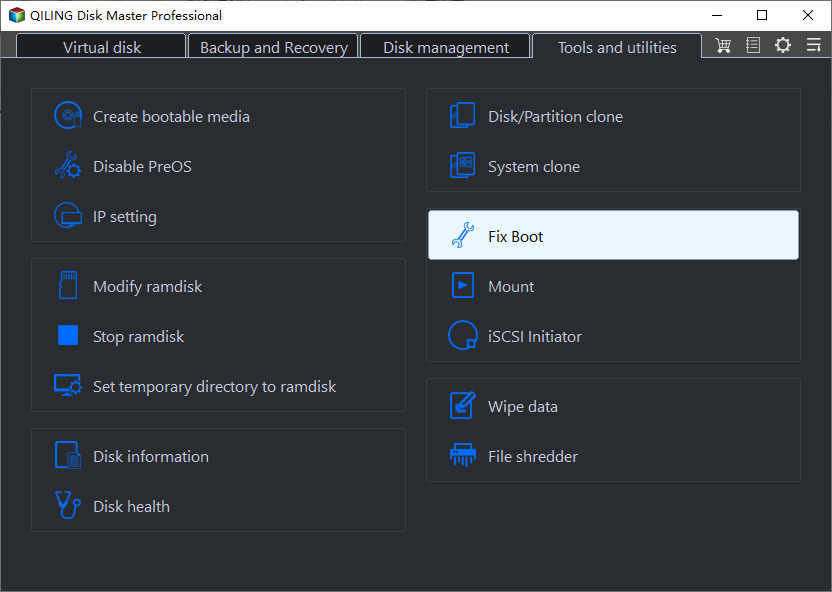
Step 1. Choose Fix Boot when the Windows partition is still present, the disk is detected, but Windows Boot Manager or startup files are damaged.
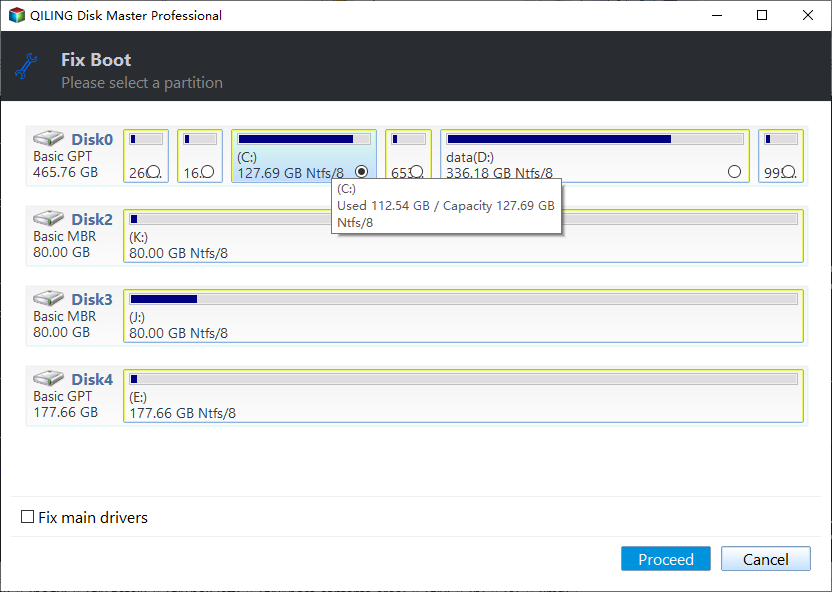
Step 2. Confirm that the selected Windows disk is correct, then click Proceed. After the repair finishes, restart the PC and set Windows Boot Manager as the first boot option in UEFI firmware if it is available.
Method 2: Use Rebuild MBR for Legacy BIOS/MBR Boot Problems
Step 1. Choose Rebuild MBR only when the Windows disk is MBR and the computer boots in Legacy BIOS mode. Do not use this method as the first choice for a GPT/UEFI Windows installation.
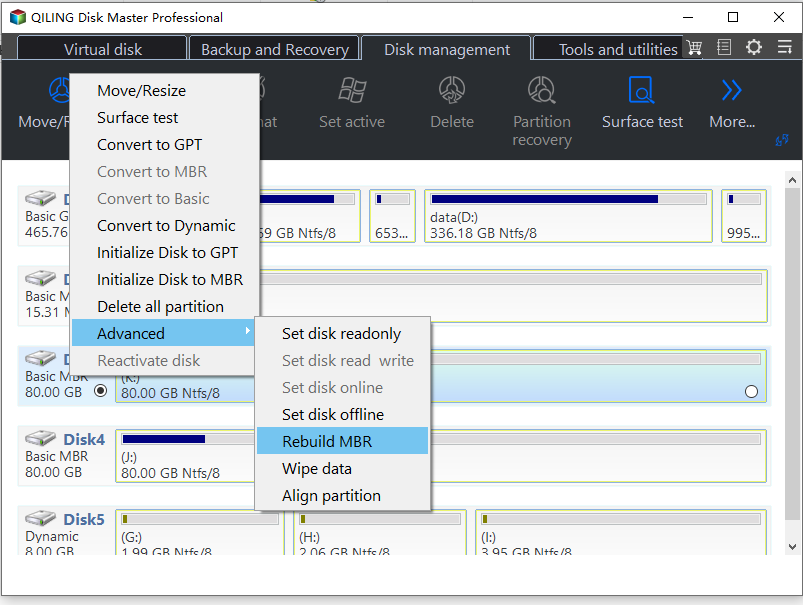
Step 2. Select the proper MBR type for the Windows version, preview the repair, and click Proceed. Restart the PC, enter BIOS, and set the repaired disk as the first boot device.
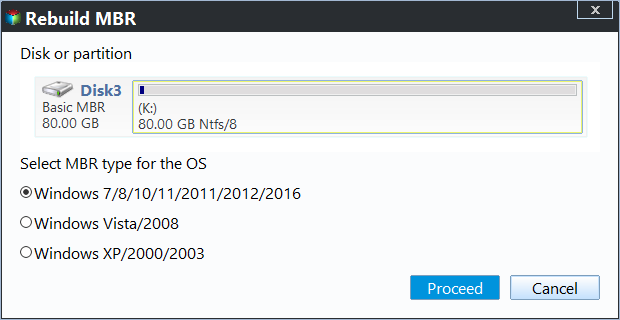
Step 3. If the PC still shows There are no fixed disks to show, return to hardware and driver checks. The problem may be disk detection or storage controller drivers, not MBR or boot files.
FAQ
Should I repair Windows before backing up? If the disk is readable, back up first. Repair commands, formatting, resizing, and reset options can change data or boot records.
Can Windows built-in tools solve the issue? Often yes. Use Settings, Disk Management, Startup Repair, CHKDSK, SFC, or DISM first when the risk is low. Use Qiling tools when you need a clearer disk map, safer preview, or a full backup before changing the drive.
What should I avoid? Do not format a drive that still holds needed files, do not run clean commands on the wrong disk, and do not clone to a target disk that contains the only copy of important data.
Conclusion
This error usually means Windows PE or DiskPart cannot see the internal drive. Confirm hardware detection and storage drivers before rebuilding boot files or formatting any disk.
Related Articles
- Windows Partition Management Tutorials
Find practical Windows partition guides for resizing, formatting, checking, converting, and repairing disks without unnecessary risk. - Windows Data Recovery Tutorials
Use these recovery guides when files are lost after formatting, partition errors, Windows repair, or accidental deletion.
Products
Articles & Tutorials
- Data Recovery
- Data Backup
- File Recovery
- File Backup
- System Backup and Restore
- Disk and Partition Clone
- Technical articles
- Mobile articles
- Disk Master Help
- Windows Data Recovery Tutorials
- Windows Secure Delete Tutorials
- Windows Partition Management Tutorials
- Windows File Backup and Restore Tutorials
- Windows System Backup and Restore Tutorials
- Windows Disk Backup and Restore Tutorials
- Windows Clone Tutorials