[Beginner Guide] What Is PCIe? What Is It Used for?
PAGE CONTENT:
What Is PCIe
PCIe PCI-e (Peripheral Component Interconnect Express) is a high-speed serial computer expansion bus standard that replaced legacy standards like PCI, PCI-X, and AGP.
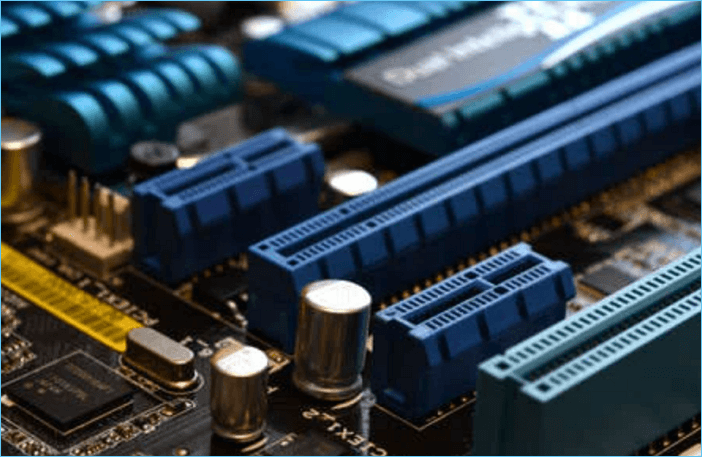
PCIe uses a serial link connection architecture with a point-to-point topology, making it more reliable, faster overall, and less expensive to produce than the PCI bus, which applies parallel communication. As a result, most modern motherboards and computers are configured with PCIe slots for expandability capabilities.
What Is PCIe Used for
The primary goal of using PCIe is to significantly enhance system throughput, scalability, and flexibility while reducing costs.
PCIe is highly scalable and supports a wide range of devices, including graphics cards, solid-state drives, wireless and wired network cards, sound cards, video capture cards, and more, thanks to its robust interface capabilities.
PCIe has a high transfer rate and is compatible with PCI at the software level, allowing for version upgrades and hot plug capabilities.
Different Types of PCIe
The PCIe standard is future-The PCIe standard has evolved significantly, with each new generation offering higher throughput. Starting from the first generation, the standard has progressed to the sixth generation, with connection speeds doubling with each advancement. This continuous improvement enables systems to handle increasing data demands, making PCIe a reliable choice for applications that require high-speed data transfer.
The PCIe standard has evolved over time, with the original PCIe 1.0 supporting a throughput of 2.5Gbps, followed by PCIe 2.0 at 5.0Gbps, and the latest PCIe 3.0 at 8.0Gbps. Most current processors, computers, and motherboards have adopted the PCIe 3.0 architecture, but newer applications require the higher speeds of PCIe 4.0.
Now the PCI-PCIe (Peripheral Component Interconnect Express) has become the main expansion slot on the motherboard, with a focus on four types: x16, x8, x4, and x1, each offering different bandwidth and compatibility options for various graphics cards, storage devices, and other peripherals.
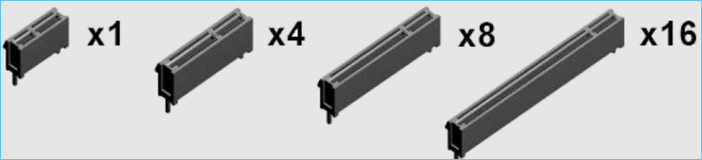
- PCI-E x16: The x16 slot is 89mm in length, has 164 pins, and features a bayonet outside the motherboard, providing excellent compatibility and backward compatibility with x1/x4/x8 level devices, making it the universal slot of PCI-E.
- PCI-E x8: The x8 slot is 56mm long and has 98 pins, but with only half the data pins valid, its actual bandwidth is half that of a real PCI-E x16 slot.
- PCI-E x4: The PCI-E x4 slot's length of 39mm is achieved by reducing the data pins from the PCI-E x16 slot. However, most modern PCI-E x4 slots are now in the form of PCI-E x16 or x8 slots or have been expanded to M.2 interfaces for compatibility.
- PCI-E x1: The PCI-E x1 slot is the shortest, with a length of only 25mm. It is typically used for independent network cards, sound cards, and USB 3.0/3.1 expansion cards, which connect to the motherboard via a PCI-E x1 slot. The bandwidth provided by the motherboard chip is usually sufficient for these types of cards.
Related Articles
- Difference Between Cloud Sync and Backup and Cloud Storage
- RAM vs. ROM: 8 Differences between RAM and ROM
- Windows 11 Is Not Activated: How to Activate Windows 11 OS for Free
- What Is DAS(Direct Attached Storage)?A Beginner Guide for DAS
- Why Is My Camera Telling Me to Format My SD Card [Full Explanation]
Why is your camera telling you to format the SD card? Learn the causes and 3 safe methods to format an SD card without losing data on Windows, camera, and Android. - How to Fix Windows 10 Installation Has Failed [SOLVED]
Learn the 8 key differences between RAM and ROM. RAM is volatile, fast, and writable, while ROM is non-volatile, permanent, and read-only. Discover how these two memory types work together in your computer.
Products
Articles & Tutorials
- Data Recovery
- Data Backup
- File Recovery
- File Backup
- System Backup and Restore
- Disk and Partition Clone
- Technical articles
- Mobile articles
- Disk Master Help
- Windows Data Recovery Tutorials
- Windows Secure Delete Tutorials
- Windows Partition Management Tutorials
- Windows File Backup and Restore Tutorials
- Windows System Backup and Restore Tutorials
- Windows Disk Backup and Restore Tutorials
- Windows Clone Tutorials