Is Clonezilla Reliable for Cloning a Windows Drive?
Clonezilla Live is a capable offline cloning tool, but reliability depends on a readable source disk, correct source and destination choices, and a successful boot test. It is not a repair for failing hardware.
Where Clonezilla fits
Clonezilla Live runs from bootable media and can copy a whole disk without Windows actively using the source. Its disk-to-disk workflow asks for the source and target; the target data is overwritten. Clonezilla's own documentation notes that online cloning is not its normal mode and that destination size and partition layout matter.
After cloning to a larger disk, the extra space may remain unused until partitions are resized. Do not treat a successful copy message as proof that Windows boots or that every file is healthy.
Pre-clone checklist
- Back up valuable files independently and check the source drive for hardware warnings.
- Label the drives by model and capacity; external adapters may change disk numbers between boots.
- Record BitLocker recovery information and keep the PC on stable power.
- Choose the whole disk when replacing a Windows boot drive, including EFI/System Reserved and recovery partitions.
How to confirm the result
Boot once with the old drive disconnected if feasible. If the PC starts, check Disk Management for expected partitions and unallocated space. Open representative files and applications. If the clone does not boot, inspect firmware boot order, mode, and partition completeness before touching the original drive.
Alternative: Clone with Qiling Disk Master
If you prefer a Windows-based interface with a visual layout preview, Qiling Disk Master offers a whole-disk clone. The same source and destination safety checks still apply.
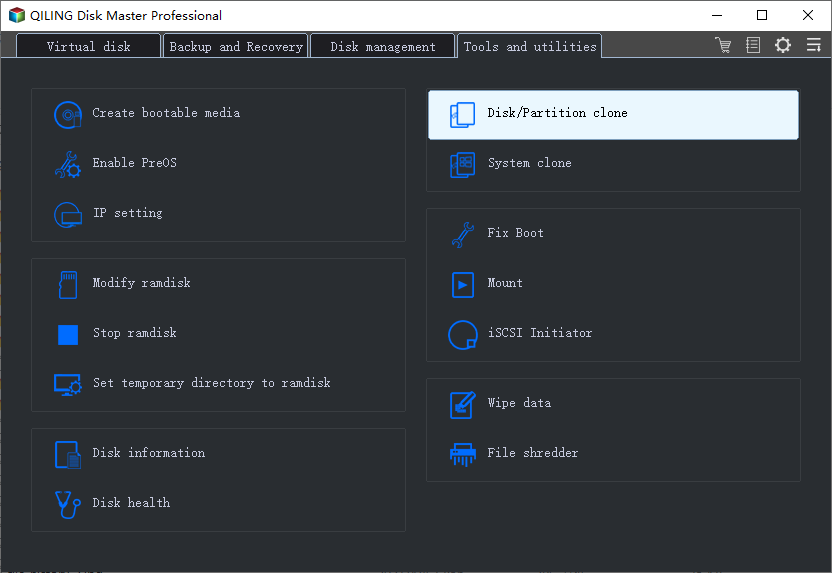
Step 1. Connect the new drive and open Qiling Disk Master. Under Tools and utilities, choose Disk/Partition clone and select the whole source disk, not just C:.
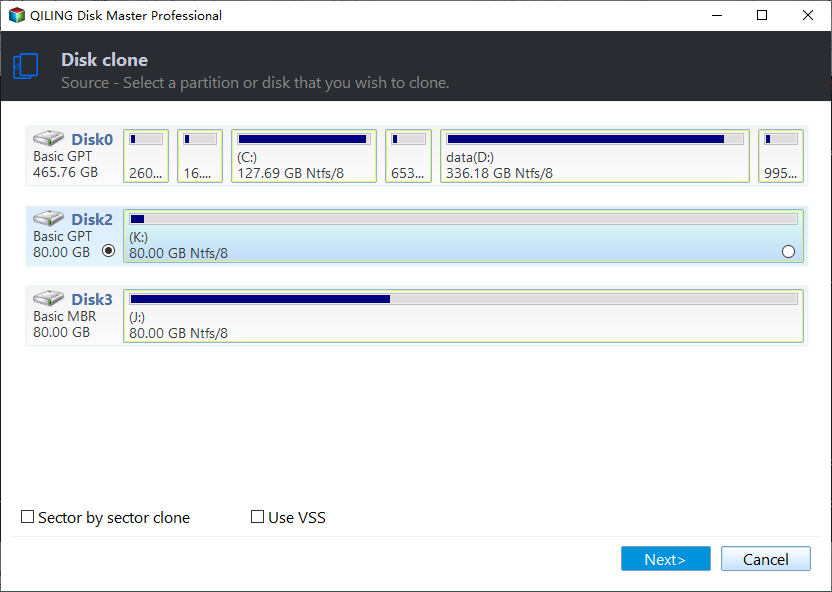
Step 2. Select the readable Windows system disk as the source. Compare its capacity and partition map, including EFI/System Reserved and recovery partitions, then click Next.
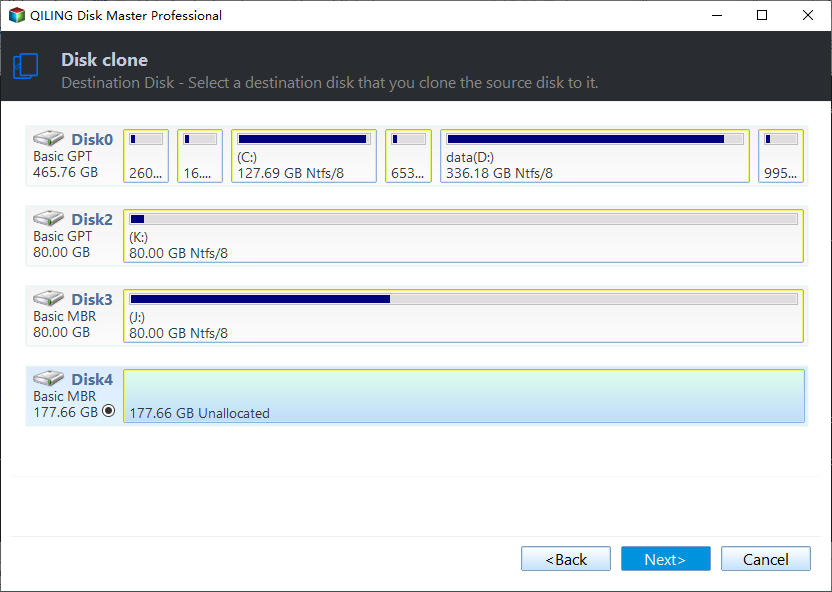
Step 3. Select the empty replacement drive as the destination and click Next. Check the disk number and capacity: every existing file on this destination may be overwritten.
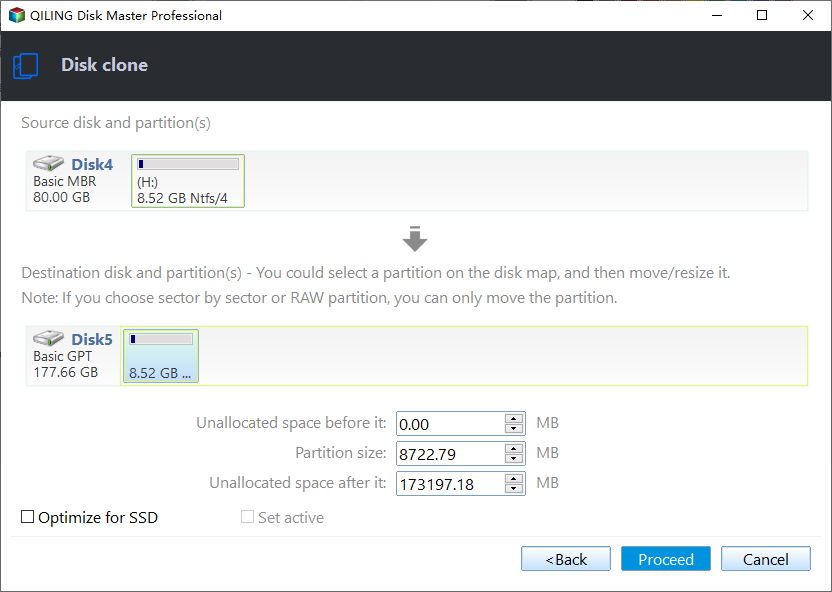
Step 4. Review the source-to-destination layout. Confirm that all required partitions fit; enable Optimize for SSD for an SSD target and adjust the layout only if you understand the resulting space. The preview shown is an example; check your own disk map.
Step 5. Click Proceed, read and confirm the overwrite warning, and keep both drives connected until completion. Boot from the clone alone and verify partitions and files.
Frequently Asked Questions
Will Clonezilla fix bad sectors? No. A failing source may stop or yield incomplete data; use a specialist recovery plan for irreplaceable files.
Do I need to reinstall Windows after a valid clone? Usually not, provided the boot partitions and boot mode are correct and the new disk starts successfully.
Conclusion
Clonezilla can be dependable for a healthy Windows disk when used carefully. Whatever tool you choose, preserve an independent backup and confirm the result by booting it.
Related Articles
- Windows Cloning Tutorials
Browse Windows disk clone, system migration, and SSD upgrade guides. - Windows Disk Backup and Restore Tutorials
Plan a separate disk image before changing a boot drive. - Windows System Backup and Restore Tutorials
Find system image and recovery options for Windows PCs. - Windows Will Not Boot After a Clonezilla Disk Clone
Diagnose a Windows disk that will not boot after Clonezilla by checking target detection, boot mode, EFI partitions, encryption, and the original clone scope.
Products
Articles & Tutorials
- Data Recovery
- Data Backup
- File Recovery
- File Backup
- System Backup and Restore
- Disk and Partition Clone
- Technical articles
- Mobile articles
- Disk Master Help
- Windows Data Recovery Tutorials
- Windows Secure Delete Tutorials
- Windows Partition Management Tutorials
- Windows File Backup and Restore Tutorials
- Windows System Backup and Restore Tutorials
- Windows Disk Backup and Restore Tutorials
- Windows Clone Tutorials