How to Move Space from D Drive to C Drive Windows 10/8/7
Computers have become essential in our lives and work, but as they age, the C drive, equivalent to the human heart, can run out of memory, causing operational problems like crashes and freezes. You might wonder how the C drive space gets smaller even without downloading anything. Don't worry, we'll explain why this happens and provide solutions. Additionally, we'll show you how to move space from the D drive to the C drive on Windows 10/8/7 using a partition magic software, such as Qiling Partition Master, which allows you to transfer space directly without data loss.
Why C Drive Is Getting Smaller
The C drive, being the system disk, tends to accumulate junk files when Windows runs, leading to a decrease in available space. Even with minimal use, the C drive's remaining space will eventually dwindle, sometimes even displaying a red bar. This reduction in space can be attributed to various factors, which include the factors below.
1. Files in the recycle bin take up space on the C drive, so deleting them can free up space. If you accidentally delete files, you can recover them from the emptied recycle bin.
2. System restore can be disabled if not necessary to free up space on the C drive.
3. The page file is a large storage space that can be used to supplement a computer's virtual memory. If it's stored on the C drive, it can cause the virtual memory to reach its limit, potentially leading to memory exhaustion. To avoid this, it's essential to monitor the computer's memory usage through the task manager and relocate the page files to another disk if necessary. This ensures the computer's memory remains within a safe limit.
4. To resolve the issue of too many temporary files, you can use the disk cleaning program that comes with the C drive system to safely remove junk files without deleting essential ones. This can be done by following the steps outlined in the article "how to solve there is not enough space on C drive".
5. Installing software to the C drive can consume memory, and even if you choose to install on other disks, relevant registration files are often placed in the system folder, which can lead to the C drive's capacity decreasing over time. To avoid this, consider installing applications outside of the C drive, such as on the D drive.
If you've tried the previous solutions but still lack space on your C drive, consider moving free space from your D drive, which has ample space, to your C drive to expand its capacity.
How to Move Space from D Drive to C Drive Windows 10/8/7
Qiling Partition Master is a popular partition management program that allows users of all levels to easily partition hard drives on Windows computers, maximizing disk space utilization.
This partition management program can be used to resize/move partitions, merge partitions, create/format/delete partitions, and even migrate the OS to an SSD/HDD to speed up Windows. It can also be used to move space from the D drive to the C drive or any other data drive to C, offering two approaches to achieve this.
Allocate Space from D Drive to C Drive Directly
To increase C drive from D drive without deleting D drive, you can follow the steps to make unallocated space.
Step 1. Select the D: partition with enough free space and select "Move/resize".
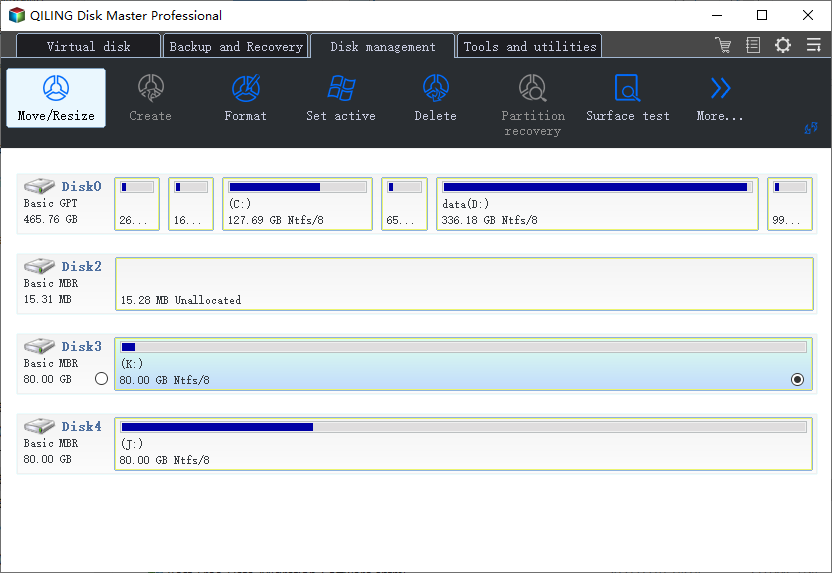
Step 2. Drag the partition panel leftward to shrink the current partition and click "Proceed" to start resize the partition.
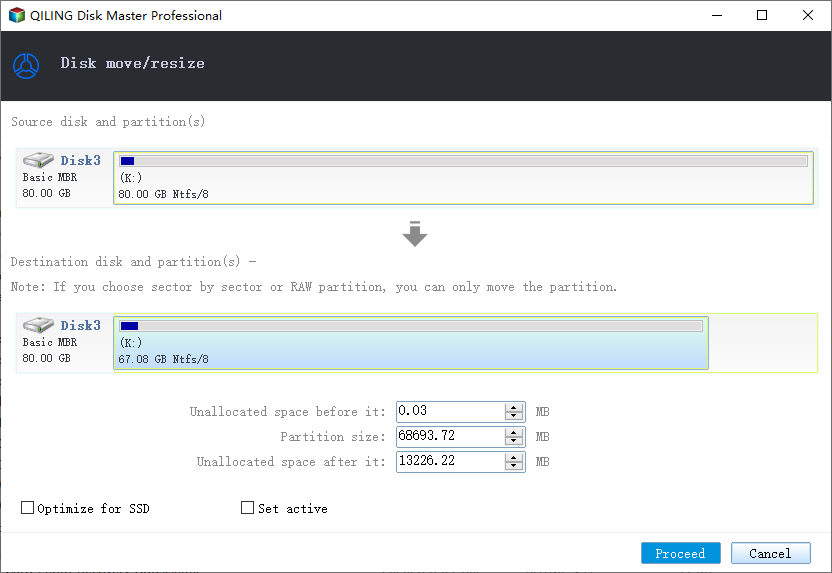
Step 3. Select the C: partition and select "Move/resize" again.
Step 4. Drag the partition panel rightward to add unallocated space into C partition and click "Proceed" to start resize the partition.
Related Articles
- How to Extend C Drive in Windows Server 2019/2016
- Transfer Windows 10 System Files to New HDD or SSD
- How to Install Windows 11/10 on External Hard Drive [2 Ways]
- How to Fix "No Audio Output Device is Installed" Windows 11
- Fix Diskpart Clean Not Working on Disk/USB/SD Card [5+ Fixes]
- How to Convert GPT to MBR (Without Data Loss) with 3 GPT to MBR Converter
- Windows 7 Backup Encryption and Your File Encryption Key
This article introduces you to Windows 7 backup encryption workarounds and 'Back up your file encryption key' solutions.
Products
Articles & Tutorials
- Data Recovery
- Data Backup
- File Recovery
- File Backup
- System Backup and Restore
- Disk and Partition Clone
- Technical articles
- Mobile articles
- Disk Master Help
- Windows Data Recovery Tutorials
- Windows Secure Delete Tutorials
- Windows Partition Management Tutorials
- Windows File Backup and Restore Tutorials
- Windows System Backup and Restore Tutorials
- Windows Disk Backup and Restore Tutorials
- Windows Clone Tutorials