Difference Among Full, Incremental and Differential Backup
This article applies to:
All Qiling Backup editions
Description
This article, along with a visualized diagram, offers a comprehensive understanding of the differences among the terms "Full", "Incremental" and "Differential" backup.
For a simpler comparison, read this overview of full backup vs. incremental backup.
Full backup
A complete backup of everything you want to back up. The backup process is the slowest as it copies all selected files by reading all disk sectors with data to the backup image file. It always generates the largest image files.
However, the full backup is the foundation for all subsequent incremental or differential backups, which means that a full backup must be created first before generating incremental or differential backups.
Incremental backup
This method will only back up the files that have changed since the last backup, regardless of whether the last one was a Full, Incremental or Differential backup image. Incremental backup is the fastest when creating a backup and requires the least storage space.
However, incremental backup also has its drawbacks. Restoring from incremental backups is the slowest because it requires the full backup it is based on plus all previous incremental backups to fully restore the data. If one of the incremental images in the chain is damaged, all subsequent images based on it will become unavailable.
Differential backup
The differential backup copies those files that have been changed since the last full backup took place. Since a differential backup is directly associated with the original full image, if one differential backup is removed or corrupted, the others will not be affected.
The differential backup is faster to create than a full backup but slower than an incremental backup. The restoration speed of this type of backup is slower than using the full backup image and faster than using the incremental backup file.
Example to explain the three backup methods
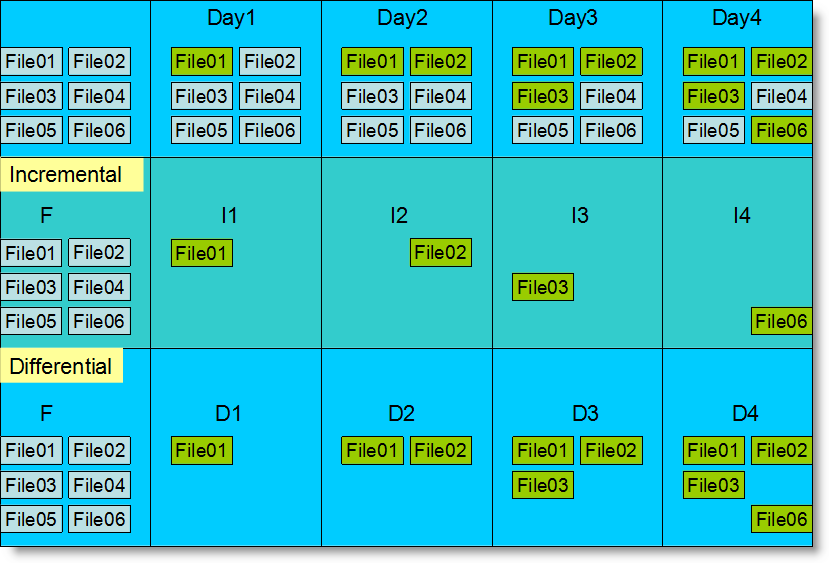
We assume there are 6 files in total, and each day 1 more file is modified (file in green box), then Incremental backup and Differential backup will work as follows:
Difference in recovery
When recovering with the latest incremental backup, you need the Full backup and every Incremental backup for that period. For the restoration of the latest differential backup, you only need the Full backup and the last Differential backup. Incremental and Differential backups require the prior base of a Full Backup to provide a successful recovery process.
For example, if you want to recover 'Incremental2.fvd', you will need 'Full.fvd', 'Incremental1.fvd' and 'Incremental2.fvd' to complete the restoration.
However, when recovering 'Differential2.fvd', you only need 'Full.fvd' and 'Differential2.fvd' to restore the files.
Backup Recovery speed comparison
Full backup requires the longest time to include all files, but it can recover in the shortest time as no other image file has to be read first.
Incremental backup can be finished in the shortest time, but it usually needs the longest time to recover because it must read all its based image files first.
Differential backup has a medium backup and recovery speed between the other two backup types.
Related Articles
- Does Windows 11 Have Cloning Software?
Does Windows 11 have cloning software? Do you want to know the right answer? This article will tell you whether Windows 11 has disk cloning software and introduce a better cloning tool to help you. - How to Enable SMB on Windows 10?
This post explains how to enable SMB on Windows 10. - Fresh Install of Windows 10 on SSD Without Losing Data?
Do you know how to fresh install of Windows 10 on ssd without losing data? This article will tell you how to clean install Windows 10 on SSD without losing data and offer a tool to help you. - How Do I Save Game Data while Updating the Game?
If you are a game player, you will know that games are always under updating. Then, how to make sure you won't lose data during this process? The best way is to make a backup for your games. You can find the answer fo how to save game data while updating the game here. - Best Free Backup Software for Windows Server(2022 Featured Picks)
Data backup is the ideal solution to escape the risk of loss and piracy of the latter. The information below will help you choose the best free backup software specially designed to back up your Windows Server data. So kindly read the entire blog post and acquire the best solution. - How to Backup Outlook Live Emails: Automatic Real-Time Backup
Learn how to backup Outlook Live emails automatically with Qiling Backup. This step-by-step guide shows you how to protect your Outlook emails by scheduling automatic backups to external hard drives, USB drives, or cloud storage, ensuring your important emails are never lost.
Products
Articles & Tutorials
- Data Recovery
- Data Backup
- File Recovery
- File Backup
- System Backup and Restore
- Disk and Partition Clone
- Technical articles
- Mobile articles
- Disk Master Help
- Windows Data Recovery Tutorials
- Windows Secure Delete Tutorials
- Windows Partition Management Tutorials
- Windows File Backup and Restore Tutorials
- Windows System Backup and Restore Tutorials
- Windows Disk Backup and Restore Tutorials
- Windows Clone Tutorials