Why Can You Not Clone a Hard Drive to an SSD?
A clone can fail before it starts, during copying, or only at the first boot. Each stage points to a different cause. Record the exact error and protect the original disk before changing partitions or trying another tool.
If the tool cannot start the job
Check whether Windows detects both physical drives at their expected capacities. An M.2 SATA enclosure cannot be assumed to read an NVMe SSD. Inspect cable, port, power, and firmware support. Back up target data, then confirm the source and target were not accidentally reversed.
A smaller SSD may not fit the selected source partitions even if C: reports little used space. Check EFI, recovery, and data volumes. Sector-by-sector mode usually needs a target at least as large as the full source. Also check edition licensing and whether the tool supports the source encryption state.
If copying stops midway
An HDD with read errors, clicking, or intermittent detection may be deteriorating. Avoid repeated full reads when irreplaceable data is at stake; copy critical files or consult a recovery specialist. Unstable USB adapters, sleep, insufficient power, and target faults can also interrupt a clone.
Check the product log and Windows event logs, then test the connection or replacement disk without altering the only readable source. Do not enable sector mode in the hope that it will repair bad sectors.
If the clone finishes but will not boot
Install the SSD in the intended slot and confirm firmware sees it. Disconnect the original boot disk for the first test. Match UEFI/GPT or Legacy/MBR boot mode and select the SSD's Windows Boot Manager.
If only C: was cloned, the SSD may lack EFI or System Reserved. Re-clone the full disk or use System clone after backing up. A BitLocker recovery prompt needs the key, not random boot repair commands. Keep the original untouched until independent startup works.
Retry a Healthy Disk Clone in Qiling Disk Master
Repeat the clone only after the underlying detection, capacity, or selection problem is fixed. These steps do not treat software as a repair for mechanical damage.
Step 1. Connect the destination by a compatible SATA or NVMe port or enclosure. Open Qiling Disk Master and choose Tools and utilities > Disk/Partition clone. Use stable connections and a target with enough actual capacity.
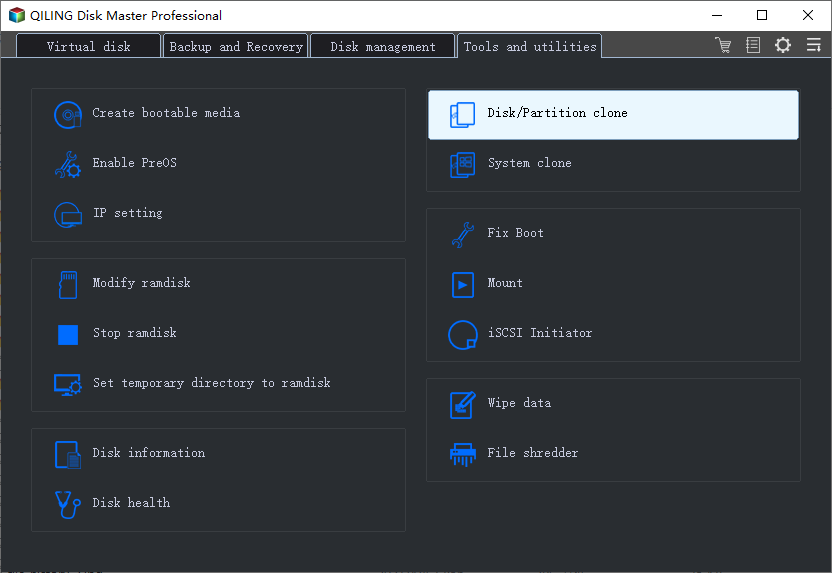
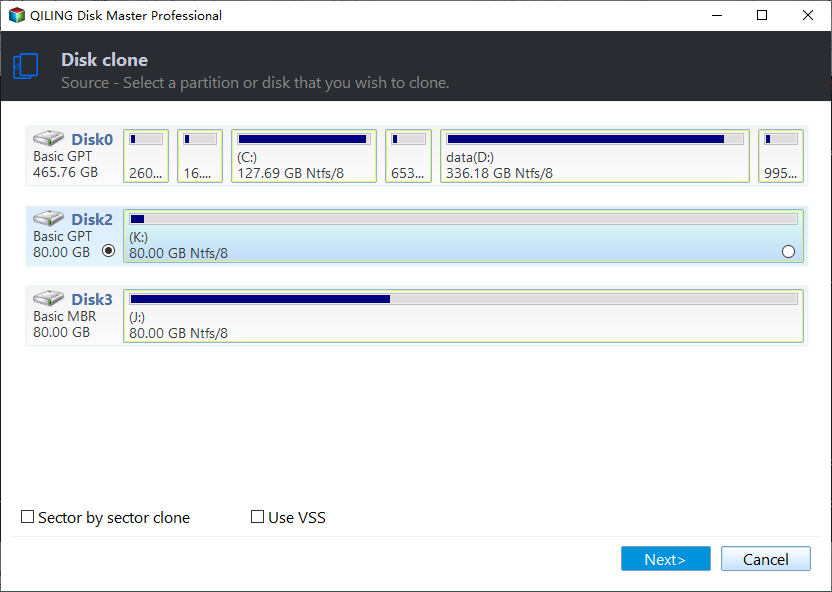
Step 2. Select the entire source disk row by model and capacity, not just its C: partition. Select the complete source HDD and check for read errors first.
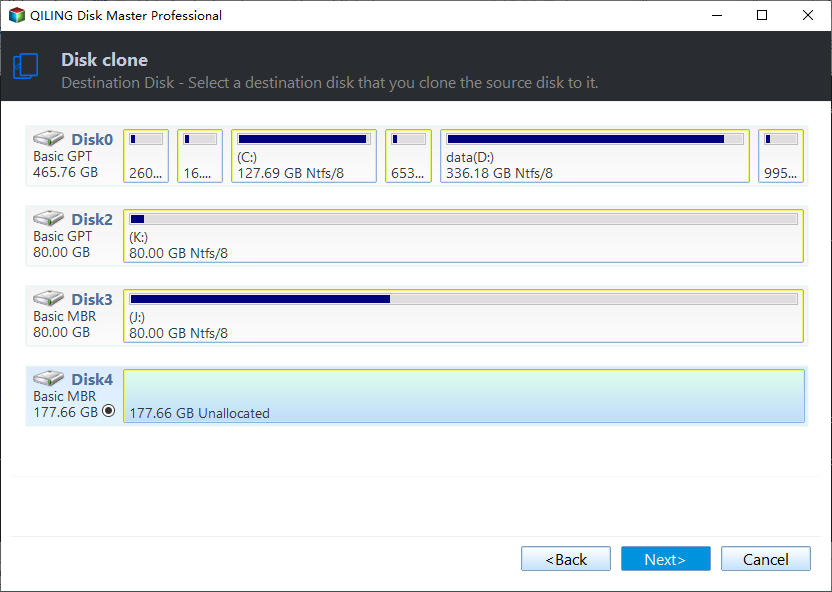
Step 3. Click Next, choose the destination disk by model and capacity, and click Next again. Existing target data will be overwritten. Choose the SSD by model; back up any target files.
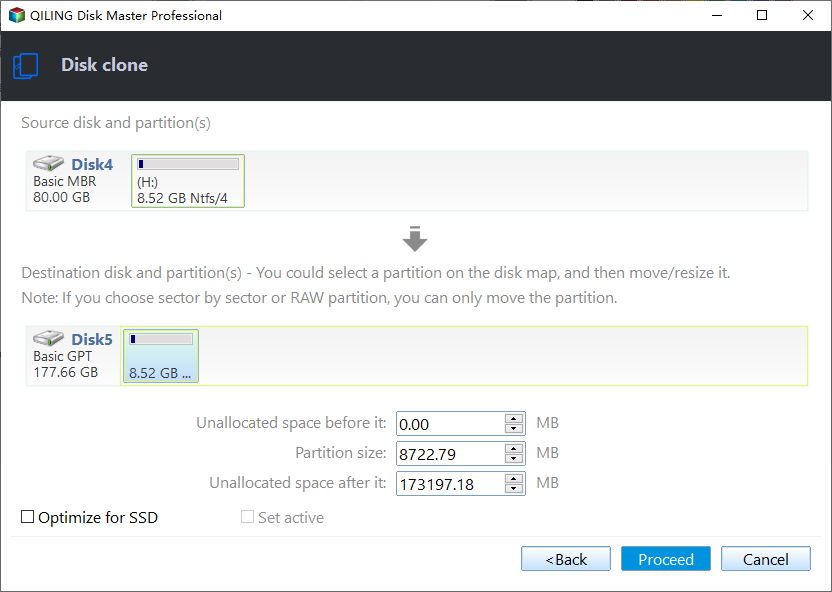
Step 4. Review both disk identities and the proposed layout. Click Proceed, confirm the erase warning, and wait without disconnecting either drive. Confirm boot partitions fit and avoid sector mode unless required.
Step 5. Test the target independently before erasing or reusing the source. Boot from the SSD alone and inspect the exact failure stage if it still fails.
Frequently Asked Questions
Can a smaller SSD hold a larger HDD clone?
Sometimes, if all selected partitions fit with supported resizing; a sector copy generally cannot.
Will a new cloning app fix a clicking HDD?
No. Mechanical failure needs data-preservation planning.
Conclusion
Diagnose the failure stage before retrying, preserve the source, and verify the SSD in its final connection.
Related Articles
- SATA-to-NVMe Clone Will Not Boot
Investigate firmware and EFI problems. - HDD-to-SSD Clone Time
Understand when a slow job signals trouble.
Products
Articles & Tutorials
- Data Recovery
- Data Backup
- File Recovery
- File Backup
- System Backup and Restore
- Disk and Partition Clone
- Technical articles
- Mobile articles
- Disk Master Help
- Windows Data Recovery Tutorials
- Windows Secure Delete Tutorials
- Windows Partition Management Tutorials
- Windows File Backup and Restore Tutorials
- Windows System Backup and Restore Tutorials
- Windows Disk Backup and Restore Tutorials
- Windows Clone Tutorials