Windows 11 KB Update Improvement: Settings Change, Security Improvements, Memory Leaks
Windows Patch Tuesday refers to the regular release of software patches for Windows on the second Tuesday of every month, which can be checked in Settings > Windows Update or through Windows's update history.
Windows 11 has released a new update, Windows 11 build 22000.613, also known as KB5012592, available for all users to download and install. The update, released on April 12, 2022, brings various improvements and new features to the operating system. In this article, we will discuss the main enhancements and changes included in the Windows 11 KB5012592 update.
Changes and Fixes for Windows 11 KB5012592 Update
Windows is releasing a new KB update that primarily addresses a security issue that first appeared in the March 22 KB5011563 update.
Apart from this fix, Windows 11 build 22000.613 also addressed improvements to the following issue.
- Displays up to three high-The feature allows up to four toast notifications to appear simultaneously, with three being high-priority and one being normal priority, for apps that use Windows notifications for calls, reminders, or alarms.
- This update addresses an issue that turns off auto-startup for Universal Windows Platform (UWP) apps after you upgrade the OS.
- Addresses an issue that causes SystemSettings.exe to stop working.
- A fix is needed for the searchindexer.exe issue that is preventing Microsoft Outlook's offline search from returning recent emails. The problem should be resolved.
- This update addresses an issue that causes Windows to take longer to start up due to a UI thread in a networking API that stops responding when a 5G wireless wide area network (WWAN) device is slow to wake up.
- The patch addresses a memory leak issue in the wmipicmp.dll module that leads to excessive false alarms in System Center Operations Manager (SCOM) data center monitoring system.
- The issue is addressed by using the Get-ExecutionPolicy cmdlet to retrieve the Execution Policy settings, rather than relying on the registry to determine the current policy. This ensures that the correct Execution Policy settings are returned, even if the registry is not up-to-date or is corrupted.
- Addresses an issue where modern browsers fail to correctly render HTML generated by gpresult/h.
- The issue arises when a PowerShell test for AppLocker encounters an "Access denied" exception for a file, which is due to the test's inability to access the file's parent directory. This occurs because the test is running under a different user context than the one that owns the file, and therefore lacks the necessary permissions to access the file's parent directory.
- This update addresses an issue where the Remote Desktop Service (RDS) server becomes unstable when the number of signed-in users exceeds 100, preventing access to published applications using RDS on Windows Server 2019.
- The problem occurs when attempting to browse for a domain or organizational unit (OU) due to an issue with memory being improperly zeroed out, resulting in an error message.
- This fix addresses an issue where the Group Policy Management Console stops working after being closed, resulting in Application Error Event ID 1000 and error 0xc0000005 (STATUS_ACCESS_VIOLATION) due to the GPOAdmin.dll module.
- This fix addresses an issue where the Group Policy Service might stop processing telemetry information for Group Policy Registry Preferences, potentially leading to issues with Group Policy configuration and management.
- The patch addresses a stop error (0xD1, DRIVER_IRQL_NOT_LESS_OR_EQUAL) in the DirectX kernel component.
- This update addresses an issue that might cause Kerberos.dll to stop working within the Local Security Authority Subsystem Service (LSASS), which occurs when LSASS processes simultaneous Service for User (S4U) user-to-user (U2U) requests for the same client user.
- The KDC Proxy is unable to obtain Kerberos tickets for Key Trust Windows Hello for Business sign-in.
- The feature allows Azure Active Directory (AAD) Web Account Manager (WAM) to support Microsoft Account (MSA) Pass-through scenarios, enabling the integration of MSA credentials with Azure AD for authentication purposes. This enhancement facilitates the management of user identities and access control within the Azure AD environment, ensuring seamless and secure authentication experiences for users.
- This update addresses an issue where Event ID 37 is logged during certain password change scenarios, including changes to the failover cluster name object (CNO) or virtual computer object (VCO) password.
- This update resolves an issue where the User Account Control (UAC) dialog does not correctly display the application requesting elevated privileges, resulting in confusion and potential security risks.
- This fix addresses an issue that might cause a Microsoft OneDrive file to lose focus after you rename it and press the Enter key. The issue occurs because the file selection is lost when renaming a file in OneDrive.
- The corresponding Settings page is returned when searching for the word widgets.
- The fix addresses an issue where Event 4739 fails to display updated attribute values after a policy change, preventing accurate tracking of changes. This patch ensures that the event accurately reflects the new values of affected attributes, enabling better monitoring and auditing of policy modifications.
- The Move-ADObject command fails when moving computer accounts across domains due to an attribute error, resulting in the message "Multiple values were specified for an attribute that can have only one value".
- This update addresses an issue that prevents users from accessing Server Message Block (SMB) shares using an IP address when SMB hardening is enabled, allowing for continued access to shared resources.
- This update addresses an issue that causes a stop error 0x1E in the SMB Server (srv2.sys).
- This update resolves an issue where the NetBIOS and DNS Active Directory domain names don't match when creating a cluster, leading to unexpected behavior or errors.
How to Download and Install Windows 11 Build 22000.613 (KB5012592)
To get the latest Windows 11 build, the easiest method is to download from Windows Settings. This process can be completed step-by-step, with the simplest approach being to follow the guide below.
Step 1. To check for Windows updates, go to Windows Settings and select Windows Update, or click on the update icon in the taskbar if it's visible.

Step 2. The Windows update information and the latest Windows update version are displayed here.
Step 3. Click Download & Install, and your computer will start to download the ISO file. This may take a while, depending on the size of the file and your internet connection.
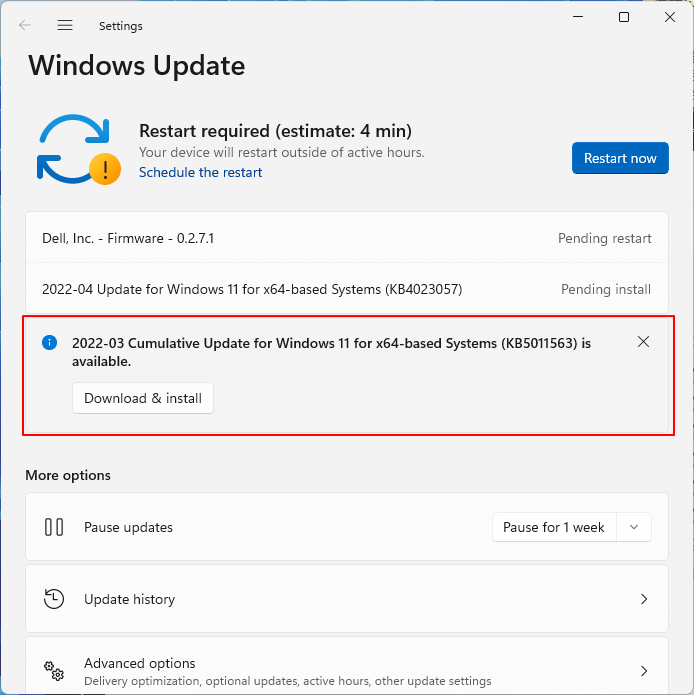
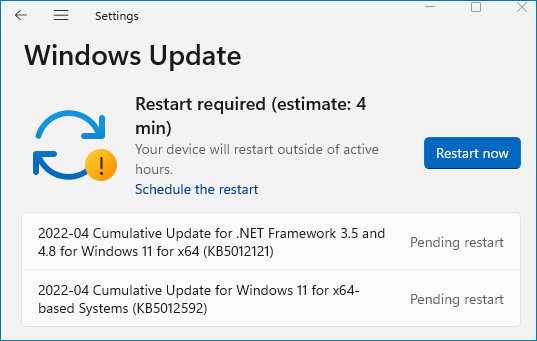
Step 4. When the ISO file download is finished, restart your computer to complete the installation. Click the "Restart now" button and wait for about 4 minutes for the installation to finish.
Qiling Data Protection - Qiling back
- Supports every user to create a free backup to the whole PC, including all files, folders, and system settings.
- Various backup options include scheduling a backup, backing up upon a specific event, incremental or differential backup, and more.
- This software offers the fastest restore speed, allowing users to quickly restore backup files in minutes, while also preserving the original file path.
Conclusion
The Windows 11 build 22000.613 (KB5012592) update brings improvements, and users can download and install it from the article. For devices meeting the minimum requirements, Windows 11 is worth trying. If your computer is still in Windows 10 and incompatible with Windows 11 requirements, you can use Windows 11 on an unsupported PC, as described in the article.
Related Articles
- How to Clone C Drive to SSD in Windows 10
- Windows 11 Ruined My Computer! Slows Down and Crashes a Lot
- Run Disk Clone Windows 11 and Windows 10 with Qiling Backup
- 5 Reasons to Download Qiling Free Backup Software
- How Do I Remove or Repair Programs in Windows Server
Windows Server can face issues with applications, and in such cases, you have the option to either remove or repair the program to prevent it from slowing down the server. This can be achieved through traditional methods or by using third-party tools that make the process more accessible. - How to Repair Windows 7 Without CD in 3 Possible Ways
If you're having trouble with Windows 7, there are ways to repair it without a CD. This article presents three methods to help you fix Windows 7, and you can choose the one that best suits your needs.
Products
Articles & Tutorials
- Data Recovery
- Data Backup
- File Recovery
- File Backup
- System Backup and Restore
- Disk and Partition Clone
- Technical articles
- Mobile articles
- Disk Master Help
- Windows Data Recovery Tutorials
- Windows Secure Delete Tutorials
- Windows Partition Management Tutorials
- Windows File Backup and Restore Tutorials
- Windows System Backup and Restore Tutorials
- Windows Disk Backup and Restore Tutorials
- Windows Clone Tutorials