How to Allocate a Hard Drive to Add Space to Another Partition in Windows 11/10/8/7
Windows 11/10 Free Space VS Unallocated Space
Before diving into how to allocate a hard drive, it's essential to understand the basics of disk space management. You'll often come across two terms: unallocated space and free space. Both hold a part of your computer's storage, with the key difference being that unallocated space is raw, unformatted storage, whereas free space is formatted and ready for use. Understanding this distinction is crucial before learning how to allocate a hard drive.
Unallocated space Unallocated space refers to space on a hard drive that potentially contains intact files, remnants of data, or temporary files that were created and then deleted. It is the space on a hard drive or other devices that hasn't been partitioned, and can be extended using a partition tool like Qiling partition tool if available.
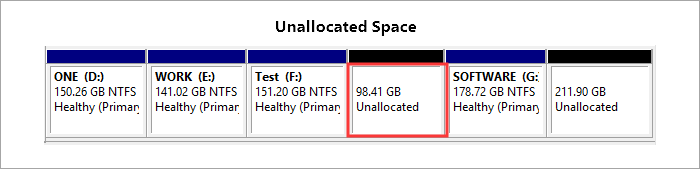
Also read: How to Make Use of Unallocated Space in Windows 10
Free space The free space of a partition refers to the amount of space available for use on that partition, excluding any unusable space. For example, if a 300GB drive has 100GB used, the 200GB remaining is the free space, which can be used for storing files. This is different from unusable space, which is space that cannot be used due to disk errors or other issues. The free space is the amount of space that is available and can be used for storing files, making it a more accurate measure of available storage.
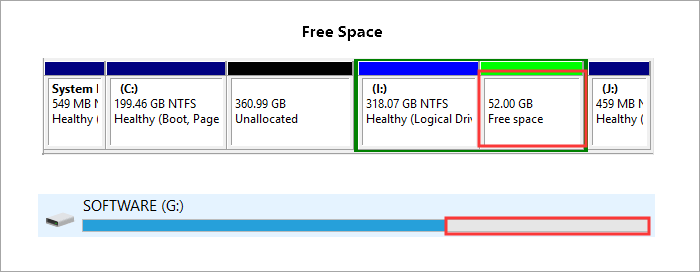
When using Disk Management or other partition tools, it's essential to have unallocated space on your hard drive to create a partition, extend the C drive, or increase drive space. However, this space must be adjacent to the partition you want to resize, limiting the ability to move free space between drives. Unallocated space can only be obtained through these specific methods.
- Delete a partition to get unallocated space
- When you shrink a drive in Windows, the operating system will reserve the newly created free space as "unallocated" by default. This means that the unused portion of space is not automatically formatted or assigned a drive letter, but rather is simply marked as available for future use.
- After initializing a disk, you will see the whole disk shown as unallocated in Disk Management, which means that the disk is ready to be formatted and assigned a drive letter. You can then create a new partition or use the existing unallocated space to create a new volume.
To maximize the risk of data loss, one should avoid using the methods mentioned. However, to directly add free space from one drive to another, one can use Qiling Partition Master to allocate a hard drive space.
How to Allocate a Hard Drive on Windows 11/10/8/7
Qiling Partition Master features an "Allocate Space" function, allowing you to directly allocate unused space from one partition to another on the same disk, among other highlights.
- Merge partitions without losing data
- Migrate operating system to SSD
- Create/format/delete partitions
- Convert MBR to GPT or GPT to MBR
To allocate free space on a hard drive, download the Qiling disk management tool and follow its steps. For example, if you want to allocate free space on the D drive, you can use the tool to do so, or if you want to allocate free space on the C drive, you can also use the tool to achieve that.
Step 1. To free up space on the D: partition, click on it and choose the "Resize/Move" option. This will allow you to adjust the partition size to your needs.
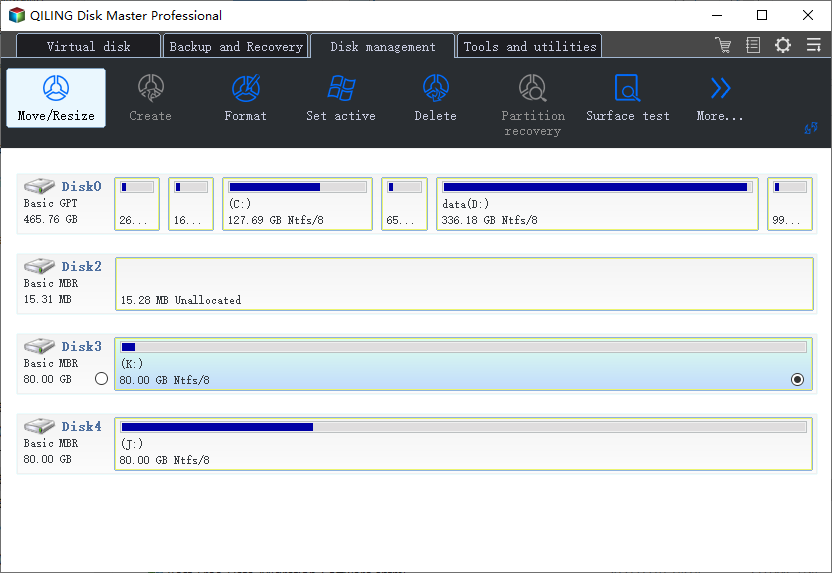
Step 2. Drag the partition panel leftward to shrink the D: drive partition, then click "Proceed" to confirm the free space from D: drive will be moved to C: drive.
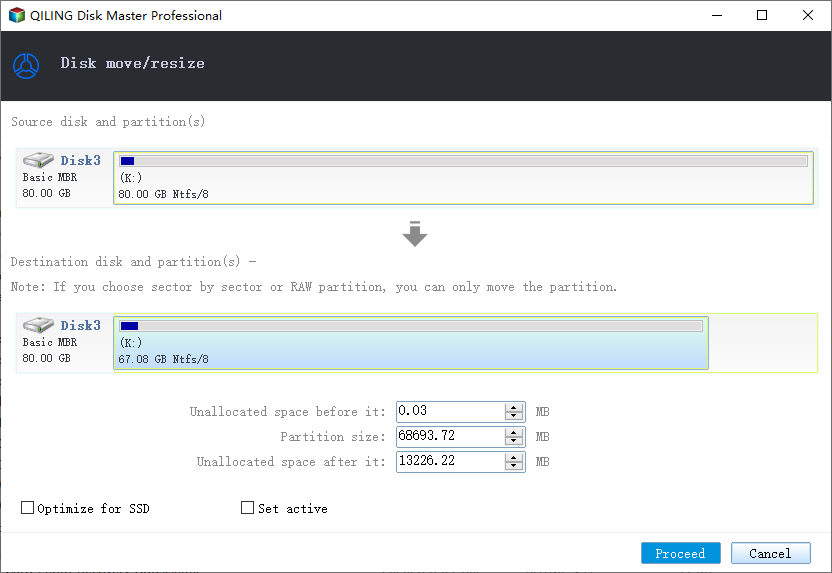
Step 3. Select the target partition - C: drive and drag the partition panel rightward to add the free space from D: drive to C: drive. Then click "Proceed" to start the process of moving free space from D: drive to C: drive.
Common Ways to Get More Free Space on a Hard Drive
To free up disk space, you can try deleting unnecessary files and folders, uninstalling unused programs and games, emptying the Recycle Bin, checking for and removing temporary files, and running a disk cleanup tool to remove unnecessary system files. You can also consider upgrading to a larger hard drive or adding an external storage device if you're running low on space. Additionally, compressing files or using a cloud storage service can help free up space on your local drive. It's also a good idea to check for and remove any malware or viruses that may be consuming disk space, and to use a disk space analyzer tool to identify which files and folders are taking up the most space. By following these methods, you should be able to free up some disk space and improve your computer's performance.
Method 1. Clean Up Large Files
If you need to free up space quickly, consider using reliable junk file cleanup software, such as Qiling CleanGenius, to remove large files and optimize your storage.
Step 1. Qiling Partition Master Suite can be downloaded and installed for free on a Windows PC, and then launched.
To download and install Qiling CleanGenius, hover your mouse on "PC Cleaner" on the suite, then click the Download icon to initiate the installation process, which will also launch the software once complete.
Step 2. To start the cleanup process on Qiling CleanGenius, select "Cleanup" on the main screen and click "Scan" to initiate the scanning process.
Step 3. When the scanning process finishes, select the unnecessary large files and click "Clean" to remove them.
Step 4. After Qiling CleanGenius has completed cleaning the selected files, click "Done" to finalize the cleaning process.
Method 2. Empty Recycle Bin to Get Free Space
The Recycle Bin takes up a lot of space on your hard drive, storing deleted files until you empty it or restore them.
Step 1. Right-click on the Recycle Bin.
Step 2. Select "Empty Recycle Bin" and click "Yes".
You get free space on your hard drive or SSD.
Method 3. Uninstall Unused Applications
To free up disk space, identify and uninstall infrequently used applications to reclaim space occupied by unused programs.
Step 1. Open "Settings > Apps > Apps & features".
Step 2. Select the app or game you want to remove and click the "Uninstall" button.
Method 4. Use Disk Cleanup to Remove Temp Files
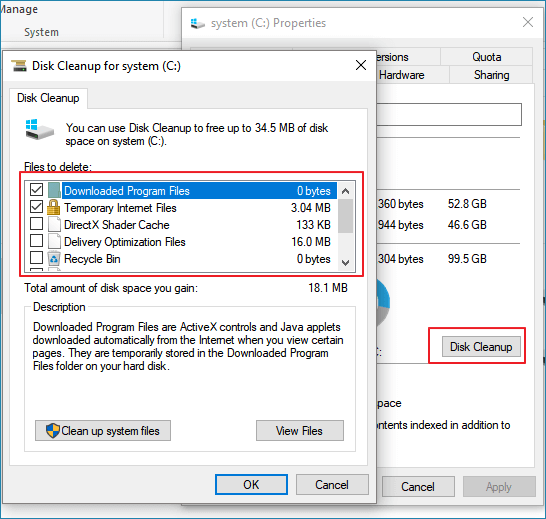
Windows has a built-Using Disk Cleanup is an excellent idea to gain free space, as it enables users to delete temporary files, system files, and other unnecessary data that are no longer needed. This tool allows users to efficiently clean up their computer by removing various temporary files, freeing up valuable storage space. By utilizing Disk Cleanup, users can maintain a clutter-free computer and ensure it runs smoothly and efficiently.
Step 1. To run Disk Cleanup, open the "Start" menu, search for "Disk Cleanup" and select the top result to open the experience.
Step 2. Select the files you want to delete, then click OK to delete them.
Conclusion
Allocating space makes it easier to add free space to another partition in Windows, with no need to create unallocated space. This software also allows for flexible partition resizing, as well as cloning a hard disk, migrating OS to SSD/HDD, and converting MBR and GPT without deleting partitions.
How to Allocate Disk Space Windows 11/10 FAQs
Here are some additional tips about allocating a hard drive on Windows 10 devices. If you still have problems, you can read on: If you're having trouble allocating a hard drive on your Windows 10 device, try checking the drive's properties to see if it's been set to read-only or if there's a file system issue. You can also try running a disk check or a file system check to see if there are any errors that need to be fixed.
How do I partition a hard drive on Windows 11/10?
steps to partition a hard drive:
Step 1. Install and launch Qiling Partition Master.
Step 2. Shrink the partition size.
Step 3. Create a new partition.
Step 4. Adjust the new partition size, file system, label, etc.
Step 5. Click "Proceed" to create the partition.
What does it mean when a hard drive is unallocated?
A computer considers any physical space on a hard drive that doesn't belong to a partition as "unallocated", meaning no programs can write to it. To utilize this space, you can either create a new partition using the area or expand an existing partition, effectively making use of the previously unused space.
Should I leave unallocated space on a hard drive?
You do not need to do anything and use the entire disk (or at least what Windows thinks is the whole disk).
Related Articles
- Repair and Restore Not Working/Failed/Dead SSD
- Best FAT32 Converter Free Download [Tried and Free]
- How to Wipe a Hard Drive in Windows XP Without CD
- How to Convert MBR to GPT or GPT to MBR Without Losing Data in Windows 11/10/8/7
- Solutions to Windows Can't Be Installed to Disk 0 Partition 1
Windows can't be installed to disk 0 partition 1 is an error message you may meet when installing Windows. Here, I'll tell why & how to fix it in several ways. - How to Resize Dynamic Disk Volume in Windows 2012 (R2)?
Here you can learn how to resize dynamic disk, especially extend dynamic disk partition in Windows 10, 8, 7 or Windows Server 2008 (R2), 2012 (R2), 2016 and 2019.
Products
Articles & Tutorials
- Data Recovery
- Data Backup
- File Recovery
- File Backup
- System Backup and Restore
- Disk and Partition Clone
- Technical articles
- Mobile articles
- Disk Master Help
- Windows Data Recovery Tutorials
- Windows Secure Delete Tutorials
- Windows Partition Management Tutorials
- Windows File Backup and Restore Tutorials
- Windows System Backup and Restore Tutorials
- Windows Disk Backup and Restore Tutorials
- Windows Clone Tutorials