How Do I Format a Disk in Windows 10? Follow and Learn How To [Beginners' Guide]
To format a disk on a Windows 10 or Windows 11 computer, follow these steps: Open File Explorer, right-click on the disk you want to format, and select "Format" from the context menu. In the Format window, choose the file system (e.g.
To format a disk on Windows 10, you need to:
- 1. Back up essential data from the source disk to another hard drive or external disk.
- 2. To format a disk, select a reliable disk formatting tool, such as Disk Management or Qiling Partition Master, which can help ensure a safe and effective formatting process.
- 3. Format the disk with the selected tool, and erase all existing data.
Looking for a simple guide to format a disk on Windows 10? Follow these steps to successfully format a hard drive, HDD, SSD, external hard drive or USB, and more. With four complete solutions, you'll be able to format your disk instantly. Just read on and follow the detailed steps provided.
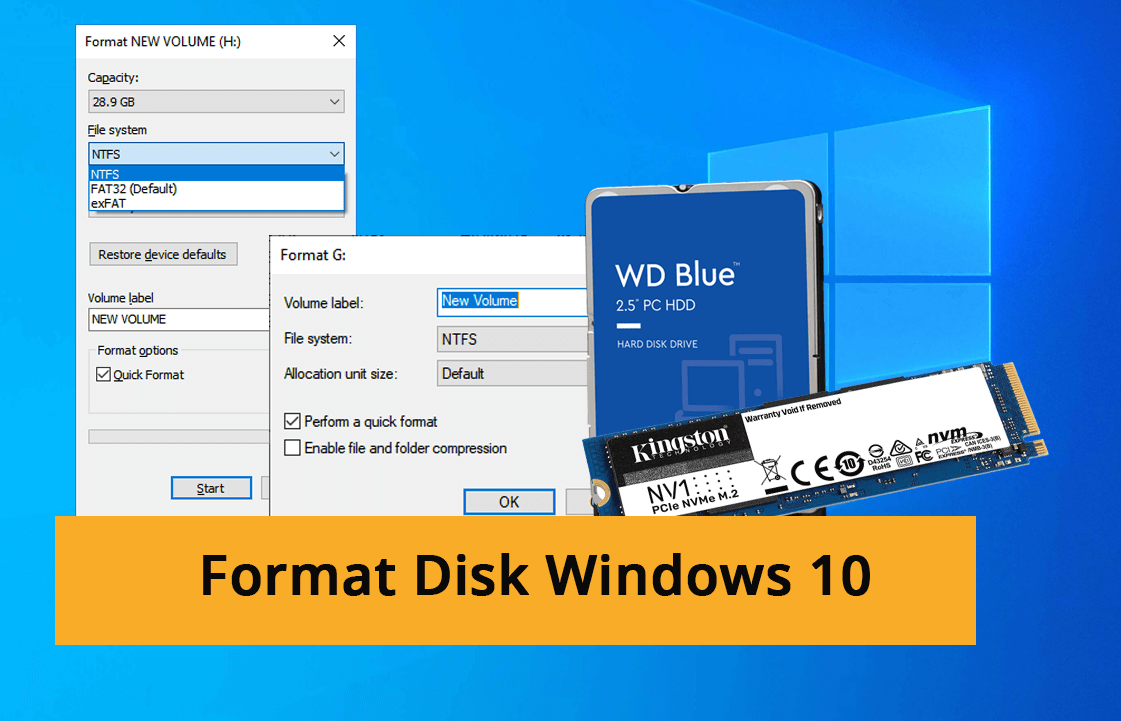
How Do I Completely Format a Disk? Your Start Guide Here
Before formatting a disk, it's essential to take a few precautions. First, ensure you have a backup of all important data on the disk, as formatting will erase all contents. Next, check if the disk is still under warranty or has any manufacturer-specific formatting requirements.
#1. Figure Out Why Do You Need to Format a Disk
Formatting a disk is a necessary step that requires understanding the underlying reason behind it. Whether it's to erase data, free up space, or prepare a disk for reuse, the goal of formatting a hard disk or SSD is crucial to determine. The major reasons for formatting a disk include erasing data, freeing up space, and preparing a disk for reuse, among others.
- Erase all data on a disk and repurpose the disk for new uses.
- To completely erase the disk, remove all data, and sell it, you can use a disk wiping tool or simply throw it away.
- To clear a single partition of data on the disk.
If you're trying to format a partition, you can try the tips on this page for help. If you're planning to clean up the system C drive for reinstalling Windows, follow the step-by-step guide on this link: How to Format C Drive in Windows 10. Otherwise, move on to the next guide. If you're formatting a partition, you can also try the tips on this page for help.
If you're looking to completely erase a disk, follow the steps outlined in the guide on "Secure Erase Hard Drive" for assistance.
#2. Check and Back Up All Essential Disk Data Before Formatting
Formatting a disk, also known as disk formatting, is a process that prepares a data storage device, such as a hard drive or USB flash drive, for initial use. This process also clears all existing data on the drive, resulting in the loss of files and data.
To avoid potential data loss, it's recommended to backup your hard drive data and files in advance. You can either manually copy and paste essential files to an external hard drive or use a free backup software like Qiling Backup Free to automatically back up all critical disk data. This will help keep your important files safe and prevent any potential loss.
Pick a Reliable Formatting Tool to Format a Disk Windows 10 - Your Checklist
To format a disk in Windows 10, Windows 11, or older Windows computers, you can use built-in formatting tools or third-party software. Windows provides a built-in disk management tool that allows you to format a disk, as well as other formatting tools like Disk Management, Command Prompt, and PowerShell. Alternatively, you can use third-party software like Qiling Partition Master, which offer more advanced features and user-friendly interfaces.
- No 1. Third-party Formatting Software - Qiling Partition Master
- No 2. File Explorer With Right-Click Format
- No. 3 Disk Management with "Format" Feature
- No 4. CMD - Diskpart with Format Command
Here is a comparison table for you to view and get a clue about which tool to select:
| Format Tools | Why Choose It | Formatting Features | Price |
|---|---|---|---|
| Qiling Partition Master Free |
|
|
$0 |
| File Explorer |
|
|
$0 |
| Disk Management |
|
|
$0 |
| CMD - DiskPart |
|
|
$0 |
The table shows that Qiling Partition Master is more suitable for formatting hard drive disks from various situations, whereas the other three tools are better suited for formatting a normal and healthy hard drive or partition.
Here is Qiling Editor's suggestion for selecting a disk formatting tool: Qiling Editor recommends using the built-in disk formatting tool provided by the operating system, such as Disk Management in Windows or Disk Utility in macOS, as they are usually reliable and efficient. If you need more advanced features, consider using a third-party tool like DBAN, which is specifically designed for securely erasing data from hard drives and other storage devices. However, be cautious when using third-party tools, as they may have limitations or compatibility issues with certain systems.
- For the easiest disk formatting solution, pick Qiling Partition Master.
- To format a healthy hard drive disk, you can use either File Explorer or Disk Management, both of which are built-in tools in Windows.
Now that you know which formatting tool to use, you can refer to the guide for the specific tool you've chosen to start formatting your disk.
#1. Format Disk in Windows 10/11 with Qiling Partition Master Free - Easiest
Qiling Partition Master Free is a third-party partition manager software for personal users to partition hard drives and manage storage devices on Windows computers.
To format a disk on a Windows computer, repeat the following process for each existing partition: Click on the Start menu, then select "This PC" or "Computer" to access all drives. Right-click on the drive you want to format, then select "Format" from the context menu. Confirm that you want to format the drive by clicking "OK" in the Format dialog box.
Step 1. Right-click the hard drive partition and choose the "Format" option.
Step 2. In a new window, set the Partition label, File system, and Cluster size for the partition, then click "Proceed" to proceed.
Step 3. You can see a warning window, click "Yes" to start formatting the hard drive partition. This will erase all data on the partition.
What Else Can Qiling Partition Master Do?
Aside from formatting a disk using Qiling Partition Master, this tool can also be used to perform other tasks on your hard drive, such as:
- Partition hard drive, extend, shrink, and merge partitions for free.
- Delete, format, and erase hard drive partition for free.
- Clone data partition for free.
- Convert data disk from GPT to MBR for free.
- Convert NTFS to FAT32 or FAT32 to NTFS for free.
- Check file system error, 4k align SSD, etc.
#2. Format Disk with File Explorer
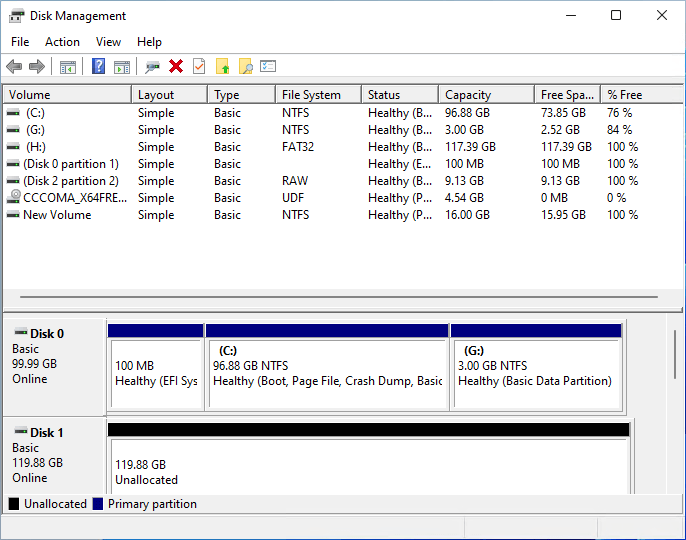
To format a disk using File Explorer's right-click format feature, first confirm how many partitions the target disk has by opening Disk Management. Note the drive letter of each partition. This information is crucial for the successful formatting process.
To format your Windows computer's disk, repeat the following command in the Command Prompt: `format c:`. This will erase all data on the C drive and prepare it for a fresh installation of Windows.
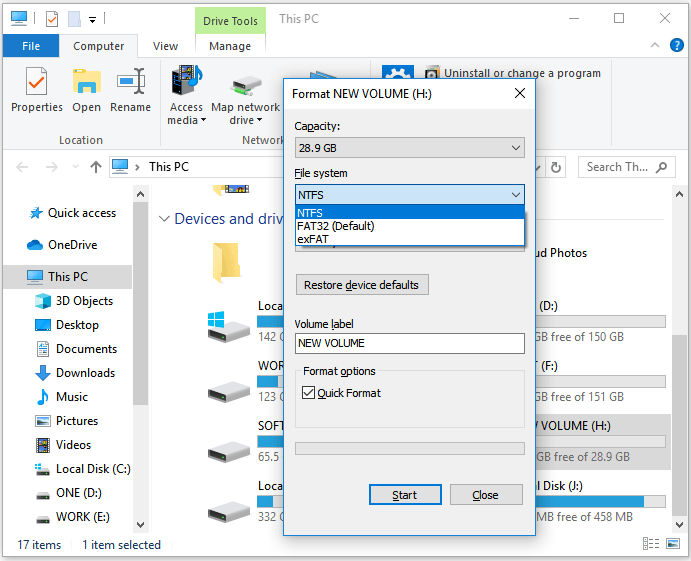
Step 1. To open the File Explorer and view your disk partitions, press the Windows key + E keys on your keyboard. This will launch the File Explorer, and you can navigate to the "This PC" or "Computer" section to see a list of your disk partitions, including the drives and storage devices connected to your computer.
Step 2. Right-click on one of the disk partitions and select "Format...".
Step 3. Set the file system format to NTFS on your hard drive partition and select "Perform Quick Format".
Step 4. Click "Start", and click "OK" to complete the formatting.
Follow the steps to format all disk partitions, repeating the process until you've completed formatting all of them.
#3. Format Disk with Disk Management
Disk Management is a built-For sophisticated Windows users, Disk Utility for Windows offers a free solution to manage hard drives and SSDs on their computer. This tool enables users to create, format, delete, and extend volumes with ease, providing flexibility and convenience in managing their storage devices.
To format a disk using Disk Management, first, open the Disk Management tool and select the partition that needs to be formatted. Then, right-click on the selected partition and choose the Format option. In the Format dialog box, choose a file system (such as NTFS or FAT32) and a label for the partition. Finally, click the Format button to begin the formatting process.
Step 1. Right-click on the Windows icon, then select "Disk Management".
Step 2. To format a disk partition, locate the partition you want to format, right-click on it, and select the "Format" option from the context menu.
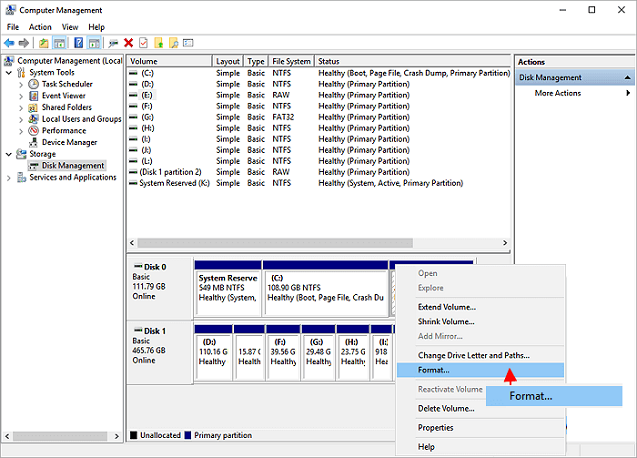
Step 3. Set the file system format to NTFS and select the "Perform a quick format" option.
Step 4. Click "OK" to confirm.
Follow the steps to format the entire disk on Windows 10, repeating them until the entire disk is formatted, and refer to a guide for more detailed information on using Disk Management if needed.

A Starter Guide to Disk Management
This guide provides an overview of Windows disk management, covering its features and capabilities. If you want to use this Windows-built tool to set up a hard drive, start from the basics to learn about its various features.

#4. Format Disk Using CMD DiskPart Command
The DiskPart command prompt is a tool that allows advanced Windows users to manage their computer's hard disk drives through a command line interface. It enables users to execute various disk managing operations for free.
Notice that this process is a bit more complex than using File Explorer or Disk Management, so make sure that you follow the guide below very carefully. Here are the steps of how to format a hard drive using CMD on Windows 10:
Step 1. Press the Windows key + S to open the search bar, type "cmd" and press Enter, then right-click on Command Prompt and select "Run as Administrator" from the context menu.
Step 2. Type the following commands one by one and hit Enter each time to format your disk:
- diskpart
- list disk
- select disk *
- list volume
- select volume *
- format fs=NTFS quick
Step 3. To format all partitions on the target disk in DiskPart, you would repeatedly use the command "format" followed by the drive letter of each partition, such as "format C:", "format D:", and so on, until all partitions are formatted. After formatting each partition, type "exit" to close DiskPart.
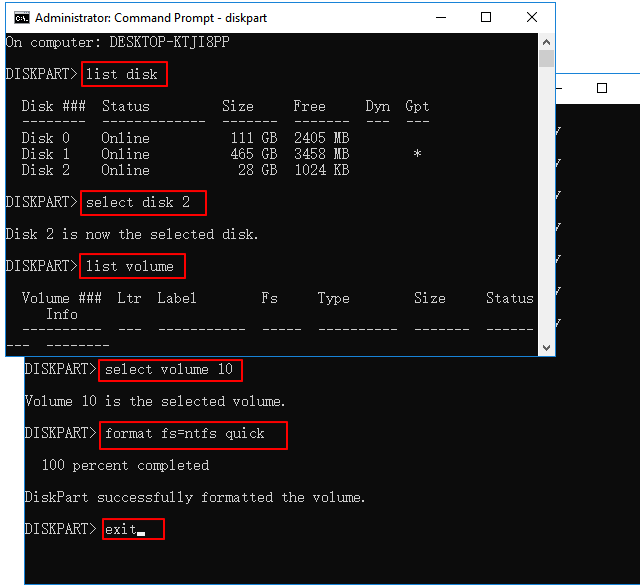
Aside from formatting a disk, you can also use Diskpart to perform various operations on all types of storage devices, including formatting, deleting, creating, and managing partitions, as well as executing other tasks.
Conclusion
If you're looking to format a disk on your Windows 10 or newer computer, or even an older system like Windows 8 or 7, this guide can help. On this page, you'll find four practical solutions to help you completely format your disk, making it easier to start fresh and get your computer running smoothly again.
For disk formatting, File Explorer is a simple and user-friendly option for beginners, while Qiling Partition Master is more suitable for complex situations. For Windows administrators, using the CMD is a more recommended option.
As an ordinary user, you can try Qiling Partition Master as it also has a strong and powerful tech support team that you may reach and contact us anytime for online assistance.
FAQs About Formatting a Disk on Windows 10
What are the steps to format a disk on Windows?
1. How to format a hard drive Windows 10 from BIOS?
To format a hard drive from BIOS, you have two options. You can either apply Qiling Partition Master to format the drive, or create a bootable disk to format the drive from BIOS.
The other option is to use Command Prompt:
- 1. Download a Windows installation media on your PC.
- 2. To resolve the issue, simply reboot your PC, then enter the BIOS settings. From there, select the option to boot from the installation media.
- 3. While entering the Install Windows window, click "Repair your computer".
- 4. Then go to Troubleshoot > Advanced Options > Command Prompt.
- 5. Here are the commands to type:
- diskpart
- list volume
- exit
- dir F:
- format F: /FS:NTFS
The process will be repeated until the target hard drive is completely formatted from the BIOS.
2. What does it mean to format a disk?
Formatting a storage device, such as a hard drive or disk, involves preparing it for new usage by deleting all existing files and data, bypassing the recycle bin, and making the device ready for new content to be written to it.
Formatting a drive can also change the default file system format, so if you need to clean up a disk or change a drive format, you can use a disk formatting tool to accomplish the task.
3. How do I format all files in Windows?
Before formatting a Windows computer, it's essential to back up all valuable files to an external hard drive to prevent data loss.
Unfortunately, there is no way to format files directly, but you can format the hard drive partition where the files are stored, effectively erasing all files on that partition. This approach applies a formatting tool to the entire partition, effectively formatting all files within it. This method can be used to format all files in Windows.
Related Articles
- How to Partition External Hard Drive in Windows 11/10/8/7
- Best Partition Recovery Software for Windows 11 ( Reliable and Easy)
- How to Use and Allocate Unallocated Space in Windows 11/10 [6+ Ways]
- How to Delete EFI (System) Partition in Windows 11/10/8/7 [2 Ways]
- Solved: The Selected Disk is of the GPT Partition Style in Windows
Why "The selected disk is of the GPT partition style" happens? This post will explain and show you how to fix it in two simple way. - Best Free SSD Repair Tool: Fix Corrupted SSD Easily
Need an SSD repair tool to fix some SSD issues? Here, we collect some SSD repair methods and bring a great solid-state-drive repair program. It can help fix some damaged SSD drives.
Products
Articles & Tutorials
- Data Recovery
- Data Backup
- File Recovery
- File Backup
- System Backup and Restore
- Disk and Partition Clone
- Technical articles
- Mobile articles
- Disk Master Help
- Windows Data Recovery Tutorials
- Windows Secure Delete Tutorials
- Windows Partition Management Tutorials
- Windows File Backup and Restore Tutorials
- Windows System Backup and Restore Tutorials
- Windows Disk Backup and Restore Tutorials
- Windows Clone Tutorials