[Fixed] Hard Drive or C Drive Full for No Reason in Windows 10/8/7
If your Windows 10/8/7 hard drive is full but there are no files on it, try these 8 solutions: check for system restore points, remove temporary files, delete hibernation file, check for disk errors, use the Disk Cleanup tool, check for duplicate files, use a disk cleanup software, and check for malware. Each solution can be tried individually to resolve the issue.
| Workable Solutions | Step-by-step Troubleshooting |
|---|---|
| Fix 1. Empty Recycle Bin | Recycle Bin is part of the hard drive and keeps all the temporary deleted files. The more disk space...Full steps |
| Fix 2. Verify the virus | You should suspect a virus or some malicious software you unknowingly installed...Full steps |
| Fix 3. Repair disk errors, Extend C | If your hard disk has errors with a corrupted file system, you will see the hard drive full without reason...Full steps |
| Fix 4. Show hidden files, clean junk files | When there are a lot of hidden files or folders on your hard drive, you will find hard drive full but no files...Full steps |
| Fix 5. Delete temporary files | Step 1. Go on typing %temp% in the Run box and hit Enter; Step 2. Press Ctrl + A to select all and press Delete...Full steps |
To make your C drive space available and your PC faster, consider using Qiling partition manager software, which can effectively make your C drive bigger and improve your computer's performance in running apps.
Why Is My Hard Drive Full
Many users have encountered the issue of their hard drive or C drive being full for no reason on Windows 10, leading to slow computer performance and inability to store new files.
If your hard drive or C drive is full without a clear reason, there are several possible causes. These can include a large number of unnecessary files, such as temporary files, system logs, and other data that's taking up space, as well as a full recycle bin, which can also contribute to the full drive. Additionally, some programs or applications might be storing data on the drive, such as browser cache, application logs, or other temporary files, which can also be consuming space.
- Too many applications or files saved on the disk.
- There is not enough disk space.
- File system corruption on the hard drive.
- Much temporary and cached files.
- Virus or malware attack.
If you're experiencing a "hard drive full for no reason" issue on Windows 10 or Windows 7, this guide can help. To resolve this problem, let's troubleshoot together with some effective solutions outlined in this tutorial.
8 Fixes for a Hard Drive Full But No Files Windows 10/8/7
The below part consists of all possible solutions to C drive full for no reason. They also can be applied to some relevant searches, for example, "hard disk full but no files", "external hard drive full for no reason" and "C drive showing full but nothing on the computer".
Fix 1. Empty Windows Recycle Bin
Don't neglect the recycle bin, which holds a lot of abandoned files. If it's crowded, it can take up some disk space until you empty it.
Step 1. To access the Recycle Bin, locate the Recycle Bin icon on your computer, right-click on it, and select "Open" from the context menu. This will open the Recycle Bin window, allowing you to view and manage the deleted files and folders.
Step 2. Press Ctrl + F1 to open the Recycle Bin Tools, then select "Empty Recycle Bin" from the options.
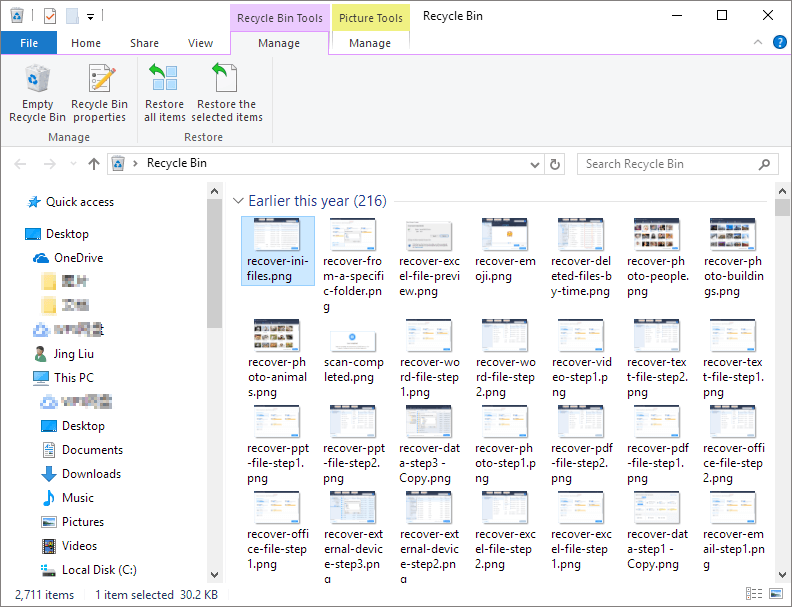
In my case, I cleared the recycle bin and spared about 13GB of disk space.

Fix 2. Verify the virus problem
The used space on your computer doesn't match the actual size of your files and folders, suggesting something is consuming disk space. A likely culprit is a virus or malicious software installed unknowingly from an email link or other source. Run a thorough disk scan using anti-virus software, such as Kaspersky or Malwarebytes, to detect and remove any suspicious programs. Uninstall and delete them completely to free up space. If you don't have virus protection, consider installing one for added security.
If you prefer using CMD to remove a virus from a hard drive or external storage drive, visit the linked page for a tutorial.
Fix 3. Check and repair disk errors, and Extend C Drive
When a hard drive's file system becomes corrupted, it can display incorrect capacity and cause the C drive to be full unexpectedly. To resolve this issue, you can utilize a hard drive repair tool, specifically Qiling Partition Master, which features a "Check File System" function. This tool allows you to scan and repair the file system errors, thereby fixing the corrupted sectors and resolving the issue.
To resolve the issue of a full hard drive but no files, download a partition management software to check and repair a corrupted file system on Windows 10. This software can help identify and fix the problem, allowing you to free up space on your hard drive.
Check and Fix Disk Error:
Extend C drive:
If you're experiencing the issue of the C drive being full for no reason, you can use Qiling Partition Master to easily increase the C drive space on Windows 10 for free.
Option 1. Extend System C drive with unallocated space
- 1. Click on the System C: drive and select "Resize/Move".
- 2. Drag the system partition end into the unallocated space so to add it to the C: drive. To extend the C drive, click the "Extend" button, then click "Proceed" to execute the operations and extend the C drive.
Option 2. Extend System C drive without unallocated space
- To resize a partition, click on a large partition with sufficient free space on the system disk and select the "Resize/Move" option.
- 2. Drag the end of the big partition to the right to shrink it and make room for the unallocated space. Click "Proceed" to confirm the changes.
- 3. Select the system drive at the Disk management page, and select "Resize/Move".
- 4. To extend the C drive, drag the end of System C drive into the unallocated space and click "Proceed" to save the changes. This will extend the C drive into the newly created unallocated space.
Fix 4. Show hidden files & folders, clean up junk files and large files
If your hard drive is showing full but you can't see any files, try checking if hidden files and folders are taking up the space by enabling the option to view them in your file system settings. This might reveal the cause of the issue.
How to show hidden files/folders in Windows 10/8/7:
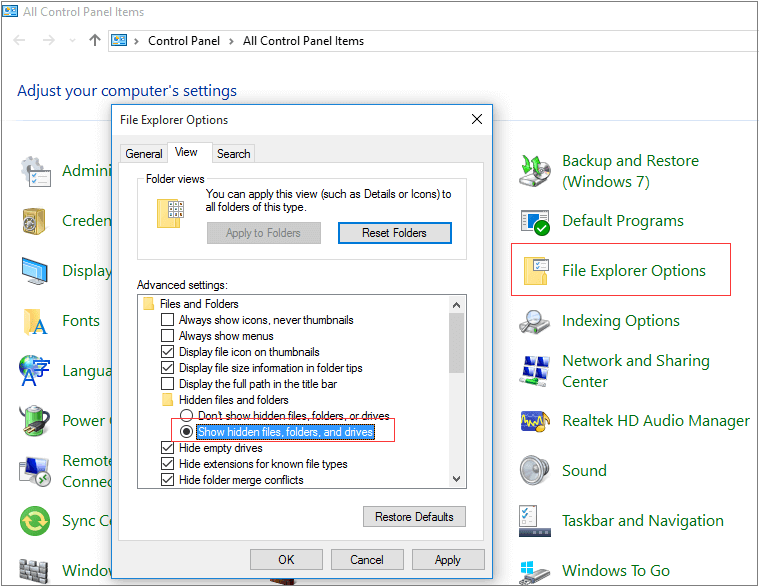
Step 1. To show hidden files, folders, and drives in Windows, go to the Control Panel, then File Explorer Options, click on the View tab, and check the box next to "Show hidden files, folders, and drives".
Step 2. Check the problematic drive for hidden items taking up disk space, and delete any unnecessary ones.
Using a system or software can generate a lot of garbage files, which can be safely cleaned out using a free PC cleanup tool. This can help improve computer performance by freeing up space on the C drive.
Here is how to clean up system junk files on your hard drive:
Step 1. Download and install Qiling Partition Master Suite on your PC, and then click to download PC Cleaner from the panel.
Step 2. To use Qiling CleanGenius, start by installing it on your PC. Once installed, navigate to the "Cleanup" section and click on "Scan" to begin the cleaning process.
Step 3.Qiling CleanGenius will immediately scan your PC, identifying and selecting all useless files, system junk files, and invalid entries. With just one click on the "Clean" button, it will remove all these unwanted items from your computer.
Step 4. Once you've completed the cleanup process, you can see the total amount of data that's been cleaned, displayed in MBs or GBs, and then click "Done" to finish.
Fix 5. Delete temporary files
If you're experiencing a full C drive without a clear reason, it's likely due to temporary files taking up space. These files often include leftover installation files, upgrade logs, browser caches, and other unnecessary data. To resolve the issue, follow the steps to clear out these temporary files, which should help free up space on your system drive.
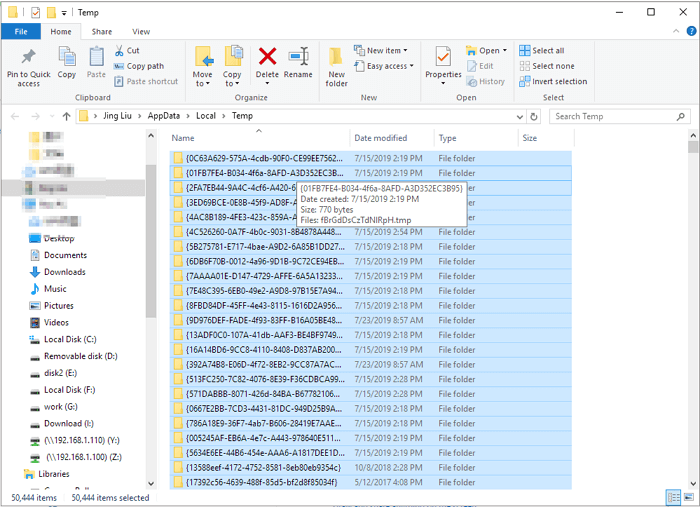
Step 1. When you type %temp% in the Run box and hit Enter, Windows will open the folder that contains temporary files. This folder is used by Windows to store temporary files that are created by various applications, and it's usually located on the local drive, such as C:\Users\YourUsername\AppData\Local\Temp.
Step 2. Press Ctrl + A to select all and press Delete. Skip the one that is currently using.
Conclusion
In a nutshell, we presented 8 useful methods to fix the problem of a hard drive being full for no reason, which should help Windows users recover their free space. If the issue is caused by a real hard disk problem, the methods should be able to help restore the lost space.
Bonus Tips: How to Fix Hard Drive Full for No Reason on Mac
Just like Windows users, Mac users can also experience the issue of a full hard disk. To free up storage space on your Mac, there are several useful tips that can be employed, such as deleting unnecessary files and documents, emptying the trash, and uninstalling unused apps, among others.
- Store all files, photos, and messages in iCloud, freeing up local disk space and allowing access from any device with an internet connection.
- To save space on your device, you can use the Optimize Storage feature, which automatically removes unwanted files and frees up storage space. This feature can be enabled in the phone's settings, and it will periodically scan your device for files that can be deleted, such as duplicate photos, old messages, and unused apps.
- Empty Trash and remove unneeded files
- To declutter your computer, use the Reduce Clutter option to find and delete large files you no longer need. This feature can be found in the Storage settings on Windows 10.
- Move files to an external storage device
- Manually delete application/browser caches and system junk
- Remove iOS devices' backups
- Delete language packs
- ...
Related Articles
- How to Fix External Hard Disk Slow to Respond in Windows 11/10/8/7
- [2022 Update]How to Resize EXT4 Partition in Windows 11/10
- What Is Surface Test? How to Do Disk Surface Test HDD/SSD on Windows 10
- What Is A Typical Symptom That Might Indicate the MBR Record Is Damaged? Fix MBR in Windows 10/11
- I Can't Format USB to exFAT on Windows 10, What Should I Do
This short page explains why you are unable to format USB to exFAT on Windows 10. And you can use the best solution to fix the format error on Windows. - Can't Safely Eject External Hard Drive on Windows 10, How to Solve It?
If you encountered the 'Problem Ejecting a USB Mass Storage Device' problem and can't safely eject an external hard drive on Windows 10, you can try the practical ways in this post to fix this issue.
Products
Articles & Tutorials
- Data Recovery
- Data Backup
- File Recovery
- File Backup
- System Backup and Restore
- Disk and Partition Clone
- Technical articles
- Mobile articles
- Disk Master Help
- Windows Data Recovery Tutorials
- Windows Secure Delete Tutorials
- Windows Partition Management Tutorials
- Windows File Backup and Restore Tutorials
- Windows System Backup and Restore Tutorials
- Windows Disk Backup and Restore Tutorials
- Windows Clone Tutorials