How to Securely Erase Your SSD Information
If you're getting rid of old hard drives or solid-state drives, make sure to wipe all data from them before selling, giving away, or disposing of them, to prevent unauthorized access to your personal information.
Deleting files in File Explorer without a secure method, such as a secure delete software, can allow them to be easily recovered, rendering the deletion process ineffective.
If you're looking to securely delete private information from a hard drive or SSD, we've got a tool for that. Here's how you can use it to erase all sensitive data.
Let's dive in!!
Does Secure Erase Damage the SSD?
You don't need to perform maintenance on your solid-state drive (SSD) as it is designed to be self-sufficient, with built-in algorithms and fail-safes to extend its lifespan and ensure data is properly discarded.
What is the Wear-leveling of SSD?
A key difference between magnetic hard drives and solid-state drives is that solid-state drives use wear-leveling to distribute data evenly among blocks, preventing uneven wear.
A traditional hard drive uses magnetic platters to store files, while a solid-state drive uses flash memory, similar to a USB thumb drive but with a larger capacity.
Solid-state drives (SSDs) write data to blocks rather than specific locations on a physical disc, which causes each writing process to degrade or "wear" the memory.
The SSD ensures even wear across all memory blocks by reshuffling data and recording the changes in a separate file map, in addition to transmitting data storage locations to the host system through a file system.
SSDs don't have physically indexable locations, making it impossible for software to address specific sectors on the disc, so the computer can't tell "where" the data was copied.
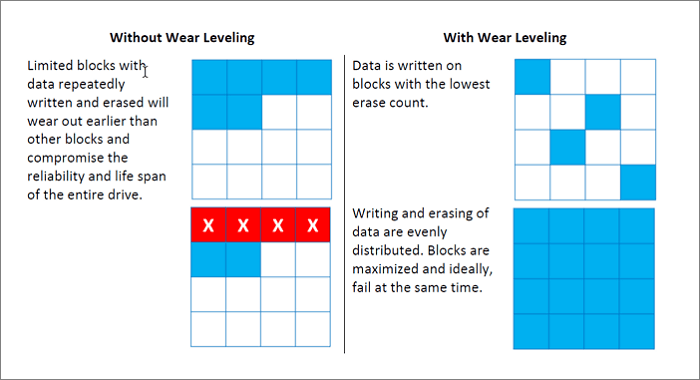
So that's all about the wear-leveling on SSD. Now jump in to know what SSD trim is.
What Is SSD Trim?
SSD TRIM is an ATA command that enables an operating system to inform a NAND flash SSD which data blocks are no longer in use and can be deleted. This command can improve the performance of writing data to SSDs and extend their lifespan.
TRIM is available for SSDs that support SATA, UNMAP for SAS, and DEALLOCATE for NVMe, allowing for efficient data deletion and freeing up space on SSDs.
The TRIM command was added to the ATA standard by the T13 Technical Committee of INCITS.
How Can You Securely Delete Information from an HDD/SSD
If you're looking for ways to securely delete information from a hard drive or SSD, the Qiling free partition tool is a reliable solution.
This software is the best for erasing or wiping a hard drive or partition, allowing you to completely delete all data, including personal info, programs, viruses, and malware. It uses advanced technology to overwrite your data multiple times, ensuring it's unrecoverable even with sophisticated tools.
Qiling Partition Master is a sophisticated software that can accomplish your disk-related needs. With this free partition software, you can resize, move, merge, split, and even clone partitions, as well as create, delete, and format partitions. It also supports disk wiping, disk imaging, and bootable media creation, making it a comprehensive tool for managing your hard drive.
- Resize partitions to allot disk space according to your needs.
- Merge partitions to increase storage capacity.
- The rewritten response is a direct copy of the original response, which is a one-sentence summary. However, it's worth noting that the original response was already quite concise, so the rewritten response doesn't provide any significant improvement in brevity.
- Convert a disk or partition from primary to logical, MBR to GPT, or FAT to NTFS (Pro Version).
To securely wipe an SSD or HDD using the Qiling tool, follow these steps: Boot from a Qiling bootable media, select the drive you want to wipe, and choose the desired wiping mode (Quick Erase, Secure Erase, or Low-Level Format). Then, confirm your selection and let the tool do the rest, ensuring a thorough and secure deletion of all data on the drive.
We've set two options for you to wipe data. Choose the one you need.
Option 1. Wipe Partition
- Right-To erase data from a partition, click on the partition you want to erase data from and select the "Wipe Data" option.
- To wipe a partition, you need to set the time for which you want to wipe the partition. This is usually done by setting the number of passes for the wipe process.
- Click the "Proceed" button to wipe the data.
Option 2. Wipe Disk
- Select the HDD/SSD. And right-click to choose "Wipe Data".
- Set the number of times to wipe data. (You can set to 10 at most).
- Click "Proceed" to wipe data.
- Check the message. Then click "Yes".
Note:Be aware that after using Qiling free hard drive erase software to wipe your disc, you won't be able to undo the operation. Once completed, no data recovery software tool will be able to retrieve the data, so please proceed with caution.
What Is the Difference between Wiping and Formatting Data?
The terms "wiping" and "formatting" are often used interchangeably to describe permanently erasing data from a hard drive, but this is incorrect. The distinction between these terms can be crucial, especially for organizations that recycle their computers and have sensitive data on the hard drive that others might access. If not done properly, using these terms incorrectly can lead to disastrous consequences.
When it comes to erasing data from a hard drive, there are two common terms that are often used interchangeably: wiping and formatting. However, they have distinct meanings. Wiping, also known as secure deletion, involves overwriting the data on the hard drive with random characters, making it unrecoverable.
- Wiping Data
To irretrievably delete data on a hard drive or other storage device, you must overwrite the space with new data. Data destruction software programs can delete entire disks by overwriting or wiping every area of the drive using various data sanitization methods, essentially inserting fresh random data on top of the primary data.
A single pass through a disk wiping application is usually enough to prevent data recovery, but for extremely sensitive data, running the process twice or more may be necessary to ensure complete deletion.
- Formatting Data
Formatting a drive is a way to delete data, but it's not a permanent erasure. It's like deleting a file, but all files are erased at once, and the data can potentially be recovered using data recovery software or a specialist.
Does Formatting an SSD Shorten Its Lifespan?
In general, formatting a solid-Formatting a state drive has little impact on its longevity unless you execute a specific type of format, and even then, it depends on how frequently you format it. Most formatting programs allow you to format wholly or quickly, with the fast format overwriting the partition and file tables without physically deleting anything from the drive.
On the other hand, a full format will go through each sector on a disk and "reset" it, potentially reducing the SSD's lifespan. However, MLC solid-state discs had a write limit of roughly 10,000 before the sector's collapse.
Formatting a hard drive a few times is unlikely to have a significant impact on its longevity, as long as it's not done excessively.
Conclusion
Finally, we have come to the end of this article. Hope now you know how to safely delete information from your hard drive or SSD. Secure Erase can safely wipe out your SSD or HDD and render the data unrecoverable, making it a good option for sanitizing the drive and restoring its performance. However, we recommend using the Qiling Partition Manager tool, which not only allows you to erase your SSD or HDD securely but also enables you to swiftly backup the entire drive before the cleanup if necessary.
Related Articles
- How to Remove Write Protection and Format Write Protected SSD [6+ Fixes]
- Partition Magic VS Qiling Partition Master, Which Is Better & How to Select
- 2 Ways to Clone Seagate HDD to SSD | Try Seagate Disk Clone Software
- C Drive is Full in Windows 11
- How to Install Windows 11 from USB Step by Step
Installing Windows 11 from USB is possible in various ways. You can install it from a bootable USB drive or use the Windows Media Creation tool to do so. Additionally, you can install Windows 11 on a new PC by directly migrating the OS to a Hard Disk Drive (HDD) or Solid-State Drive (SSD). - Internal Drive vs External Hard Drive. Which is better?
The choice between an external and internal hard drive depends on your specific needs. If you're using a PC or laptop, you may need an external drive for backup purposes or to expand your storage capacity for gaming.
Products
Articles & Tutorials
- Data Recovery
- Data Backup
- File Recovery
- File Backup
- System Backup and Restore
- Disk and Partition Clone
- Technical articles
- Mobile articles
- Disk Master Help
- Windows Data Recovery Tutorials
- Windows Secure Delete Tutorials
- Windows Partition Management Tutorials
- Windows File Backup and Restore Tutorials
- Windows System Backup and Restore Tutorials
- Windows Disk Backup and Restore Tutorials
- Windows Clone Tutorials