How to Resize Windows Server 2008 Partition Without Data Loss
Why Resize Server 2008 Partitions?
Windows Server 2008 is a server operating system that Microsoft is proud of, sharing the same architecture and functionality with Windows Vista.
When the C drive is out of space, a partition resize is often necessary. This is because a lack of spare space in the boot partition can cause the computer to become less responsive. To resolve this issue, allocating some space from other partitions can be a suitable solution.
For Windows Server users, resizing partitions is a crucial task, especially when dealing with confidential company data. To achieve this safely and efficiently, a professional tool like Qiling Partition Master for Enterprise is highly recommended. This partition manager offers a reliable solution for resizing partitions on Windows Server, providing an easy, safe, and fast way to manage disk space. Additionally, two common methods for resizing partitions on Windows Server are also available, providing users with a range of options to suit their specific needs.
- Resize Server 2008 Partition with Diskpart Command
- Windows Server 2008 Partition Resize with Disk Management
- Resize Partition on Server 2008 with Qiling Partition Master
1. Resize Server 2008 Partition with Diskpart Command
To resize partitions using the command line, you can use a tool like `fdisk` or `parted`. First, boot from a live CD or USB, then open a terminal and run the command `fdisk /dev/sdX` (where `X` is the drive letter) to access the disk's partition table. From there, you can delete unwanted partitions, create new ones, and resize existing ones using various commands.
Step 1. Type cmd in the search box and then press "Enter".
Step 2. Type diskpart at the command prompt.
Step 3. Type list volume and press "Enter".
Step 4. Type select volume * and press "Enter".
Step 5. Type shrink/extend desired = (* MB) and press "Enter".
Step 6. Type exit and press "Enter" and close it.
Tips:
1. Extending a partition can only be done using Diskpart.exe when there is unallocated space behind the partitions that need to be expanded.
2. The Diskpart command may not be able to move a partition, typically because there is no unallocated space behind the partition to extend it or no unallocated space available. In such cases, a professional server partition manager software is required to resize the Server 2008 partition.
2. Windows Server 2008 Partition Resize with Disk Management
Windows Server 2008 built-In Disk Management, you can shrink a volume to free up space on a disk, extend a volume to increase its size, and resize a Windows Server 2008 partition.
To shrink a Windows Server 2008 volume, right-click on the volume you want to resize and select "Shrink Volume".
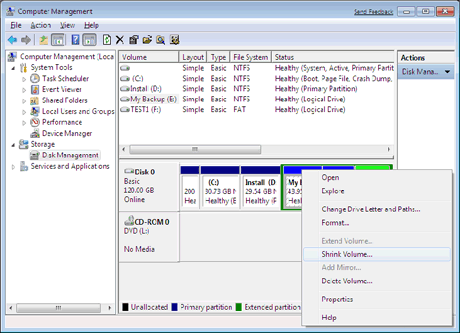
To extend a Windows Server 2008 volume, right-click on the volume to be extended, select "Extend Volume", and specify the amount of space to add to the volume.
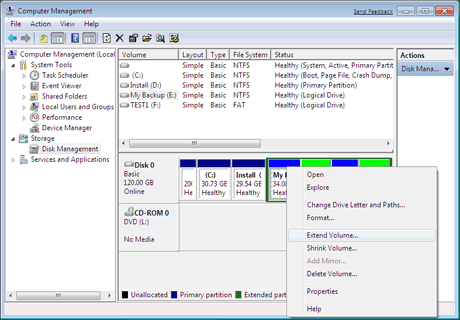
Windows Server 2008's Disk Management interface is actually powered by Diskpart.exe, meaning that its shortcomings also reflect the limitations of the Diskpart command.
3. Resize Partition on Server 2008 with Qiling Partition Master
Qiling Partition Master for Enterprise is designed for organizations and IT professionals, providing best-in-class disk management on Windows Servers and PCs. This tool allows for easy expansion of system partitions, thereby speeding up Windows Server system performance, all without the need to reinstall the OS.
Qiling Partition Master cannot only resize Server 2008 partitions but also move, create, delete, merge, and format partitions, and even migrate the OS to a new HDD or SSD. You can download Qiling Partition Master and follow the detailed tutorial to resize your Windows Server 2008 partitions.
Qiling Partition Master Enterprise
Your trustworthy Windows Server disk manager.
- Extend System drive, combine/split partitions.
- Clone disk, migrate OS to HDD/SSD.
- Convert MBR to GPT, GPT to MBR, no data loss.
- 1-click adjust disk layout, create volumes at one time.
Before partitioning, try Qiling Backup Server to ensure your data security.
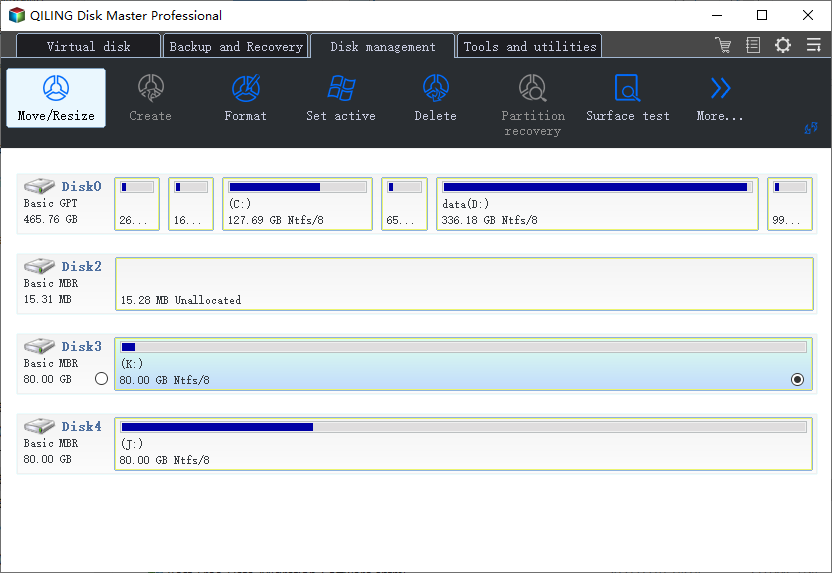
Step 1. Locate the Target Partition.
To extend a partition, you should first locate the target partition and select the "Resize/Move" option.
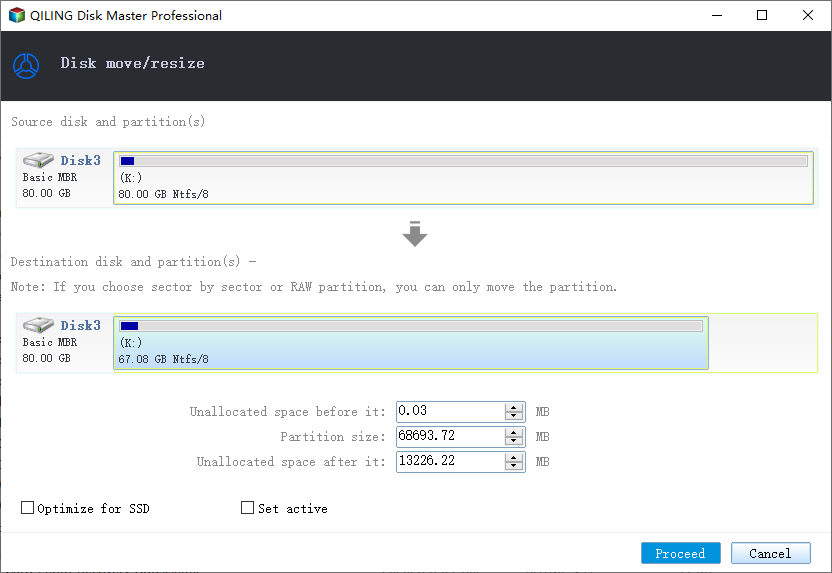
Step 2. Extend the Target Partition.
To add unallocated space to your current partition, drag the partition panel to the right or left, depending on the desired direction, and then click "Proceed" to confirm the changes.
Extra Option: Get Space from Another Drive
If there's not enough unallocated space on your disk, select a larger partition with enough free space, then choose "Resize/Move".
To resize the partition, drag the partition panel rightward or leftward to shrink it for unallocated space and click "Proceed" to confirm.
Supported Operating System
This Server 2008 partition manager supports a variety of Windows server operating systems, including Windows 2000 Server SP4, Windows 2000 Advanced Server SP4, Windows Server 2003 Standard and Enterprise Editions, Windows Server 2003 x64 Standard and Enterprise Editions, Windows Server 2008, and Windows Server 2008 x64 Enterprise Edition.
The Bottom Line
To resize partitions in Windows Server 2008, you can use one of the following methods, which also work for common Windows PCs. You can either use the built-in Disk Management tool to shrink or extend partitions, or use third-party software like Partition Magic to resize and manage partitions. Additionally, you can use the command-line utility Diskpart to resize partitions, providing more advanced options and flexibility. Regardless of the method you choose, it's essential to ensure that the partition you want to resize is not in use by any operating system or applications, and that you have a valid backup of your data before making any changes.
Related Articles
- How to Migrate Windows 7 to SSD in Two Easy Ways
- How Do I Use Unallocated Free Space in Disk Management | 2026 Windows Tutorial
- How to Fix The Selected Disk is not a Fixed MBR Disk
- Move Unallocated Space to the Left, Right or End of A Drive Easily
- Selected Boot Device Failed - 6 Quick Fixes with Pictures
Does your PC encounter the error of the selected boot device failed? Learn six quick fixes step-by-step with pictures to resolve the issue in no time. - How to Fix Selected File Is Not a Proper BIOS [4 Ways]
Learn 4 effective methods with our expert troubleshooting guide to resolve the selected file is not a proper BIOS issue easily to get your system running smoothly again.
Products
Articles & Tutorials
- Data Recovery
- Data Backup
- File Recovery
- File Backup
- System Backup and Restore
- Disk and Partition Clone
- Technical articles
- Mobile articles
- Disk Master Help
- Windows Data Recovery Tutorials
- Windows Secure Delete Tutorials
- Windows Partition Management Tutorials
- Windows File Backup and Restore Tutorials
- Windows System Backup and Restore Tutorials
- Windows Disk Backup and Restore Tutorials
- Windows Clone Tutorials