How to Use Deep Data Recovery
Quick Navigation:
- Step1. Select file types that you want to recover
- Step2. Select a location to scan or find data
- Step3. Preview and recover the lost files
Recovering lost data can be a daunting task, but with the right tools, it becomes a straightforward process. Deep Data Recovery software provides two powerful scanning modes to help you restore all deleted, formatted, or lost data with ease.
Step1. Select file types that you want to recover
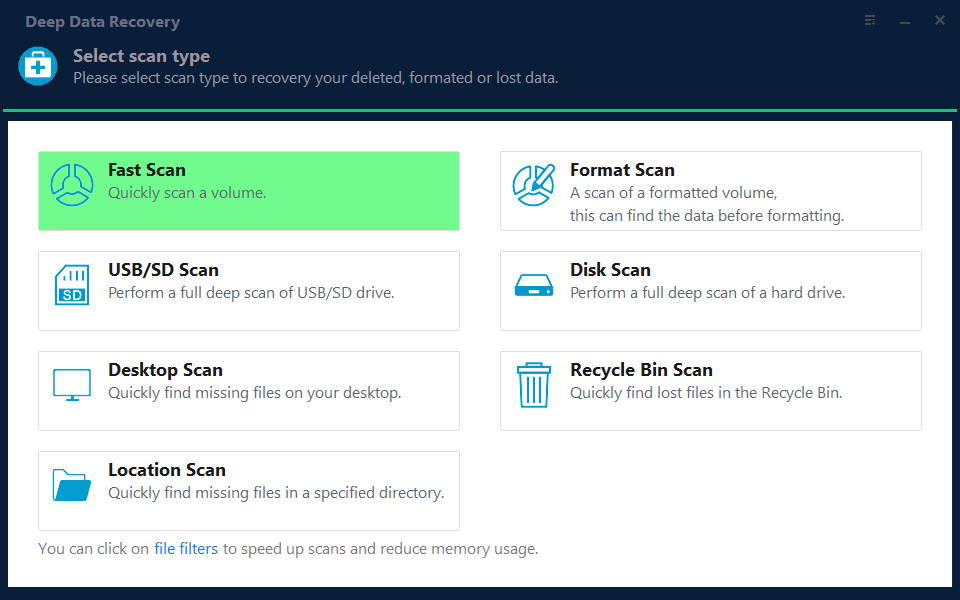
When launching Deep Data Recovery, you have the flexibility to customize your data recovery experience. By default, all file types are checked, allowing you to recover a wide range of files. However, if you only want to recover specific file types, you can uncheck and remove other file types.
Step2. Select a location to scan or find data
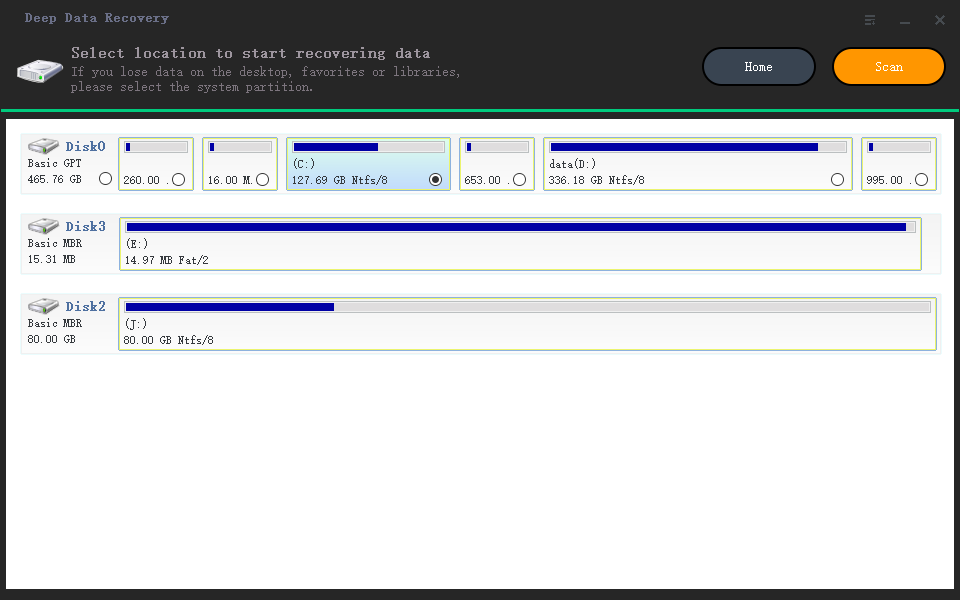
When using Deep Data Recovery, the first step is to select a location to find the lost data. This can be a specific partition, a designated location, or even the entire hard drive or external storage device.
Step3. Preview and recover the lost files
After completing the Quick Scan, you'll see the scan results displayed in the upper part of the window. This is a good starting point to review the lost data found by Deep Data Recovery.
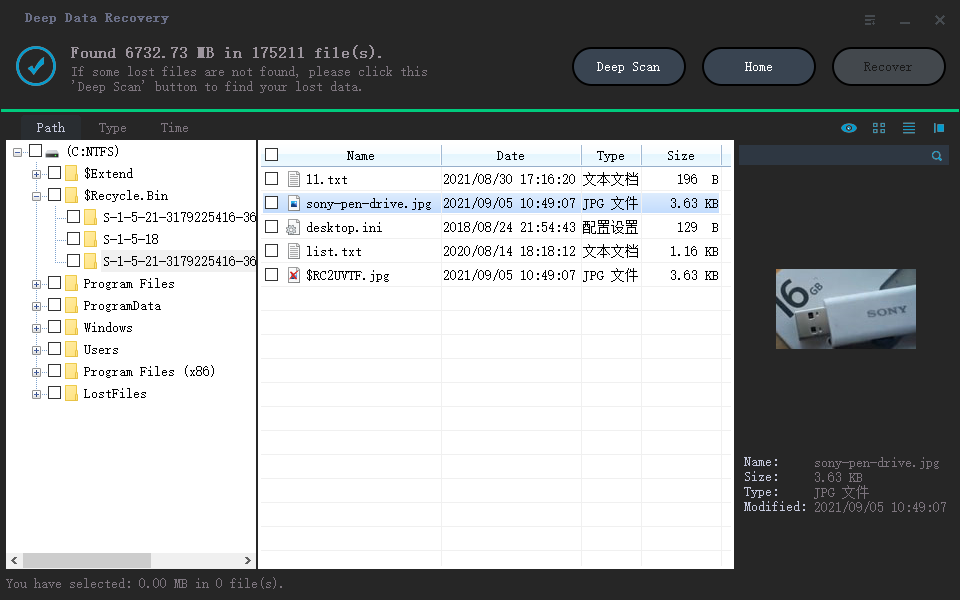
If the Quick Scan and Recovery process doesn't find all the lost files or if some files are not recoverable, you can perform a Deep Scan to find more data. This process will scan every sector of the disk, which may take some time to complete.
After the deep scan, if you still cannot open the target file or cannot find the target file, consider trying alternative recovery methods or contacting professional data recovery services.
Related Articles
- How to Unformat SSD
- How to Unformat SD Card on Mac/Windows
- How to Unformat USB Drive
- 4 Best Ways to Recover Deleted Files in Windows 11 Without Software
if you lose files in Windows 11. This post provides the four best ways to recover deleted files in Windows 11 without software. Read on to get more information. If you still prefer a data recovery tool, download and run Deep Data Recovery. - Top 3 Ways to Recover Deleted HTML Files on Windows 11/10/8/7
If you lost important HTML files and need to get them back, read this post. There are three ways to recover deleted HTML files on Windows 11/10/8/7. Among them, Qiling data recovery software works well in retrieving lost files from any device. - How to Recover Files from External Hard Drive Without Formatting
The best way to recover files from external hard drive without formatting is by using Deep Data Recovery. It only takes three steps to restore hard drive data. If your external hard drive gets corrupted, repair the corrupted external hard drive with the methods below. - How to Rollback DROP/TRUNCATE Table in SQL Server
In SQL Server, the TRUNCATE TABLE command permanently removes all rows from a table, making it impossible to rollback. Unlike DROP TABLE, which can be rolled back by simply restoring the database to a previous point in time, TRUNCATE TABLE is a non-logged operation that cannot be rolled back.
Products
Articles & Tutorials
- Data Recovery
- Data Backup
- File Recovery
- File Backup
- System Backup and Restore
- Disk and Partition Clone
- Technical articles
- Mobile articles
- Disk Master Help
- Windows Data Recovery Tutorials
- Windows Secure Delete Tutorials
- Windows Partition Management Tutorials
- Windows File Backup and Restore Tutorials
- Windows System Backup and Restore Tutorials
- Windows Disk Backup and Restore Tutorials
- Windows Clone Tutorials