How to Fix Recuva Deep Scan Stuck or Frozen
Issue: Recuva Deep Scan Stuck
Some users of Recuva have reported issues with the program getting stuck or frozen during a deep scan, particularly on hard disks, USB flash drives, or memory cards. The scan may not complete, even when it reaches 0%, 16%, 25%, or 100%, as reported by a user on the Piriform forum.
Recuva's deep scan can take a significant amount of time, especially for large drives like yours. The estimated completion time of 8 days seems unusually long, but it's possible that the scan is still progressing. You can try to cancel the scan and restart it to see if that resolves the issue. If you're still experiencing problems, you might want to consider using a different recovery software or seeking further assistance from the Recuva support team.
Recuva, a top data recovery software for Windows, is often the go-to choice for users who have lost data on their storage devices, including hard drives, USB flash drives, SD cards, and digital cameras. However, like any other program, Recuva can sometimes get stuck or frozen, especially during a deep scan.
What Is Recuva Deep Scan
A deep scan, also known as a full scan, is a feature on most data recovery software, including Recuva, which allows for a thorough search of a storage device. This feature is often accompanied by a "quick scan" which provides a faster but less comprehensive search. The deep scan is a more detailed search that can recover more data than a quick scan, making it a useful tool for recovering deleted or lost files.
- A quick scan is the simplest way to search for files on the selected drive because it only looks for deleted files by searching for entries that are marked as deleted.
- A deep scan involves a quick scan phase and searching for lost files in unallocated clusters based on their headers and footers, allowing it to find more files, including existing files, RAW files, and others.
If users can't find their desired files after a quick scan, they might switch to a more thorough search, such as a deep scan, to locate them.
How Long Does Recuva Deep Scan Take
A deep scan with Recuva can take anywhere from a few hours to several days, depending on the size of the disk and the number of files being scanned, due to the varying conditions of the hard drive.
Why Is Recuva Deep Scan Stuck
If you're scanning a large disk with many files, it's normal for scanning to take several hours. To check if Recuva is running properly, look at the Task Manager and see if the CPU, Memory, and Disk usage values are changing, indicating that the program is working and not stuck.
If Recuva's deep scan is taking an unusually long time, still stuck at stage 1 after hours, or you're sure it's stuck, it might be due to the software being overwhelmed or issues with the disk or partition, such as bad sectors.
How to Fix Recuva Deep Scan Stuck
Based on the possible causes, there are three solutions for you to fix the Recuva deep scan stuck issue.
Method 1. Force Quit Recuva and Reconnect the Hard Drive
Refreshing the software is the easiest way to fix the stuck issue.
Step 1. Right-click any space on the taskbar and choose "Task Manager".
Step 2. Click "Recuva" > "End task".
Step 3. To successfully scan a device, reconnect it and ensure Windows can recognize it, addressing any issues if the hard drive is not recognized.
Step 4. Launch Piriform Recuva and reinitiate the deep scan.
Method 2. Fix the Disk Corruption and Restart Deep Scan
Bad sectors on a disk can slow down a deep scan, and the more sectors the slower the scan will be. Repairing the bad sectors can speed up the scanning process.
Bad sectors on a hard drive can be classified into two types: logical and physical. Logical bad sectors can be repaired using tools like chkdsk, but physical bad sectors, which are caused by physical damage to the drive, can only be blocked by using third-party software, and cannot be repaired.
Method 3. Choose Recuva Alternative
The last working solution is to apply the hard drive recovery software Deep Data Recovery, which outranks its equivalents in scanning speed, recovery quality, and success rate. It was tested alongside five other popular data recovery tools on the editor's computer, with Deep Data Recovery scanning the same disk and recovering data successfully.
| Product Name | Recover My Files | Recuva | Disk Drill | Stellar Data Recovery | Deep Data Recovery |
|---|---|---|---|---|---|
| Scanning Time | 1h | > 1h | > 1h | 37min | 27min |
| Files Found | 321,297 files | 111,213 files | 2,254 files | 414,170 files | 784,741 files |
| File Size | 13.80GB | no size shown | 1.92GB | 19.84GB | 38.53GB |
Deep Data Recovery finished the deep scan in the shortest time and found the most files, making it a viable alternative when Recuva's deep scan is stuck or frozen.
When using Deep Data Recovery, it first performs a quick scan and then initiates a deep scan. Unlike Recuva, Qiling allows you to recover files during the scanning process and stop the deep scan at any time.
Three Steps to recover files:
Step 1. Run Deep Data Recovery on your computer, selecting the desired file types, and then click "Fast Scan".
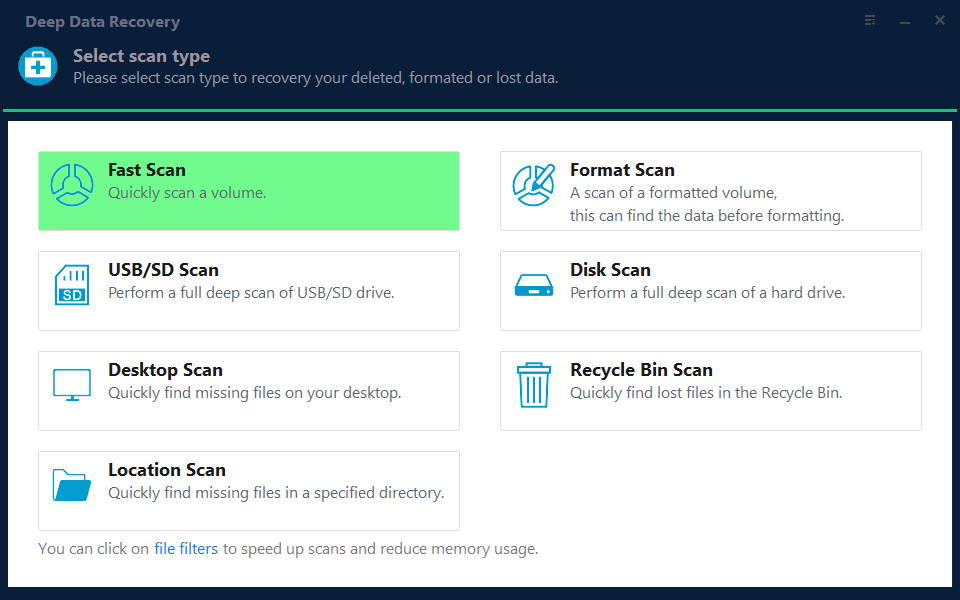
Note: You can choose different search modes based on where and why the data was lost.
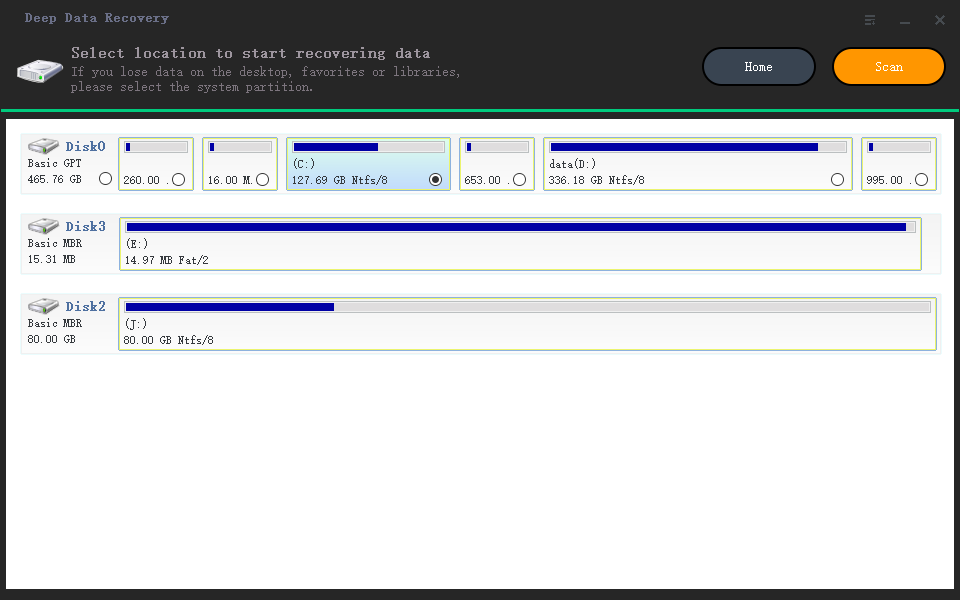
Step 2. Choose the drive where you lost files and click "Scan". If your lost files were on an external storage device, connect it to your computer first.
Step 3. The software rapidly scans deleted files, followed by a deep scan to locate more lost files. After scanning, a "Filter" option allows for quick filtering of specific file types.
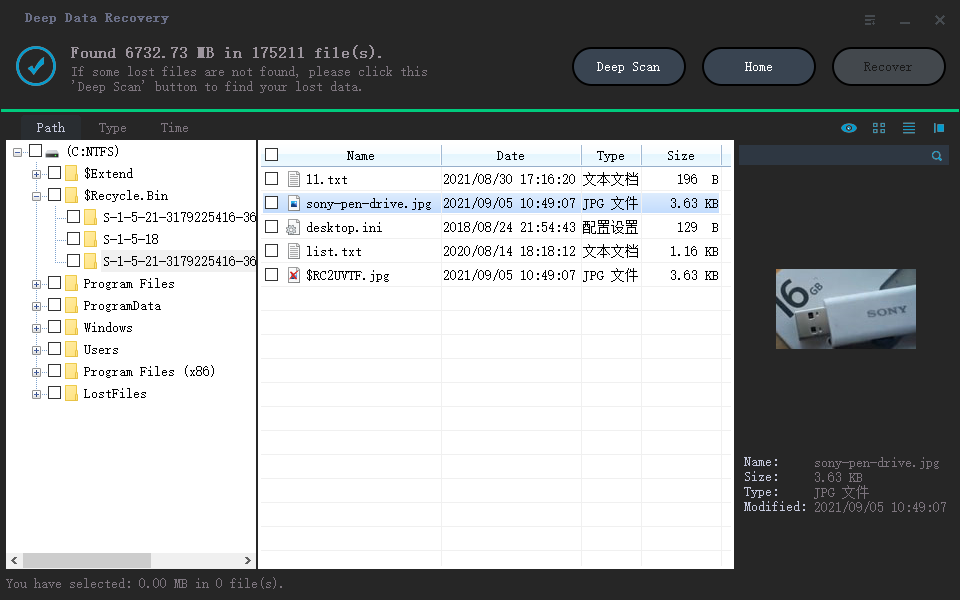
Step 4. To preview and recover files, click the "Preview" button or double-click on a file to see its contents. Select the desired files, click "Recover", and choose a safe location to save them.
If Deep Data Recovery is stuck during the deep scan, you can refer to the related guide to troubleshoot the issue or reach out to our support team at support@idiskhome.com for assistance.
The Bottom Line
If Recuva's deep scan gets stuck, it's essential to determine whether it's a genuine issue or just a sign of scanning a large drive. If it's truly frozen, you can try three troubleshooting methods. If these fail or Recuva isn't working, consider using a Recuva alternative for a smoother experience.
Before repeating a long scan, learn when a deeper scan helps and when overwriting or an unstable drive limits the results.
Related Articles
- 5 Best External Hard Drive Recovery Software: Recover Data from External Hard Drive
- How to Remove/Delete Directory in Linux
- Windows 10 Won't Update with/Without Sending Errors - (20+) Tips
- How to Format SD Cards in All Devices
- 3 Ways for How to Retrieve Hidden Files in Flash Drive
If you're having trouble accessing hidden files on your flash drive, this guide is here to help. You can learn how to recover hidden files from your flash drive by following the steps outlined in this guide. - Top 4 Alternatives to SanDisk RescuePro Recovery Software
Here are the top 4 alternatives to SanDisk RescuePro or SanDisk RescuePro deluxe: you can free download the alternatives Windows or Mac SanDisk RescuePro recovery software to help you recover deleted/lost files.
Products
Articles & Tutorials
- Data Recovery
- Data Backup
- File Recovery
- File Backup
- System Backup and Restore
- Disk and Partition Clone
- Technical articles
- Mobile articles
- Disk Master Help
- Windows Data Recovery Tutorials
- Windows Secure Delete Tutorials
- Windows Partition Management Tutorials
- Windows File Backup and Restore Tutorials
- Windows System Backup and Restore Tutorials
- Windows Disk Backup and Restore Tutorials
- Windows Clone Tutorials