Free Download USB Flash Drive Recovery Software to Undelete Files
Overview - USB Flash Drive Recovery
Losing data on a USB drive can be frustrating, and it's not uncommon. Data loss on a USB drive can occur due to various reasons, including accidental deletion, formatting, physical damage, or corruption caused by viruses or malware. If you've lost files on your USB drive, don't panic!
- Virus attack
- A power surge or electrostatic discharge
- Improperly removing the mass storage device
- Accidentally deleting files from the device
- If you accidentally format your hard drive or disk when Windows asks you 'do you want to format the disk?', you can't retrieve the data. However, you might be able to recover some data if you act quickly.
- If the file system on your flash drive converts to RAW, it means that the data on the drive becomes inaccessible.
Data loss is a common issue for anyone who regularly uses data storage devices. While some cases of data loss may be unavoidable, there is a solution to rescue your data. We recommend using USB recovery software to help retrieve your lost data.
Advanced USB Recovery Tool - Deep Data Recovery
Qiling data recovery software is a powerful and intuitive program that can help you recover lost data from removable flash drives. With over a decade of experience in the field, it has successfully helped many users retrieve their precious files.
| Category | Details |
|---|---|
| Supported Devices | The storage devices listed include USB drives, pen drives, memory cards, internal and external hard drives, RAID drives, digital cameras, and video players. |
| Supported File Types | The system can handle almost all types of files, including photos, documents, videos, audio files, emails, compressed files, and more. |
| Supported File System | FAT(FAT12,FAT16,FAT32), exFAT, NTFS, NTFS5, ext2/ext3, HFS+, ReFS |
Qiling USB data recovery software allows you to recover deleted files from various USB brands due to different reasons, and it won't charge you if the recovered file is under 2GB.
Flash Drive Recovery with Qiling USB Recovery Tool
Qiling USB recovery tool is known for its user-friendly interface, fast scanning speed, and high-quality recovery. With just three steps, you can recover your USB data using Deep Data Recovery. Simply connect your USB to your computer and follow the guide to start the recovery process.
Step 1. Select file types and click "USB/SD Scan" to start
Launch Deep Data Recovery, select file types, and click "USB/SD Scan" to initiate the process.
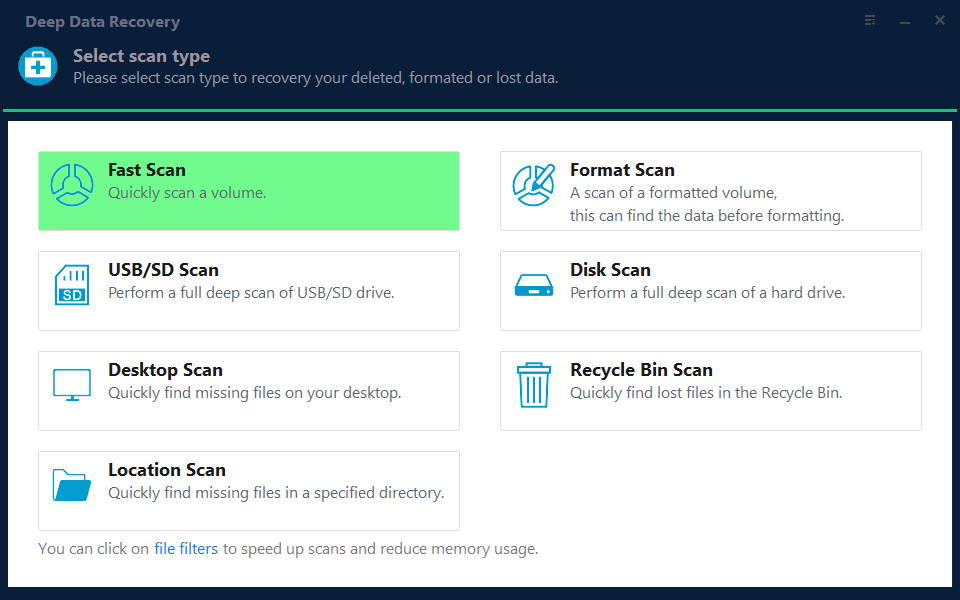
Note: You can choose different search modes based on where and why the data was lost.
Step 2. Choose the USB drive to scan
To recover lost files from a USB drive, select the drive where the files were lost. Then, click the "Scan" button to initiate the recovery process. This will allow the software to search for and identify the lost files.

Step 3. Check and preview USB drive data
When the scanning is finished, you can quickly locate a specific type of file by using the Filter feature and the Search option.

Step 4. Restore flash drive data
After finding the lost files on your USB drive, click "Recover" to restore them to your PC. It's essential to save the recovered files to a safe location on your computer, rather than back to the USB drive itself. This ensures that the files are safe and won't be lost again.
In addition to USB data recovery, Deep Data Recovery also supports memory card, CF card, external hard drive, memory sticks, and other data recovery. To prevent complete data loss, it's recommended to back up important files regularly or equip your computer with a data recovery tool like Deep Data Recovery. This software allows you to recover data from your USB with just a few simple steps.
People Also Ask
1. How do you recover files from a flash drive?
You can download the Qiling flash drive recovery tool to recover lost, deleted, formatted, or virus-damaged files from any USB drive brand, including SanDisk, Kingston, Toshiba, PNY, Sony, and more.
2. How can I repair my USB flash drive?
Method 1. Check and fix USB problems
If your flash drive isn't physically broken and your computer can recognize it, assigning it a drive letter, you can use Windows' built-in tools to identify and potentially fix the issue.
- Connect the USB to your PC
- Go to My Computer>The USB Drive.
- Right-click the USB drive and open its Properties.
- Click on the Tools tab.
- Click the "Check" button.
- Let the scan process complete, then close the scan window.
- Right-click to safely remove a USB flash drive, click on its icon on your desktop and select "Eject". Once the drive is ejected, you can physically remove it from the USB port.
To fix a damaged USB flash drive, check all the other methods on the linked page, as they may provide a solution to your problem. The page likely contains various troubleshooting tips and techniques to help you recover your damaged USB drive.
3. What's the best USB flash drive recovery tool?
There are numerous USB recovery tools available in the market, and here are the top 10 options for you to consider.
10 Best USB Recovery Software
- 1. Deep Data Recovery
- 2. Recuva
- 3. Stellar Data Recovery
- 4. Disk Drill
- 5. R-Studio
- 6. Acronis Revive
- 7. Remo Recover
- 8. Recover My Files
- 9. Puran Data Recovery
- 10. TestDisk
For more detailed information, please refer to: Top 10 Best Free USB Data Recovery Software (100% Working)
4. Can you recover files from a broken flash drive?
Flash drives can become broken due to file system corruption, turning to RAW, which can be recovered using Deep Data Recovery and a 3-step process. For more severe issues, refer to the full solutions on the page "How to fix a broken USB stick".
Related Articles
- How to Recover Deleted Files from Recycle Bin | Recover Recycle Bin
- How Do I Repair a Corrupted DOCX File? [6 Reliable Fixes Available]
- Fix I/O Device Error on External Hard Drive/USB Drive in Windows
- Fix Error Code 0x800F0954 on Windows 10
- [Solved] Cannot Connect to Camera Please Make Sure to Close Other Apps
This post provides a solution to the issue of not being able to connect to a camera, suggesting that other apps running in the background may be using the camera and to close them and try again. It also mentions that if photos are lost, Qiling photo recovery software can be used to recover them. - Fix Can't Find or Open Recycle Bin Windows 10
If you're having trouble finding the Recycle Bin icon on your desktop or opening it to recover deleted files in Windows 10, 8, or 7, we have solutions for you.
Products
Articles & Tutorials
- Data Recovery
- Data Backup
- File Recovery
- File Backup
- System Backup and Restore
- Disk and Partition Clone
- Technical articles
- Mobile articles
- Disk Master Help
- Windows Data Recovery Tutorials
- Windows Secure Delete Tutorials
- Windows Partition Management Tutorials
- Windows File Backup and Restore Tutorials
- Windows System Backup and Restore Tutorials
- Windows Disk Backup and Restore Tutorials
- Windows Clone Tutorials