Incremental Backup Advantages and Disadvantages
What Is Incremental Backup?
An incremental backup is a faster method of backing up data, only backing up the data that has changed since the last backup.
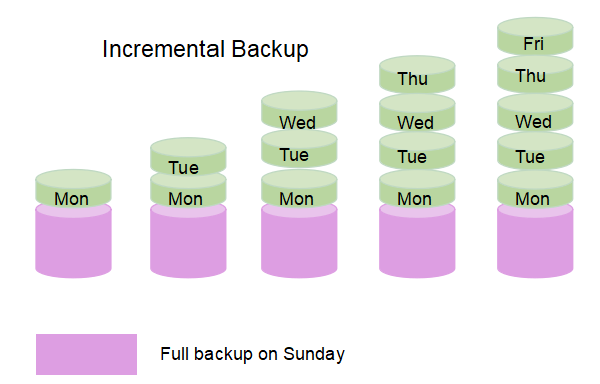
Incremental backups are a type of backup that records every change made since the last backup, rather than duplicating all files like a full backup. They can back up files, folders, and external hard drives, making them a convenient option for storing data.
The incremental backup is one of the three types of backups, and it has several subtypes, including multilevel incremental, reverse incremental, incremental forever, block-level incremental, byte-level incremental, and synthetic full backup.
The Advantages of Incremental Backup
Backups help prevent irreparable loss or damage to computer systems and contents. Among the three types of backups, including full, incremental, and differential backups, incremental backup is the most frequently used one. Many people tend to make an incremental backup for the following reasons:
- Incremental backups are smaller in size because they only save new or changed files, making each subsequent backup smaller, which can help save storage space.
- Incremental backups are faster than full backups because they only copy new or changed files, reducing the time needed to complete the process.
- Incremental backup requires less bandwidth as it only transfers the changes made since the last backup, reducing the amount of data that needs to be transferred. This is particularly useful for backing up data to online services, where bandwidth is often a concern.
The Disadvantages of Incremental Backup
Incremental backups offer greater flexibility for data backups, but also have limitations. They allow for more frequent backups, but may not be as fully featured as other backup methods. This means users should be aware of their limitations when using incremental backups.
- When performing a complete restore, you need the first full backup and all increments since then, which can take longer.
- To restore the latest version of a file, you need to locate the increment that contains the most recent version of the file, and then restore that version.
- To ensure that all increments are restored in a particular file, and if any previous increment fails, the entire file should be restored from the last successful increment, rather than being left in an unrecoverable state. This approach prioritizes data integrity and minimizes potential data loss.
Conclusion
With computers being an essential part of our daily lives, it's crucial to protect your valuable data from potential threats like the WannaCry virus or a blue screen of death. Regularly saving your files and taking necessary precautions can help prevent data loss in case of a cyberattack or system failure.
Incremental backup is the most beneficial backup method due to its reliability, accessibility, and storage space-saving features, while also consuming less bandwidth and resulting in faster backups compared to full backups. However, its slower restoration and dependence on increment integrity can be mitigated by performing full backups periodically and setting a proper retention policy.
This article provides a comprehensive overview of incremental backups, highlighting their advantages and disadvantages. Like other backup methods, incremental backups have their features, and using multiple methods to back up data can be beneficial, where professional backup software can assist in implementing these strategies.
- Notice:
- Incremental backups are a type of backup that only saves the changes made since the last full backup, rather than saving the entire dataset. This type of backup is useful for large datasets where a full backup would be too time-consuming or resource-intensive.
Related Articles
- 0xC1900101 Error in Windows Update, Cannot Install Windows 11 [FIXED]
- WD Backup vs. Windows Backup - Which One to Choose
- 3 Ways to Right Click on a Mac [Step by Step]
- What Is Malware & Tips to Avoid Malware on Your Computer
- Do I Need a Heatsink for My M.2 SSD [2023 Full Guide]
Learn whether your M.2 SSD needs a heatsink. Compare SSD temperature, workload, motherboard design, and cooling needs before buying one. - Do I Need to Backup OneDrive? [Why & How-to Guide]
OneDrive users should be cautious as the platform is not always secure, and data breaches can occur. To mitigate this, users can create a backup of their OneDrive data using a professional tool like Qiling Disk Master, ensuring their files are safe in case of emergencies.
Products
Articles & Tutorials
- Data Recovery
- Data Backup
- File Recovery
- File Backup
- System Backup and Restore
- Disk and Partition Clone
- Technical articles
- Mobile articles
- Disk Master Help
- Windows Data Recovery Tutorials
- Windows Secure Delete Tutorials
- Windows Partition Management Tutorials
- Windows File Backup and Restore Tutorials
- Windows System Backup and Restore Tutorials
- Windows Disk Backup and Restore Tutorials
- Windows Clone Tutorials