What Is RAID 10 and What Are Its Benefits?
The various RAID levels, ranging from 0 to 9, offer different advantages based on how the disks are connected or configured.
To compare RAID 10 with another common RAID level, read this guide on RAID 6 vs. RAID 10.
This essay will focus on RAID 10, a widely used RAID level, discussing its key benefits and drawbacks in detail.
What Is RAID 10
RAID 10 combines the striping of RAID 0 and the mirroring of RAID 1, distributing data across multiple disks to improve efficiency while also duplicating data for redundancy.
RAID 10 combines the striping of RAID 0 and the mirroring of RAID 1, allowing for faster read and write speeds than RAID 5 due to its lack of parity management.
Many people mistakenly believe that using RAID 10 (or any other RAID level) is the same as creating a backup, as it provides redundancy and can recover data if one drive is corrupted. However, this is not the case - if one drive is contaminated, the data on the other drive can also become corrupted, making it essential to have a separate backup system in place.
For a backup to be considered real, it must be possible to restore damaged data before it is duplicated and saved in another location. This means that the backup should be able to recover the original data in case of a failure or corruption, ensuring that no data is lost.
"It's a good idea to implement robust online security measures such as having a backup server or using traffic rerouting technologies before a cyber attack occurs," advises Mark Preston, a cybersecurity expert from Cloud Defense.
Having administrators use distinct accounts for various activities, such as backing up data, is another option to explore. This approach can help ensure that sensitive tasks are performed with the appropriate level of access and separation of duties, reducing the risk of unauthorized access or data tampering.
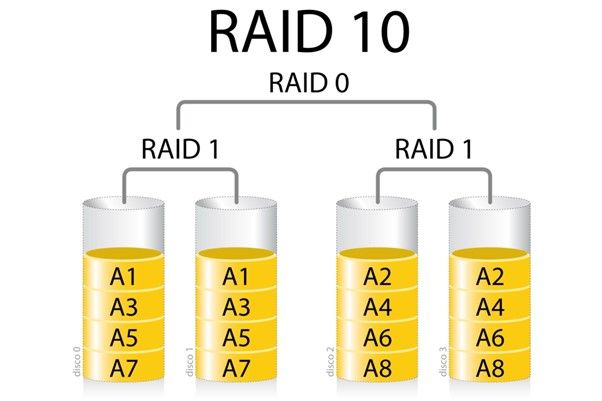
Advantages of RAID 10
- RAID 10, also known as RAID 1+0, is a type of disk array that combines the features of RAID 1 and RAID 0. It uses striped arrays with RAID 1 segments to build a redundant and high-performance storage system.
- Mirroring with RAID 10 provides the same fault-tolerance overhead as RAID 1, with the added benefit of improved read performance.
- To achieve high I/O throughput, consider striping the RAID 1 component, which can help distribute the load and improve performance.
- Multiple disk failures may be tolerated in a RAID 10 array under specific conditions.
- For sites that need a speed increase but don't want to use RAID 1, an excellent alternative is available. This alternative provides a similar level of redundancy and data protection to RAID 1, but with the added benefit of improved performance.
Disadvantages of RAID 10
- RAID level 10, also known as RAID 10, is a RAID (Redundant Array of Independent Disks) configuration that combines the features of RAID 0 and RAID 1. It provides both data redundancy and improved performance by using multiple disks and distributing data across them.
- The drives must operate in sync for optimal performance, but sustained performance may degrade under heavy workloads.
- Scalability is limited and the inherent cost is very high.
When Should Raid 10 Be Used
RAID 10 is the optimal solution for high-speed read/write operations, with read performance twice as quick as RAID 5, due to its ability to handle parity checks efficiently.
Conclusion
RAID 10 is a hybrid system that combines the benefits of RAID 0 and RAID 1, offering exceptional fault tolerance and performance. This combination of striping and mirroring provides a high level of redundancy and data protection, making it an ideal choice for critical applications and high-capacity storage needs.
RAID 10 is a suitable choice for production and hosting servers due to its excellent performance and data security, but it requires more disks, making it a more expensive option. Despite the added cost, its performance and data security make it a perfect choice for such applications.
Related Articles
- Difference Between Cloud Sync and Backup and Cloud Storage
- Windows 11 Download: How to Download and Install Windows 11 [3 Ways]
- How to Fix High Memory Usage in Windows 11
- What is AMD CPU fTPM? Everything You Need to Know
- Stardew Valley Saves Location: All You Want to Know
Find Stardew Valley saves location on Windows, Mac, Linux, and mobile. Learn how to back up, move, and recover Stardew Valley save files. - Steam Deck Save File Location(All You Should Know)
Many users get confused when trying to find the Steam Deck save file location. However, accessing and transferring game saves between the Steam Deck and PC is a relatively straightforward process, and this post will provide a detailed guide on how to do so.
Products
Articles & Tutorials
- Data Recovery
- Data Backup
- File Recovery
- File Backup
- System Backup and Restore
- Disk and Partition Clone
- Technical articles
- Mobile articles
- Disk Master Help
- Windows Data Recovery Tutorials
- Windows Secure Delete Tutorials
- Windows Partition Management Tutorials
- Windows File Backup and Restore Tutorials
- Windows System Backup and Restore Tutorials
- Windows Disk Backup and Restore Tutorials
- Windows Clone Tutorials