Clone OS from HDD to Smaller SSD Without Reinstallation
You're looking to clone your Windows 10 installation from a larger HDD to a smaller 128 GB SSD to improve your computer's performance. Cloning the OS to an SSD can indeed make your computer run more efficiently. To do this, you'll need to use a cloning software such as Qiling Disk Master. This tool will help you create an exact copy of your HDD to the SSD, including the operating system, programs, and data. Simply download the software, select the source and target drives, and follow the on-screen instructions to complete the cloning process. Note that you'll need to ensure the SSD has enough free space to accommodate the cloned data, and you may need to resize or reorganize some files to fit on the smaller drive. Once complete, you can boot from the SSD and enjoy the performance boost.
Why Need to Clone OS from HDD to Smaller SSD
As solid-state drives (SSD) become increasingly popular, many computer and laptop manufacturers are now using them as system disks to enhance system performance and speed up devices for users worldwide.
Here are SSD'S advantages compared with HDD:
- Better stability.
- Fast reading and writing speed.
- Less power consumption.
As computer users, especially gamers, seek to enhance performance, many are attempting to clone their operating system (OS) from a hard disk drive (HDD) to a solid-state drive (SSD) on their computers.
You can migrate Windows 10 from a hard drive to a smaller solid-state drive (SSD) by cloning the larger hard drive to the smaller SSD without reinstalling Windows. This can be done using a simple and effective method, allowing you to transfer your operating system to the new drive without the hassle of reinstalling.
The Best Software to Clone Windows 10 to Smaller SSD
Qiling Disk Copy is a professional tool that allows for disk and partition cloning. It automatically selects the current HDD and target SSD to be cloned, ensuring the disk can be properly started after migration. The software also supports resizing partitions when copying disks, making it ideal for copying a HDD to a smaller SSD or cloning a corrupted hard drive.
Cloning a HDD to a smaller SSD is a straightforward process, but it requires ensuring the SSD has enough capacity to accommodate the contents of the HDD.
Qiling Disk Copy also features partition clone, a useful option if your important files are all stored on one partition. This allows you to make a copy of the entire partition, including all your files and data.
Qiling Disk Copy not only clones disks and partitions but also enables the creation of a bootable disk, addressing the issue of an OS being unusable. After creating a bootable disk, you can proceed with the disk/partition cloning process.
How to Clone Windows 10 to smaller SSD with Qiling Disk Copy
To migrate your OS (Windows 10/8/7) to a smaller SSD without reinstalling Windows, follow these steps: you can clone a laptop HDD to SSD, or follow the detailed steps provided below. If you need further guidance on cloning a laptop HDD to SSD, click on the link to get more information.
Step 1: Download, install and run Qiling Disk Copy on your PC.
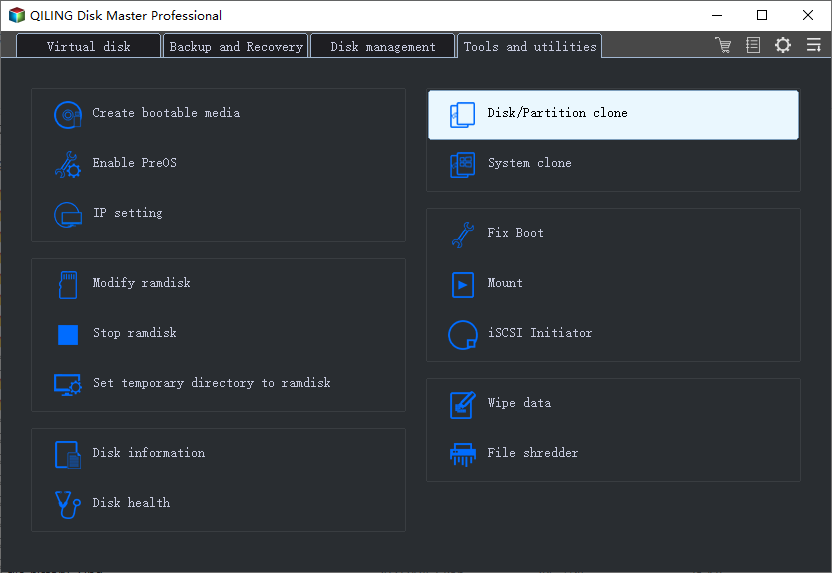
Choose "Disk/Partition clone" to start.
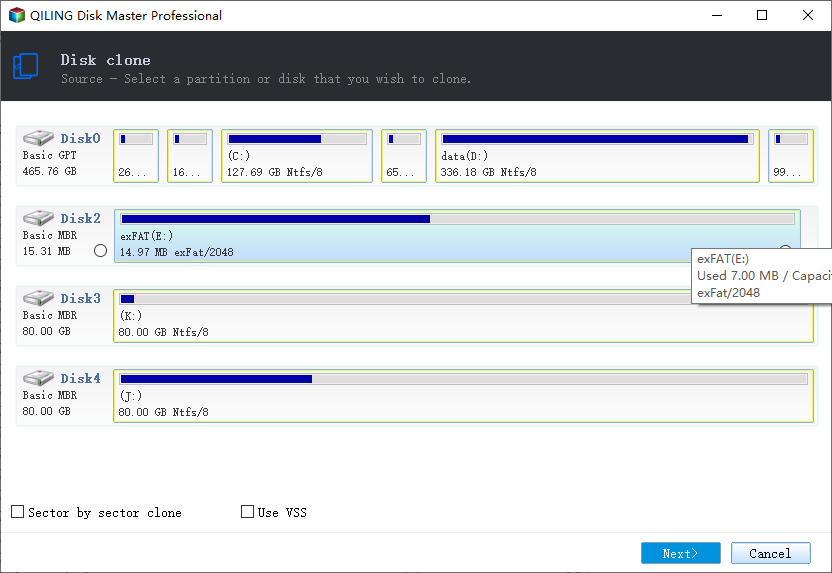
Step 2. Select the HDD that you want to clone. Click "Next" to continue.
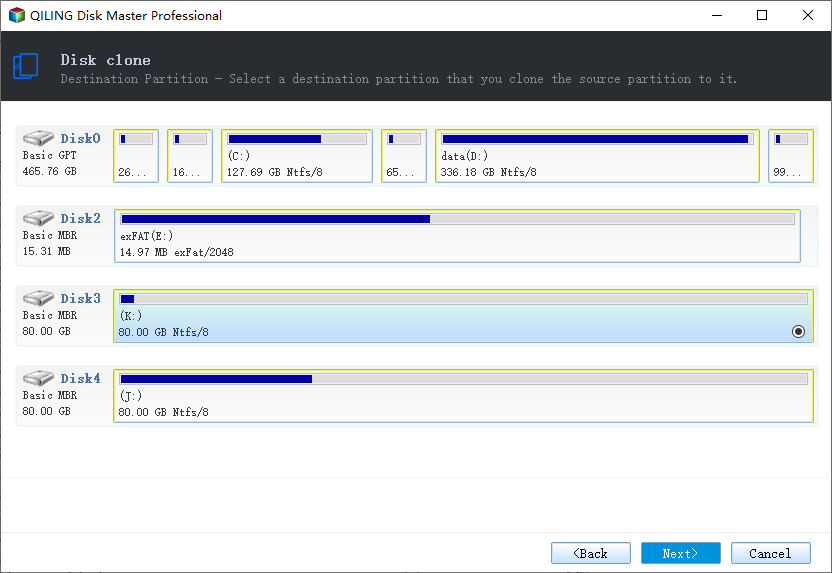
Step 3: Select the SSD as your destination and click "Next".
Step 4: Check and edit the disk layout.
When transferring files to a destination disk, make sure to select the "Optimize for SSD" option if the target disk is an SSD drive. This ensures that the transfer process is optimized for the speed and performance of the SSD.
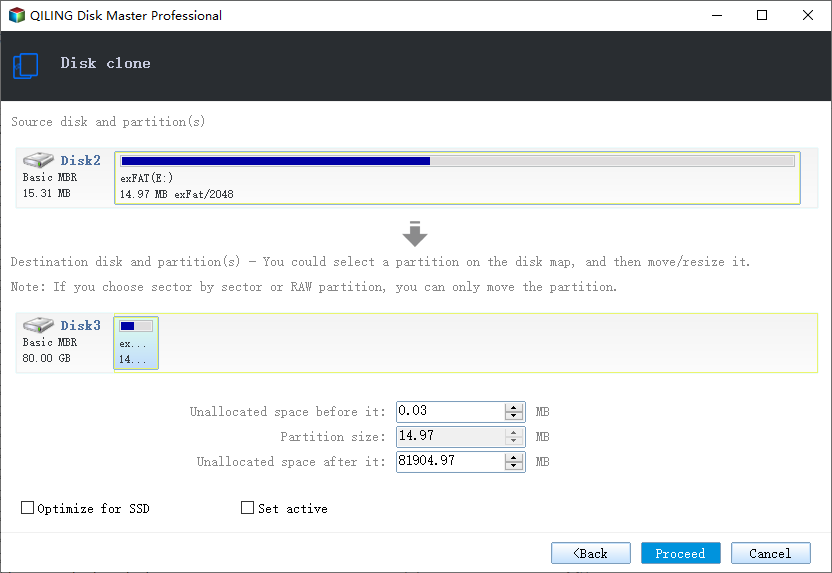
Step 5: Click "Proceed" to start the hard drive cloning process.
A warning message informs you that the data on the destination disk will be overwritten. To proceed, click "OK" if the destination disk does not contain important data.
After cloning the Windows 10 system to the new SSD, you'll need to physically install the SSD into your computer. Once installed, reboot your PC and access the BIOS or UEFI settings (usually by pressing a key like F2, F12, or Del).
1. To resolve the issue, simply restart your PC and press F2 or F8 (depending on your system) to access the BIOS settings, where you can make the necessary adjustments.
2. To change the boot drive to a new SSD, go to the Boot option, select the new SSD as the new boot drive, and save all the changes.
3. After exiting the BIOS and restarting the computer, you should be able to see Windows 10 running smoothly on your new disk without any issues.
Helpful tips about cloned SSD won't boot after copying HDD to Smaller SSD:
Method 1: Change HDD or fix the source disk error.
If your old hard drive has disk errors, you should replace it or fix the errors before cloning to a smaller SSD.
Method 2: Do not take out HDD to another computer.
If you clone a hard drive to a smaller SSD and then insert it into another computer, the operating environment will change, preventing the cloned SSD from booting. This is because the new computer's hardware and software configurations may differ from the original system, causing compatibility issues.
Method 3: Use a common sata cable for connecting SSD.
To avoid this issue, you should use a SATA cable to connect the target hard drive to the computer, or use a SATA-to-USB adapter, so the cloned disk will be recognized as a bootable disk.
Related Articles
- [Get it now!] Super Fast Disk Cloning/Copying Software
- How to Migrate Linux Installation to New Drive
- How to Clone IDE to SATA HDD/SSD (2 Ways)
- Clone Hard Drive to Larger Drive Without Reinstalling Windows and Programs
- 8 Best Portable Backup Software Examples in 2026
If you're looking for portable backup software, this page offers eight top options for Windows, Mac, and Linux users. Each program can be chosen based on individual needs, providing a suitable solution for users. - How to Recover Deleted Restore Points in Windows 10/11?
This is especially helpful when you troubleshoot an error on your system and none of the solutions can fix the issue. If you're having problems with your windows, the following article can help you decide which recovery option to use.
Products
Articles & Tutorials
- Data Recovery
- Data Backup
- File Recovery
- File Backup
- System Backup and Restore
- Disk and Partition Clone
- Technical articles
- Mobile articles
- Disk Master Help
- Windows Data Recovery Tutorials
- Windows Secure Delete Tutorials
- Windows Partition Management Tutorials
- Windows File Backup and Restore Tutorials
- Windows System Backup and Restore Tutorials
- Windows Disk Backup and Restore Tutorials
- Windows Clone Tutorials