How to Recover Deleted Restore Points in Windows 10/11?
Every operating system has a built-in failsafe feature that creates a backup of its datasets and files at regular restore points. In the event of a system crash or OS failure, you can recover the files from these restore points, and if needed, use computer restore software to backup your laptop or desktop. This allows you to restore the operating system to its original version with no lost or corrupted data.
When Windows restore points are deleted, you won't have any backup copies of files stored in those locations, making it difficult to restore the OS to its original version. This can lead to a loss of all files and details, as they are tied to the OS.
If you're experiencing issues with deleted restore points, don't worry - we've got you covered. We've put together a step-by-step guide to help you resolve the problem in a straightforward and efficient manner.
Windows 11/10 Restore Point Deleted?
Before learning how to fix deleted restore points in Windows 10 or 11, it's essential to understand why they get deleted in the first place. Knowing the reasons behind the deletion will help you choose the most effective step to take, ensuring a successful resolution to the issue.
The deletion of restore points from your system can be attributed to several factors. These include software updates, disk cleanup, and system maintenance, which may inadvertently remove the backup files. Additionally, running out of disk space or deleting system files by mistake can also lead to the loss of restore points.
- 1. When the device storage is full, older restore points are deleted to make space for new ones, which prioritizes newer backups over older ones. You may want to consider backing up your hard drive to prevent data loss.
- 2. If you store restore points and OS backup files in separate locations and that separate storage runs out of space, the restore points will be deleted first.
- 3. Restore points on a device are deleted if the stored files become corrupted, which can damage the entire folder and other files.
- 4. Windows restore points are temporary and can only stay for 90 days. After that, they are deleted to make space for new files.
- 5. When upgrading from Windows 10 to Windows 11, the restored files stored on Windows 10 will be deleted because the restore points are not compatible between the two operating systems.
Understanding these causes can help you take preventive measures. For example, you can allocate more disk space for restore points, regularly clean up corrupted files, and create a full system image backup as a more reliable alternative to restore points.

To create a system image backup and protect your data from unexpected restore point deletion, you can use Qiling Backup. This software allows you to schedule automatic backups and store them on local drives, external hard drives, cloud, or NAS.
Creating a system image backup is a reliable way to safeguard your entire Windows system, including all settings, applications, and files, ensuring you can restore everything even if restore points are lost.

How to restore/recover Restore Point Windows 10/11?
Now that we've established the main reasons why restore points get deleted from Windows 10 and 11, let's look at the potential fixes. To recover deleted restore points, some of the best ways include.
Fix 1: Use Qiling Backup to create a System Image
Fix 2: Increasing the Memory Space
Fix 3: Deletion of corrupted files
Fix 1: Use Qiling Backup to Create a System Image
Qiling Backup is a free software that allows you to create a system image and backup important OS files, freeing up space and storage concerns, and saving backups to local drives, cloud, network, and NAS.
Qiling Backup's user interface is easy to navigate, and restoring system images from backups is a straightforward process. If system restore points are deleted, the software can restore the system image from a backup in a few simple steps, provided the backup is not corrupted. Additionally, users can recreate and encrypt backup files without data loss.
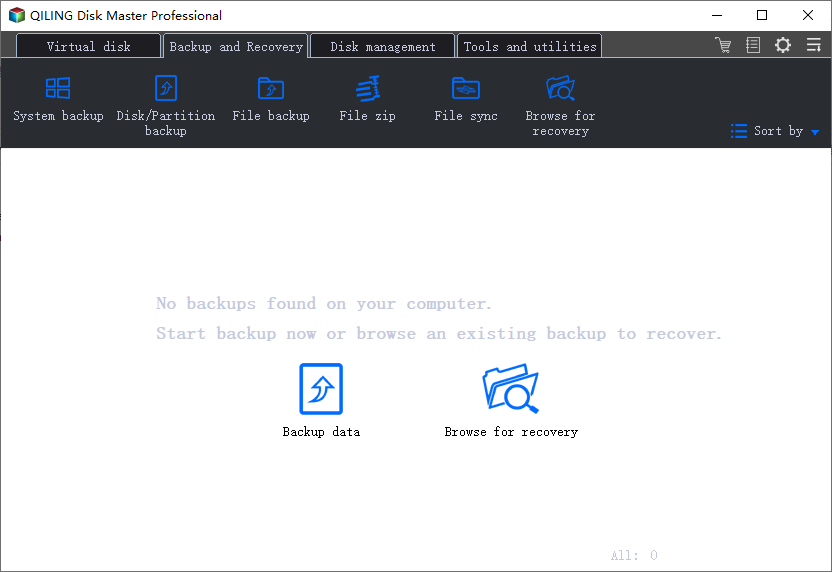
Step 1. Launch Qiling Backup on your computer, click System Backup on the home screen to start the backup process.
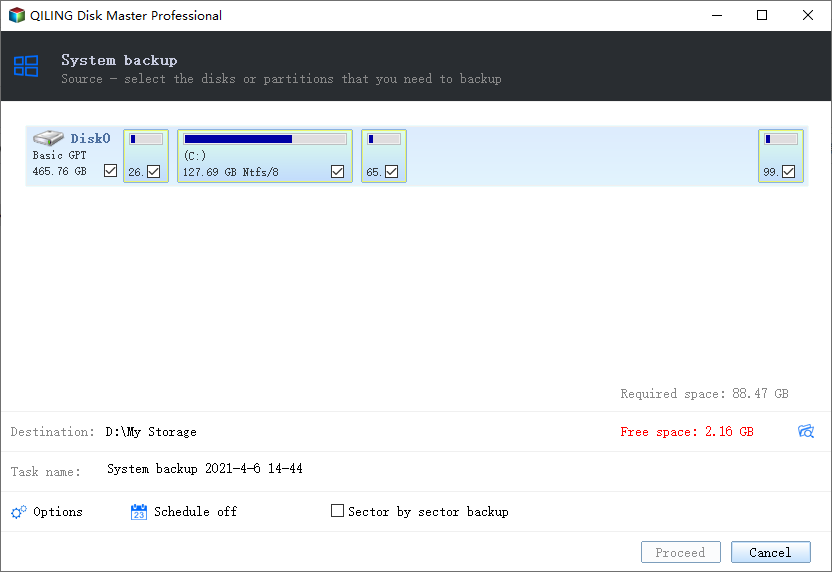
Step 2. In this step, your Windows operating system information and all system related files and partitions will be automatically selected, so you don't need to manually select them. Next, you'll need to choose a location to save the system image backup by clicking on the illustrated area.
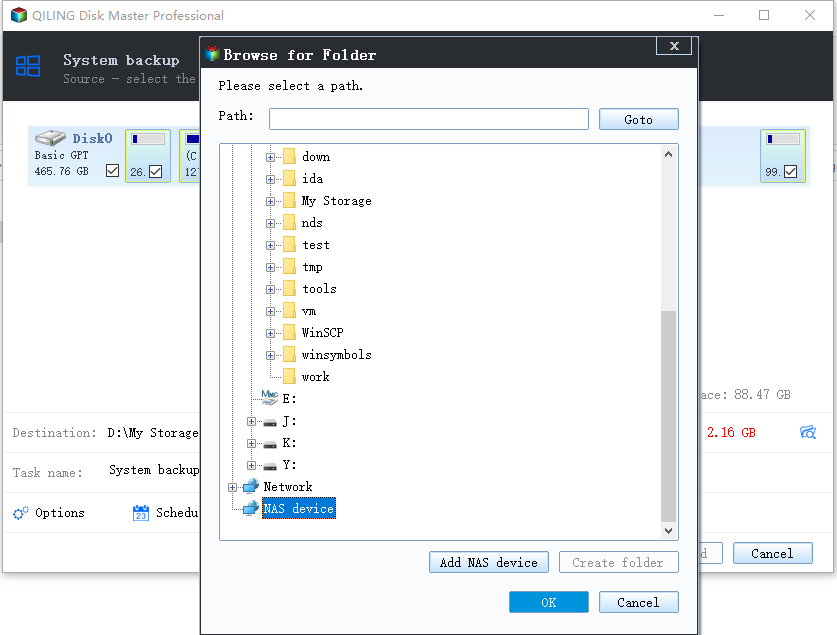
Step 3. The backup location can be a local drive, external hard drive, network, cloud, or NAS, with external physical drives or cloud storage being recommended to preserve system backup files.
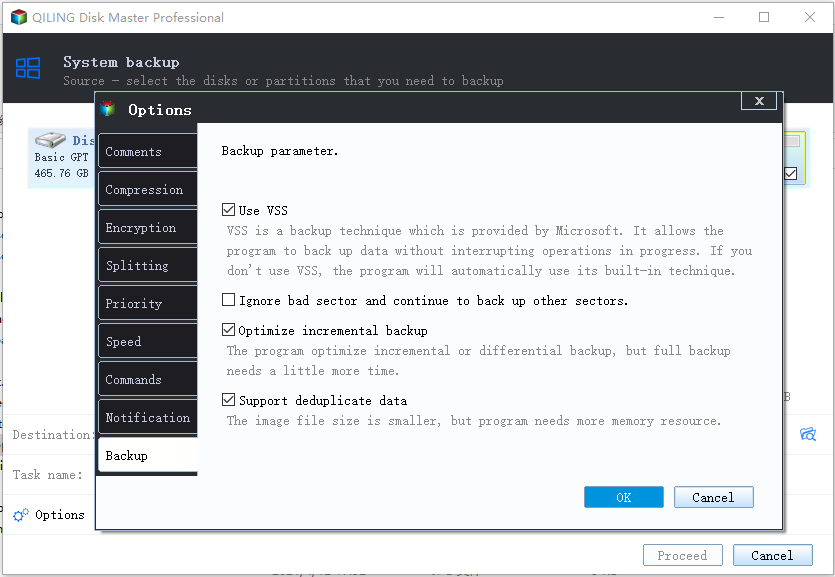
Step 4. Customization settings like automatic backup schedules and differential and incremental backups are available in the Options button. Click Proceed, and the Windows system backup process will begin, displaying the completed task on the left side.
Notice how easy and user-friendly these steps are, making it simple to download Qiling Backup and give it a try.
Fix 2: Increasing the Memory Space
To fix the deleted restore point issue in Windows 10 or 11, you can clear unnecessary files from your device memory, freeing up space for restore points to be saved without issues. This can be done by deleting files you no longer need, or by integrating a cloud account to store files like documents, songs, and movies, thereby emptying your device memory.
If you're using a hard disk, store restore points solely on it to avoid space issues and deleted old points. This way, you can easily access and restore the original OS version without hassle.
Fix 3: Deletion of corrupted files
Run a diagnosis on restore points to check if files in those paths are corrupted. If they are, delete them to prevent deletion of all restore points.
To get rid of corrupted files, you can use software that scans your files and identifies the corrupted ones. Once found, you can delete them permanently by selecting the file, pressing Shift+Delete, which bypasses the recycle bin and directly removes the file. This method ensures that the corrupted files are completely erased and won't be recovered.
Conclusion
To recover deleted restore points in Windows 10 or Windows 11, you can follow the steps shared in this article to easily retrieve files that were accidentally removed. Alternatively, you can use a backup software like Qiling Disk Master, which makes file restoration a breeze.
Qiling Backup is a reliable and easy-to-use tool that can help you protect your system and recover from unexpected data loss.
Restore Point Deleted FAQ
Q1. Why was my restore point deleted?
Restore points can be deleted due to various reasons, such as a full device memory or lack of space in the allocated path, which can cause the deletion of restore points and the files stored in them. Additionally, corrupted files stored in the restore points can also lead to their deletion.
Q2. How long are restore points kept?
The restore points have a lifetime of 90 days, after which they will get deleted automatically.
Q3. Where can I find older restore points?
You can use the backup software to recover deleted restore points and free up space for new files.
Related Articles
- [All-in-One] Create Windows 11 Backup to NAS (Network drive)
- 2022 Windows XP Backup Software & Backup Utility Free Download
- How to Backup Files in Windows 10 for Full Recovery (100% Work)
- Boot Drive vs Recovery Drive: Are They the Same Thing?
- How to Transfer Everything From your Old Computer to your New Computer Windows 11
Want to know how to transfer everything from your old Windows 11 computer to your new one? Check out this post for the perfect solution. - How to Transfer Files Between Two Computers Using IP Address
To connect and transfer files between two computers using their IP addresses, you can use Qiling Disk Master.
Products
Articles & Tutorials
- Data Recovery
- Data Backup
- File Recovery
- File Backup
- System Backup and Restore
- Disk and Partition Clone
- Technical articles
- Mobile articles
- Disk Master Help
- Windows Data Recovery Tutorials
- Windows Secure Delete Tutorials
- Windows Partition Management Tutorials
- Windows File Backup and Restore Tutorials
- Windows System Backup and Restore Tutorials
- Windows Disk Backup and Restore Tutorials
- Windows Clone Tutorials