What Is Hard Disk Partition, Everything You Need to Know
A hard disk partition refers to a specific section of a hard drive's storage capacity, allowing for the organization and management of data in a structured manner.
Most operating systems allow users to divide a hard disk into multiple partitions, making one physical hard disk into several smaller logical hard disks.
Reasons to Use Hard Disk Partitions
A user may choose to split a hard disk into multiple partitions to organize their data more effectively, such as separating the operating system and applications from user data. This allows for a clean reinstallation of the operating system on one partition without affecting the other, making it easier to troubleshoot and resolve issues.
A user may split a hard disk into multiple partitions to take advantage of smaller cluster sizes, which can be beneficial when storing a large number of small files, as it can reduce the overall disk space usage.
If a user has a large hard disk that exceeds the partition size limit supported by their operating system, they may need to split the hard disk into multiple partitions to utilize the extra space. This is typically done using a partitioning tool or software, which allows the user to create additional partitions on the hard disk, effectively dividing it into smaller, more manageable sections.
Creating Hard Disk Partitions
Most operating systems use the 'fdisk' command to create hard disk partitions, with many also having graphical tools like Qiling Partition Master that accomplish the same task.
Hard Disk Partitions and File Systems
You don't actually store data in hard disk partitions.
File systems are stored in hard disk partitions, which serve as the primary storage units for organizing and managing data. In this setup, data is stored within the file system, making it a crucial component for storing and retrieving digital information.
Some operating systems blur the lines between partitions and file systems, making it difficult to distinguish between the two concepts.
The Partition Table
Partition information is stored in the partition table, a reserved area at the beginning of a hard disk.
Extended Partitions
A standard partition table can only store information about four partitions, limiting a hard disk to a maximum of four partitions.
To work around this limitation, extended partitions were created.
An extended partition allows you to create multiple partitions on your hard disk, beyond the standard four, by storing information about these additional partitions.
The four standard partitions are often called the primary partitions.
When partitions are configured into an extended partition, they are often referred to as logical partitions.
Partition Types
When a partition is created, a special byte of data is written to identify what type of partition it is.
Due to one hard disk being shared by multiple operating systems, operating systems tend to agree on the meaning of these values.
The table lists various partition types, including those in use.
| Partition Number | Partition Type |
| 00 | Empty |
| 01 | DOS 12-bit FAT |
| 02 | XENIX root |
| 03 | XENIX usr |
| 04 | DOS 16-bit FAT <=32M |
| 05 | DOS Extended Partition |
| 06 | DOS 16-bit FAT >=32 |
| 07 | OS/2 HPFS, WinNT NTFS |
| 08 | AIX |
| 09 | AIX bootable |
| 0a | OS/2 Boot Manager |
| 0b | Win95 FAT32 |
| 0c | Win95 FAT32 (LBA) |
| 0e | Win95 FAT16 (LBA) |
| 0f | Win95 Extended (LBA) |
| 35 | OS/2 JFS |
| 39 | Plan 9 |
| 40 | Venix 80286 |
| 51 | Novell |
| 52 | Microport |
| 63 | Unix System V, Mach, GNU HURD |
| 64 | Novell Netware 286 |
| 65 | Novell Netware 386 |
| 75 | PIC/IX |
| 80 | MINIX until 1.4a |
| 81 | MINUX, Linux |
| 82 | Solaris X86, Linux swap |
| 83 | Linux native |
| 85 | Linux extended |
| 93 | Amoeba |
| 94 | Amoeba BBT |
| a5 | FreeBSD, NetBSD, BSD/386, 386BSD |
| a6 | OpenBSD |
| a7 | NEXTSTEP |
| b7 | BSDI BSD/386 filesystem |
| b8 | BSDI BSD/386 swap |
| be | Solaris 8 bootable |
| bf | Solaris x86 |
| c7 | Syrinx |
| db | CP/M |
| e1 | DOS access |
| e3 | DOS R/O |
| eb | BeOS BFS |
| fb | VMWare filesystem |
| fc | VMWare swap |
| f2 | DOS secondary |
| ff | Xenix Bad Block Table |
Bonus Part: Restore Lost Data from Hard Drive Partitions
You can also apply data recovery software - Deep Data Recovery to retrieve data that's lost while managing the partitions.
Note: To maximize the chances of successful data recovery, install a data recovery software like Qiling on a separate disk, rather than the original one where the files were lost.
Step 1.Launch Deep Data Recovery on your Windows computer, select the file type, and click "Fast Scan".
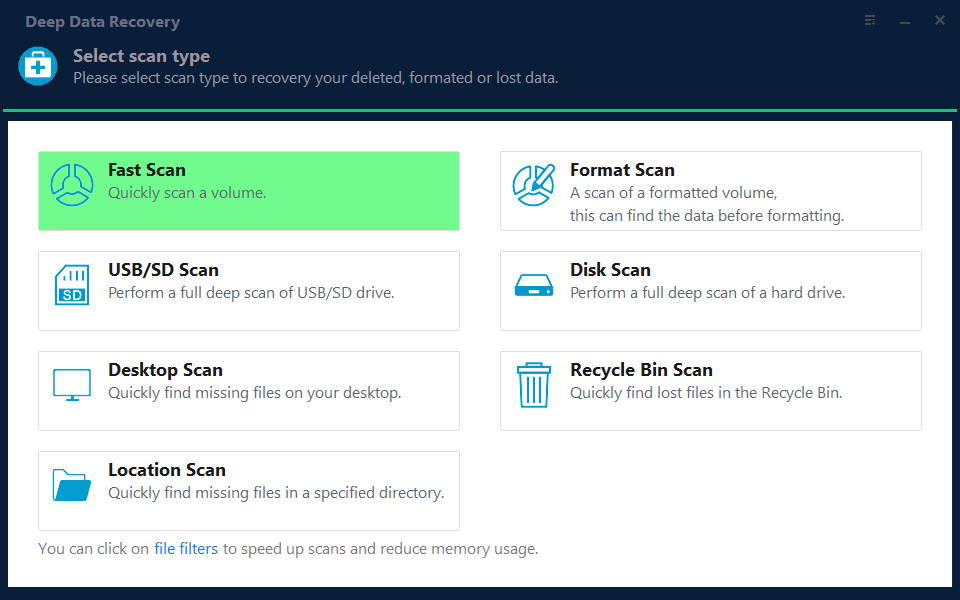
Note: You can choose different search modes based on where and why the data was lost.
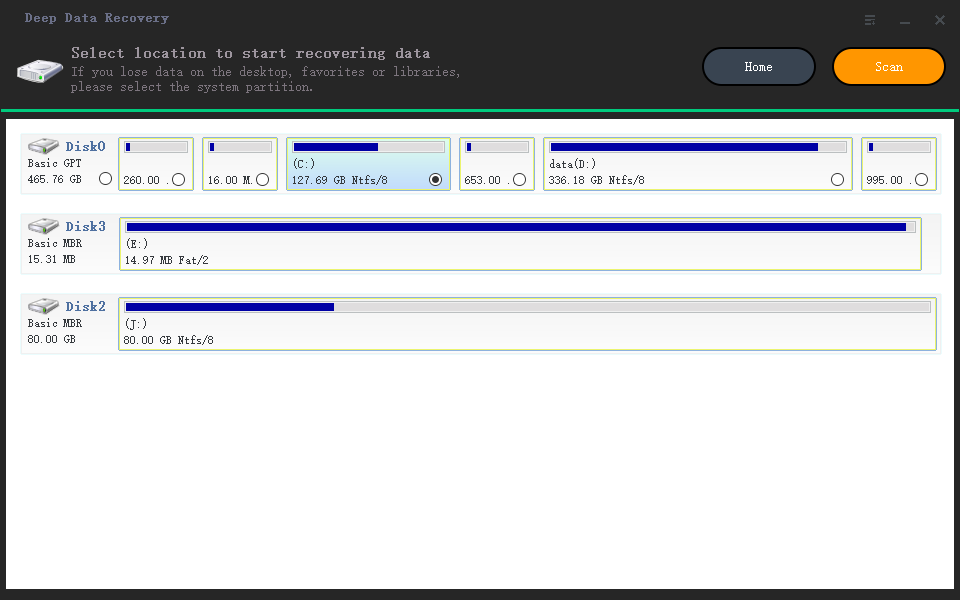
Step 2.Select the disk partition or storage location where you lost data and click "Scan".
Step 3. The recovery software will scan the disk to find lost and deleted files. Once the scan is complete, you can click on "file type" or the search icon to locate the missing files.
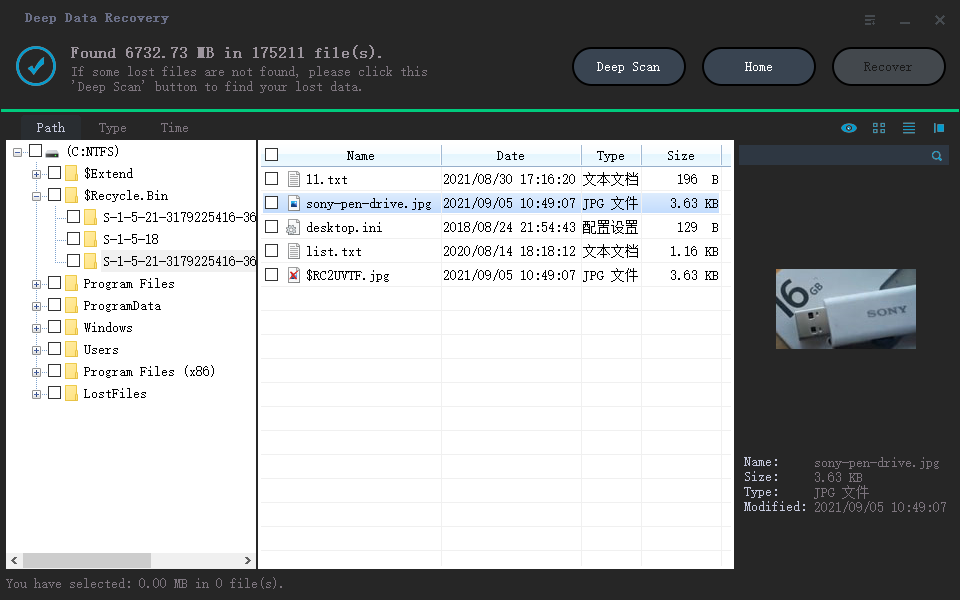
Step 4.You can preview and restore lost Windows files by scanning them. Double-click to preview the scanned files, then select the target data and click the "Recover" button to save them to another safe spot in the PC or an external storage device.
Related Articles
- [Fixed] Office 365/2016/2013 Won't Open with 'Stopped Working' Error in Windows 10
- Computer Freezes When Playing Games in Windows 10
- How to Install Windows 10 on a New Hard Drive Without Disk or USB
- Fixed: CPU Isn't Supported | CPU Isn't Compatible with Windows 10/8.1/8
- How to Change Download Location in Windows Server
To change the download location in Windows Server, click on the “Move” option, which will display a list of destination folders. Click on “This PC” to select a new preferred download location. - How to Copy MS Office from Laptop to Pen Drive (Including Word, Excel, PPT)
Do you want to copy Microsoft Word onto a flash drive so you can run the Microsoft Word from the USB drive on another computer? You can easily make it happen with the help of Qiling easy transfer software.
Products
Articles & Tutorials
- Data Recovery
- Data Backup
- File Recovery
- File Backup
- System Backup and Restore
- Disk and Partition Clone
- Technical articles
- Mobile articles
- Disk Master Help
- Windows Data Recovery Tutorials
- Windows Secure Delete Tutorials
- Windows Partition Management Tutorials
- Windows File Backup and Restore Tutorials
- Windows System Backup and Restore Tutorials
- Windows Disk Backup and Restore Tutorials
- Windows Clone Tutorials