How Do I Clone My 2TB Hard Drive to a 1TB SSD
You can clone a 2TB hard drive to a 1TB SSD only when the used data fits within the SSD capacity.
The physical size of the source disk is not the main limit; used space is.
PAGE CONTENT
- What This Problem Means
- Before You Start
- Use Windows Built-in Tools First
- Use the Qiling Product Workflow
- Check the Result
- FAQs
What This Problem Means
A larger-to-smaller clone copies used data and required boot partitions, then adjusts partition sizes to fit the smaller target.
- Used space must be less than the real SSD capacity.
- Hidden boot partitions must be included.
- Bad sectors can cause clone failures.
- The destination SSD will be overwritten.
- 顦?/i> Important
- Back up personal files and do not erase the old HDD until the SSD boots correctly.
Before You Start
Move videos, backups, and archives away until used space fits on the 1TB SSD.
- Confirm the exact disk, partition, USB drive, SD card, or Windows installation you are changing.
- Copy irreplaceable files to another drive if the device is still readable.
- Check whether BitLocker, Secure Boot, UEFI/Legacy mode, or a vendor recovery partition is involved.
- Avoid formatting, deleting, wiping, or running DiskPart clean until you know whether data must be recovered first.
Use Windows Built-in Tools First
Use Windows to reduce source data before cloning.
Step 1. Check used space on the 2TB drive.
Step 2. Run Disk Cleanup and uninstall unused programs.
Step 3. Move large files to another disk temporarily.
Step 4. Run chkdsk if the HDD has errors.
Step 5. Connect the SSD and confirm Windows sees it.
Detailed Qiling Disk Copy Workflow
Use Qiling Disk Copy when the goal is to migrate Windows, clone a drive, or copy a system partition without reinstalling Windows. Before starting, connect the destination disk and confirm that it does not contain files you still need because cloning overwrites the target.
Step 1. Open Disk Management and write down the source disk number, partition style, capacity, and used space. If you clone to a smaller SSD, reduce used space first.
Step 2. Launch Qiling Disk Copy and choose Disk/Partition clone. Use Disk clone for a bootable Windows disk. Use Partition clone only when you know the partition does not need to boot alone.
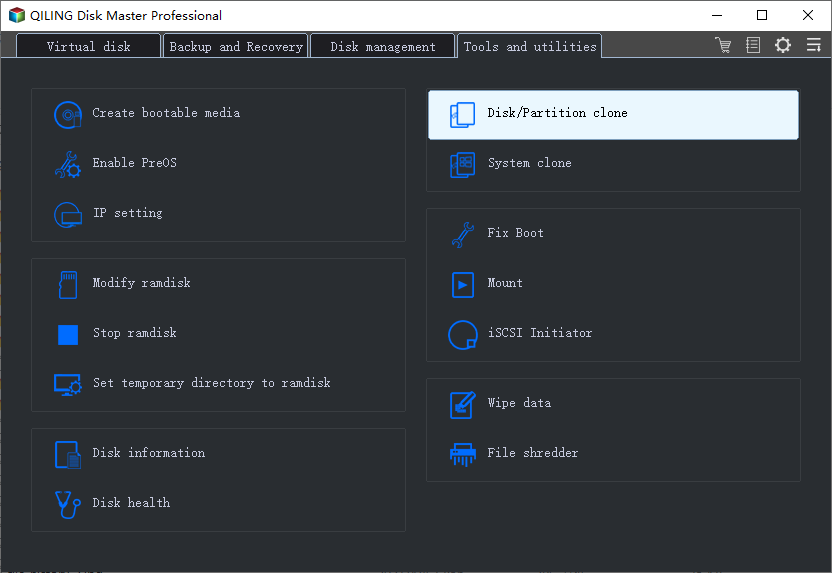
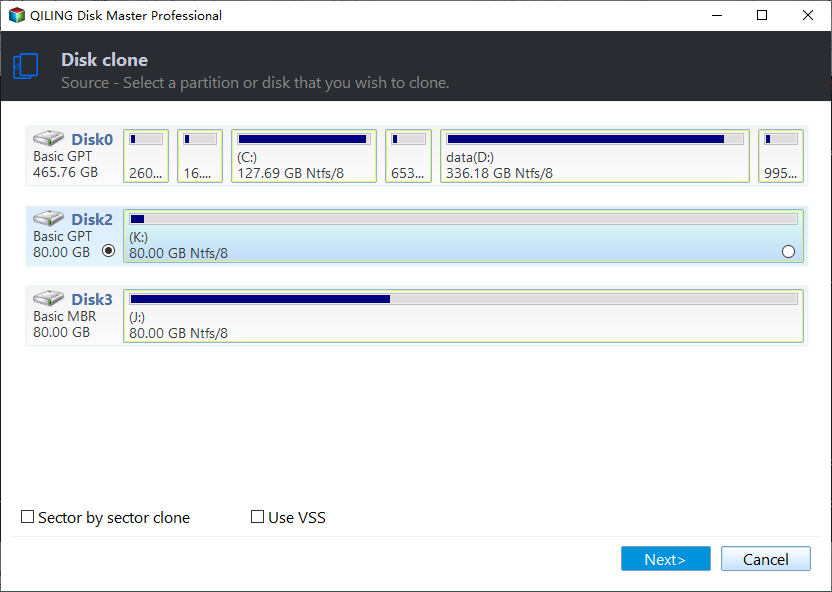
Step 3. Select the original HDD, SSD, or system partition as the source. Confirm it by drive letter, size, and partition list.
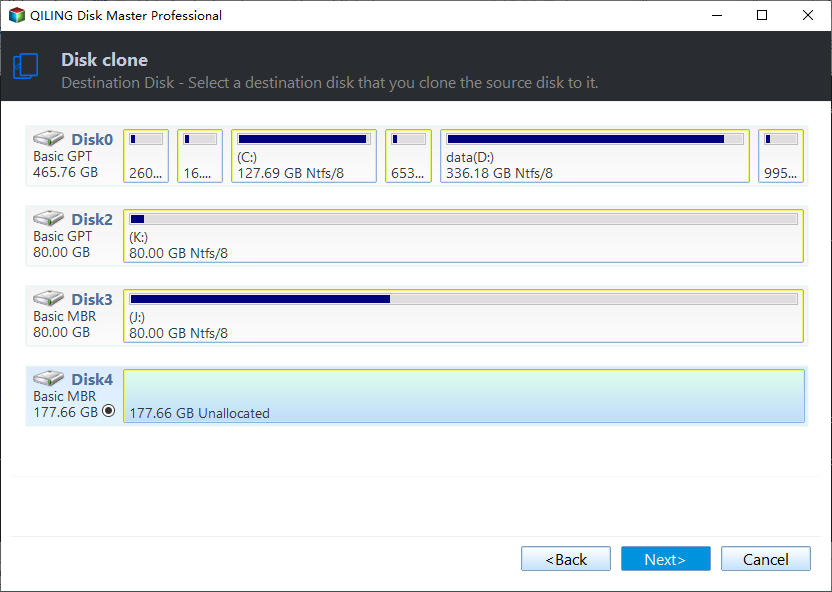
Step 4. Select the destination disk. Recheck the model and capacity because the destination will be overwritten.
Step 5. Preview the clone layout. Keep EFI, System Reserved, C drive, and Recovery partitions when cloning a boot disk. Enable SSD optimization if the target is an SSD.
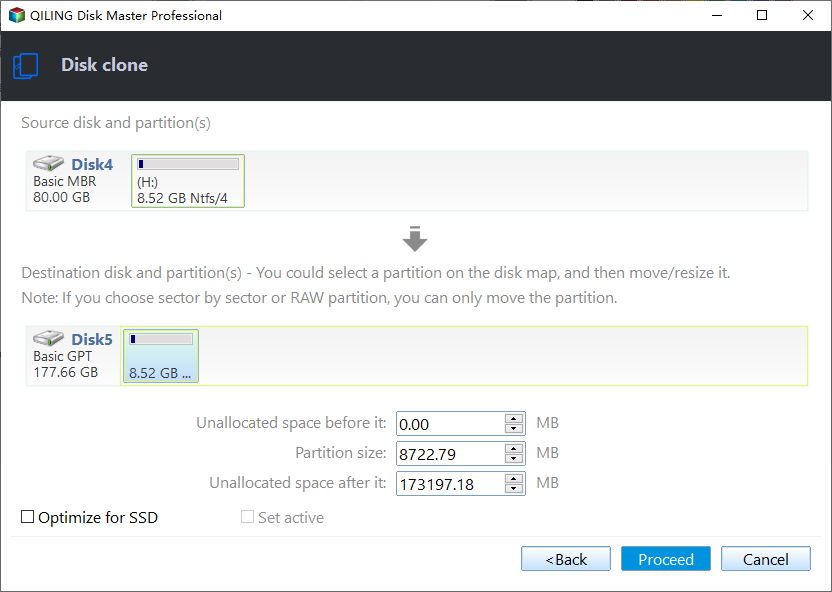
Step 6. Click Proceed and wait until the clone finishes. Do not unplug either drive or shut down the PC.
Step 7. Set the cloned disk as the first boot device in BIOS/UEFI, boot Windows, and verify files, programs, and partitions before reusing the old disk.
Check the Result
After the SSD boots, keep the old HDD unchanged for a few days as a fallback.
- Restart Windows and confirm the drive, partition, backup task, or cloned disk appears as expected.
- Open several files instead of only checking that a drive letter exists.
- Keep one recent backup on an external drive before making another high-risk change.
- If the same error returns, check hardware health, cable quality, firmware, and Event Viewer before repeating the same operation.
FAQs
Can I clone 2TB to 1TB?
Yes, if used data is smaller than the SSD capacity.
What if used space is over 1TB?
Move or delete files, uninstall apps, or choose a larger SSD.
Will the SSD boot?
It should if all boot partitions are cloned and boot order is set correctly.
Conclusion
A 2TB-to-1TB clone is a planning task. Reduce used space first, clone with SSD optimization, and verify boot before repurposing the old drive.
Related Articles
- Best Free Partition Manager Software of 2026
- How to Clone HDD to SSD in Windows 10/11/7
- Windows System Backup and Restore Tutorials
- Windows Data Recovery Tutorials
Products
Articles & Tutorials
- Data Recovery
- Data Backup
- File Recovery
- File Backup
- System Backup and Restore
- Disk and Partition Clone
- Technical articles
- Mobile articles
- Disk Master Help
- Windows Data Recovery Tutorials
- Windows Secure Delete Tutorials
- Windows Partition Management Tutorials
- Windows File Backup and Restore Tutorials
- Windows System Backup and Restore Tutorials
- Windows Disk Backup and Restore Tutorials
- Windows Clone Tutorials