Cache vs Buffer: What's the Difference and Why It Matters
People use cache and buffer almost interchangeably, and in casual conversation that is usually harmless. Technically they are different tools: a buffer smooths out a mismatch between two speeds, while a cache keeps a copy of data so you do not have to fetch it twice. One is about timing, the other about reuse. Knowing which is which tells you where to look when something feels slow.
This guide explains both in plain language, compares them side by side, shows where you meet each on a normal Windows 11 PC, and explains what to do about a slow disk or a stuttering stream.
PAGE CONTENT
- The Short Answer
- How a Buffer Works
- How a Cache Works
- Buffer and Cache Compared
- Where You Meet Both on a PC
- Why the Difference Matters When You Optimize
- FAQs About Caches and Buffers
- Back Up Windows Before You Change Settings
The Short Answer
A buffer is a waiting area. Data passes through it on the way from a fast producer to a slow consumer, or the other way around, and it exists so that neither side has to stop and wait. Data in a buffer is on its way somewhere; once it arrives, it is gone.
A cache is a storage shortcut. It holds a copy of data that has already been used, so the next request for that data can be answered quickly. Data in a cache stays there and is reused, until it is replaced by something more useful.
In one line: a buffer handles speed differences, and a cache handles repeated access.
How a Buffer Works
Buffers exist because two parts of a system rarely run at the same rate. A video stream arrives over the network at a variable rate and must be played at a fixed rate; a document is created faster than a printer can print it; a program can compute new data far faster than a hard drive can accept it. In each case, a buffer absorbs the difference.
Buffers share a few traits:
- They are transient. Data enters, is consumed, and leaves. Nothing stays behind waiting to be reused.
- They are usually sized for a peak. A buffer that is too small overflows or stalls; one that is too large only wastes memory.
- Losing a buffer means losing in-flight data. If the power fails with data still in a write buffer, that data has not reached its destination.
You see this every day: the spinning circle when a video "buffers" is a download buffer filling up so playback can continue smoothly, and the print queue is a buffer that lets you keep working while the printer catches up.
How a Cache Works
A cache is built around one observation: programs and people ask for the same data again and again. Windows reads the same boot files at every startup, a browser fetches the same logo on every page, and a game loads the same textures at every level. If the second request can be answered from somewhere faster than the original source, the wait disappears.
Cache behavior is described with two words:
- A hit is a request served from the cache. Fast.
- A miss is a request the cache cannot answer, so the original, slower source is used. The result is usually stored in the cache for next time.
The share of requests that are hits is the hit rate, and it decides whether the cache is earning its place. A disk cache that serves 80 percent of reads from faster storage has removed four out of five slow trips to the drive.
Buffer and Cache Compared
| Buffer | Cache | |
|---|---|---|
| Purpose | Absorb a difference in speed or timing | Answer repeated requests faster |
| Data lifetime | Transient, consumed and discarded | Persists until replaced |
| Typical size | Small, sized for a peak burst | Large, sized to hold a working set |
| What it stores | Data in transit, not the only copy | Copies of data that still exists elsewhere |
| If it is lost | In-flight data can be lost | Only speed is lost; the data is re-read |
| Everyday examples | Video streaming buffer, print queue, write buffer | Disk cache, browser cache, CPU cache |
The two often work side by side. A caching tool may hold a large store of hot data for reuse, and also use a small write buffer so that many small writes can be sent to the drive together, which is more efficient than one at a time.
Where You Meet Both on a PC
Buffers you already rely on:
- Streaming buffer in video apps and browsers, which prevents playback from stalling when the network hiccups.
- Print spooler, which accepts a document quickly and feeds it to the printer at the printer's pace.
- Write buffer in the storage stack, which lets a program continue working while the disk finishes writing.
Caches you already rely on:
- Browser cache, holding images, scripts, and styles for the sites you visit.
- Windows disk cache, keeping frequently read files in RAM.
- CPU cache, the tiny, extremely fast memory inside the processor.
- Thumbnail and icon cache, so File Explorer does not rebuild previews constantly.
For a deeper look at the storage side, including how RAM and SSD tiers cooperate, see What Are L1 and L2 Cache?.
Why the Difference Matters When You Optimize
This distinction is practical, because the two problems have different fixes.
- A video that constantly stalls is a buffering problem. The network cannot deliver data fast enough, so a bigger cache on your disk changes nothing. Check the connection quality first.
- An app that opens slowly every single time is a cache problem. The same files are read from a slow drive again and again, which is exactly what a disk cache solves.
- Saving large files that feel sluggish is partly a buffering problem. The drive's write speed is the limit, and a write buffer only smooths the burst.
For repeated reads, a disk cache is the right fix, and Qiling Fast Cache is built for it. It keeps the hot blocks of a slow drive in spare RAM and on a spare SSD, and it reports the hit rate so you can see how much of your workload it is covering.
Step 1. Download and install Qiling Fast Cache.
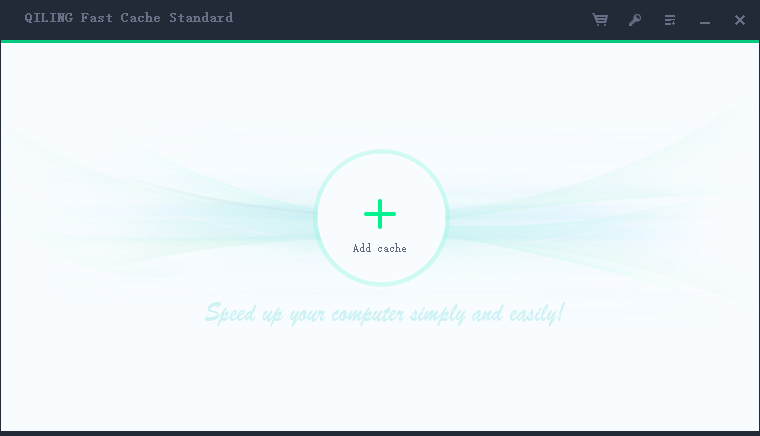
Step 2. Open the program, click the + button, and choose the drive you use most.
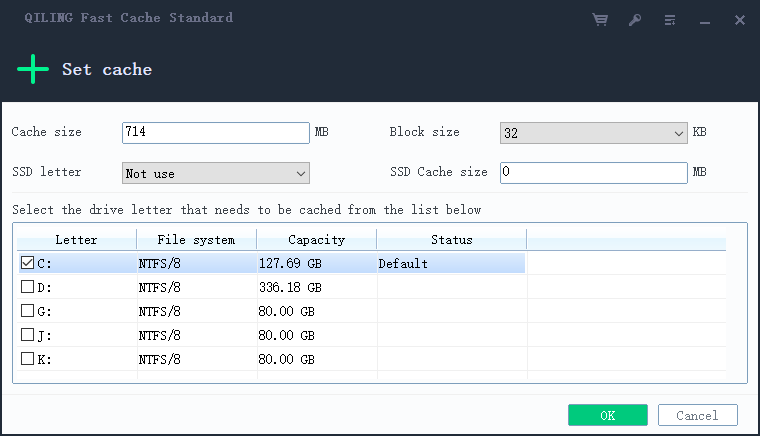
Step 3. Set the cache size, add the SSD tier for a cache that survives reboots, and click OK.
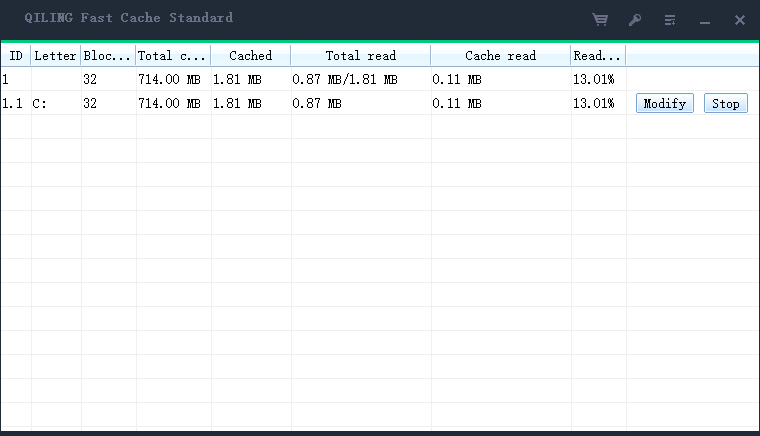
Step 4. Watch the statistics window. A rising hit rate means more of your reads are being answered from the cache instead of the original drive.
FAQs About Caches and Buffers
Is a cache a type of buffer?
They are related but distinct. A cache stores data for reuse, while a buffer stores data in transit. Many systems use both together, which is why the words get mixed up.
Can a buffer be used as a cache?
Only by accident. A buffer's contents are usually the newest data in flight, not a copy of what you accessed most, so it rarely answers repeated requests the way a cache does.
Why does clearing my browser cache log me out of websites?
Because the cache holds more than images: it also stores cookies and session data for many sites. Clearing it removes those, so sites treat you as a new visitor.
Does a bigger write buffer make my PC faster?
It can improve throughput for many small writes by batching them, but it also means more data is in flight when something goes wrong. Keep buffer flushing enabled unless your system is protected by a UPS.
How do I know if I need more cache instead of more buffer?
Look at the pattern. If the same operations are slow every time you repeat them, a cache helps. If slowness only appears during bursts or when the network is busy, you are looking at a buffering or bandwidth limit.
Does a RAM disk act as a cache or a buffer?
Neither, strictly speaking. A RAM disk is real storage that happens to live in memory, so applications treat it as a normal drive. It is often used for the temporary data that caches and buffers would otherwise write to your SSD.
Back Up Windows Before You Change Settings
Tuning caches is safe, but if you also change storage settings, a backup protects your system. Qiling Disk Master creates a full Windows image you can restore from if anything goes wrong.
Part 1: Create a Full System Backup
Step 1. Install and open Qiling Disk Master. On the home screen, open "Backup and Recovery" and choose "System Backup". This option automatically includes Windows and the hidden boot partitions, so you do not have to select them one by one.
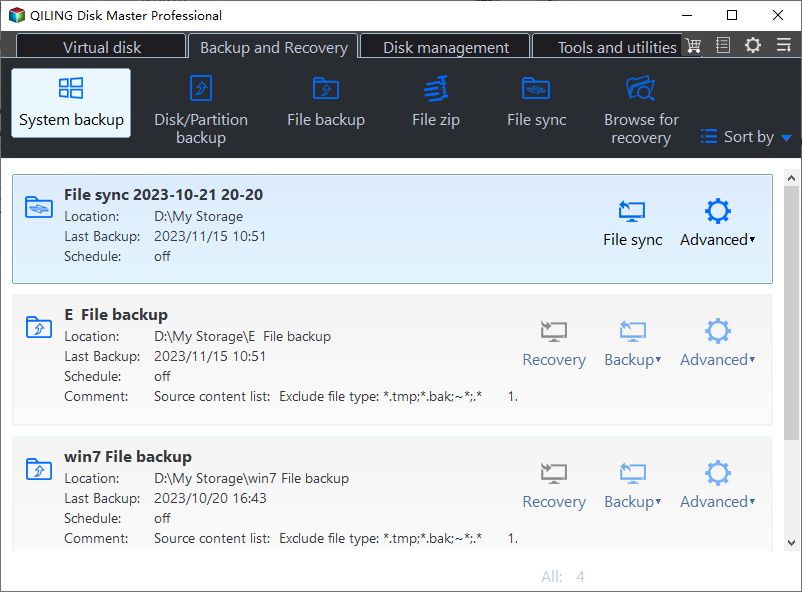
Step 2. Check the source. The disk where Windows is installed and its system partitions are already ticked for you. If you only need your personal documents, run a separate "File Backup" task instead.

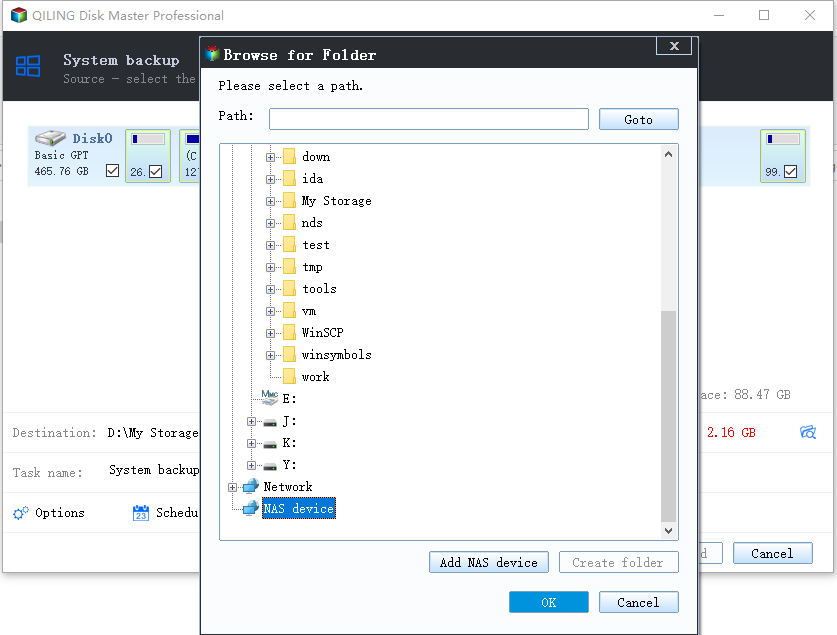
Step 3. Click the destination box and choose where the image should be saved. Use an external HDD or SSD, a NAS, or any drive other than the one Windows is installed on, and make sure it has enough free space.
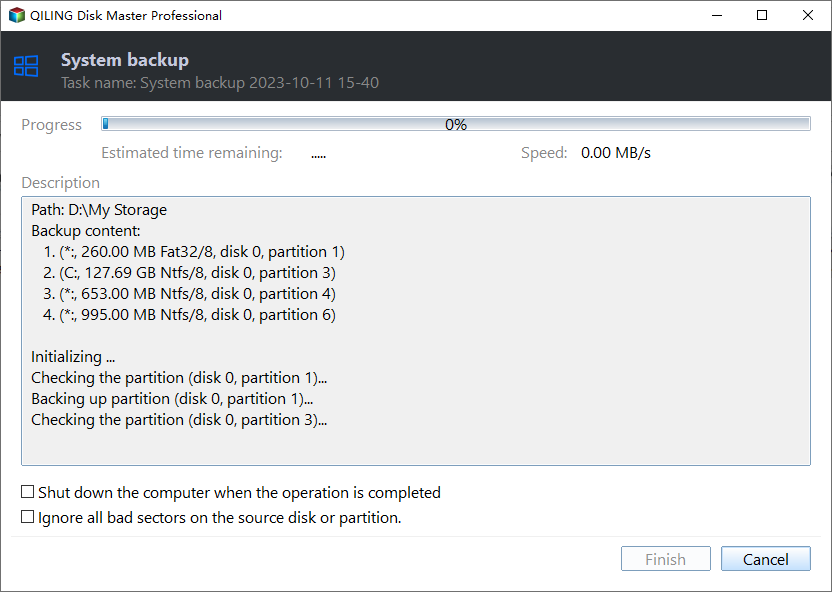
Step 4. Review the task summary and click "Proceed". Wait until the progress bar reaches 100%. Do not unplug the drive or turn off the PC while the backup is running.
Part 2: Restore Windows from the Backup
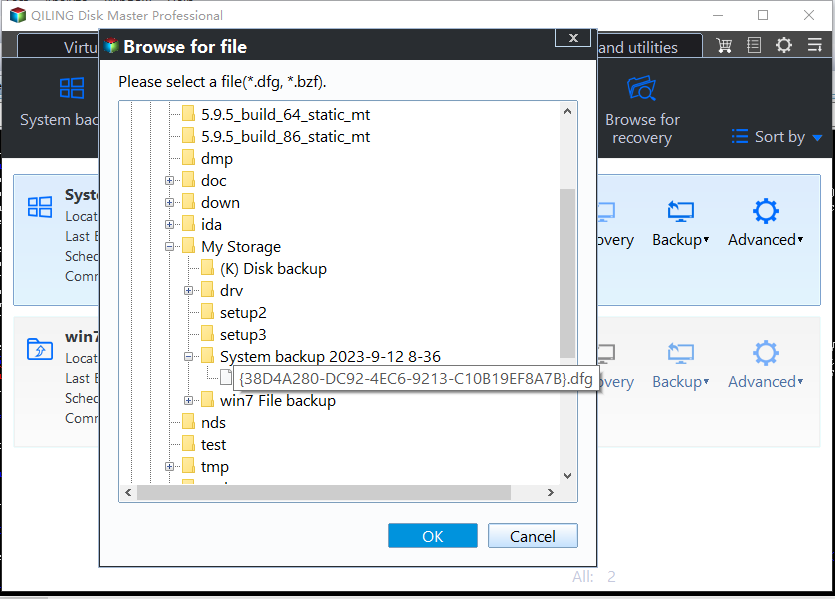
Step 1. Open Qiling Disk Master again, go to "Backup and Recovery", and select the recovery option. Your backup images are listed, so pick the one you created before the changes began.
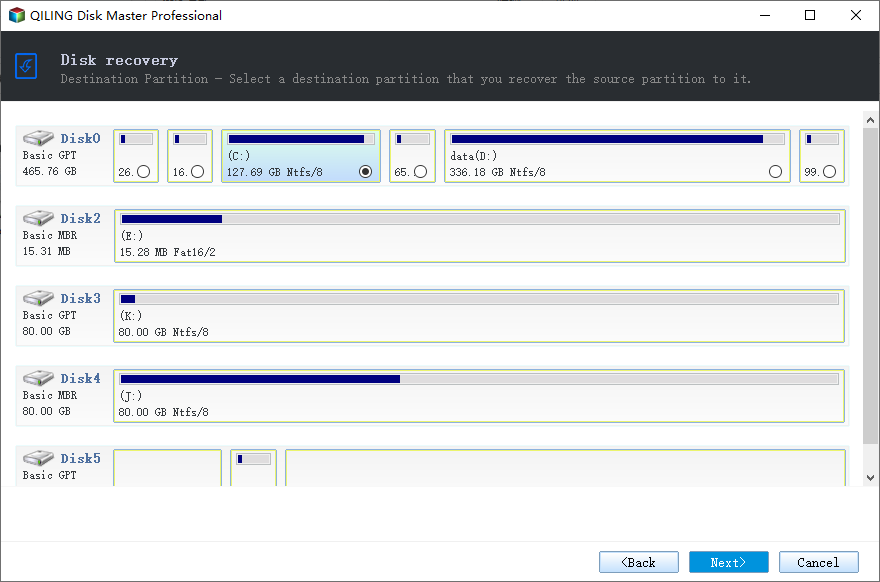
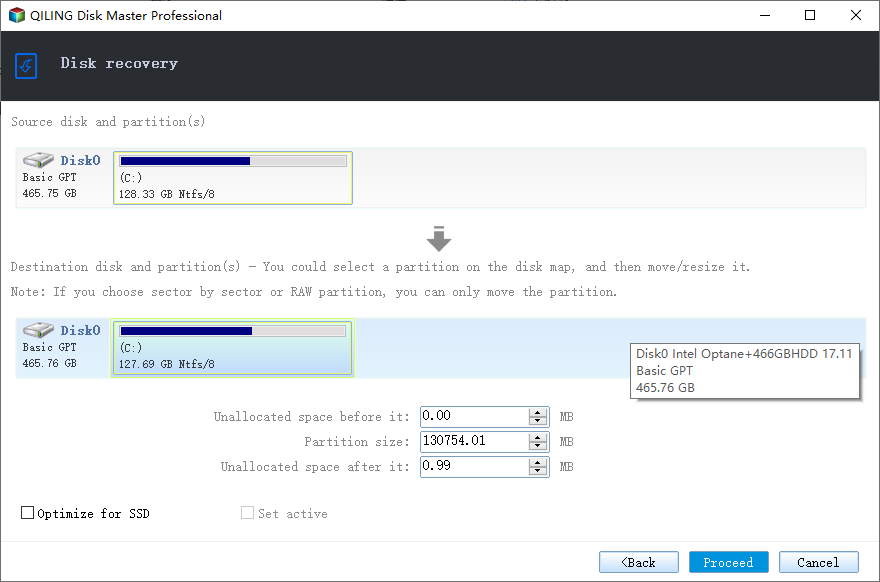
Step 2. Choose the target disk or partition. Normally you restore to the original system disk. If the drive was replaced, select the new disk instead, and the restore rebuilds Windows together with its boot partitions.
Step 3. Preview the restore plan, click "Proceed", and confirm the warning. The PC restarts to finish the job, and Windows comes back exactly as it was on the day the image was created, with your files and programs intact.
- Note
- Keep the backup image on a separate drive, and refresh it before changing storage or cache settings.
Conclusion
A buffer and a cache both sit between slow and fast parts of a system, but they do opposite jobs. A buffer absorbs a speed mismatch and its data is transient; a cache keeps copies of data for reuse and its whole value is measured by the hit rate. On a PC you rely on both, from the streaming buffer that keeps video smooth to the disk cache that makes repeated reads fast. When something feels slow, identify which one is involved: bandwidth problems need a better connection, while repeated slow reads need a cache. Qiling Fast Cache handles the second case by serving your hot data from spare RAM and a spare SSD.
Protect your PC with Qiling Backup—create a system image before your next round of settings changes.
For more Windows 11 performance guides, see What Are L1 and L2 Cache?, Write Caching vs Read Caching, How to Check Cache Hit Rate, Windows 11 Fast Cache, and What Is Cache Warm-Up?.
Related Articles
- What Are L1 and L2 Cache? RAM and SSD Tiers Explained
How the two cache levels differ and why both are useful. - Write Caching vs Read Caching: What's the Difference?
The write side of caching, where buffers and caches overlap. - How to Check Cache Hit Rate and Measure Cache Performance
- What Is Cache Warm-Up? Why the First Run Is Slow
- Windows 11 Thumbnail Cache: Why Explorer Is Slow
- Torrent Client Cache: Speed Up Seeding and Rechecks
Products
Articles & Tutorials
- Data Recovery
- Data Backup
- File Recovery
- File Backup
- System Backup and Restore
- Disk and Partition Clone
- Technical articles
- Mobile articles
- Disk Master Help
- Windows Data Recovery Tutorials
- Windows Secure Delete Tutorials
- Windows Partition Management Tutorials
- Windows File Backup and Restore Tutorials
- Windows System Backup and Restore Tutorials
- Windows Disk Backup and Restore Tutorials
- Windows Clone Tutorials