What Is Cache Warm-Up? Why the First Run Is Slow and How to Fix It
You set up a disk cache, the first day feels fast, and then after a reboot everything seems slow again. Nothing is broken. What you are seeing is the difference between a cold cache and a warm cache. Understanding cache warm-up explains that behavior, tells you how long to wait before judging a cache, and shows how to keep your cache hot for as long as possible.
This guide explains what warming up a cache means, why the first run after a reboot is slow, how a RAM tier and an SSD tier behave differently, and how to warm up and keep the cache hot with Qiling Fast Cache.
PAGE CONTENT
- What Cache Warm-Up Means
- Why the First Run After a Reboot Is Slow
- RAM Cache vs SSD Cache: Which Stays Warm?
- How to Warm Up a Cache Faster
- How to Tell Whether the Cache Is Warm
- Tips to Keep the Cache Hot
- FAQs About Cache Warm-Up
- Back Up Windows Before You Change Settings
What Cache Warm-Up Means
A disk cache starts empty. The first time Windows or an app reads a block of data, the cache has nothing to serve, so the request goes to the original drive and the cache saves a copy for next time. That first read is a miss. The next time the same block is needed, the cache can answer it, and that read is a hit.
Warming up is simply the process of filling the cache with the data you actually use. As you work, more of your hot data moves into the fast tier, the hit rate climbs, and the drive feels quicker. The cache is "warm" when most of the data you touch repeatedly is already in it.
Three things decide how long warm-up takes:
- Your workload. Booting, opening the same apps, and re-opening the same project files warm the cache quickly. Reading thousands of unique files never warms it much.
- Cache size. A cache that is too small for your working set keeps evicting data it will need again.
- How often you reboot. A cache stored in RAM must be refilled after every restart, while a cache stored on an SSD survives.
Why the First Run After a Reboot Is Slow
Right after a restart, a RAM cache is empty by definition, because RAM loses its contents when the power goes off. Windows then has to read hundreds of files from the drive to bring up the desktop, and every one of those reads is a miss. The same is true for the first launch of each app, the first load of each game level, and the first open of each project.
In practice this looks like a slow first few minutes, then a gradual return to normal speed. It is not a sign that the cache stopped working. It is the cost of rebuilding the cache, and it happens again after every shutdown or restart.
- Note
- Do not benchmark a cache right after a reboot. Let it warm up with normal use, then measure. Judging a cache on its first minute is like judging a car engine before it has warmed up.
RAM Cache vs SSD Cache: Which Stays Warm?
The two cache tiers behave differently across reboots, and that difference is the key to keeping a cache hot.
| RAM cache (L1) | SSD cache (L2) | |
|---|---|---|
| Speed | Fastest, memory speed | Fast, SSD speed |
| After a reboot | Empty, must warm up again | Keeps its contents, stays warm |
| Capacity | Limited by spare memory | Limited by the SSD you dedicate |
| Write endurance impact | None | Adds writes to the SSD |
| Best role | Hottest, most reused blocks | Large working set that must persist |
Qiling Fast Cache can run both tiers at once. The second-level SSD cache holds your working set across restarts, and the first-level RAM cache refills from that SSD at SSD speed instead of from a slow hard drive. The result is that warm-up after a reboot takes seconds rather than minutes, which is the main reason to add an SSD tier even when you already have spare memory.
How to Warm Up a Cache Faster
You cannot skip warm-up entirely, but you can shorten it by putting the right data through the cache early.
- Use the PC normally. Ordinary work is the most representative way to warm a cache, because it fills it with the data you actually need.
- Run your main apps once. Launch the programs and games you use most, and open the projects or documents you return to daily. Each one warms its own blocks.
- Do a real pass of your workload. Compile the project, export the video, or play one level. A realistic pass warms the files that will matter next time.
- Add an SSD tier. With an SSD cache, warm-up is a one-time cost instead of a daily one, because the data survives a reboot.
- Size the cache for your working set. If the cache is smaller than the data you use daily, it can never fully warm. Increase it, or cache the drive you use most.
Copying a folder to the drive does not reliably warm the cache, because writing data is not the same as reading it. The cache learns from the reads you perform, so use the files rather than moving them around.
How to Tell Whether the Cache Is Warm
You do not have to guess. Qiling Fast Cache shows live statistics in its main window:
- Hit rate — the share of reads served from the cache. A hit rate that climbs from near zero toward 50 percent or more means the cache is warming up.
- Cached data size — how much data is already in the cache. If it stops growing long before the cache is full, your workload simply does not repeat much.
- Read speed — the throughput being delivered. It rises as more requests hit the fast tier.
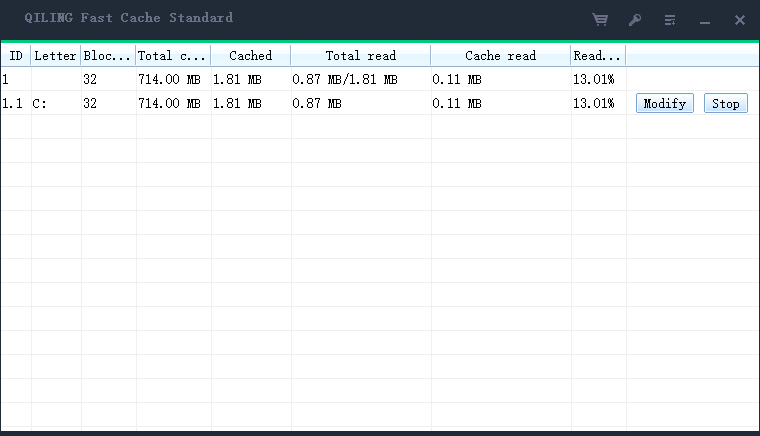
For a full explanation of these numbers and what counts as a good result, see How to Check Cache Hit Rate.
Tips to Keep the Cache Hot
- Use an SSD tier for anything you do daily. A persistent cache is warm the moment Windows starts.
- Cache the drive you work from. A warm cache on a rarely used drive does nothing for the programs you actually run.
- Keep the accelerated drive's contents stable. Constant large installs, drive wipes, or mass file moves push new data through the cache and evict hot blocks.
- Do not defragment or mass-clean the cached drive. These operations move data around and throw away the pattern the cache learned.
- Avoid rebooting when a RAM-only cache is in use. Sleep keeps memory intact, so the cache stays warm; a full shutdown or restart clears it.
- Leave spare memory for Windows. A cache that starves the system makes the whole PC slower, no matter how high its hit rate is.
FAQs About Cache Warm-Up
How long does cache warm-up take?
It depends on the workload, the cache size, and the tier in use. A RAM cache typically needs a few hours of normal use, or two or three runs of each app, and then starts over after every reboot. An SSD cache warms up once and keeps its data.
Is a cold cache a sign that something is wrong?
No. A hit rate near zero immediately after a reboot is exactly what a RAM cache should look like. It is only a problem if the hit rate stays low after hours of normal use.
Can I warm the cache by copying files to the drive?
Not reliably. A cache is filled by reads, not writes, so copying data into place does not guarantee it will be served from the cache. Use the files instead.
Does Windows Prefetch do the same thing?
Windows prefetches a limited set of boot and application data to speed up startup, but it does not act as a general disk cache. A caching tool works across the whole drive and adapts to whatever you actually use.
Does the cache stay warm after sleep?
Sleep keeps the contents of memory, so a RAM cache stays warm and the PC resumes quickly. A full shutdown or restart clears a RAM cache; an SSD tier is unaffected either way.
Why is my hit rate lower than my friend's?
Because hit rate reflects your workload, not the quality of the cache. Someone who repeats the same tasks all day will always show a higher hit rate than someone who opens new data constantly.
Back Up Windows Before You Change Settings
Tuning a cache is safe, but if you also change storage settings, a backup protects your system. Qiling Disk Master creates a full Windows image you can restore from if anything goes wrong.
Part 1: Create a Full System Backup
Step 1. Install and open Qiling Disk Master. On the home screen, open "Backup and Recovery" and choose "System Backup". This option automatically includes Windows and the hidden boot partitions, so you do not have to select them one by one.
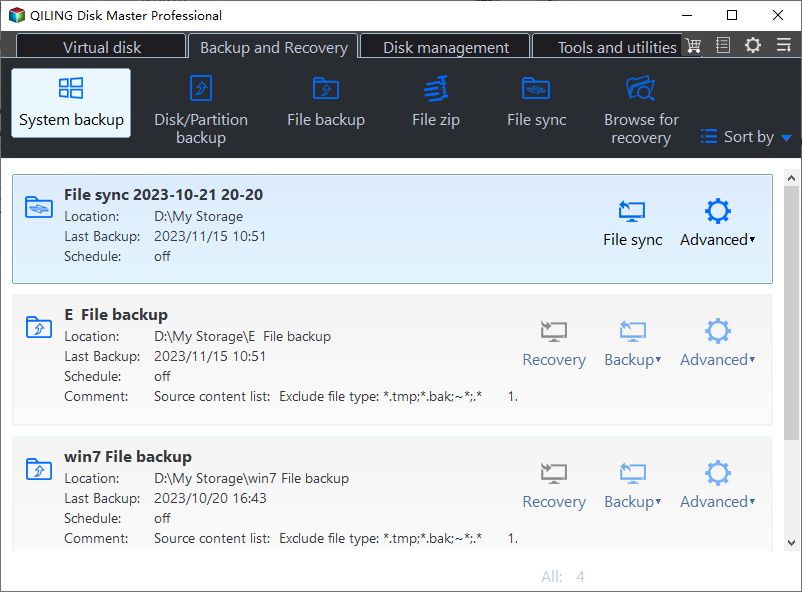
Step 2. Check the source. The disk where Windows is installed and its system partitions are already ticked for you. If you only need your personal documents, run a separate "File Backup" task instead.

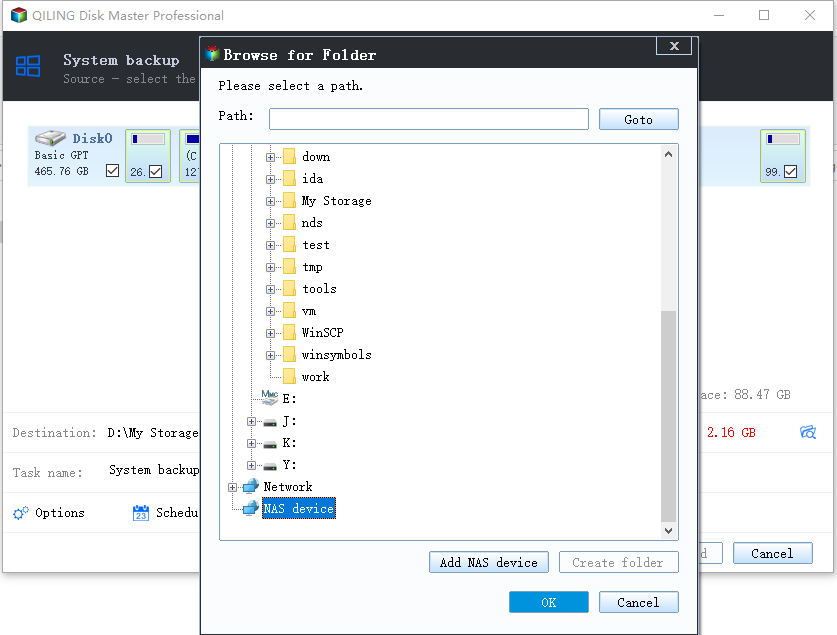
Step 3. Click the destination box and choose where the image should be saved. Use an external HDD or SSD, a NAS, or any drive other than the one Windows is installed on, and make sure it has enough free space.
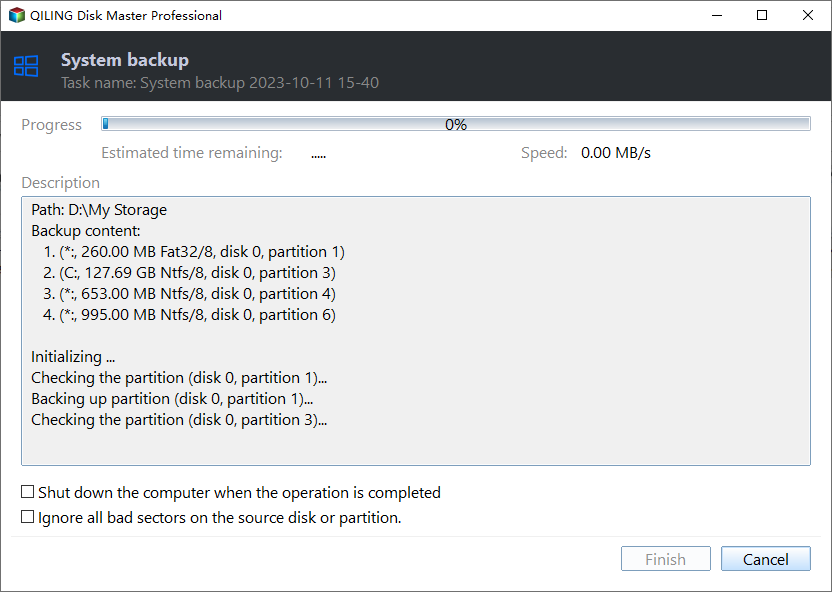
Step 4. Review the task summary and click "Proceed". Wait until the progress bar reaches 100%. Do not unplug the drive or turn off the PC while the backup is running.
Part 2: Restore Windows from the Backup
Step 1. Open Qiling Disk Master again, go to "Backup and Recovery", and select the recovery option. Your backup images are listed, so pick the one you created before the changes began.
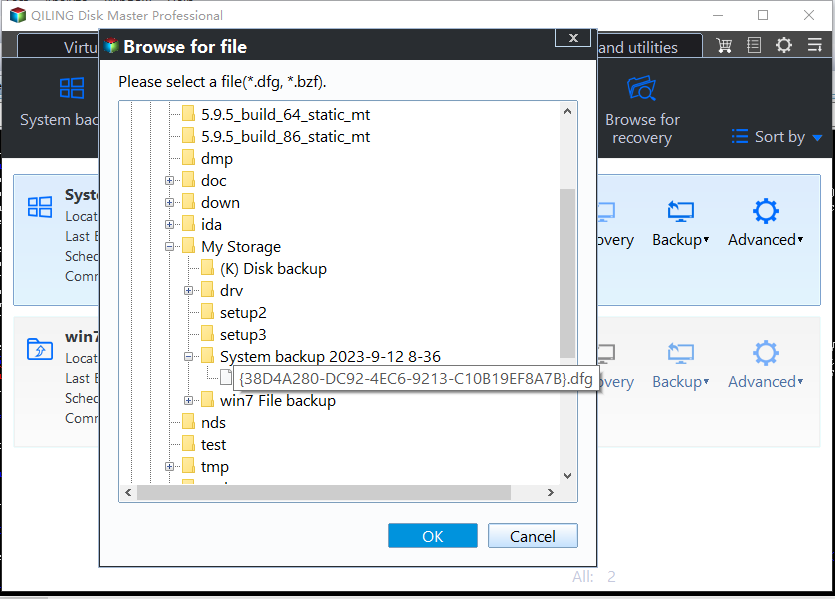
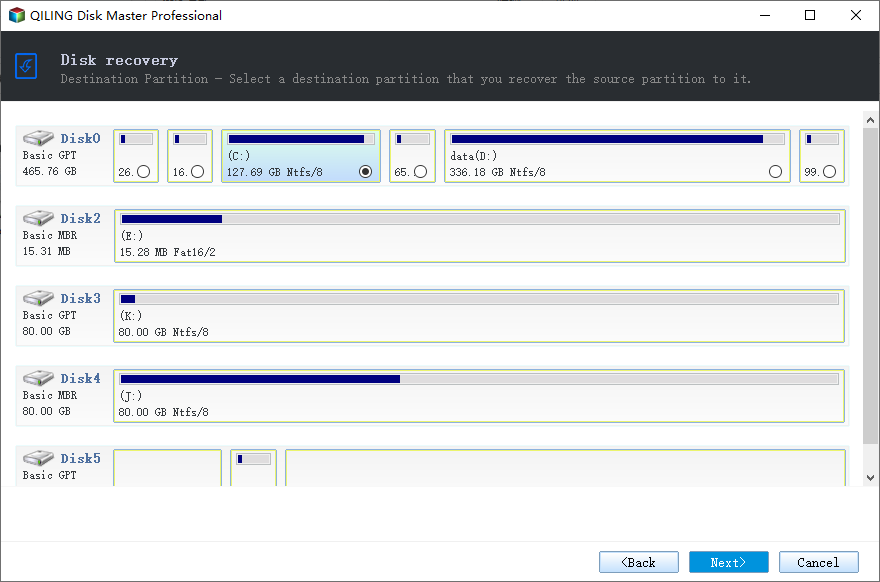
Step 2. Choose the target disk or partition. Normally you restore to the original system disk. If the drive was replaced, select the new disk instead, and the restore rebuilds Windows together with its boot partitions.
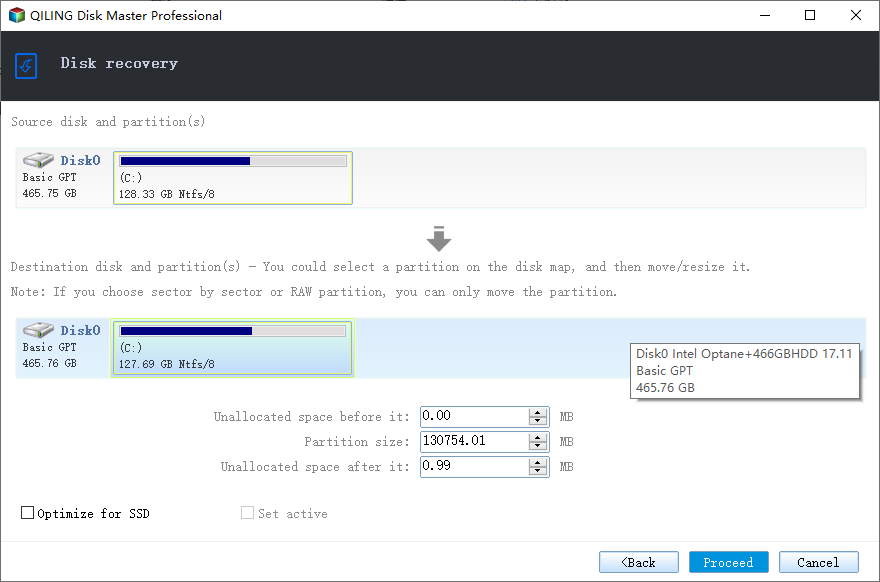
Step 3. Preview the restore plan, click "Proceed", and confirm the warning. The PC restarts to finish the job, and Windows comes back exactly as it was on the day the image was created, with your files and programs intact.
- Note
- Keep the backup image on a separate drive, and refresh it before changing storage or cache settings.
Conclusion
Cache warm-up is the reason a freshly rebooted PC feels slow even when a cache is configured: the RAM tier starts empty and every early read is a miss. The fix is not to warm the cache by hand but to make warm-up cheap. Add an SSD tier in Qiling Fast Cache so your working set survives reboots, size the cache to the data you really use, and let normal work fill it. Then check the hit rate in the main window instead of judging by feel: a rate that climbs above 50 percent means the cache is warm and doing its job.
Protect your PC with Qiling Backup—create a system image before your next round of settings changes.
For more Windows 11 performance guides, see How to Check Cache Hit Rate, Windows 11 Fast Cache, What Are L1 and L2 Cache?, Reduce Boot Time in Windows 11, and Speed Up Windows 11 with RAM and SSD Cache.
Related Articles
- How to Check Cache Hit Rate and Measure Cache Performance
Use the built-in statistics to see when your cache has finished warming up. - What Are L1 and L2 Cache? RAM and SSD Tiers Explained
Understand why the second-level SSD cache keeps your data hot. - How to Reduce Boot Time in Windows 11
- ReadyBoost vs RAM Disk vs SSD Cache: Which to Use?
- When a Disk Cache Does Not Help (and What to Do Instead)
- Speed Up Databases with a RAM Disk and Disk Cache
Products
Articles & Tutorials
- Data Recovery
- Data Backup
- File Recovery
- File Backup
- System Backup and Restore
- Disk and Partition Clone
- Technical articles
- Mobile articles
- Disk Master Help
- Windows Data Recovery Tutorials
- Windows Secure Delete Tutorials
- Windows Partition Management Tutorials
- Windows File Backup and Restore Tutorials
- Windows System Backup and Restore Tutorials
- Windows Disk Backup and Restore Tutorials
- Windows Clone Tutorials