When a Disk Cache Does Not Help (and What to Do Instead)
Disk caching is one of the few PC upgrades that costs nothing but configuration, and it genuinely transforms a mechanical drive in daily use. It also does nothing for a long list of problems people install it to solve, and that is where most disappointment comes from.
This guide explains the single rule that decides whether a cache can help, lists the cases where it cannot, shows how to confirm which situation you are in, and points to what actually fixes the rest.
PAGE CONTENT
- The One Rule That Explains Everything
- Seven Cases Where a Cache Will Not Help
- How to Confirm It Is Not Helping
- What Actually Fixes Those Cases
- When a Cache Is Still Worth It
- FAQs About Caching Limits
- Back Up Windows Before You Change Settings
The One Rule That Explains Everything
A disk cache speeds up repeated reads of the same data. That is the whole mechanism, and it only produces a gain when three conditions are true at once:
- The data is read more than once. Something has to be read again for a cached copy to save time.
- The cache is large enough for the working set. If the hot data does not fit, the cache keeps evicting what it just stored and the hit rate stays low.
- Storage is the actual bottleneck. If the processor, memory, or network is what you are waiting for, faster reads change nothing.
Miss any one of them and the cache looks useless - not because it is broken, but because the problem was never in the place it works.
Seven Cases Where a Cache Will Not Help
- One-pass copies and backups. Reading a folder to copy it somewhere else reads each file exactly once. A cache cannot save time on data it has never seen, which is why scheduled incremental backups reduce backup time while caching does not.
- First access to new data. Opening a project for the first time, watching a freshly downloaded video, or importing new photos all read data that has never been cached.
- Processor-bound work. Video export, code compilation, and simulation spend their time on the CPU or GPU. Storage may be barely active while the machine still feels slow.
- A memory shortage. When Windows swaps constantly, it is already using the disk as memory. A RAM cache takes memory away from that problem and can make it worse.
- A failing drive. Reallocated sectors, SMART warnings, or a drive that has become slow over time are hardware problems. A cache sits in front of a drive that is quietly dying.
- A network or cloud bottleneck. Data on a NAS share, in cloud storage, or streaming from the internet is limited by the connection, not by your local disk.
- A workload that never repeats. If every file you touch is different from the last, there is nothing to reuse and the hit rate will stay near zero no matter how the cache is configured.
How to Confirm It Is Not Helping
Three checks tell you whether a cache is doing anything at all:
- Watch the hit rate over several days, not minutes. A new cache starts empty, so early numbers are always low; see cache warm-up for why the first run is slow.
- Watch the disk at the same time. Open Task Manager, go to the Performance tab, and watch Active time for the drive while the slow task runs. If it sits near 100% with a long queue, storage is the bottleneck. If it stays low while the CPU or network is saturated, it is not.
- Time one specific task before and after. Booting, launching the app that annoys you most, or opening a large project. A stopwatch on a single repeatable task settles the question faster than any benchmark suite.
Reading the result is simple:
- Low hit rate - the data is not being reused, so the workload does not suit caching.
- High hit rate but still slow - the cache is working and the bottleneck is elsewhere: processor, graphics, memory, or network.
- High hit rate and faster - keep it, and consider a larger cache if the working set outgrows it.
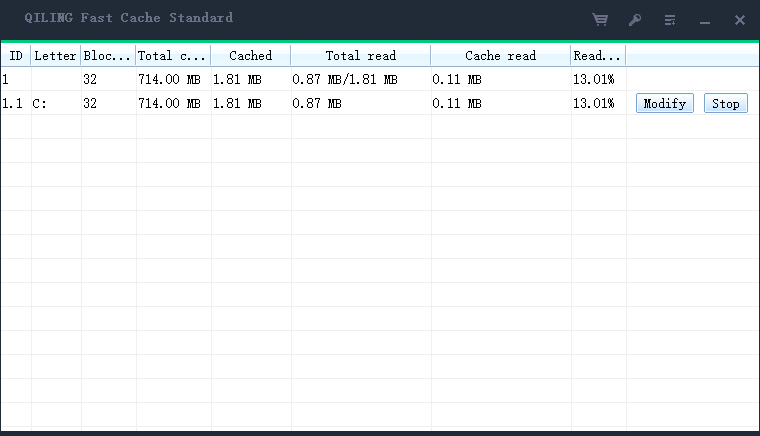
You do not need separate tools for the first check. Qiling Fast Cache shows the hit rate, cached data size, and read speed in its main window, so the same screen tells you whether the cache is working and whether it is touching the drive you care about.
What Actually Fixes Those Cases
- A failing or ageing drive - back up immediately, then replace the drive. Nothing else is worth doing first.
- One-off large operations - reduce the amount of data instead of accelerating it, using incremental backups, change-based syncing, and copying during idle hours.
- Processor-bound work - a faster CPU or GPU, or fewer background tasks. Storage changes will not move the needle.
- A memory shortage - add RAM. If the machine swaps constantly, that is the whole problem; see how to use extra RAM.
- A network bottleneck - move the data local, upgrade the network path, or accept that cloud storage is limited by your connection.
- A genuinely slow drive with repeated access - an SSD is the real answer, and caching is the cheaper stopgap. Compare them in cache a slow drive or buy a bigger SSD.
When a Cache Is Still Worth It
If your workload matches any of these, a cache is one of the cheapest improvements available:
- A mechanical system drive in daily use. Boot, application launch, and file access repeat constantly, which is exactly what a cache handles best.
- Game and media libraries on a secondary hard drive. The same assets are read every session.
- Virtual machine images. A VM re-reads blocks of the same disk file throughout the day.
- An old laptop with a mechanical drive. See how to speed up an old laptop with a disk cache for the sizing rules when memory is tight.
- Anything you would describe as the same files, again. If that sentence fits, a cache will help.
FAQs About Caching Limits
Why is my cache hit rate so low?
Because the data is not being read twice. A low hit rate is rarely a misconfiguration - it is the workload telling you that caching does not apply to it.
Will a cache help if my drive is already an SSD?
Rarely for that drive, since the SSD is already fast. It can still help a secondary mechanical drive, or act as a RAM tier in front of a slower SATA SSD.
Should I buy a bigger cache or a bigger SSD?
If the workload repeats and the cache is simply too small, a larger cache helps. If the workload is one-off or the drive is failing, an SSD is the better spend. Compare both in cache a slow drive or buy a bigger SSD.
Can a cache make my PC slower?
It can, in three ways: it consumes memory that applications needed, a too-small cache thrashes without raising the hit rate, and a badly configured write cache risks data loss on power failure.
How long should I wait before judging the cache?
Give it several days of normal use. A cache needs repeated access to fill, so a single session is not a fair test.
Back Up Windows Before You Change Settings
Changing cache settings is safe, but if you move on to an SSD upgrade or storage changes, a backup protects your system. Qiling Disk Master creates a full Windows image you can restore from if anything goes wrong.
Part 1: Create a Full System Backup
Step 1. Install and open Qiling Disk Master. On the home screen, open "Backup and Recovery" and choose "System Backup". This option automatically includes Windows and the hidden boot partitions, so you do not have to select them one by one.
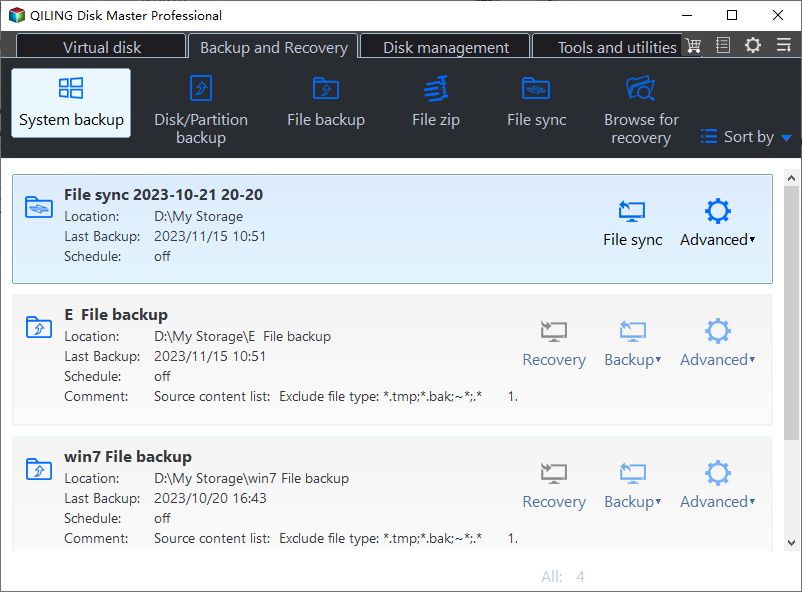
Step 2. Check the source. The disk where Windows is installed and its system partitions are already ticked for you. If you only need your personal documents, run a separate "File Backup" task instead.

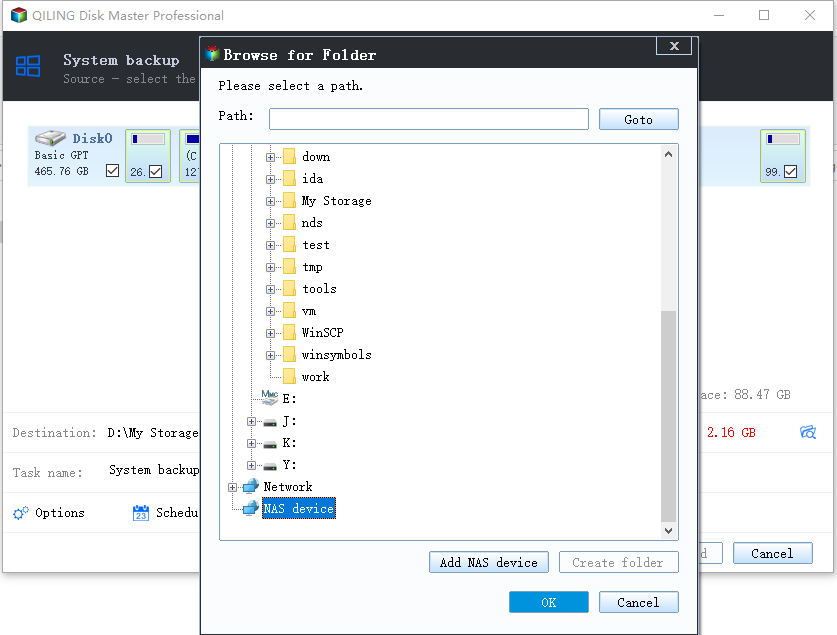
Step 3. Click the destination box and choose where the image should be saved. Use an external HDD or SSD, a NAS, or any drive other than the one Windows is installed on, and make sure it has enough free space.
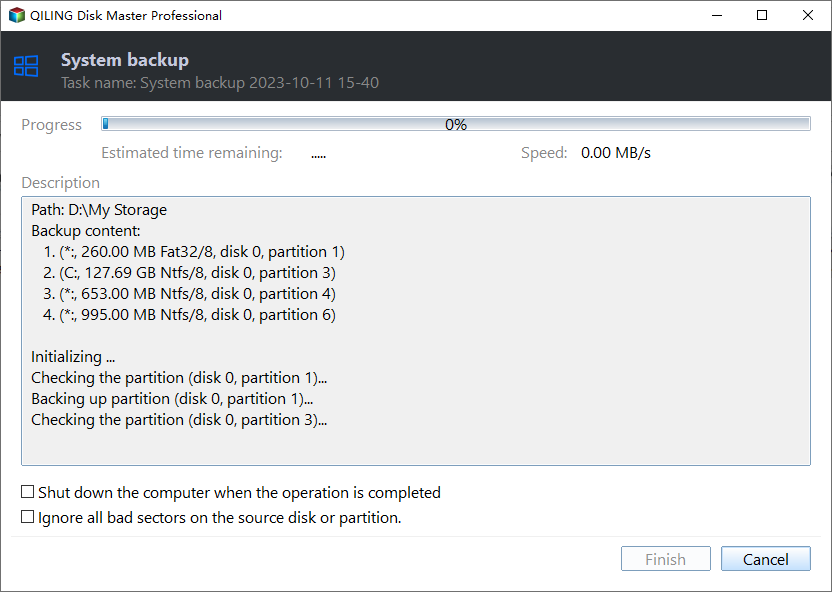
Step 4. Review the task summary and click "Proceed". Wait until the progress bar reaches 100%. Do not unplug the drive or turn off the PC while the backup is running.
Part 2: Restore Windows from the Backup
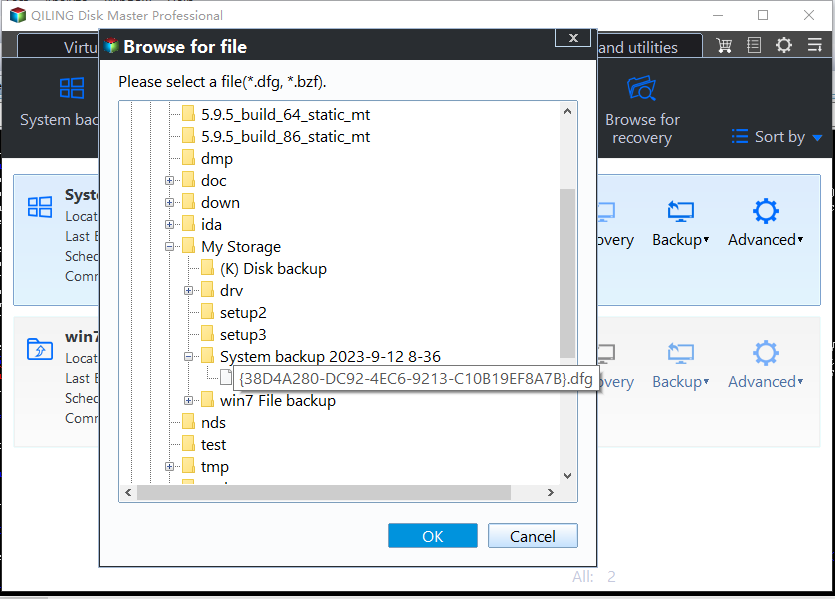
Step 1. Open Qiling Disk Master again, go to "Backup and Recovery", and select the recovery option. Your backup images are listed, so pick the one you created before the changes began.
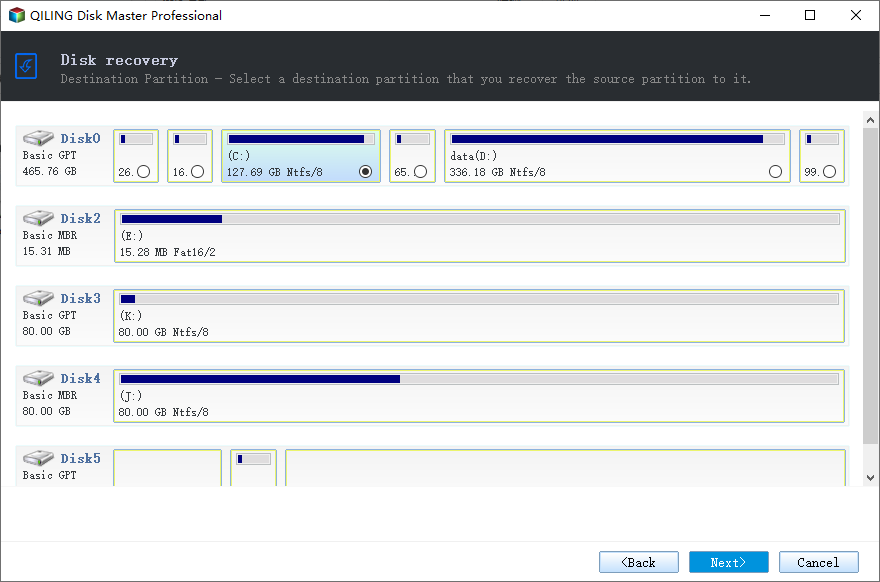
Step 2. Choose the target disk or partition. Normally you restore to the original system disk. If the drive was replaced, select the new disk instead, and the restore rebuilds Windows together with its boot partitions.
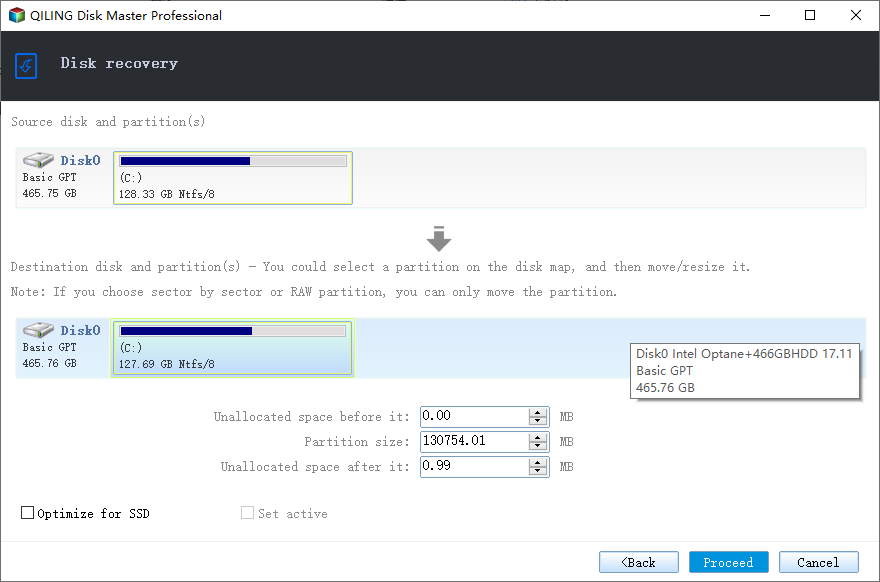
Step 3. Preview the restore plan, click "Proceed", and confirm the warning. The PC restarts to finish the job, and Windows comes back exactly as it was on the day the image was created, with your files and programs intact.
- Note
- Keep the backup image on a separate drive, and refresh it before changing storage cache settings.
Conclusion
A disk cache is a narrow, effective tool: it removes repeated reads from a slow drive. That makes it superb for booting, launching the same applications, reopening the same projects, and streaming the same media libraries. It is close to useless for one-off copies, freshly created data, processor-bound work, a memory shortage, a network bottleneck, and a drive that is failing. If you measure a low hit rate, believe it - the workload does not repeat, and no amount of tuning will change that. Look instead at an SSD, more memory, or the real bottleneck, and keep the cache for the drives where data is genuinely reused.
Protect your PC with Qiling Backup—create a system image before your next round of settings changes.
For more Windows 11 performance guides, see How to Check Cache Hit Rate, How Big Should Your Disk Cache Be?, Cache a Slow Drive or Buy a Bigger SSD?, How to Use Extra RAM to Speed Up Your PC, and Windows 11 Fast Cache.
Related Articles
- What Is Cache Warm-Up? Why the First Run Is Slow and How to Fix It
Explains why early results look disappointing even when the cache is working correctly. - How to Speed Up an Old Laptop with a Disk Cache
- SSD Cache vs Storage Spaces Tiering: Which Is Better?
- Cache vs Buffer: What's the Difference and Why It Matters
- Speed Up Databases with a RAM Disk and Disk Cache
- Can a Disk Cache Hide a Failing Drive?
Products
Articles & Tutorials
- Data Recovery
- Data Backup
- File Recovery
- File Backup
- System Backup and Restore
- Disk and Partition Clone
- Technical articles
- Mobile articles
- Disk Master Help
- Windows Data Recovery Tutorials
- Windows Secure Delete Tutorials
- Windows Partition Management Tutorials
- Windows File Backup and Restore Tutorials
- Windows System Backup and Restore Tutorials
- Windows Disk Backup and Restore Tutorials
- Windows Clone Tutorials