Move Office/Outlook or Other Programs to New HDD/SSD
How to move Office/Outlook or other programs to new HDD/SSD?
To free up space on your primary drive and improve computer performance, you can move installed programs, such as Office or Outlook, to a new HDD or SSD. This process is called "disk space optimization." To do this, follow these steps:
If you're planning to move files and installation data to a new HDD/SSD, some office files like Word, Excel, or PowerPoint may work, but applications like Outlook may not boot properly due to improper installation. To thoroughly move installation files of Office/Outlook or other apps to the new HDD/SSD without reinstallation, you can use Qiling Disk Master, a professional program transfer software that makes the process simple and easy.
Solution: move Office/Outlook or other programs to new HDD/SSD with program transfer software
Qiling Disk Master allows users to transfer files, programs, and installed applications from one computer to another via internet or image, without the need for reinstallation.
The software is fully compatible with all Windows systems and can be downloaded directly or found online. It allows users to optimize their computer by moving programs such as Office, Outlook, and PC game files to a new HDD/SSD, freeing up space on their system.
Qiling Disk Master
- Transfer Office 2003/2007/2010/2013/2016/365 and find key.
- To transfer the Office suite from one PC to another PC or laptop, you can use various methods depending on the network connection and the operating system. One way is to use the LAN (Local Area Network) connection, where you can simply copy the Office installation files from the source PC to the destination PC.
- Move Office from C drive to a local/external drive, no boot error.
Move Office/Outlook or other programs to new HDD/SSD
After downloading and installing Qiling Disk Master on your computer, you'll need to purchase a serial key to activate it, and then you can transfer as much data as needed to a new HDD/SSD.
Step 1. Connect new SSD or HDD to your PC and Run Qiling Disk Master
1. Connect the new SSD or HDD to your computer and initialize it to make the drive accessible. The computer will automatically detect the new drive, and you may be prompted to initialize it through the BIOS or UEFI settings.
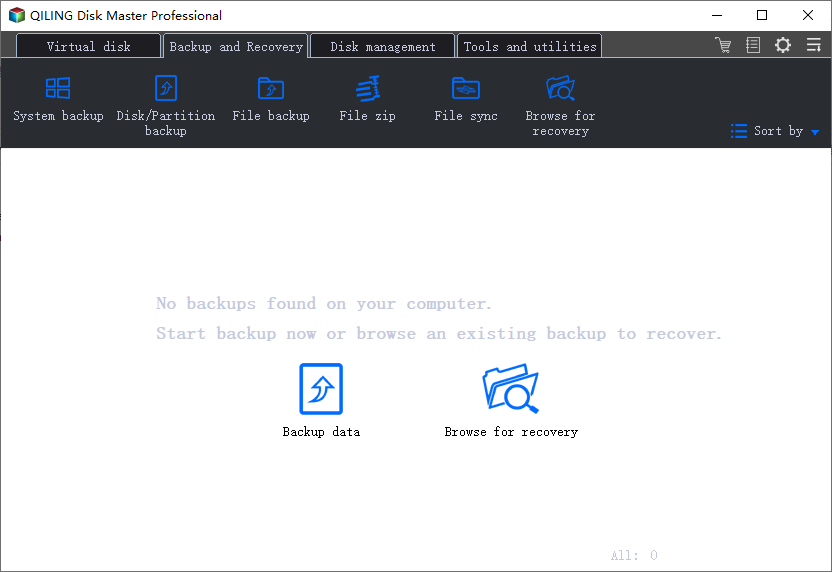
2. On the main screen of Qiling Disk Master, click "Backup and recovery" and then click "File sync" to proceed.
Step 2. Select apps, programs on the source disk and select SSD or HDD as target disk to transfer
1. On the source partition where you installed apps, select the desired programs (marked as "Yes") that you'd like to transfer to your SSD or HDD.
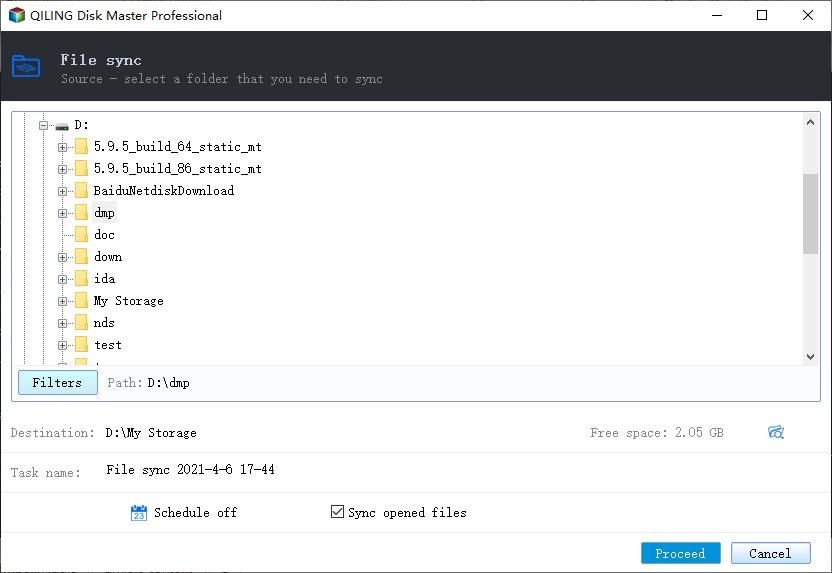
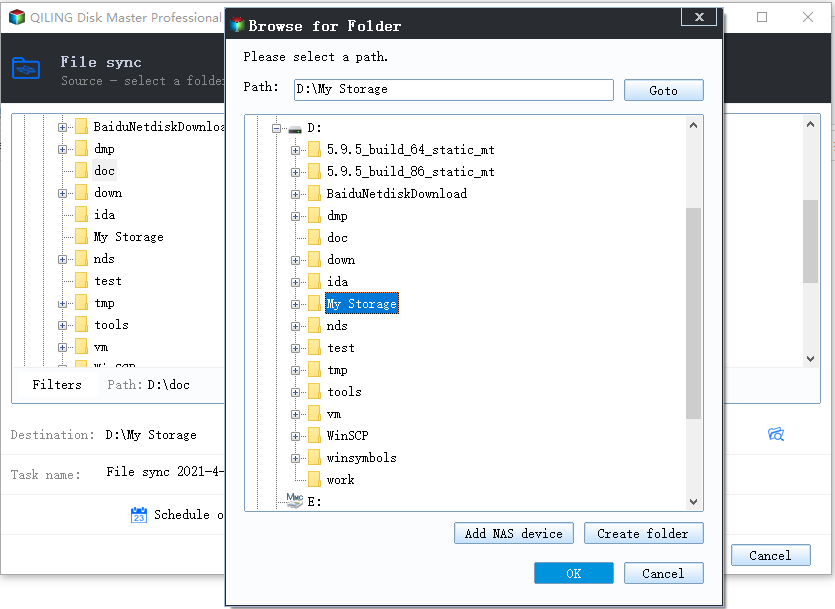
2. Select the new SSD or HDD as the destination by clicking the browse icon, then click "Proceed" to move the selected programs.
Step 3. Wait for the transferring process to finish
When the process finishes, click "OK" to complete.
Then you can restart your PC to keep all the changes and you can run the transferred program on your new SSD or HDD again.
Don't worry about the booting issues after the move, as all installation files will be moved together with the software or application you're trying to move, allowing you to launch Outlook or reuse your Office after following the above steps.
Related Articles
- Look! 5 Ways to Clean Up Junk Files in Windows 10
- Move Microsoft Store Apps and Games to Another Drive
- How to Network and File Sharing Between Windows 7 and Windows 10/11 in 2022
- Does Windows 11 have Easy Transfer?
- How to Create A System Restore Point Windows 10/8/7 for Disaster Recovery (One Way to Make It)
Learn how to create a system restore point in Windows 10, 8, or 7 so you can roll back system changes after errors or failed updates. - 2 Available Ways | How to Create an ISO Image from your Operating System
You're probably wondering what an ISO image is and how to create one from your operating system. This article will guide you through two ways to make an ISO image of your Windows computer, allowing you to check and find out how to do it.
Products
Articles & Tutorials
- Data Recovery
- Data Backup
- File Recovery
- File Backup
- System Backup and Restore
- Disk and Partition Clone
- Technical articles
- Mobile articles
- Disk Master Help
- Windows Data Recovery Tutorials
- Windows Secure Delete Tutorials
- Windows Partition Management Tutorials
- Windows File Backup and Restore Tutorials
- Windows System Backup and Restore Tutorials
- Windows Disk Backup and Restore Tutorials
- Windows Clone Tutorials