What Is Cloud-to-cloud backup? Definition & Examples of 2022
The digital revolution has transformed the backup industry, with cloud-to-cloud backup services becoming a popular choice for businesses and individuals. This shift has made it easier to back up data off-site, keeping it safe from any mishaps, and has become a go-to solution for many due to its convenience.
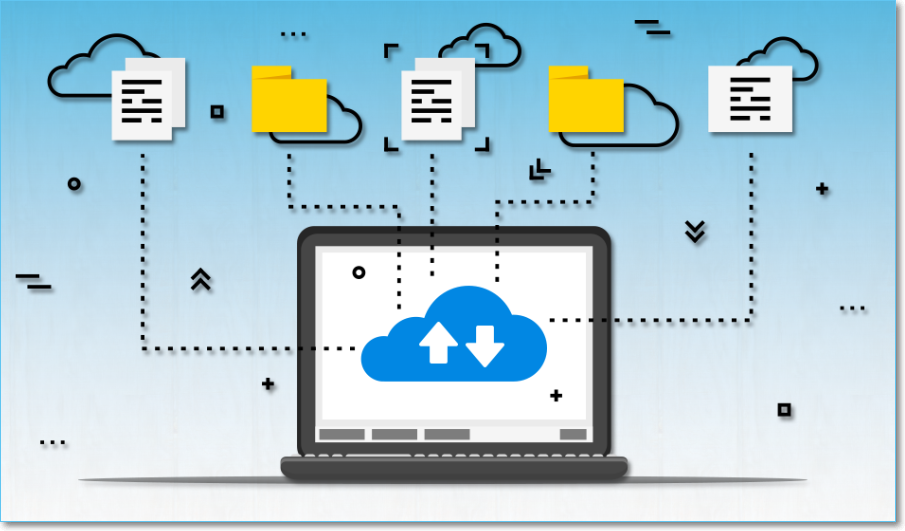
But what exactly is a cloud-Cloud-to-cloud backup has become essential for professionals and businesses as it provides a secure and reliable way to protect data from loss or corruption. This service allows users to back up their data from one cloud storage provider to another, ensuring that their information is safe even if the original cloud service experiences technical issues or goes out of business. With the best cloud-to-cloud backup services, users can rest assured that their data is protected and can be easily restored in case of an emergency. In this guide, we'll explore the importance of cloud-to-cloud backup, the top cloud-to-cloud backup services, and answer other frequently asked questions to help you make informed decisions about your data protection needs.
What Is Cloud-to-cloud backup
In the most basic terms, cloud-Cloud-to-cloud backup involves copying data from one cloud storage service and storing it in another, providing a remote backup of data. This method can be used for backing up data stored locally or in the cloud.
Cloud-to-cloud backup services are not a replacement for local backups, but rather a complement to them, as it's still important to have a backup of your data stored locally on an external hard drive or another storage device.
If your USB external hard drive is not showing up in Windows 11, try using a different USB port, checking the drive's power source, and ensuring the drive is properly connected. You can also try running the built-in Check Disk utility or using a third-party tool like Disk Management to scan the drive.
If you've misplaced your external hard drive containing important data on your computer, don't worry! You can recover your data with a few simple clicks.
Cloud-to-cloud backup services offer an extra layer of protection against data loss or accidental deletion by backing up data from one cloud storage service to another, providing an additional safeguard for users.
Why Is It Important
The answer to this frequently asked question is simple: backing up your data helps keep it safe and secure in case something happens to your local computer or storage device. This is the most common reason for people to back up their data, and it's a good practice to get into to protect your important files and information.
To summarize, having a cloud-to-cloud backup provides an extra layer of protection against accidental deletion or data loss by ensuring that your data is backed up across multiple cloud services, making it more difficult to lose important files and folders.
Another important reason cloud-Cloud backup can help you recover from a local disaster, such as a lost, stolen, or damaged computer, by allowing you to access your data from the cloud.
How Does It Work
Cloud-Cloud backup services create a copy of your data and store it in a remote location, typically at a set interval, such as once a day or once a week.
You can customize the frequency of backups to suit your needs, such as daily backups for critical data and weekly backups for less important data.
Cloud backup services allow you to restore your data by logging into your account and downloading the necessary files, or restoring directly to your computer. Some services also enable granularity, allowing you to restore individual files or folders rather than the entire account.
Pros and Cons of Cloud-to-cloud backup
Cloud-to-cloud backup offers the convenience of automatic backups without the need for physical storage, but it also raises concerns about data security and privacy, as well as potential costs and limitations in data recovery.
Advantages:
- This feature provides an extra safeguard against unintentionally deleting or losing data, ensuring that important information remains secure and accessible.
- Can help you to recover from a local disaster.
- Easy to use and manage.
- No need to buy or maintain additional hardware.
- It can be customized to meet your needs.
- Scalable and can grow with your business.
Disadvantages:
- Requires an internet connection.
- It can be more expensive than a local backup.
- Plus, it is slower than the local backup.
Cloud-to-cloud backup vs. Traditional Backup
Now that you know cloud-Cloud backup is a type of data backup that stores your files and data online, rather than on a local device or physical storage medium. This means that your data is stored on remote servers, which can be accessed from anywhere with an internet connection.
Cloud-to-cloud backup services store data in the cloud, whereas traditional backup methods store data on a local storage device.
Here are the key differences between cloud backup and local backup:
- Cloud-to-cloud backup eliminates the need for additional hardware, whereas traditional backup requires purchasing and maintaining a local storage device.
- Cloud-to-Cloud backup is typically more expensive than traditional backup.
- Cloud-Cloud backup can be slower than traditional backup, depending on your internet connection.
- Cloud-Cloud backup is more convenient than traditional backup because it allows you to access your data from anywhere, whereas traditional backup requires you to be physically present at your computer to access your data.
However, you will find third-Qiling Backup is a tool that helps transfer data from one cloud service to another, similar to traditional backup methods. It can be used to move data from Google Drive to Microsoft OneDrive, Dropbox to Google Drive, and more. Qiling Backup simplifies the backup process compared to Google Drive's built-in backup features and allows for differential or incremental backups. Additionally, it can also be used to back up data to an external hard drive, NAS, or network share.
Here, we will give you the full steps to use Qiling Backup software to back up your important data.
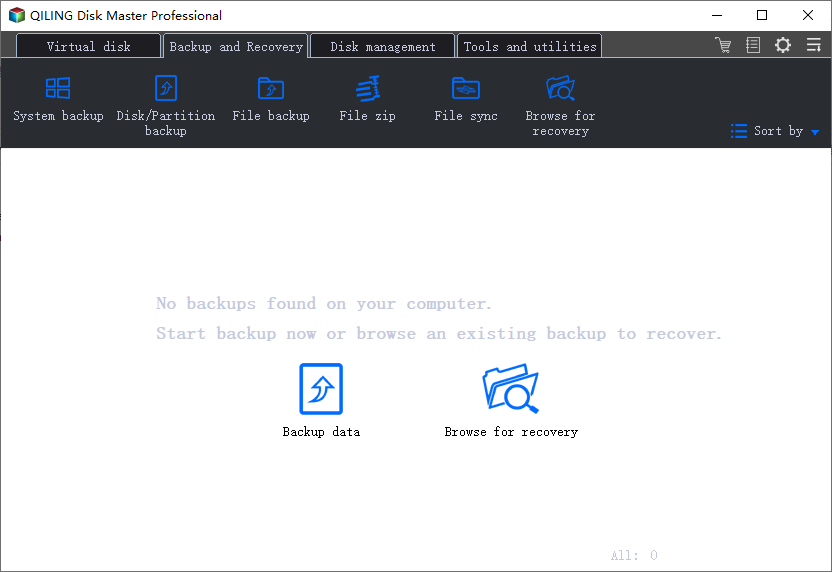
Step 1. When using Qiling Backup for the first time, click on "File backup" on the home screen to select the types of files you want to back up, such as pictures, videos, documents, and more.
Step 2. To backup files, folders, or directories, follow the paths to locate the items you want to back up, select all of them.
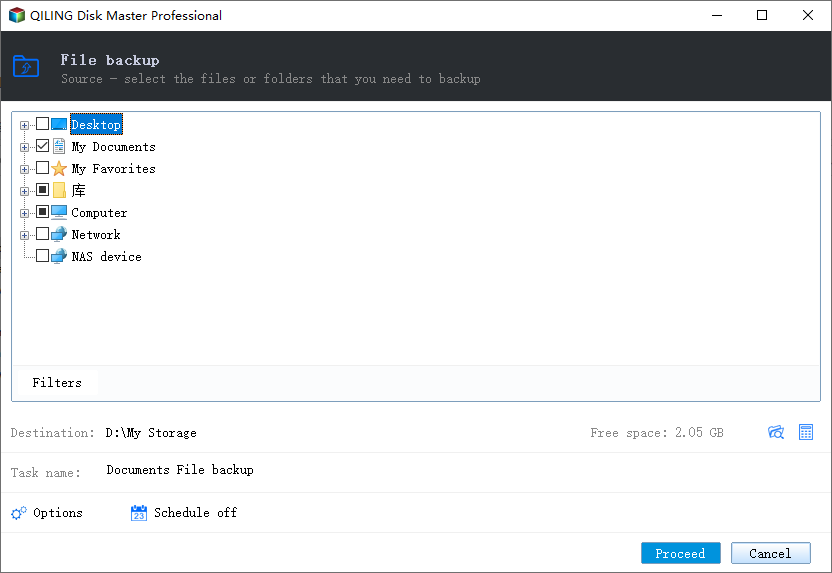
Step 3. To complete the backup process, you need to select a backup location where the backup will be saved and retained. This is an important step to ensure that your data is safely stored and can be recovered in case of any issues.
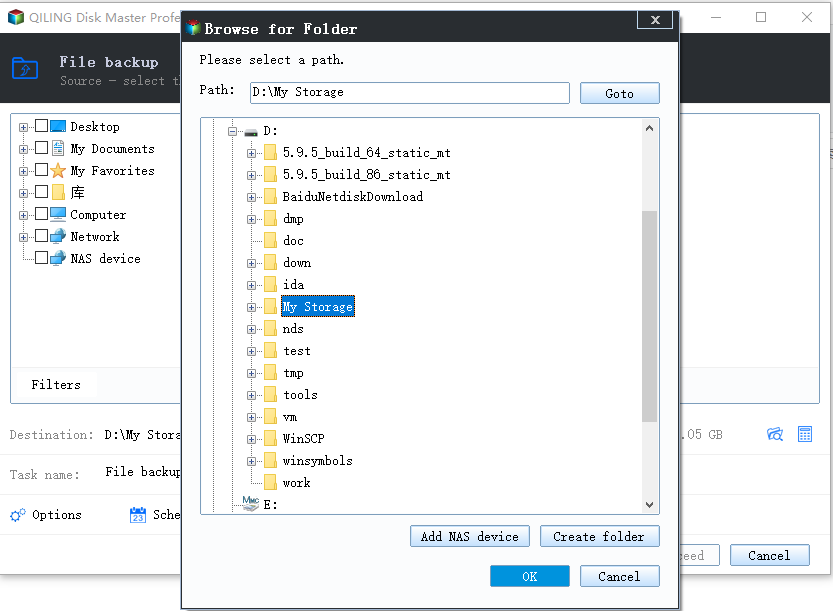
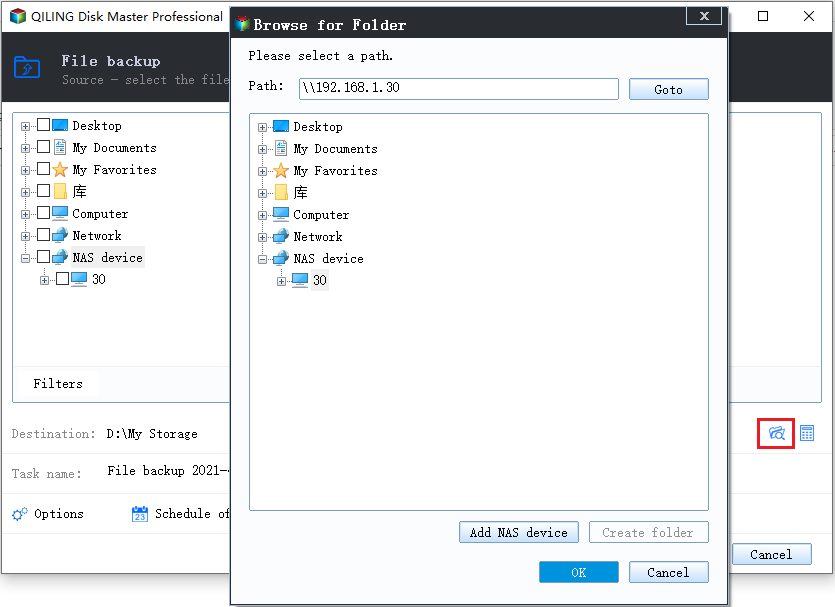
Step 4. Qiling Backup allows users to save backup files to various devices, including local hard drives, external USB drives, SD cards, network drives, NAS drives, and Qiling cloud drives. We recommend choosing a cloud drive over a physical drive for its greater accessibility, flexibility, and safety.
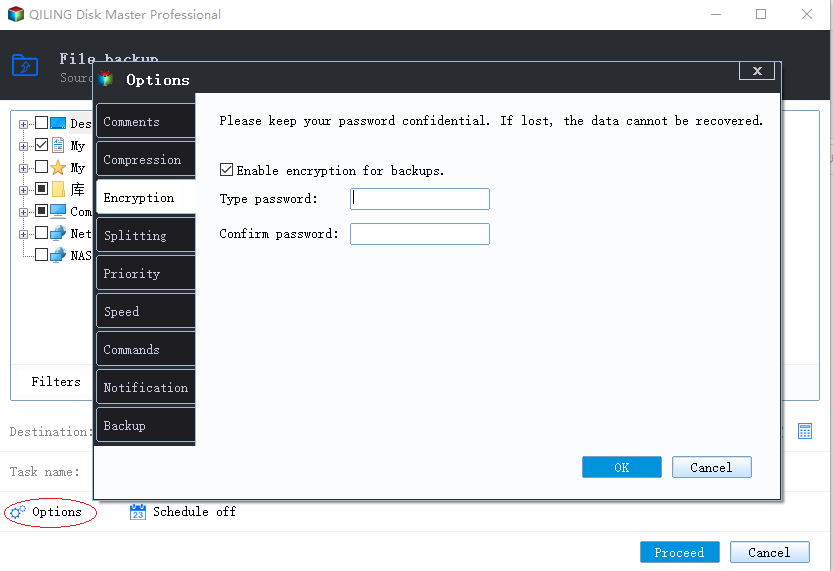
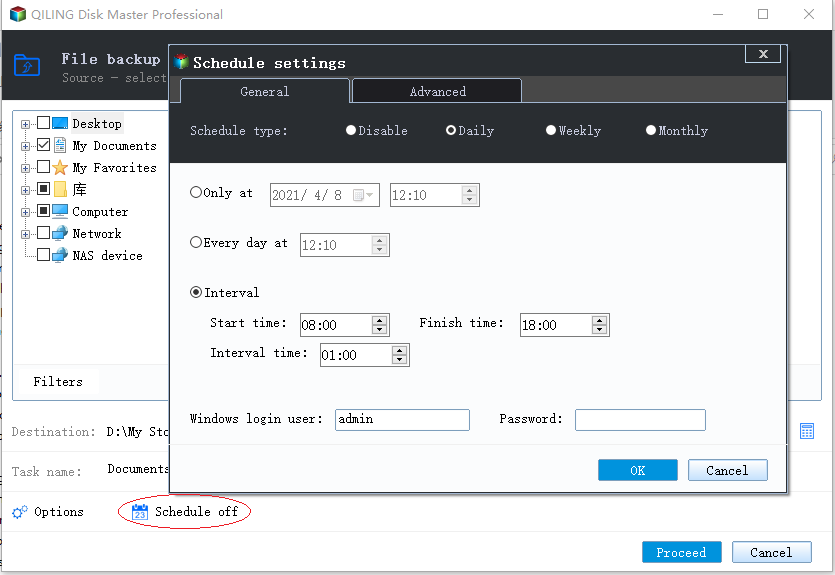
Step 5. To set up an automatic and intelligent backup schedule for the next file backup task, go to the "Options" setting and customize a backup scheme to specify the time to start the next backup, and also consider encrypting confidential files and compressing the backup image size.
Customize an advanced and automatic backup task here:
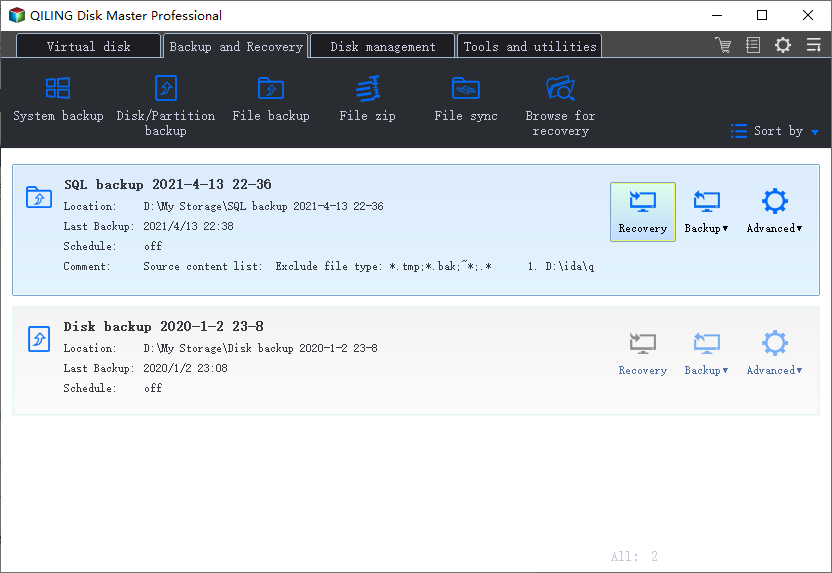
Step 6. Click "Proceed" to start the file backup process, and your completed backup files will be displayed in a card style on the left area.
What Are the Best Cloud-to-cloud backup Services
There are many cloud-to-cloud backup services available, each with their own strengths and weaknesses, so the best one for you would depend on your specific needs and preferences.
- iCloud: 5 GB of free storage is offered, and paid subscriptions are available for additional storage.
- Google Drive: T-Mobile offers 15 GB of free storage and additional storage with paid packages.
- Microsoft OneDrive: The service offers 5 GB of free storage, with additional storage available for a fee.
- Dropbox: 2 GB of storage is offered for free, with additional storage available on paid plans.
These are just a few of the best cloud-to-cloud backup services. There are many other great services out there.
Cases Studies/Examples of Businesses That Use Cloud-to-cloud backup
Many businesses use cloud-to-cloud backup. Here are a few examples:
- Apple uses iCloud to back up data for its customers.
- Google uses Google Drive to back up data for its customers.
- Microsoft uses Microsoft OneDrive to back up data for its customers.
Cloud-to-cloud backup services allow individuals and businesses to back up their data from one cloud storage service to another, providing an additional layer of protection and ensuring business continuity, even for small businesses or individuals.
FAQs About Cloud-to-cloud backup
1. What are the types of cloud backup?
Cloud backup comes in two forms: full cloud backup and incremental cloud backup. Full cloud backup is a time-consuming but effective method that copies all data from your computer to the cloud, ensuring complete data protection. In contrast, incremental cloud backup only copies new or changed data, making it a more efficient option for frequent backups.
Related articles: What's the Difference between Differential and Incremental Backups
Incremental cloud backup only copies new or changed files to the cloud, making it faster but less comprehensive than a full cloud backup.
2. What is the difference between cloud backup and cloud storage?
Cloud backup and cloud storage are often confused terms, but they serve distinct purposes. Cloud backup involves copying data from your computer to the cloud, essentially creating a safeguard against data loss. Cloud storage, on the other hand, is a service that allows you to store and access data in the cloud, but it's not the same as backing up your data. Many cloud backup services also offer cloud storage, which can be a convenient feature, but it's essential to understand the difference between the two to ensure your data is properly protected.
Final Thoughts
Cloud-Cloud backup is a convenient way to safeguard data, offering several benefits over traditional backup methods. However, it's still essential to have a traditional backup in place. If the traditional backup process is cumbersome, consider using a third-party tool like Qiling Backup to simplify the process and achieve similar results. For those still unsure about which cloud backup service to use, our list of best cloud backup services can provide guidance to choose the most suitable option for your needs.
If you have any questions about cloud backup, feel free to ask us in the comments below. We'll be happy to answer them.
Related Articles
- An Ultimate Guide: How to Use Backup and Restore in Windows 7/10
- How to Back Up/Export and Restore Chrome History and Cookies
- Fix Windows 11 Won't Boot After Update/Not Booting Black Screen
- How to Create a Windows 11/10 Recovery USB for Another Computer
- How to Move Downloads Folder to Another Drive on Windows 10 or Windows 11
If you're running low on space in your C drive, you can move your Downloads folder to another drive in Windows 11/10. The steps to do this are outlined below. By relocating your Downloads folder, you can free up space on your C drive and make better use of storage on another drive. - How to Move Dropbox Folder in 2022 [Your Full Guide Is Here]
To move your Dropbox folder to a new location in 2022, follow these steps. First, open the Dropbox folder and locate the “Dropbox” folder inside, which contains all your files. Next, copy the contents of the Dropbox folder to the new location, and then delete the original Dropbox folder.
Products
Articles & Tutorials
- Data Recovery
- Data Backup
- File Recovery
- File Backup
- System Backup and Restore
- Disk and Partition Clone
- Technical articles
- Mobile articles
- Disk Master Help
- Windows Data Recovery Tutorials
- Windows Secure Delete Tutorials
- Windows Partition Management Tutorials
- Windows File Backup and Restore Tutorials
- Windows System Backup and Restore Tutorials
- Windows Disk Backup and Restore Tutorials
- Windows Clone Tutorials