Hard Drive Partition Not Responding in Windows 10/8/7
If a hard drive partition in Windows 10 fails to respond when trying to open it for storing new data, or if you can't access a partition on the hard drive, or if one of the hard disk partitions is not opening, The issue can be resolved. The partition should show up on the computer, but if it's not opening, there are easy and reliable solutions to fix the problem.
Method 1. Fix No Partitions on Hard Drive by Checking and Repairing File System
The "Can't access partition on hard drive or the local disk not responding" issue is likely caused by file system corruption or bad sectors, leading to reading and writing issues. You can try using Qiling Partition Master Free, a free partition manager, to check and repair the damaged file system.
This free disk management tool offers a range of features for partition management, including resizing or moving partitions to address low disk space issues, merging partitions, cloning disks, creating, deleting, or formatting partitions, wiping data, and converting disks or partitions, all of which are available for free.
Now, follow the tutorial below to easily fix the file system to resolve hard drive partition not showing or responding issues.
Method 2. 3 Ways to Delete and Create a Partition to Fix Hard Drive Partition Not Responding
If file system repair doesn't work, you can try deleting the problematic partition and creating a new one, but first, export and back up the files on it to avoid losing any data.
How to Recover Data from Not Responding Hard Drive Partition
To recover files from a not responding or opening partition, use Deep Data Recovery to help you do it easily. This process involves just a few clicks and three steps, allowing you to scan the hard drive and export files intact.
Qiling data recovery software is a world-renowned tool for recovering data from corrupted hard drives, and is also capable of recovering data from formatted drives, RAW recovery, lost partition recovery, OS crash recovery, and virus attack recovery.
Step 1: Launch Deep Data Recovery and select file types that you want to recover. Click the "Fast Scan" button to continue.
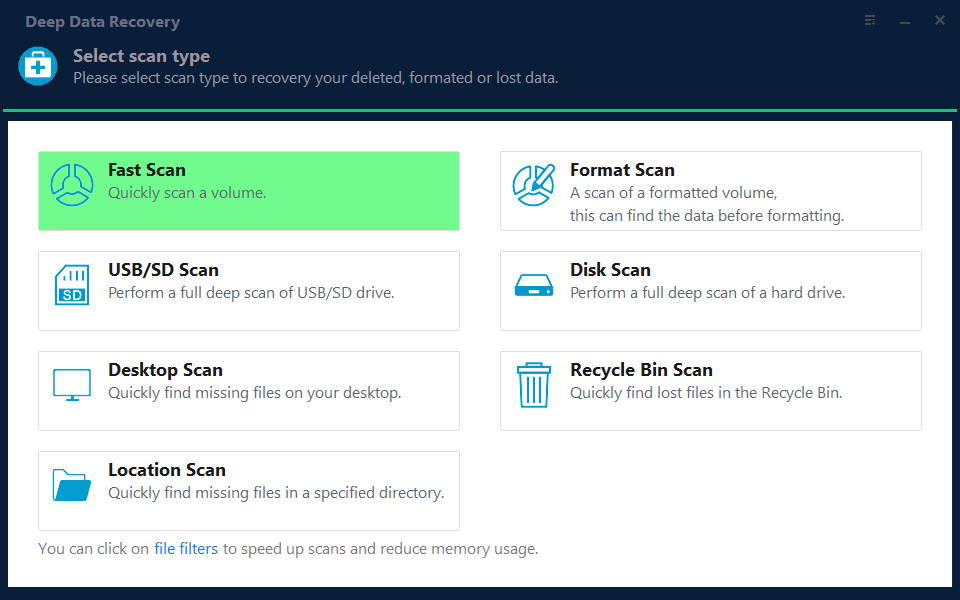
Note: You can choose different search modes based on where and why the data was lost.
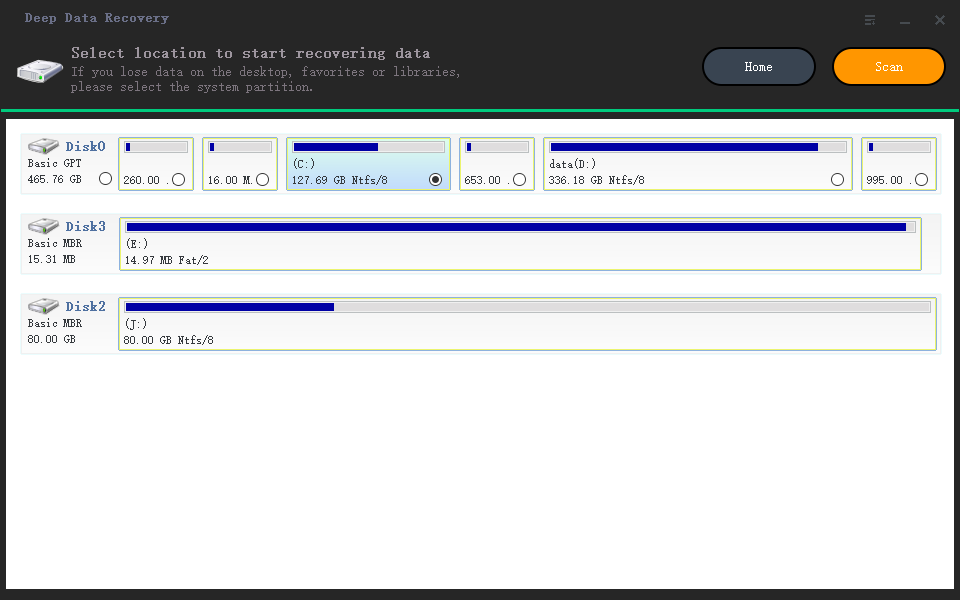
Step 2.To recover lost data, select the drive where the data was lost and click "Scan" to begin the scanning process.
Step 3.When the scan completes, use the "Filter" or "Search" feature to find the lost files. This will help you locate the files you're looking for among the recovered data.
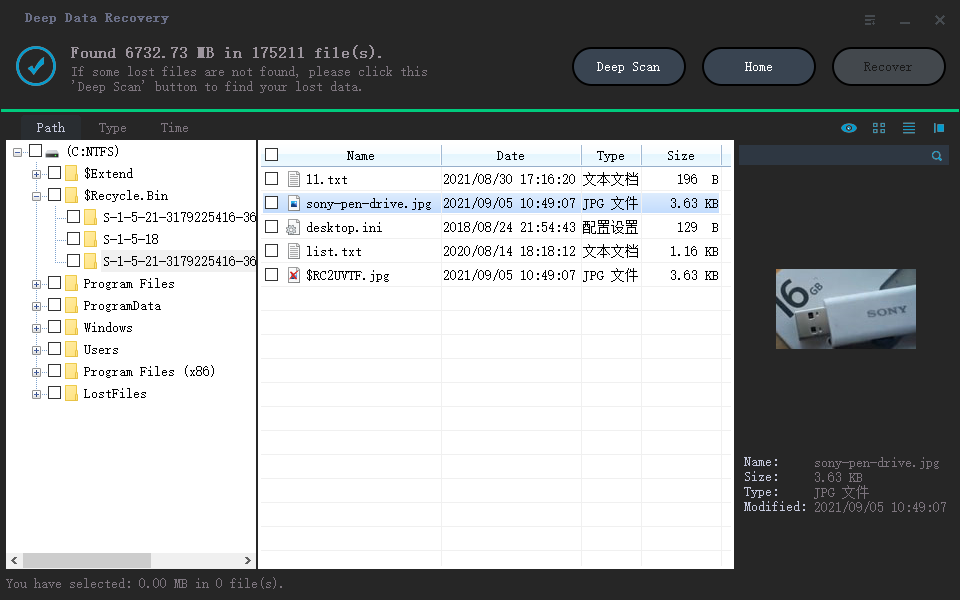
Step 4.Select the files you want to recover and click "Recover". Then, save them to a secure location.
After recovering data, you can proceed with deleting and creating a partition to troubleshoot further.
1. Delete and Create Partition with Free Partition Management Tool
To delete and create a partition on a not responding hard drive, you can use Qiling Partition Master. Install and open the software, select the problematic hard drive, right-click it, and choose the Delete option to remove the partition. This should resolve the issue.
To free up space on your C drive, you can delete any unnecessary partitions or files, and then create a new partition with the freed space. This can be achieved using Qiling Partition Master, which allows you to extend your C drive and resolve space issues.
Step 1.Launch Qiling Partition Master, click on the unallocated space on your hard drive or external storage device, and select "Create" from the main window.
Step 2.Adjust the partition size, file system (selecting one based on your specific needs), and label for the new partition, then click "Proceed" to create it.
Watch the following video tutorial to learn how to create a partition in NTFS, FAT, or EXT file system.
2. Delete and Create Partition Using CMD
If your hard drive partition cannot be detected or fails to show up in PC, your first step is to force it to show up with CMD. To do this, follow these steps:
- Open Command Prompt > Type: diskpartand hit "Enter".
- Type: list diskin DISKPART and hit Enter;
- Select the disk you want to repair and hit Enter. The disk number is usually 0.
- Type: cleanand hit "Enter".
- Type: create partitions primary and hit "Enter".
- When a window pops up asking if you want to format it now, click on Cancel.
- Type: exitand hit "Enter".
3 . Delete and Create a New Partition with Disk Management
Now you may directly delete the not responding partition and recreate a new partition to store data again.
- Open Device Manager > Click "Disk Management".
- Right-After fixing the hard disk partition issue, select the partition you've just repaired and click on "Delete Volume" to remove it.
- Click "Yes" > Right-click on it again and select New Simple Volume.
- The user is asked to specify the size of their hard disk, and then click Next.
- Rename your hard disk and click "Next".
- Click Next > Finish.
Now that you've successfully repaired the not responding hard drive partition in Windows 10/8/7, you can restore your saved data back into the newly created partition.
FAQs About No Partitions on Hard Drive
If your hard drive partition isn't responding or showing up, ! We'vethis guide can help.
How do I fix a missing hard drive partition?
If your hard disk is not showing up for a different reason, there are several approaches you can take to fix the issue.
- Unhide the hidden partition in Windows 10
- Create partitions and assign a drive letter
- Reformat partition to fix no partitions on hard drive
- Update device drivers using the device manager
Is partitioning hard drive necessary?
Partitioning a hard drive allows you to divide a single hard disk into multiple independent drive partitions, helping to organize your data and making it easier to manage your hard disk when backing up and restoring files. By saving files on different partitions, you can reduce the risk of data loss in case of a system failure or other issues.
If you plan to run different operating systems on your computer, having separate drive partitions is necessary, as each OS requires its own partition, and it's also a good idea to use separate partitions for storing files for each OS.
What do no partitions mean?
For a new disk that has never been used before, there may only be unallocated space, allowing you to see any partition. To resolve the issue of no partitions on a hard drive, you can try creating partitions and assigning drive letters to fix the problem.
How can I see all partitions on my hard drive?
To view your hard disk partitions, you can check Disk Management on your computer. Right-click the Start button and select Disk Management, which will display all the partitions on your hard drive. Alternatively, you can also open File Explorer to see the existing partitions.
Related Articles
- How to Optimize Windows 11 for Gaming (6 Ways)
- Convert MBR to GPT Without Data Loss (Windows 11 Available)
- How to Install Operating System on SSD and Everything Else on HDD
- Check & Repair Hard Disk Partition Errors in Windows 10 for Free
- Does Formatting a Drive to exFAT Wipe It?
If you need to format your internal drive or external device to exFAT for some reason, you might wonder, 'Does formatting a drive to exFAT wipe it.' Here in this post, we explains the answer you are looking for. - Does SSD Slow Down Over Time, How to Optimize It
Does SSD slow down over time? This post will answer your question and provide effortless methods to optimize and speed up your SSD.
Products
Articles & Tutorials
- Data Recovery
- Data Backup
- File Recovery
- File Backup
- System Backup and Restore
- Disk and Partition Clone
- Technical articles
- Mobile articles
- Disk Master Help
- Windows Data Recovery Tutorials
- Windows Secure Delete Tutorials
- Windows Partition Management Tutorials
- Windows File Backup and Restore Tutorials
- Windows System Backup and Restore Tutorials
- Windows Disk Backup and Restore Tutorials
- Windows Clone Tutorials