How to Transfer Space from One Drive to Another in Windows 11/10/8/7
When dealing with low disk space on a partition, it's frustrating to have plenty of free space on other partitions. Fortunately, it's possible to transfer unused space from one drive to another, effectively enlarging the partition space in Windows 11/10/8/7. This allows you to reclaim valuable storage space and breathe new life into your computer or laptop.
To transfer free space from one partition to another, open Disk Management by typing "diskmgmt.msc" in the Run dialog box (Windows key + R) or searching for it in the Start menu. Once open, right-click on the partition with free space you want to transfer and select "Shrink" to create unallocated space. Then, right-click on the partition where you want to transfer the free space and select "Extend" to add the unallocated space to that partition.
Part 1. How to Move Free Space from One Partition to AnotherThe Two Partitions are on the Same Disk
If the two partitions are on the same disk, it's easy to move free space from one partition to another. For example, to transfer D drive's free space to C drive, or move any partition's free space to another drive, you can follow these simple steps.
Qiling partition magic software has an "Allocate Space" feature that allows allocating unused space of a selected partition to another partition on the same disk.
After downloading the Qiling disk management tool, follow these steps to allocate free space to another drive. For example, if you want to allocate free space from D drive to C drive, you can use the tool to achieve this. Here's how: after launching the tool, select the D drive as the source disk, and then choose the C drive as the target disk.
Step 1. To free up space on your computer, click on the D: partition with enough free space and select "Resize/Move".
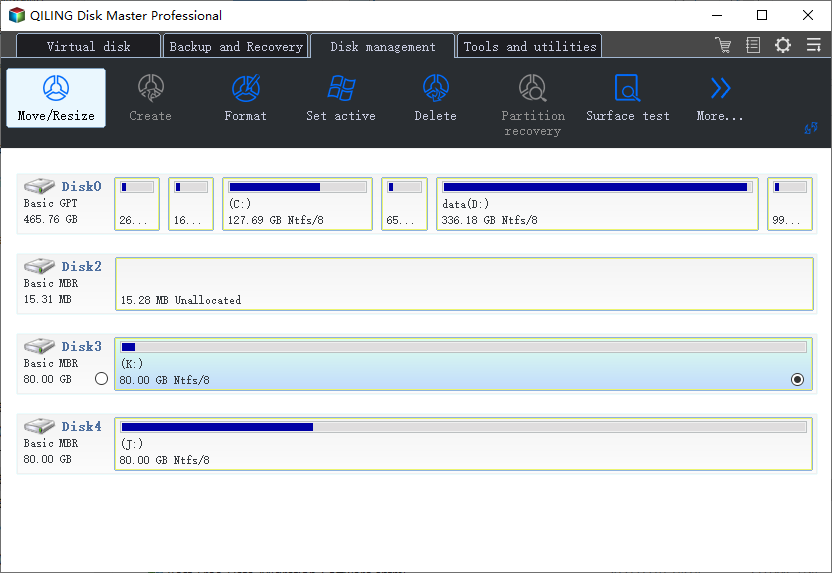
Step 2. To free up space, drag the D: partition to the right or left, reducing its size to create ample unallocated space. The "Partition size" area will display the reduced space. Click "Proceed" to confirm the changes.
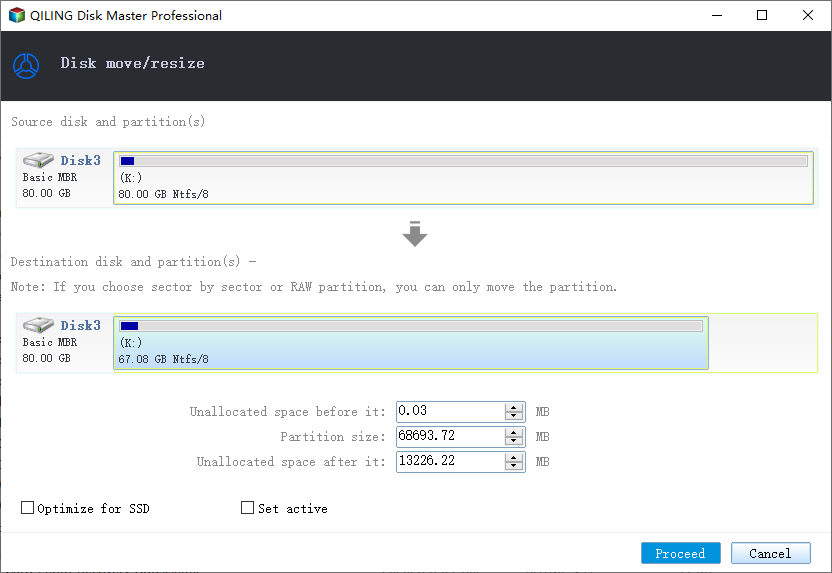
Step 3. Select the target partition, which is C: drive, and choose "Resize/Move". Then, drag the partition panel to the right to add free space from D: drive to C: drive, and click "Proceed" to start the process.
If you have unallocated space on your disk, you can move it to the desired hard drive by resizing partitions using Qiling Partition Master.
Part 2. How to Transfer Space from One Drive to AnotherThe Two Partitions are Not on the Same Disk
To transfer free space from one disk to another, you need to convert your basic disks to dynamic disks, then use partition manager software like Qiling to move the free space. This is necessary when the free space is on one disk and the partition you want to move it to is on a different disk.
To move space to another partition even they are on different hard disks, you can use the built-in disk management tool in Windows. First, open the Disk Management tool by searching for it in the Start menu.
- Tip
- Qiling Partition Master does not support expanding the C drive, system partition, or boot partition across different disks, but it does allow expanding data partitions across different disks.
Step 1. Convert Basic into Dynamic
- To merge one of the disks into a dynamic disk, click on the disk you want to merge (disk 0, disk 1 or disk 2), then choose the "Convert to Dynamic" option.
- Confirm the disk conversion from the Basic to Dynamic.
- To free up disk space on a Windows system, select the disk with the operating system and convert it to a dynamic disk, then delete the primary partition and extend the dynamic disk to fill the free space. Select the other disk (with lots of free space) and convert it to a dynamic disk in the same way.
- To merge free space from one dynamic disk to another, you can follow these steps. First, ensure that both disks are dynamic disks.
Step 2. Merge Two Disks into One Disk
Note: To successfully convert a basic disk to a dynamic disk, the other dynamic disk must be unallocated space. If it's not, you'll need to delete all partitions on it using Qiling Partition Master. Additionally, you cannot merge a system partition, even after conversion to dynamic.
- Select the full disk, right-click on it and choose "Resize/Move".
- To resize a partition, simply drag the partition panel to the right or left using your mouse, effectively increasing the partition size. This allows for a seamless expansion of the partition without requiring any complex commands or operations.
If you want to extend a partition and the unallocated space is on the left, you can simply drag the left partition handle to the desired size. This will effectively move the unallocated space to the right of the partition you want to extend.
- Click "Proceed" and you'll be able to merge space from one disk to the other.
ConclusionTo Sum Up This Post
You can transfer space from one partition to another in Windows 11,10, 8.1, 8, 7 using trustworthy steps. If you have unallocated space on your hard drive, you can turn to the Resize/Move feature in Qiling Partition Master, which offers a way to transfer space from one partition to another.
FAQsHow to Move Space from One Partition to Another
Here are some hot topics and answers. If you still have questions, you can read on and get additional help.
What is unallocated space and free space?
Unallocated space on a hard drive refers to unused space that may contain intact files, remnants of deleted data, or temporary files. It's the unpartitioned area on a device where data can potentially be stored. You can use tools like Qiling to extend a partition and utilize this unallocated space.
The free space on a partition is the amount of space available for use, calculated by subtracting the used space from the total space. For example, if a 200GB partition has 150GB used, the free space is 50GB. This represents the amount of space that can still be used without running out of storage.
How do I transfer space from D to C in Windows 11/10?
- 1. Download Qiling Partition Master.
- 2. Right-click on the D partition and select "Allocate Space" to allocate the free space.
- 3. Select the C drive, then drag the partition panel to the right to combine the space from the source partition with the target one.
- 4. Click the "Proceed" button.
Is it possible to transfer free storage space from one hard drive to another?
If you have turned your hard drives into dynamic disks, you can transfer free storage space from one hard drive to another.
Why my C drive is automatically filling up?
A full C drive can be caused by various factors such as malware, a bloated WinSxS folder, incorrect Hibernation settings, system corruption, system restore points, temporary files, and other hidden files. To resolve this issue, you can free up space on your C drive and take steps to increase its available space.
Related Articles
- How to Format WD Passport for Mac and PC (3 Ways)
- Format SanDisk SD Card|How to Format SanDisk SD Card on Windows 10 and Mac
- 5 Ways to Test Hard Drive Speed for Free
- [Solved] Preparing to Delete Takes Forever Windows 11/10, Windows 11/10/8/7 is Slow to Delete Files
- How to Format C Drive Using Command Prompt in Windows 11, 10, 8, 7?
Learn how to How to Format C Drive Using Command Prompt in Windows 11, 10, 8, 7?. This guide explains the causes, steps, and practical tips for format c drive command prompt, format c drive cmd, format c drive using command prompt on Windows with Qiling Disk Master. - How to Restore/Format USB to Full Capacity in Windows 10/8/7?
If your USB drive does not show full capacity, here you can know why and learn how to format it to full capacity in Windows 11/10/8/7 via 2 different methods.
Products
Articles & Tutorials
- Data Recovery
- Data Backup
- File Recovery
- File Backup
- System Backup and Restore
- Disk and Partition Clone
- Technical articles
- Mobile articles
- Disk Master Help
- Windows Data Recovery Tutorials
- Windows Secure Delete Tutorials
- Windows Partition Management Tutorials
- Windows File Backup and Restore Tutorials
- Windows System Backup and Restore Tutorials
- Windows Disk Backup and Restore Tutorials
- Windows Clone Tutorials