Free Toshiba HDD Recovery: Perform Toshiba Hard Drive Recovery for Free
Toshiba Hard Drive Recovery Overview - What Is Toshiba HDD
Toshiba is a Japanese company that manufactures and markets various products, including hard drives, laptops, and internet-based solutions. As of 2019, it is one of the five major companies that produce hard drives, along with Seagate, Western Digital, Hitachi, and Samsung. Toshiba hard drives are known for their reliability and are widely used around the world.
How to Recover Data from Toshiba Hard Drive (Free)
If your Toshiba hard drive is experiencing issues such as data corruption, file system errors, or power outages, there is a solution - Qiling file recovery software can help you recover lost data. As long as the hard drive is not physically damaged, this professional data recovery software can recover lost files and folders, making it a reliable solution for Toshiba hard drive recovery.
- Recover data after format, accidental deletion, or system crash.
- Support almost all HDD - Seagate SATA, Toshiba MK serial/Canivo, WD Elements SE, LaCie, and other external hard drives are popular options for expanding storage capacity.
- Recover more than 1000 types of file types.
- Supports Windows XP - 10, Windows Server 2003 - 2019.
Although Toshiba hard drives are highly regarded, users may face issues such as inaccessibility or total data loss. If you're in a critical situation, follow the video and take steps to recover your Toshiba HDD.
Follow the steps to restore Toshiba Hard Drive Data:
Step 1. Select file types and click "Fast Scan" to start
Launch Deep Data Recovery, select file types and click "Fast Scan" to start the recovery process.
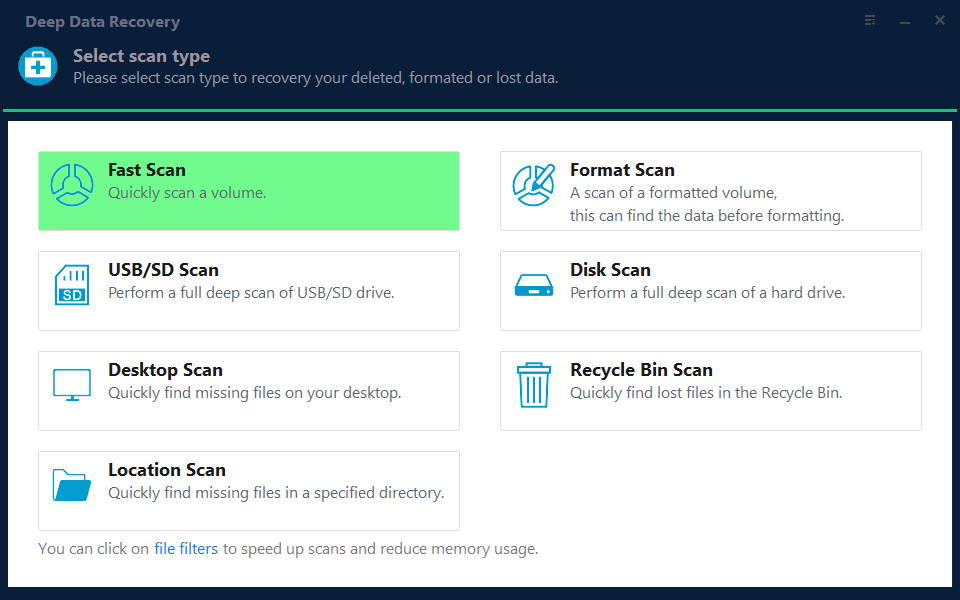
Note: You can choose different search modes based on where and why the data was lost.
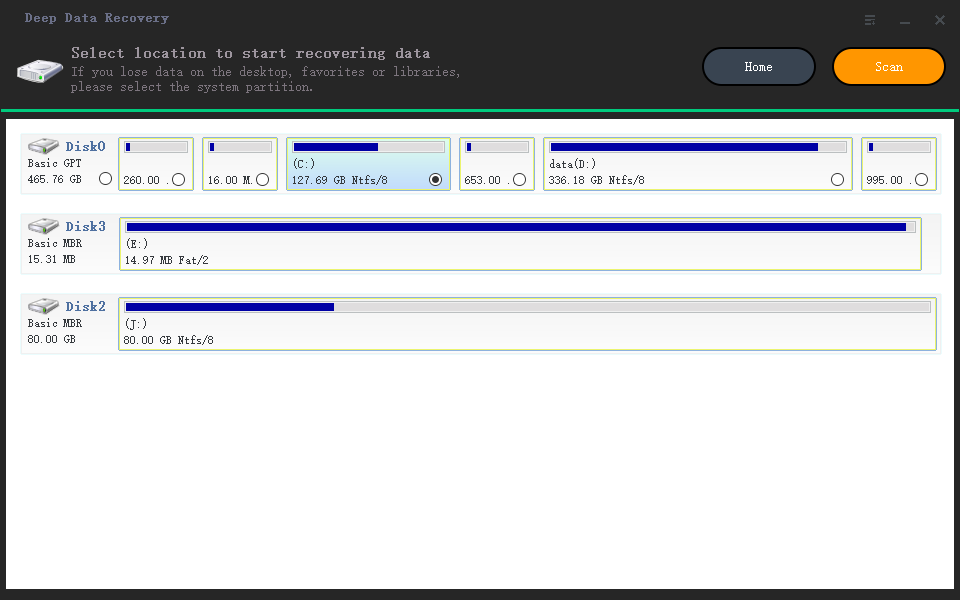
Step 2. Scan the hard drive partition
Select the drive on your hard disk where you lost or deleted files, click "Scan" and let Qiling data recovery software scan for all lost data and files on the selected drive.
Step 3. Check the results
After the scan is complete, you can apply the "Filter" feature or click "Search files or folders" to locate the missing files on the hard drive.

Step 4. Restore lost hard drive data
Select the lost files you want to recover and click "Recover" to save them to a different location.
Other Tips to Restore Toshiba HDD Data on Windows 10/8.1/8/7
If you've lost data from a Toshiba hard disk drive, try booting from a recovery disk or using a data recovery software like Deep Data Recovery to scan the drive for recoverable files. You can also try using a Toshiba-specific data recovery tool, such as Toshiba's own recovery software, if available.
1. Access the Device with Another PC
If your laptop or desktop computer can't access your Toshiba hard drive files and data, try connecting it to another computer. If you can access the hard drive but not your data, due to accidental deletion or formatting, stop writing new data to the hard drive to prevent further damage.
2. Recover Deleted Data from Recycle Bin
If you've lost data from your Toshiba hard disk drive, you can try recovering it by checking the Recycle Bin on your PC and restoring the deleted files.
Step 1. Open Recycle Bin on your PC.
Step 2. Double-click on the file you want to restore, then select "Restore" from the menu.
3. Use Toshiba Recovery Utility
To recover your Toshiba laptop's hard drive to its original factory state, you can use the Toshiba Hard Drive Recovery Utility, which is stored in a special partition on the hard disk drive, along with the system files. To access this utility, hold down the 0 (zero) key, which will display three options for recovery.
- Restore the original factory image (recommended).
- Restore partition C: of HDD without changing the current partition size (Advanced option).
- The command is to restore an image to the C: partition with a user-specified size, using the advanced option.
Choose any of the options and continue with the easy process.
Conclusion
Formatting the hard drive may be the best way to repair it, especially if it's not severely physically damaged. However, this approach comes with the risk of losing all data on the drive. Therefore, if you're looking to recover lost data, Deep Data Recovery should be your first choice.
What Causes Toshiba Hard Drive Data Loss
Data loss from Toshiba hard drives can occur easily, and if you don't have a backup of your files, recovering Toshiba data becomes necessary. Common causes of Toshiba hard drive data loss include various factors.
- Accidentally deleted files by shift + delete keys.
- Hard disk corrupted due to virus attack, power failure, etc.
- Hard drives were formatted accidentally.
- System crash or application failed.
- Hard drive structures were damaged or deleted.
Toshiba Hard Drive Recovery FAQs
With the Toshiba recovery tool, you can easily recover lost data. If you have any further questions, you can also refer to related questions for additional help.
How do I restore my Toshiba hard drive?
Steps to Recover Data from a Toshiba Hard Drive:
Step 1. Run Deep Data Recovery, select the HDD partition where you lost data, and click Scan.
Step 2. After the scanning process is completed, navigate to the "Deleted Files" or "Lost Files" section and double-click on any file to preview it.
Step 3.Select all the desired items, files, and click Recover to save the found HDD partition data.
What does HDD recovery mean?
Hard drive recovery is the process of recovering data and restoring a hard drive to its last known good configuration, typically after a system or hard drive crash, corruption, or damage.
How do you fix a hard drive failure on a Toshiba laptop?
To access the recovery settings, go to Settings, click on Update and security, select Recovery, click on Advanced Startup, and then click Restart now.
Why is my internal hard drive not detected?
If the BIOS doesn't detect a hard drive, it's likely due to a damaged data cable or incorrect connection, especially with SATA cables which can sometimes come loose. Make sure the SATA cables are securely connected to the SATA port.
Related Articles
- [Top] USB Recovery Software to Recover Files from USB Flash Drive
- Recover Deleted Files Windows 10 | 6 FREE Ways
- Top 10 Best Free Data Recovery Software
- How to Recover Data After Low Level Format
- 2 Ways for How to Recover Files Deleted by Avast Antivirus
If Avast has mistakenly deleted your files, follow this guide to learn how to recover them. - How to Recover Deleted Files from Recycle Bin in Windows 7
If you want to recover deleted files from the recycle bin in Windows 7 or restore the recycle bin itself, follow this step-by-step guide for Windows 7 recycle bin recovery.
Products
Articles & Tutorials
- Data Recovery
- Data Backup
- File Recovery
- File Backup
- System Backup and Restore
- Disk and Partition Clone
- Technical articles
- Mobile articles
- Disk Master Help
- Windows Data Recovery Tutorials
- Windows Secure Delete Tutorials
- Windows Partition Management Tutorials
- Windows File Backup and Restore Tutorials
- Windows System Backup and Restore Tutorials
- Windows Disk Backup and Restore Tutorials
- Windows Clone Tutorials