What Is a Key Derivation Function?
Encryption needs a key, but people supply a password. A key derivation function is the bridge between the two: it stretches a short, human-chosen password into a long, fixed-length key that an encryption algorithm can use.
This guide explains what a KDF does, why it is deliberately slow, how the common ones differ, and what it can and cannot protect.
PAGE CONTENT
- What a Key Derivation Function Does
- Why Passwords Need Slowing Down
- Common KDFs Compared
- Put KDFs to Work with Safe Disk
- What a KDF Cannot Fix
- FAQs About Key Derivation
- Back Up Windows Before You Change Settings
What a Key Derivation Function Does
- It accepts a password. The input is whatever the user can remember and type.
- It adds a salt. Random per-file data makes identical passwords produce different keys.
- It repeats work. Thousands of hash rounds turn one guess into a measurable delay.
- It outputs a fixed length. The result is exactly the key size the cipher expects, such as 256 bits.
- It is deterministic. The same password and salt always rebuild the same key, which is how unlocking works.
Without a KDF, software would have to use the password bytes directly as a key, which is far weaker than the password itself suggests.
Why Passwords Need Slowing Down
- Passwords are predictable. Most people choose words, dates, and patterns that dictionaries already list.
- Fast hashes favor attackers. A graphics card can test billions of plain hashes per second.
- Slow functions flip the cost. If one guess takes a fraction of a second, mass guessing stops being cheap.
- Salts block shortcuts. Precomputed tables cannot be reused across files, as explained in What Is a Salt and Why Does It Matter for Encryption.
- Cost parameters can grow. A good KDF lets the defender raise the work factor as hardware improves.
The goal is not to make one guess impossible. It is to make millions of guesses expensive enough that an attacker moves on.
Common KDFs Compared
- PBKDF2. Repeats a hash many times. Simple, widely supported, and easy for hardware to accelerate.
- scrypt. Deliberately uses large amounts of memory, which makes parallel guessing on GPUs much harder.
- Argon2. The modern standard. Tunable memory, time, and parallelism, with a variant designed to resist side-channel attacks.
- HKDF. Built for deriving several keys from one strong secret, not for stretching weak passwords.
- bcrypt. A classic password hash with a fixed cost factor, still common in login systems.
The derived key is then handed to a cipher such as the one described in What Is AES-256 Encryption, which encrypts the actual file data.
Put KDFs to Work with Safe Disk
Qiling Safe Disk derives its container key from your password with salted hashing, then encrypts the files with AES-256. Download and install it first.
Step 1. Open Qiling Safe Disk and click Create to make a new container.
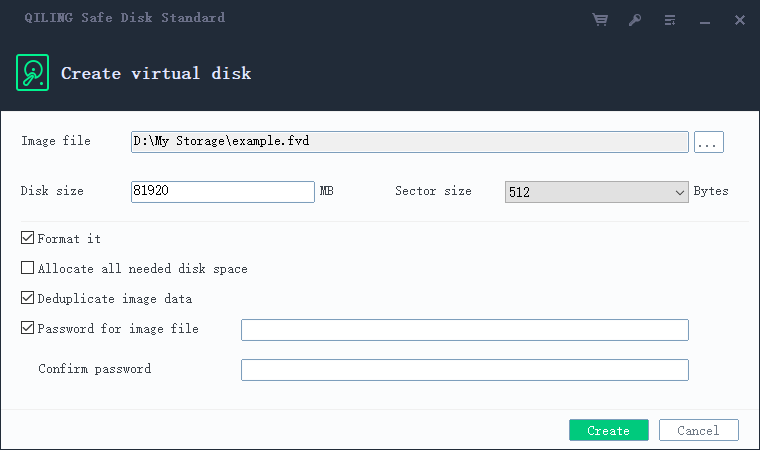
Step 2. Set the size, choose AES-256, and set a long, unique password.
Step 3. Click Create and wait while the container is written.
Step 4. Mount the container and copy the files you want to protect inside it.
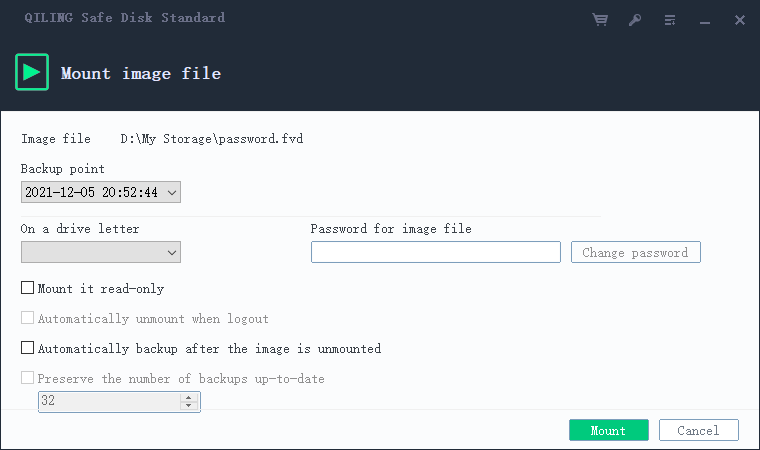
Step 5. Unmount when you are done so the container locks again.
What a KDF Cannot Fix
- A short password. Slowing each guess does not help if the whole space of guesses is small.
- A password reused everywhere. One breach still opens every account that shares it.
- A keylogger. Malware captures the password before the KDF ever runs.
- An unmounted-safe container left open. A mounted volume is readable no matter how strong the key derivation was.
- Stolen recovery data. If the salt, parameters, and recovery material are copied, an attacker can guess offline at leisure.
A KDF raises the cost of every guess. Choosing a long passphrase and keeping the container locked is what makes that cost matter.
FAQs About Key Derivation
Is a KDF the same as encryption?
No. A KDF builds a key; the cipher uses that key to encrypt or decrypt data.
Why does unlocking take a moment?
The deliberate delay is the point. It is the same delay an attacker faces for every guess.
Can two files share one key?
They can, but each container should use its own salt so that one password produces distinct keys.
Which KDF should I look for?
Argon2 is the current recommendation, with scrypt and PBKDF2 still acceptable when configured with strong parameters.
Does a KDF protect a weak password?
Only partly. It buys time, but a common password remains guessable no matter how slow the function is.
Back Up Windows Before You Change Settings
Before installing security software or changing storage, create a full Windows backup. Qiling Disk Master creates a system image you can restore from.
Step 1. Open Qiling Disk Master and select System Backup to include Windows and the boot partitions.
Step 2. Save the image to a drive other than the Windows disk and start the backup.
Step 3. If a change causes issues, restore from the image to return Windows to its working state.
Conclusion
A key derivation function turns a memorable password into a full-strength encryption key by adding a salt and repeating deliberate work. That repetition is what makes guessing expensive, and the salt is what stops precomputed tables from being reused. PBKDF2, scrypt, and Argon2 differ mainly in how they consume time and memory, with Argon2 the modern choice. Qiling Safe Disk uses salted key derivation and then encrypts your files with AES-256. A KDF cannot rescue a short or reused password, so choose a long passphrase and unmount the container when you are done.
For more on how encryption protects files, see What Is a Virtual Encrypted Drive, How to Back Up an Encrypted Drive, Best Encryption Algorithm for Files, and How to Use Qiling Safe Disk.
Related Articles
- What Is a Keyfile and How Does It Work?
A keyfile adds a second secret to an encrypted drive. Learn what it is, how it combines with a password, and how to store it. - Is an Encrypted Drive Safe from Hackers?
Encryption stops most attackers, but not all of them. See what it defends against and where the gaps are. - What Is an Encrypted Container File?
A container keeps many files inside a single locked archive. Learn how it works and when to use one. - Does Encryption Slow Down a Disk?
Worried encryption will make your PC crawl? See how much speed modern hardware encryption actually costs. - What Is Full Disk Encryption?
Full disk encryption protects an entire drive with one key. Learn how it works, what it covers, and where its limits are.
Products
Articles & Tutorials
- Data Recovery
- Data Backup
- File Recovery
- File Backup
- System Backup and Restore
- Disk and Partition Clone
- Technical articles
- Mobile articles
- Disk Master Help
- Windows Data Recovery Tutorials
- Windows Secure Delete Tutorials
- Windows Partition Management Tutorials
- Windows File Backup and Restore Tutorials
- Windows System Backup and Restore Tutorials
- Windows Disk Backup and Restore Tutorials
- Windows Clone Tutorials