Clone UEFI Disk to SSD without Boot Issue (Full Guide)
PAGE CONTENT:
- UEFI Boot VS BIOS Boot
- Why Do You Want to Clone UEFI Disk
- UEFI Disk Cloning Software Overview
- How to Clone UEFI Disk to SSD
To clone a UEFI disk to an SSD on Windows 10, 8.1, 8, or 7, use professional disk copy software. This method is suitable for both professional and ordinary Windows users and can be easily followed to clone the UEFI disk to SSD without encountering boot issues in Windows 10/8.1/8/7.
UEFI Boot VS BIOS Boot
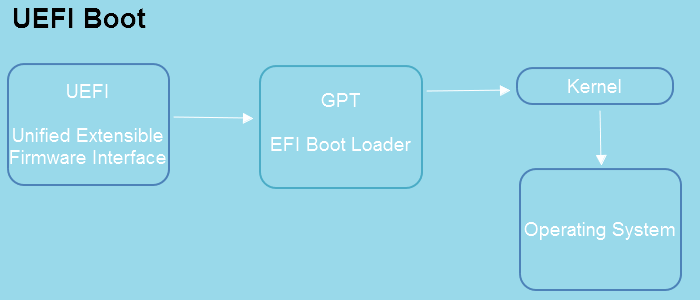
UEFI (Unified Extensible Firmware Interface) and BIOS (Basic Input-Output System) are two different firmware interfaces that initialize hard drives in different ways. UEFI adopts hard drives initialized with GPT (GUID Partition Table) partition style, while BIOS adopts hard drives initialized with MBR (Master Boot Record) partition style.
UEFI (Unified Extensible Firmware Interface) is a firmware interface that allows users to utilize disk space beyond 2TB, providing a significant advantage over traditional BIOS systems. Additionally, UEFI enables a faster booting process and incorporates more advanced security features, making it a more secure and efficient option for users. The booting process under UEFI is typically faster and more streamlined, allowing users to quickly access their operating systems and start their computing sessions.
BIOS disables users to use disk space beyond 2TB. Besides, the BIOS must run in 16-bit processor mode and has 1 MB of space to execute it. The booting process is like this:
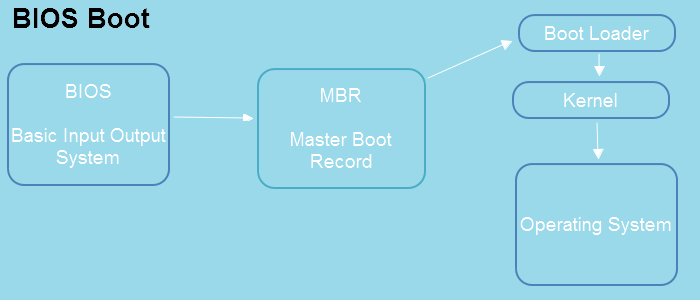
The main difference between MBR and GPT is that MBR uses a single partition table to store information about all partitions on a disk, whereas GPT uses a partition table for each partition. This makes GPT more flexible and able to handle larger storage capacities and more complex partition schemes.
Why Do You Want to Clone UEFI Disk
Here is a list of major reasons why people are choosing to clone UEFI disk:
- Upgrade UEFI disk to a bigger hard drive
- The UEFI boot drive is not working properly
- The UEFI boot disk is failing
- Clone UEFI disk to SSD and optimize Windows/PC's performance
If you're looking to clone a UEFI disk to an SSD without any boot errors, a simple and specialized disk clone tool is what you need to make the process effortless.
UEFI Disk Cloning Software in Windows 10/8.1/8/7
To clone a UEFI hard drive without effort, use Qiling Disk Copy, a software compatible with Windows XP to 10, that supports disk, partition, and sector-level cloning on GPT, MBR, and WinPE bootable disks.
Qiling disk cloning software has the following stunning features.
Your Reliable Drive Clone Software
- * Use Disk Utility on Mac or Backup and Restore on PC to clone the disk.
- It supports OS migration to avoid reinstalling the operating system.
- It clones your disk sector by sector, leaving nothing behind.
Clone UEFI Disk to SSD in Windows 10/8/7 Step-by-Step
To ensure a smooth cloning of the Windows UEFI boot disk to an SSD without any boot issues, convert the SSD to GPT in advance. This is followed by the steps to clone the UEFI disk to the SSD.
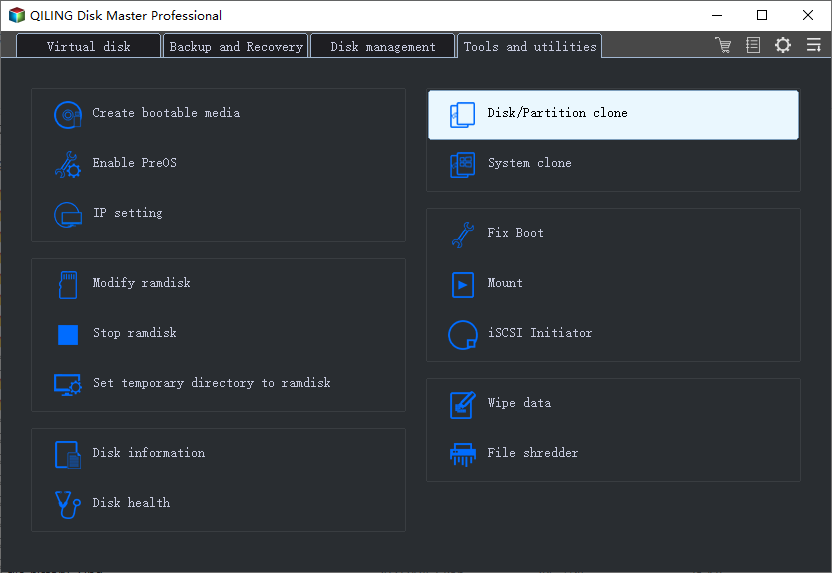
Step 1. Choose "Disk/Partition clone" in the tool page to start.
Step 2. Select a hard drive as the source disk. Click Next to continue.
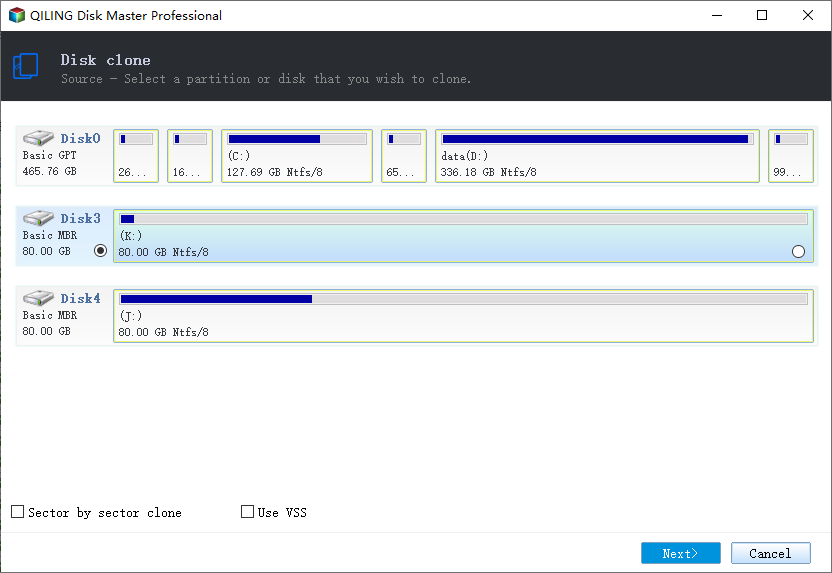
Step 3. Select the SSD as your destination and click Next to continue.
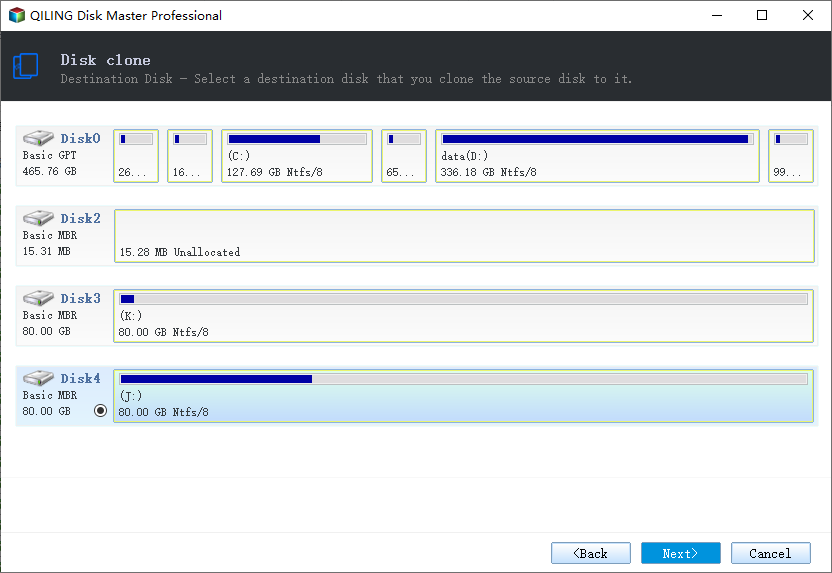
Step 4: Check and edit the disk layout.
If your destination disk is an SSD drive, remember to select the "Optimize for SSD" option when the target is an SSD.
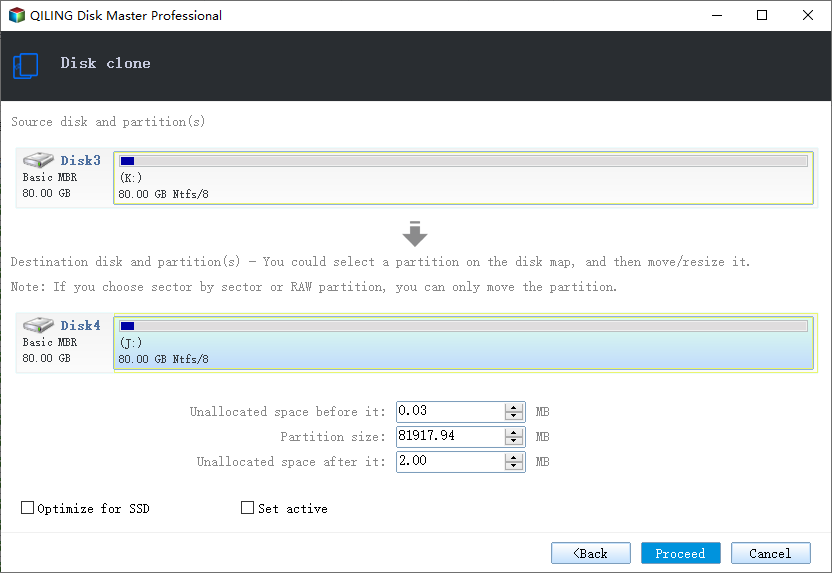
Step 5: Click "Proceed" to start the hard drive cloning process.
A warning message tells you that the data on the destination disk will be overwritten. If you don't have important data on the destination disk, click "OK" to continue.
How to Make Cloned UEFI Disk Bootable on SSD Disk
To enable UEFI boot on the SSD disk, you'll need to configure your system's BIOS settings to prioritize the SSD disk as the primary boot device. This typically involves entering the BIOS settings during startup, navigating to the boot order menu, and selecting the SSD disk as the primary boot device.
- Insert your new SSD with UEFI boot disk content to your laptop.
- Restart the PC, and you should be able to run the Windows system on your new SSD from UEFI mode now.
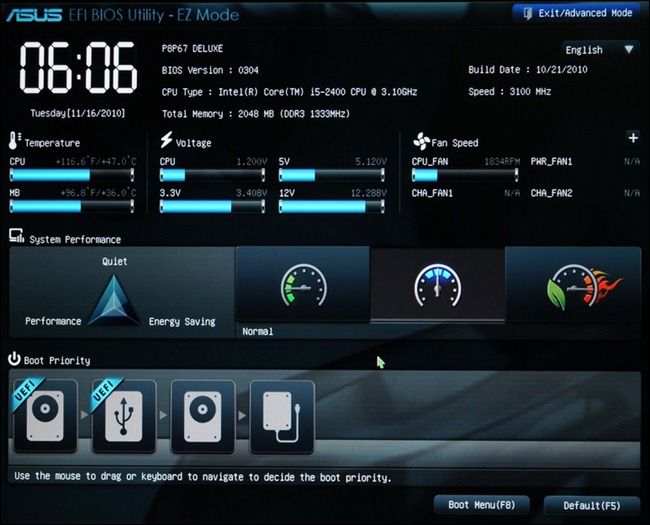
If you're experiencing issues switching between UEFI and BIOS boot modes, you can refer to Microsoft's guide on booting in UEFI or legacy BIOS mode for assistance.
Conclusion
Cloning the UEFI disk with Qiling Disk Copy is a simple process. This software can copy the UEFI boot disk to another disk, and is also capable of cloning one partition to another, as well as cloning disks with bad sectors. By using Qiling Disk Copy, you can easily solve your HDD/SSD problems. You can download this software at any time to get started.
Clone UEFI Disk to SSD FAQs
If you have problems, you can read these FAQs below to get additional help.
Can you clone a GPT disk?
You can use Qiling Disk Copy to clone a GPT disk, but note that if the source disk has a system on it, the destination must also be a GPT disk to boot successfully, otherwise you may fail to boot after cloning.
How do I boot from a cloned SSD?
Step 1. After cloning, restart your computer. During the restart process, press and hold the "F2" key (or possibly other keys like DEL) to access the BIOS/UEFI settings. This will allow you to configure the necessary settings to recognize the cloned drive.
Step 2. Change the boot order and set the cloned SSD as the boot drive in BIOS.
Step 3. Press "Enter". Now you should boot the computer from the SSD successfully.
Can I clone MBR to GPT?
You can use Qiling Disk Copy to clone an MBR data disk to a GPT disk, and the cloned disk will be GPT. The data disk itself doesn't need to consider boot issues. If you want to clone an MBR system disk to a GPT disk, you can follow these steps.
Step 1. Convert GPT to MBR disk using a partition manager program at first.
Step 2. Use the Disk Mode feature to clone the MBR disk.
Step 3. Use the partition master tool again to convert MBR to GPT disk.
To ensure the system normally starts, verify that your operating system is 64-bit GPT boot-up, the BIOS supports EFI boot mode, and change the boot mode in the BIOS after conversion.
For DriveImage XML and Windows boot-drive cloning, read Can DriveImage XML Clone a Windows Boot Drive?
Related Articles
- 2021 Tips | How to Clone HDD to M.2 SSD
- Best Bad Sector Repair Solutions to Check and Remove Bad Sectors on Hard Disk
- Samsung Cloning Software to Clone HDD to SSD Free
- How to Clone IDE to SATA HDD/SSD (2 Ways)
- Preparations for Windows Server 2016 in-Place Upgrade
This article focuses on how to prepare for Windows Server 2016 upgrade and upgrade Windows Server 2012 to 2016 step by step. No data loss. - Quick Start Guide to Sysprep in Windows Server 2012 (R2)
Before deploying an operating system to multiple devices, you must clear the security information via Sysprep. Learn how to run Sysprep in Windows Server 2012 (R2) and deploy OS to other computers simultaneously from this page.
Products
Articles & Tutorials
- Data Recovery
- Data Backup
- File Recovery
- File Backup
- System Backup and Restore
- Disk and Partition Clone
- Technical articles
- Mobile articles
- Disk Master Help
- Windows Data Recovery Tutorials
- Windows Secure Delete Tutorials
- Windows Partition Management Tutorials
- Windows File Backup and Restore Tutorials
- Windows System Backup and Restore Tutorials
- Windows Disk Backup and Restore Tutorials
- Windows Clone Tutorials