How to Install an SSD without Reinstalling Windows
If you want to make a big swap from an HDD to a prevailing SSD, you can install the SSD without reinstalling Windows by cloning the existing HDD to the SSD, which allows you to keep your existing Windows installation and data intact, eliminating the need for a fresh/clean install that would require a Windows installation disc and a repeated job of reconstructing computer data.
There is a no-To move a Windows installation to an SSD using the 'system clone' method, you can use the HDD to SSD system clone process. This allows you to keep all your data on the previous HDD and clone the system to the SSD, which can be done overnight, saving you time.
How to Install an SSD on Laptop/PC Without Reinstalling Windows
Installing a new SSD on a computer involves three main processes: connecting the SSD to the computer, cloning the system from the old hard drive (HDD) to the new SSD, and finally replacing the old HDD with the new SSD. These steps are essential to ensure a seamless transition and preserve all data and settings.
Part 1. How to Connect SSD to Your Windows Computer
Tools you need:
- A screwdriver (optional)
- A SATA-to-USB cable/SSD enclosure
To connect a new SSD to your computer, you'll need to use the compatible connection method. For desktops, this typically involves connecting the SSD to a free PCIe slot, while laptops usually have an M.2 slot. If you're using a desktop, you can connect the SSD as an external hard drive without needing to uncase your computer. Once you've connected the SSD, Windows may prompt you to initialize it to either GPT or MBR.
To initialize a new SSD in Windows:
- Go to My Computer/This PC > Storage > Disk Management
- The SSD should display as "Not initialized". Right-click on it and choose "Initialize Disk" to proceed with the initialization process.
- Continue with the wizard to choose the MBR or GPT style until the end.
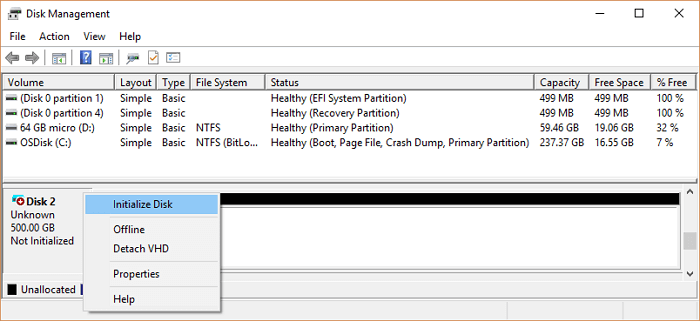
To ensure a smooth transition from an old HDD to a new SSD, it's essential to maintain the same partition style. If the new SSD partition style is not aligned with the old HDD, it may lead to boot issues with the cloned SSD. This can be resolved by using the same partition alignment when cloning the HDD to the SSD.
Part 2. How to Clone Windows 10/8/7 from HDD to SSD
We'll demonstrate the system migration process using Qiling Backup, top-notch Windows backup software that allows you to install an SSD on your laptop and desktop without reinstalling Windows.
- This tool helps users to clone their operating system, move the Windows installation to a solid-state drive (SSD), and upgrade their hard disk drive (HDD) to an SSD without losing any data.
- Enables users to make schedule backup regularly and restore everything instantly.
- Allows users to encrypt backups, protect confidential information.
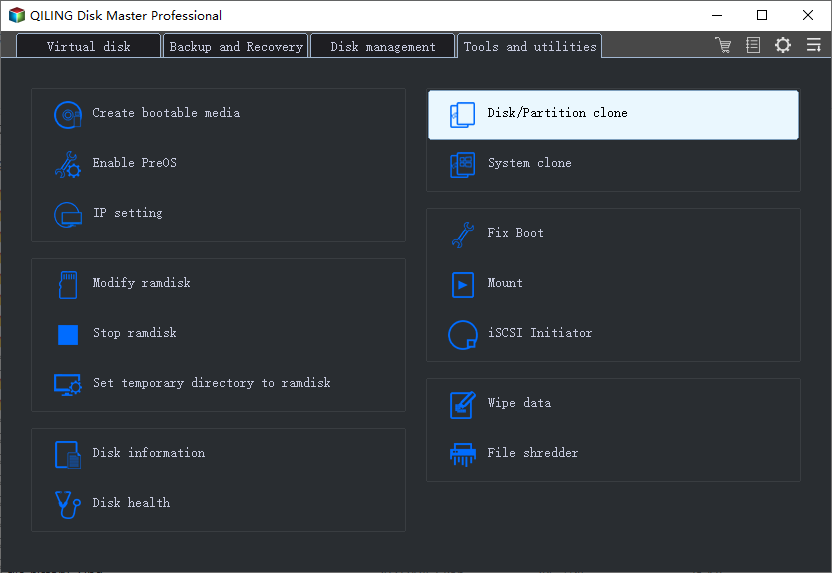
Step 1. Launch Qiling Backup and choose "Disk/Partition clone".
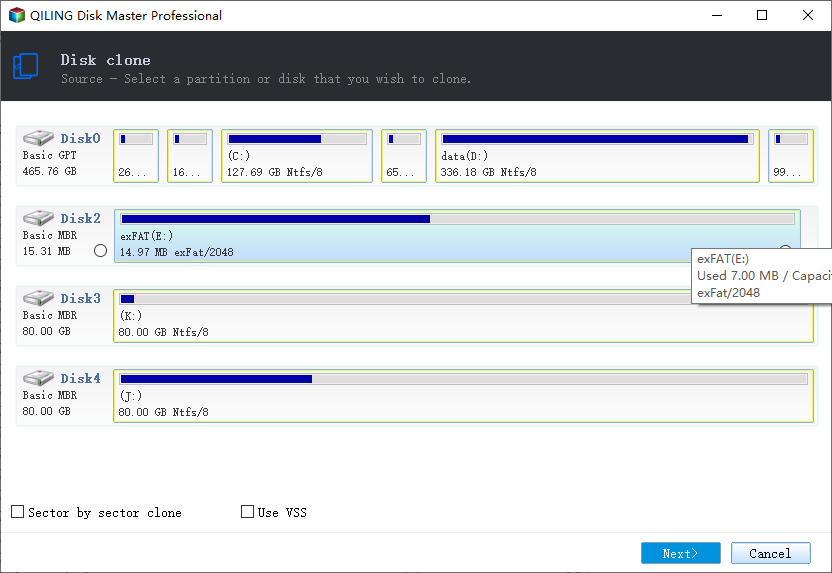
Step 2. Choose the source disk you're going to clone. Here, choose the HDD. Click "Next".
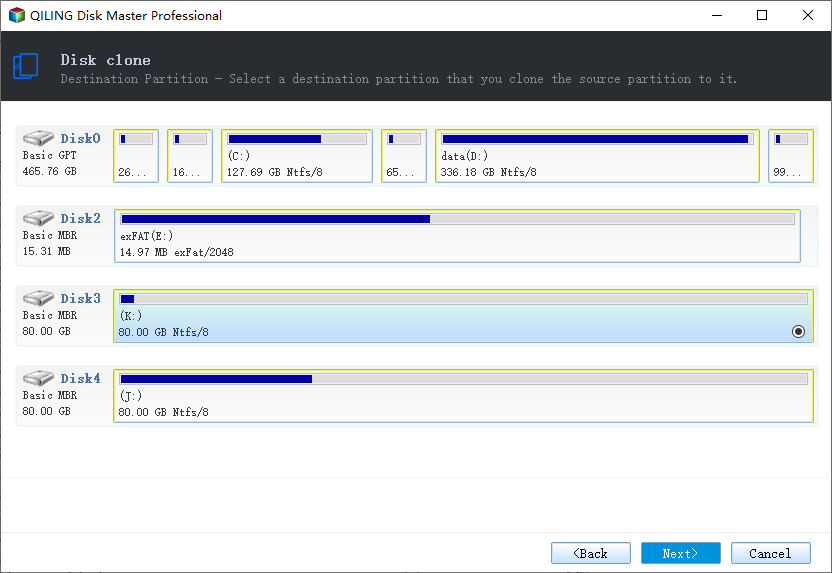
Step 3. To improve the SSD performance after cloning, choose the destination disk as the SSD and make an additional selection.
Step 4. Preview a disk layout and click "Proceed". The cloning process may take a while, depending on the size of the source disk.
Tick the option for "Optimize for SSD"
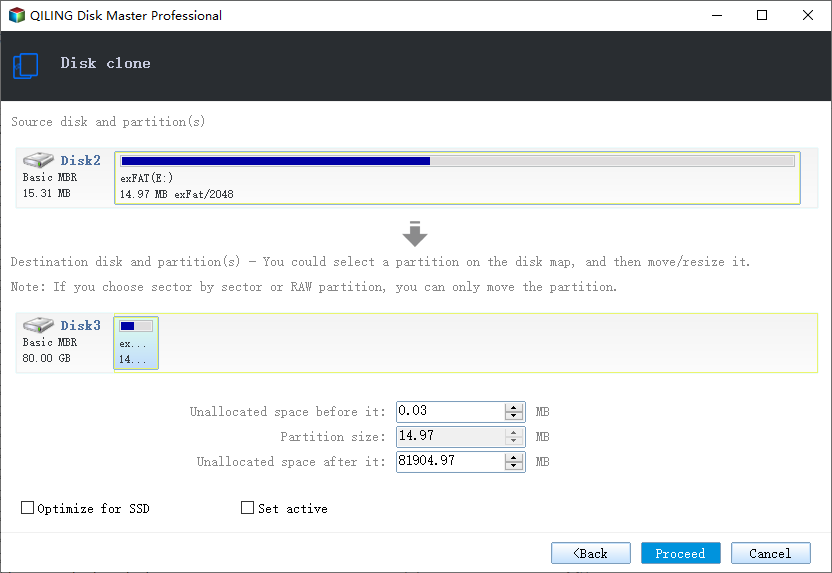
To successfully clone a Raspberry Pi SD card to another card, follow these steps: Firstly, ensure that both SD cards are in the same format, either FAT32 or exFAT. Secondly, download and install the Raspberry Pi Imager tool, which is a free and user-friendly software. Finally, launch the Imager tool, select the source SD card, and choose the target SD card to clone it to. Once you've completed all three steps, you can successfully clone your Raspberry Pi SD card to another card.
Part 3. How to Install SSD After Clone
The laptop only allows one hard drive to be installed, so you'll need to remove the old hard drive and replace it with the cloned SSD.
For laptops:
- Shut down the laptop completely
- Disconnect all the external connections including the SSD
- To access the battery, you'll need to remove the back cover of your laptop using a screwdriver. This will expose the internal components, allowing you to safely take out the battery.
- Carefully remove the old HDD with your gentle fingers, and then replace it with the new SSD in the same place.
- Close the back cover and reboot your laptop
For desktops:
If you're replacing your old hard drive with a new one, you can either keep the old one as is, use it as an extra storage drive, or completely remove it from your computer. The choice is yours.
Case 1. Keep both HDD and SSD
To let Windows choose the SSD to boot from, you need to change the BIOS boot order by placing the SSD ahead of other connected drives. This will allow the computer to boot up from the SSD in the future.
If you prefer deleting Windows from the hard drive and turning it into a pure data storage drive, the linked page has detailed instructions.
Case 2. Remove the HDD and install SSD on it
- Unplug the power cord from the wall outlet
- Unscrew and remove the sides of your computer's case
- To install an SSD, place it into its mounting bracket or a removable bay, align it with the holes underneath, and then secure it with screws.
- Connect a SATA power cable to the SSD
- Restore all the parts to the initial state and reboot your computer
Bonus Tip: SSD Specifications for Laptops
Widely seen SSD specifications for laptops are as follow.
- SIZE: 2.5-inch; 1.8-inch for ultraportable notebooks.
- THICKNESS: 7mm ~ 9.5mm
- SATA or IDE interfaces are used for connecting storage devices in laptops, with SATA drives being the most widely used option in modern laptops.
To upgrade your computer's storage, you'll need to get a new SSD (Solid-State Drive) that fits your system's form factor and interface. Ensure the new SSD has a capacity that's at least as large as your current operating system drive (usually the C drive) to hold all your system files and programs.
Move Windows to SSD FAQs
1. What else will be transferred by using the System Clone feature?
When using the "System Clone" to migrate Windows OS from an HDD to an SSD, all OS installation files, programs, downloads, user profile, system configurations, and personal data are also moved.
2. Can any laptop be upgraded to SSD?
Check the upgradability of your laptop and consult the manual for instructions on replacing the drive. You may need to find a replacement drive that matches the original one. If you're not comfortable with the process, consider consulting a professional.
3. Why Cloned SSD won't boot?
- To resolve the issue, you can try setting the cloned drive as the boot drive in the BIOS settings. This can usually be done by entering the BIOS settings during boot-up, navigating to the boot order or drive settings, and selecting the cloned drive as the primary boot device.
- If your motherboard is UEFI, you need to convert the Master Boot Record (MBR) to a GUID Partition Table (GPT) to fix the boot mode issue. This conversion involves changing the partition table from MBR to GPT, which is a different format used by UEFI systems. This process can be done using various tools and software available online, and it's usually a straightforward process that doesn't require a lot of technical expertise.
- The corrupted data from the old disk was transferred to the new SSD, likely causing issues with the new drive.
- Many more concerning reasons can be found in cloned SSD won't boot.
Related Articles
- Clone Hard Drive with Paid/Free Cloning Software Windows 10
- Best Windows Schedule Backup Software for Automatic Backup
- How to Install Software on Multiple Computers at the Same Time
- How to Create and Restore (Windows 10) System Image to Different Computer
- Easy & Quick Way to Backup Bootable USB Drive
Backing up a bootable USB drive is an essential process to ensure that your data and operating system settings are preserved in case of any hardware failure or data loss. In this guide, we will walk you through the easiest method to backup a bootable USB drive in Windows 7, 8, and 10. - How to Backup OneDrive to NAS like Synology or QNAP in Windows
How can you backup OneDrive to NAS when the built-in tools of Synology or QNAP only supports NAS to cloud backup or synchronization? In this post, I'll share a powerful backup tool to do the job with flexible options.
Products
Articles & Tutorials
- Data Recovery
- Data Backup
- File Recovery
- File Backup
- System Backup and Restore
- Disk and Partition Clone
- Technical articles
- Mobile articles
- Disk Master Help
- Windows Data Recovery Tutorials
- Windows Secure Delete Tutorials
- Windows Partition Management Tutorials
- Windows File Backup and Restore Tutorials
- Windows System Backup and Restore Tutorials
- Windows Disk Backup and Restore Tutorials
- Windows Clone Tutorials