Fix Low Disk Space Error on Windows 11/10/8/7
If your PC is experiencing a low disk space error, you can't install a new Windows update, and the PC's performance may be affected. You can try to fix this error by deleting unnecessary files, uninstalling unused programs, and freeing up disk space by deleting temporary files and system logs. Additionally, you can also consider upgrading your storage drive or adding an external hard drive to expand your storage capacity.
- Combine Low-space Drive with a Neighbour Drive
- Extend Drive with Unallocated Space
- Extend Low-space Drive with Space on Another Drive
- Transfer Large Files to An External Hard Drive
- Clean Junk Files
- Clean Large Files
Ignoring or disabling the "Low Disk Space" error pop-up is not the best approach, as it can lead to data loss or system crashes. Instead, addressing the issue by freeing up disk space or upgrading your storage can prevent the warning from appearing in the first place. Modifying the registry value to stop the notification may seem like a solution, but it's not what we're discussing here.
Learn about the "Low Disk Space" error, its consequences, and 11+ fixes to resolve the issue on your PC.
What Does "Low Disk Space" Mean?
The "Low Disk Space" warning message typically appears in Windows operating system when you boot up your PC or access your computer's hard drive, indicating that the available storage space is running low.
There are two types of warning messages, each with different meanings. The first type, often marked with a yellow triangle, indicates a potential hazard or a situation that requires attention.
1. Your computer's Local Disk (X:) is running out of storage space. Click the link to see if you can free up some space on this drive.
When you get this error, it means your local drive (X:) is running out of free space for saving data.
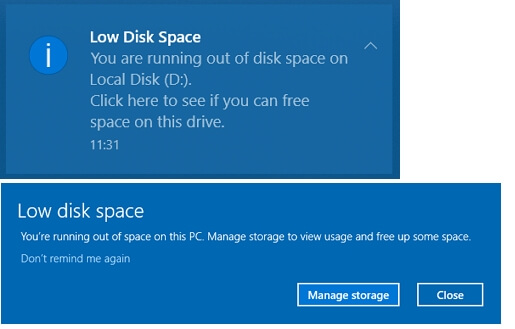
2. Low Disk Space - "You're running out of space on this PC. Manage storage to view usage and free up some space."
This error appears on Windows startup due to the C:\ Windows\Temp folder being full, which prevents Windows from starting normally.
When Windows displays low disk space warning messages, it can hinder your ability to save new data, download apps, play games, or install a recent Windows update, and may even impact your PC's overall performance.
Part 1. Fix Low Disk Space in Windows 11/10/8/7 by Extending Disk Space
To fix low disk space error by extending disk space with available free space in Windows 11/10/8/7 hard drives, you can use the built-in Disk Management tool to shrink a larger volume and allocate the freed-up space to the smaller volume, effectively increasing the disk space. This process involves opening the Disk Management tool, selecting the larger volume, right-clicking on it, and choosing "Shrink Volume" to release the unused space.
To resolve the low disk space error in Windows 11/10/8/7, simply add more space to the current drive by extending the drive or partition that is running out of space. This will resolve the issue.
Download: Partition Manager Software to Fix Low Disk Space Error
To add usable space to the low disk partition, you can use a partition manager software like Qiling Partition Master. This tool can help you extend the low disk partition by providing an all-around solution.
It is a handy third-A party software that allows users to manage and manipulate their hard drive partitions on Windows 11/10/8/7, enabling features such as partition extension/shrinking, formatting, file system conversion, Windows OS migration, and hard drive cloning.
Download this software and follow the tutorials listed below to extend the low disk partition immediately:
Fix Low Disk Space Error by Extending Partitions in 4 Methods
4 ways to solve the 'low disk space' problem using Qiling Partition Master are:
1. Extend Drive Which Is With Low Free Disk Space
2. Combine the Low-space Drive with a Neighbour Drive
Method 1. Extend Drive Which Is With Low Disk Space
When a drive partition, such as the system drive (C:) or a data partition (D:), is filled with a red bar, it indicates a low disk space issue. To resolve this, check if there is unallocated free space available. If yes, you can extend the currently running low disk space drive by following the steps below. If not, you may need to consider other options, such as deleting unnecessary files, compressing files, or even adding a new drive to the system.
To extend a system C drive or a non-system drive, follow these simple steps:
Option 1. Extend System C drive with unallocated space
1. Click on the System C: drive and select "Resize/Move" in the Disk management page.
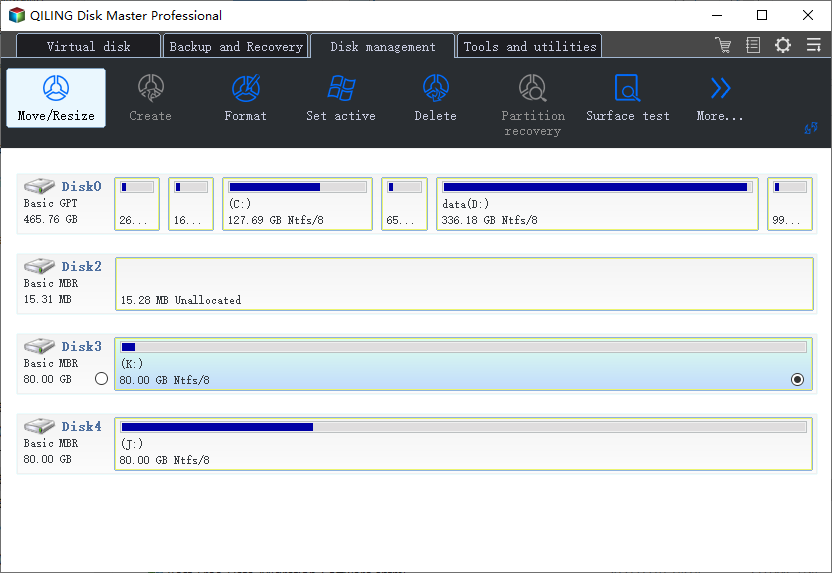
2. To expand the C: drive, drag the system partition end into the unallocated space, adding it to the C: drive, and then click "Proceed" to initiate the process.
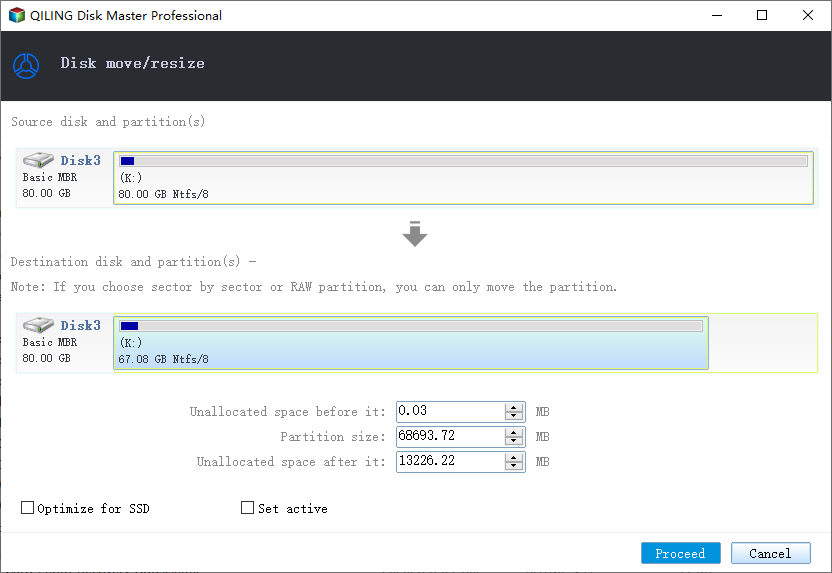
Option 2. Extend System C drive without unallocated space
1. To resize a partition, click on a large partition with sufficient free space on the system disk, then select "Resize/Move" from the "Disk management" page.
2. To free up disk space, drag the partition end into the partition space, reducing its size. Then, click "Proceed" to create some free space.
3. To extend the disk space, select the disk you want to increase in size, then go to the "Disk management" page and choose "Resize/Move" to increase the disk space.
Method 2. Combine the Low-space Drive with a Neighbour Drive
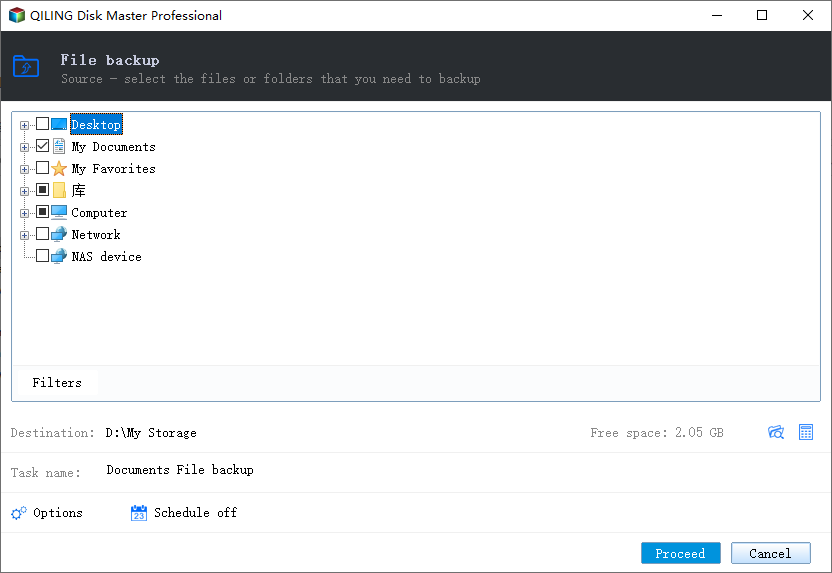
Step 1. Backup the merged partition with file backup mode
1. Click "File backup" on the main window.
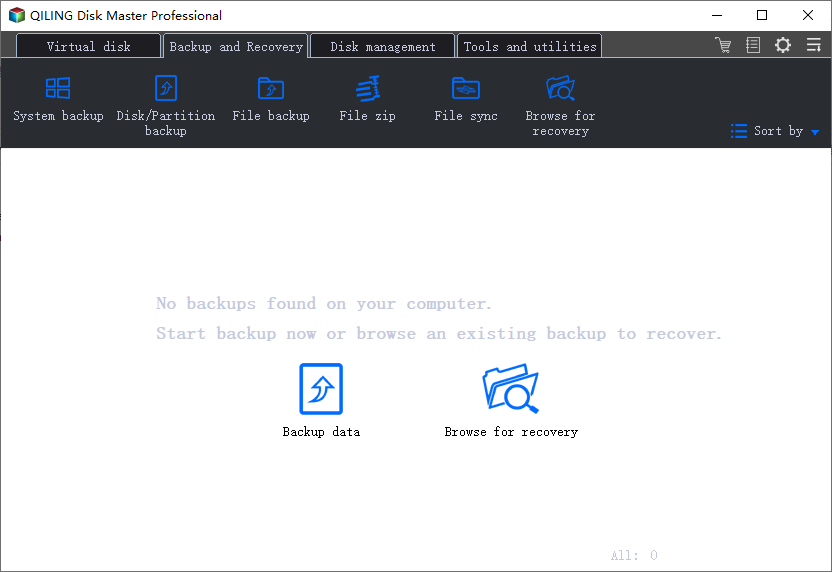
2. Select the files you want to backup, then click "Proceed" to initiate the backup process.
Step 2. Delete the merged partition.
Step 3. Extend the partition.
1. Select the partition you want to resize and click on the "Resize/Move" option in the Disk Management page.
2. To merge the unallocated space with an existing partition, drag the partition end into the unallocated space, effectively adding the unallocated space to the partition. Then, click "Proceed" to initiate the process.
Step 4. Restore the backup to the extended partition.
Part 2. Free Up Hard Drive Space to Remove Low Disk Space Error
To clean up disk temp files and free up hard drive space, you can use the built-in Disk Cleanup tool in Windows. This tool helps remove temporary files, system logs, and other items that are no longer needed, thereby freeing up disk space and resolving the low disk space error on Windows 11/10/8/7.
Qiling Partition Master has released a considerable amount of disk space for at least a short-term use by extending partitions and drives.
To prevent low disk space-associated warnings, manage your computer hard drive in a logical and clean way by regularly deleting unnecessary files, emptying the recycle bin, and uninstalling unused programs. This will help free up space on your hard drive and prevent future warnings.
8 Ways to Free Up Hard Drive Space, Get Rid of Low Disk Space on Windows:
To free up system drive space, clean junk files by deleting temporary files, system logs, and other unnecessary data that can be safely removed. This can be done using built-in tools like Disk Cleanup or by using third-party software specifically designed for this purpose. By removing these files, you can recover a significant amount of space on your system drive, making it easier to install new programs, games, or other applications.
To free up space on your computer, transfer or save important large files to an external hard drive. This will not only save storage space but also provide an additional layer of protection against data loss in case your computer's hard drive fails. You can transfer files such as videos, photos, and documents to the external hard drive, and then delete them from your computer to reclaim space.
#4. Turn on Cloud Storage Service to Save Files
To transfer programs from C drive to another drive, you can change the default install location for apps in Windows. Here's how: Go to Settings > System > Storage > This PC, and click on the drive you want to use as the new default install location. Then, go to Settings > System > Apps & features, and toggle on the "Let Windows 10 manage the size of the Windows and apps" option.
#6. Empty Recycle Bin on a Regular Basis
#7. Delete Duplicate Files and Temp Files
#8. Run Anti-Virus Software to Clean Up Malware Regularly
Way 1. Clean Junk Files to Free Up the System Drive Space
Junk files, including system junk, browser data, and app data, accumulate over time, taking up space, especially for frequent computer users, potentially reaching 15GB in a year.
Way 2. Clean Large Files
Some professions, like designers and photographers, often create large files, such as documents, images, zip files, ebooks, and movies, which can quickly consume a computer's disk space, often resulting in a low disk space problem.
Way 3. Transfer and Save Important Large Files to An External Hard Drive
To free up disk space, consider storing personal files on an external hard drive or cloud storage service, such as Google Drive or Dropbox, which can provide a secure and accessible way to preserve and share files.
It's a good idea to transfer important files like those to an external hard drive or USB flash drive, as they are seldom for use and can be safely stored elsewhere.
Step 1. Connect a big empty micro SD card, USB, or external hard drive to your PC
Step 2. Locate and copy those files to your external storage device.
Step 3. When you complete the copy, delete them from your local computer.
By consolidating data to the cloud, you can reduce the heavy load on your local hard drives, freeing up space and potentially improving your computer's performance.
Way 4. Turn on Cloud Storage Service to Save Files
Cloud storage is a good option for saving large files, reducing disk usage, and serving as a reliable backup location for valuable data files. This allows for freeing up low-space disk capacity.
Step 1. Sign up for a Cloud drive like OneDrive, Dropbox, or Google Drive.
Step 2. Log in OneDrive, Dropbox, or Google Drive with your account.
Step 3. Select and upload important large files from your PC to the cloud drive.
Step 4. After the uploading, delete the files saved on your local drive.
Way 5. Transfer Programs from C Drive to Another Drive, Change Apps' Default Install Location
The C drive is typically used for system installation, which has a direct impact on system performance.
To prevent OS crashes due to low C drive space, install programs on a different drive or location, avoiding the default C drive to maintain optimal OS performance.
To free up disk space, you can transfer installed applications to another local drive.
Way 6. Empty Recycle Bin on a Regular Basis
The Windows recycle bin holds deleted files and folders for potential recovery, but a full recycle bin can consume significant disk space.
Regularly cleaning up the recycle bin is essential to prevent the drive from filling up and running out of free space. You can either manually empty the Recycle Bin or set up an automatic clean up plan to ensure it stays tidy and doesn't consume valuable space.
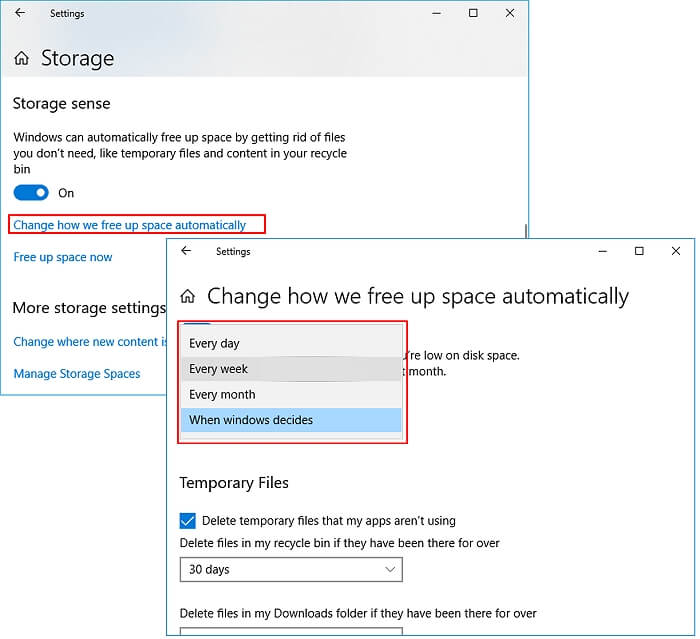
Step 1. Go to Settings > System > Storage.
Step 2. Click "Change how we free up space automatically", set a plan "Every day", "Every week", "Every month", etc.
Way 7. Delete Duplicate Files and Temp Files
Duplicate files can be a problem, but there's an easy solution. Don't let multiple copies of the same file take up valuable hard drive space.
To delete temp files, go to Windows File Explorer, navigate to the C: > Windows folder, then select and clear the contents of the Temp folder.
You can set up an automatic temporary clean up plan to remove unnecessary files and data. This plan can be set up to run at regular intervals, such as daily or weekly, to keep your computer running smoothly and efficiently.
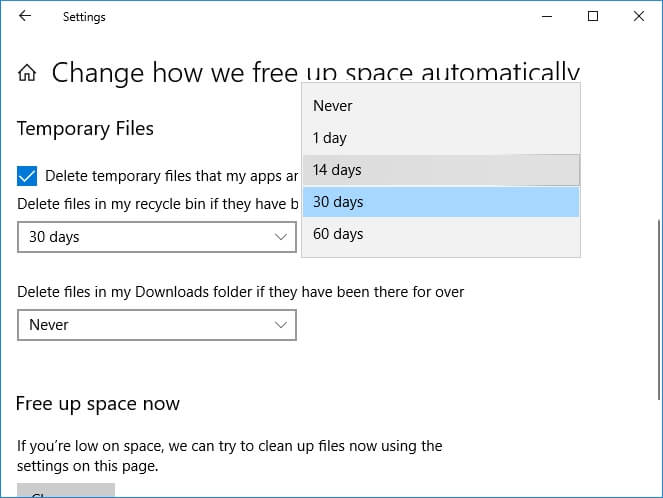
Step 1. Go to Settings > System > Storage.
Step 2. Move to Temporary Files, set up a cleanup plan for 1 day, 14 days, 30 days, or more.
Way 8. Run Anti-Virus Software to Clean Up Malware Regularly
Malware or virus infections can sometimes cause a system to report a low disk error even when the disk actually has enough free space, leading to confusion and potential data loss.
To avoid the issue, run antivirus software regularly to clear viruses and malware from your computer.
The Bottom Line
Low Disk Space refers to a condition where a computer's hard drive storage is running out of space, leading to errors and issues. If you're experiencing this error, it means your computer's storage is almost full, and you may encounter problems such as slow performance, crashes, and difficulty installing new software or saving files.
To resolve the issue, you can either extend the disk with low space or free up space on the disk.
To fix low disk space error on Windows 10/8/7, beginners can try Qiling Partition Master with the 4 methods listed in Part 2 to directly extend a hard drive, making it easy and efficient.
For daily regular prevention, try the other 8 ways listed in Part 2 to avoid low disk space issues.
If you have further concerns, check the answers listed below, your doubts may get released.
Related Articles
- Access GPT Protective Partition Without Losing Data
- How Do I Install a Second Hard Drive? Here Is the Complete Guide
- How to Migrate Linux Installation to New Drive
- "The Disk Check Could Not Be Performed" Solutions
- Clone Hard Drive to Larger Drive Without Reinstalling Windows and Programs
- Solved: Can't Remove Windows.old Folder in Windows 11/10
- How to Retrieve Files from WD Passport Efficiently? (3 Ways)
How to retrieve files from WD Passport? Refer to this essay and solve this problem with three utilities - WD SmartWare, Recoverit Pro and Qiling Disk Master Standard.
Products
Articles & Tutorials
- Data Recovery
- Data Backup
- File Recovery
- File Backup
- System Backup and Restore
- Disk and Partition Clone
- Technical articles
- Mobile articles
- Disk Master Help
- Windows Data Recovery Tutorials
- Windows Secure Delete Tutorials
- Windows Partition Management Tutorials
- Windows File Backup and Restore Tutorials
- Windows System Backup and Restore Tutorials
- Windows Disk Backup and Restore Tutorials
- Windows Clone Tutorials