Windows 11 End of Support Date and What to Do Next
In this article, you'll learn:
- Windows 11 End of Support Date
- What Happens When Windows 11 Reaches End of Service
- Can I Still Use Windows 11 (Sun Valley) After 2024
- After Windows 11 reaches its End of Support, you'll need to take action to ensure your system remains secure and functional. Consider upgrading to the latest version of Windows or exploring alternative operating systems like Linux or Chrome OS.
Windows 11 Release Date and Its Background:
It's been a well-Windows 11 was released on October 5th, 2021, and Microsoft made seven editions available for users to update and install, catering to different needs and preferences.
- Windows 11 Home
- Windows 11 Pro
- Windows 11 Pro Education
- Windows 11 Pro for Workstations
- Windows 11 Enterprise
- Windows 11 Education
- Windows 11 Mixed Reality
Windows 11 Home and Pro editions have the largest user base among the various editions, but a significant change from Windows 10 is the system requirements for installing Windows 11, which are more stringent, prompting Microsoft to recommend using a Windows 11 compatibility checker to confirm that a PC meets the requirements.
Update: Windows 11, also known as Sun Valley, is expected to be updated to the newest version, Windows 11 Sun Valley 2 (22H2), which will be released to all users in March 2022.
You may also like:
Windows 11's support is expected to end at some point, and users will need to take action when that happens. This page aims to provide information on what to expect and what steps to take when the moment arrives. By continuing to read, users can get answers to their questions and be prepared for the transition.
Windows 11 End of Support Date
Microsoft has released several editions of Windows 11 to improve its performance, but the company has also confirmed the end of service date for the operating system, which is October 10, 2024, for Home and Pro editions.
| Editions | Release Date | End of Support Date |
|---|---|---|
| Windows 11 Home (21H2) | Oct 4, 2021 | Oct 10, 2023 |
| Windows 11 Pro (21H1) | Oct 4, 2021 | Oct 10, 2023 |
| Windows 11 Education(21H1) | Oct 4, 2021 | Oct 8, 2024 |
| Windows 11 Enterprise (21H1) | Oct 4, 2021 | Oct 8, 2024 |
If your Windows 11 reaches the end of service, you'll likely experience various issues, including but not limited to, security vulnerabilities, lack of software updates, and compatibility problems with newer software and hardware. This can lead to a degraded user experience, increased risk of malware and other cyber threats, and potentially even system crashes or data loss. It's essential to stay informed about the end-of-service date and plan accordingly to ensure a smooth transition to a supported operating system.
What Happens When Windows 11 Reaches End of Service
As Windows 11's support comes to an end, several issues are expected to arise. These include the lack of security updates, which will leave users vulnerable to malware and other online threats, as well as the inability to receive critical bug fixes, which could cause system crashes and other problems.
#1. End of Mainstream Support
Once this ends, you'll continue to receive new updates for the new Windows operating system. Microsoft advises all Windows users to install new Windows updates if feasible.
#2. End of Extended Support
Microsoft will stop providing security patches for your computer once the extended support period ends.
The mainstream support for a software typically lasts for five years, after which it transitions to extended support that also lasts for around five years.
#3. No Further Updates
Once the extended support ends, Microsoft will no longer provide updates, including security fixes, which means your system will be vulnerable to viruses, bugs, and malware, leaving it to fend for itself.
Can I Still Use Windows 11 (Sun Valley) After 2024
Windows 11, also known as Sun Valley, is the latest version of the Windows operating system. It was released in 2021, not 2014.
The answer is both "YES" and "NO".
- You can continue using Windows 11 on your computer even after it reaches the end of service, as you own the computer and have the freedom to choose which operating system to use.
- A new operating system with security patches can provide a better work environment, making the "no" option a preferable choice.
As long as your computer meets the software and hardware requirements of Windows 11 or Windows N, it will be more secure and efficient to run the new system on your PC.
What Do I Do after Windows 11 Is End of Support
Once Windows 11 reaches end-of-life, you'll have two options: upgrade to the next version of Windows or switch to another operating system, such as Linux or macOS.
Whether to stay with Windows 11 or upgrade to a new operating system depends on your computer's hardware. If your device meets the system requirements for the latest OS, it's likely a smooth transition. However, if your hardware is outdated, it might be more efficient to stick with Windows 11 to ensure compatibility and optimal performance.
- For older computers, it's a good idea to stick with the current operating system to ensure they continue to run smoothly.
- For newer machines that are still compatible with newer Windows OS, you can choose to continue upgrading to the latest Windows version, such as the upcoming Windows Sun Valley 2.
#1. Stay with Windows 11
If you've decided to stay with Windows 11 on your computer, consider updating your drivers, disabling startup programs you don't use, closing unnecessary apps, and running a disk cleanup and disk defragmentation to free up space and improve performance. Additionally, consider upgrading your RAM, using a solid-state drive (SSD), and enabling the "Quick Access" feature to speed up file access.
1. Run Antivirus to Clean Up Virus and Malware
When Windows support ends, Windows Defender or Windows Security may no longer be able to block malware or viruses on your PC.
To ensure your computer is clean, run an antivirus tool or software to remove viruses and block malware from infecting your device.
For effective protection against malware and online threats, consider trying one of the following powerful antivirus software: Norton Antivirus Plus, Kaspersky Anti-Virus, Bitdefender Antivirus Plus, Avast Antivirus, McAfee Antivirus Plus, and Malwarebytes. These top-rated security tools offer robust features, real-time protection, and user-friendly interfaces to safeguard your digital life.
- AVG
- Avast
- Avira
- Eset
- McAfee
- Norton
2. Extend C Drive, Leave Enough Space in System C Drive
When a computer gets old, its operating system performance slows down due to various factors such as hardware issues, a full C drive, and even virus infections.
Among the factors that can slow down a computer, a full C drive is a top issue that can be easily resolved by managing disk partitions and utilizing existing free space on the drive.
To extend the C drive on your current Windows 11 computer, you can rely on professional partition manager software, such as Qiling Partition Master, which offers powerful features to efficiently extend the C drive.
Option 1. Extend System C drive with unallocated space
- 1. Click on the System C: drive and select "Resize/Move".
- 2. Drag the system partition end into the unallocated space so to add it to the C: drive. To extend the C drive, click on the "Extend Volume" button in the Disk Management console, select the unallocated space on the right, and click "Next". Then, select the C drive as the drive to extend and click "Next" again. Finally, click "Proceed" to execute the operations and extend the C drive.
Option 2. Extend System C drive without unallocated space
- 1. Click a big partition with enough free space on the system disk, select "Resize/Move".
- 2. Drag the big partition end into the small space. To shrink the big drive, click "Proceed" to execute the operations after you have confirmed the changes.
- 3. To extend the C drive, click on the system drive, select "Resize/Move", and drag the end of the System C drive into the unallocated space. Then, click "Proceed" to complete the extension.
3. Migrate Windows 11 to A Faster SSD
Migrating the OS from an old hard drive to a faster SSD can significantly improve a computer's performance with Windows 11, aside from addressing the full C drive issue.
SSDs outperform HDDs in both reading and writing speed, and their high stability makes them ideal for OS drives. Additionally, Qiling Partition Master's Migrate OS to HDD/SSD feature allows users to easily upgrade and replace their Windows 11 OS disk with a newer, faster SSD.
To ensure a smooth transition, install the new SSD correctly to your computer and initialize it in advance. This will help you avoid any potential issues and ensure that your system is ready for the upgrade.
Then, you can continue with the following steps:
Note:If you're planning to migrate your operating system to an SSD or HDD, be aware that the process will erase all data and partitions on the target drive if there's not enough unallocated space. Make sure to back up any important files to an external drive beforehand.
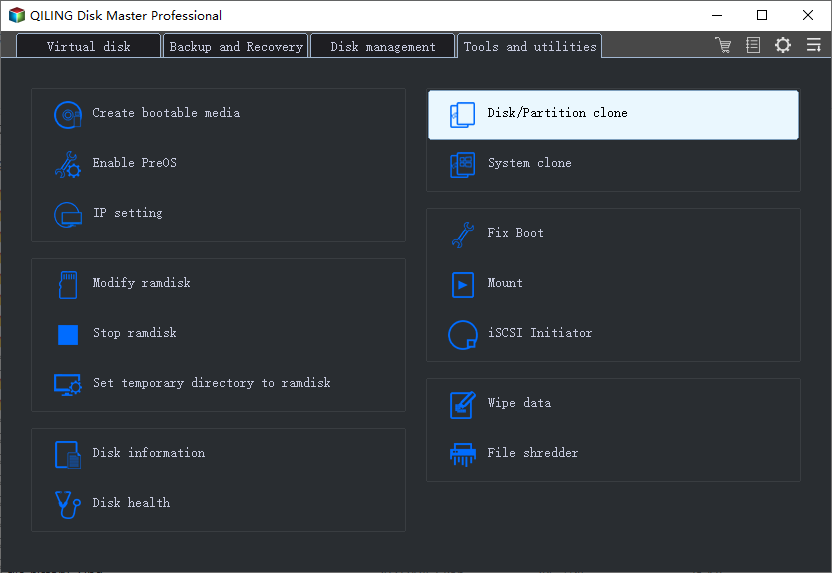
Step 1. Select "System Clone" on the tool page by clicking the icon at the right panel.
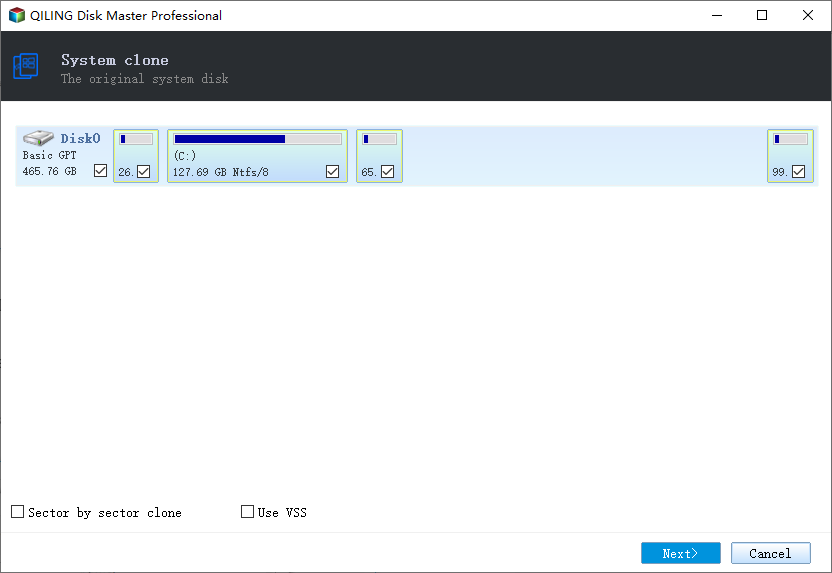
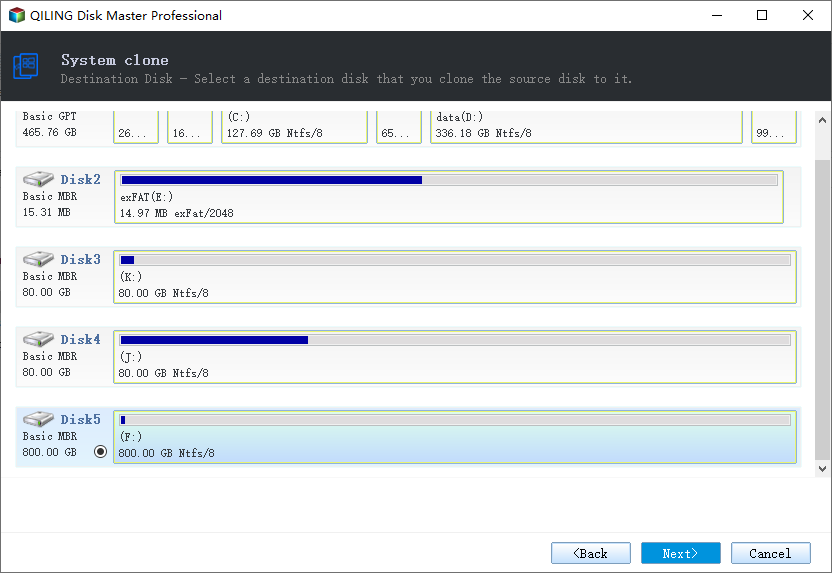
Step 2. Choose the destination disk - HDD/SSD to save Windows 10 system
Select the new HDD or SSD as the target disk for cloning the Windows 10 system.
Step 3. Then click "Proceed" to start cloning Windows 10 to HDD/SSD now.
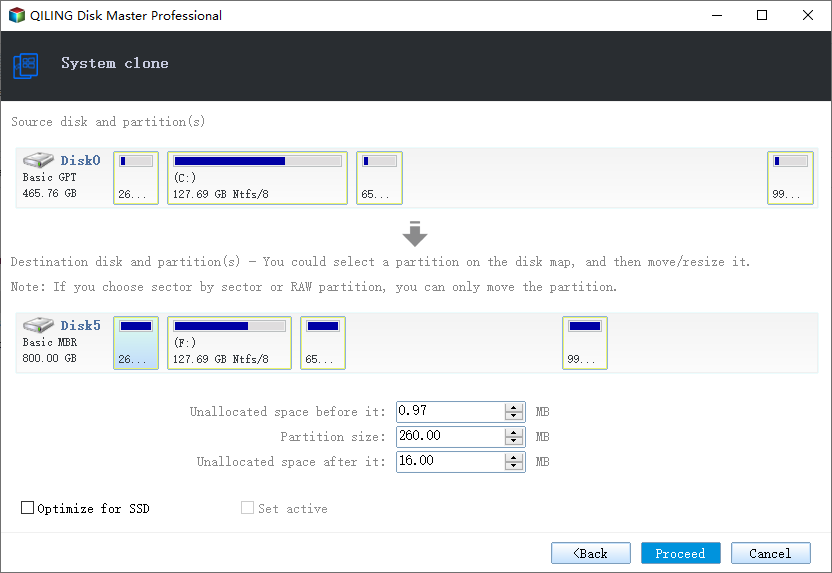
Insert your new HDD or SSD into your computer and reboot the PC. Change the boot order to set the computer to boot from the new HDD/SSD with the cloned Windows 10 system.
After upgrading your system, you'll need to configure the new SSD as the boot drive. To do this, go to the BIOS settings and select the new SSD as the boot device.
- To resolve the issue, simply restart your PC and press the F1, F2, or Del key (depending on your computer's model) as it boots up to enter the BIOS settings. This will allow you to access and configure the basic input/output system, which may have become corrupted or misconfigured, leading to the problem.
- To set the new SSD as the Boot drive, go to the boot order section and configure it to prioritize the SSD over the existing drive. This will ensure that the system boots from the SSD instead of the original drive.
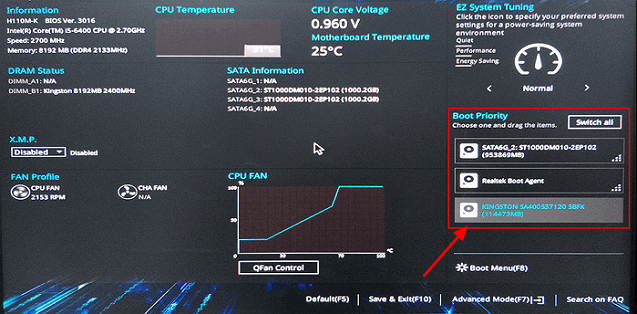
- Save and exit BIOS.
After the computer restarts, you can continue using Windows 11 with a faster speed on your computer. This is because the system maintenance task has completed, clearing out temporary files and freeing up disk space, which can improve overall system performance.
4. Create Backup of Essential Data
It's crucial to take good care of your data on your computer, especially since Windows 11's lifespan is limited.
If you want to backup your Windows 11 files, you can either manually copy them to an external storage device or upload them to a cloud drive. Alternatively, you can use a reliable automated backup software like Qiling Backup, which can backup all your files with just a few clicks.
#2. Upgrade Windows 11 to New Windows OS
If you prefer to upgrade your computer from Windows 11 to a newer OS after it ends service support, here's a complete guide to follow and get a new Windows update.
1. Check System Requirements of New Windows OS
The key to a successful operating system upgrade is ensuring that your current computer meets the system requirements, making it possible to seamlessly transition to the new OS.
Microsoft has confirmed that a new Windows edition is on the way, and to upgrade from Windows 11, your computer must meet or exceed the system requirements of Windows 11.
- Processor: 1 GHz or faster with 2 or more cores on a compatible 64-bit processor or System on a Chip (SoC).
- Memory: 4 GB RAM
- Storage: 64 GB or larger storage device
- System firmware: UEFI, Secure Boot capable
- TPM: Trusted Platform Module (TPM) version 2.0
- Graphics card: DirectX 12 compatible graphics / WDDM 2.x
- Display: >9'' with HD Resolution (720p)
- Internet connection: To set up a new Windows system, a Microsoft account and internet connectivity are required. This is necessary for the initial setup process, allowing the system to connect to Microsoft's servers and complete the setup process.
2. Upgrade to New Windows (11 Sun Valley 2) after the End of Service
To get the latest update for the newest operating system, Windows 11 Sun Valley 2, you can access it through two channels: the Windows Update section of your computer or through the Microsoft Update Catalog website.
In the event of a disaster, you'll be responsible for maintaining your computer. To ensure this, create a system recovery image for your system. For a step-by-step guide, refer to the guide on "How to Create a System Image Backup of Windows 11" for assistance.
Ensure your system C drive has sufficient space for the update, and if not, refer to Method 2 in Case 1 for assistance.
You can get Windows 11 22H2 - Sun Valley 2 from the Insider Program, which is Option 1.
- To open the Settings app on your Windows device, press the Windows key + S keys simultaneously, which will open the Search bar. From there, type "Update & security" and click on the result to open the Update & security page.
- Click "Windows Insider Program, then select "Dev Channel".
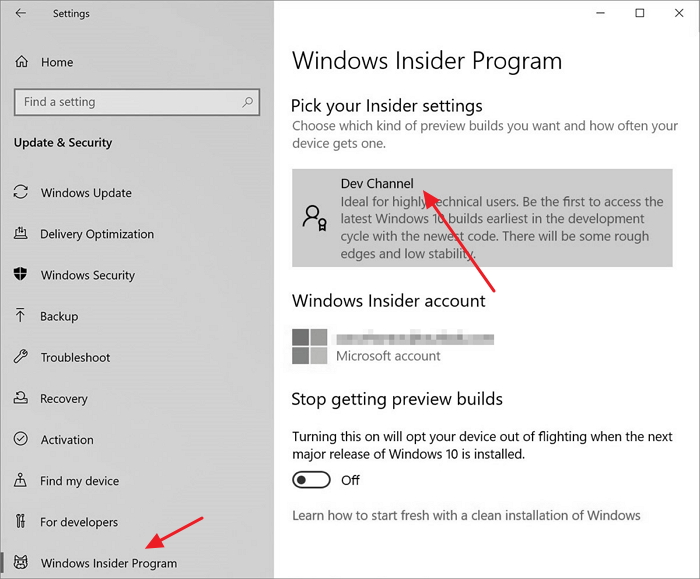
- Confirm the Privacy Statement, and click "Restart Now".
- Once the computer boots up, switch the Optional Diagnostic Data to On.
- To update Windows, go to Settings, then Update & Security, and click Check for updates.
Option 2. Download and Install Windows 11 22H2 Public Version
If a new version of Windows 11 or a newer system is available, you'll receive an update notice. If you've blocked the update notification, you can still get the update by following the steps provided, allowing you to access the latest features and security patches.
- To update Windows, go to Settings, click "Update & Security", then click "Windows Update" and finally click "Check for updates".
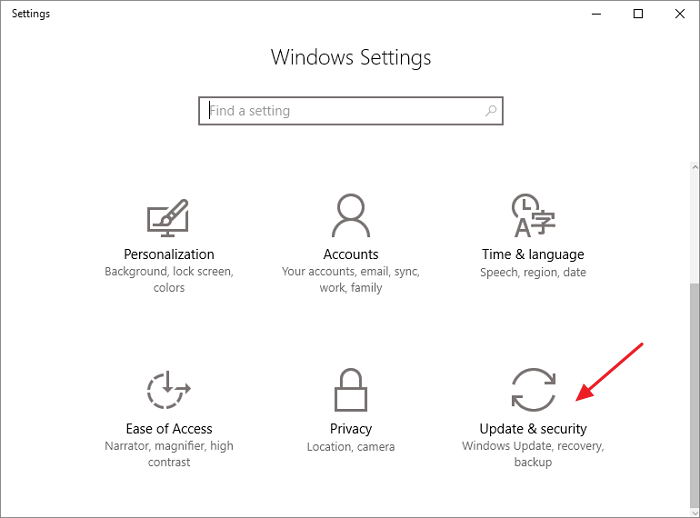
- Once a new update is found, click "Install Now" to install the newest version of Windows.
By following the onscreen guidance, you can successfully install a new operating system on your PC, even after Windows 11 ends its support.
Conclusion
On this page, we addressed the issue about when Windows 11 will end its support and provided a complete guide on what to do if Microsoft has ended its support for this system, so don't panic.
If you're considering upgrading Windows 11 to a newer operating system, you'll first need to decide whether to stay with Windows 11 or continue to the next version. Once you've made that decision, you can follow the tips on this page for assistance. Hope you find the information helpful.
Related Articles
- 2022 Solved: Unable to Format SD Card, SD Card Won't Format on PC/Android
- Partition Clone Guide | Clone EXT4/EXT3/EXT2 Partitions in Windows 10
- How to Move Partition in Windows 11/10/8/7? [New]
- How to Move Space from D Drive to C Drive Windows 11/10/8/7
- How to Transfer Windows 10 OS to SSD Without Reinstalling Windows
Learn how to transfer Windows 10 or Windows 11 to an SSD without reinstalling Windows, apps, or personal files. - How to Upgrade/Clone Xbox 360 Slim HDD to A Bigger HDD in 3 Steps
If your Xbox 360 hard drive or slim hard drive is getting full. This article will guide you through a simple 3-step process to upgrade and clone your Xbox 360 slim hard drive to a bigger HDD, allowing you to keep all your game files without. - Windows 11 24H2 End of Support: What to Do Next (2026)
Products
Articles & Tutorials
- Data Recovery
- Data Backup
- File Recovery
- File Backup
- System Backup and Restore
- Disk and Partition Clone
- Technical articles
- Mobile articles
- Disk Master Help
- Windows Data Recovery Tutorials
- Windows Secure Delete Tutorials
- Windows Partition Management Tutorials
- Windows File Backup and Restore Tutorials
- Windows System Backup and Restore Tutorials
- Windows Disk Backup and Restore Tutorials
- Windows Clone Tutorials