What Does Format Disk Mean? [Most Detailed Answer 2022]
Disk formatting is the process of preparing a storage drive for a new operating system to read and write data. It essentially wipes the drive clean of existing data and sets it up for fresh use, allowing the OS to write new data and improve overall computer performance.
What Does Format Disk Mean? Everything You Should Know
Go ahead and summarize the main points about a formatted disk in one paragraph. I'll wait.
What Is Formatting Definition?
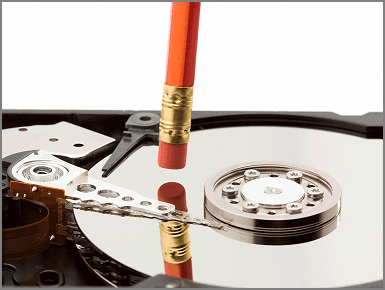
Formatting a disk erases the operating system data and reorganizes the available space, deleting existing data and leaving the disk blank, allowing for a new system or extra space to be used.
Process of Formatting in Computer
Formatting a disk involves three main processes: preparation, formatting, and verification. Preparation involves checking the disk's compatibility and ensuring it's properly connected to the computer.
1. Low-level Formatting
The factory process of marking columns and tracks on a blank drive, followed by sector division, can render data unrecoverable. This marks the foundation of the disk.
2. Partitioning
A disk partition is a division of a disk into one or more sectors, allowing for manipulation of these sectors, and can also be used to check for sector problems.
3. High-level Formatting
The process involves writing a file system or partition label to the newly created partition, allowing you to wipe the drive and reinstall the operating system on the disk.
Does Formatting a Disk Delete Everything?
Formatting a disk does not erase everything on the disk, it only removes the index that allows access to the information, effectively erasing the partition table and rebuilding it, but not deleting the actual data.
Formatting a disk is necessary to remove unwanted files, free up space, and prepare the disk for new data or operating system installation, which can improve system performance and prevent data corruption.
What Does Format Disk Do?
Formatting a disk, whether it's a hard drive or a removable media like a USB drive, involves completely erasing all data on the device and reorganizing the storage system to make it ready for new data. This process doesn't just delete files, but also rewrites the disk's file system, partition table, and other metadata, making it impossible to recover any previously stored information. As a result, formatting a disk is a more thorough and secure way to erase data compared to simply deleting files, and it can also provide other benefits, such as improving disk performance and making it easier to manage and organize new data.
1. Deleting data
Formatting a disk can delete all the data on the hard drive, so it's essential to back up your data before doing so to avoid data loss and privacy concerns.
2. Change the file system
Some file systems may not be compatible with another device, so it's necessary to change the file system from NTFS to EXT2/3/4 by formatting the disk or converting FAT to NTFS.
3. Increase space
Formatting a disk will erase all data on it, freeing up space.
4. Improve performance
Formatting a disk can improve your computer's performance by cleaning up system files and removing some malware, and also restore your computer to an undamaged state.
How to Format a Disk on Windows? [Three Ways]
Formatting a disk can benefit you in many ways. Formatting is necessary when you need to reinstall your operating system. So, do you know how to perform a formatted disk? Next, I will provide three ways to format a disk on Windows. I will start with the easiest method, and you can freely choose one of them.
Method 1: Format Disk with Qiling Partition Master
Qiling Partition Master is the best software to manage disks, supporting disk space adjustments and partition management on Windows 11/10/8.1/8/7 and XP. It allows for effective formatting of disks or erasing partitions, with a user-friendly interface. To format a disk, users can follow these steps:
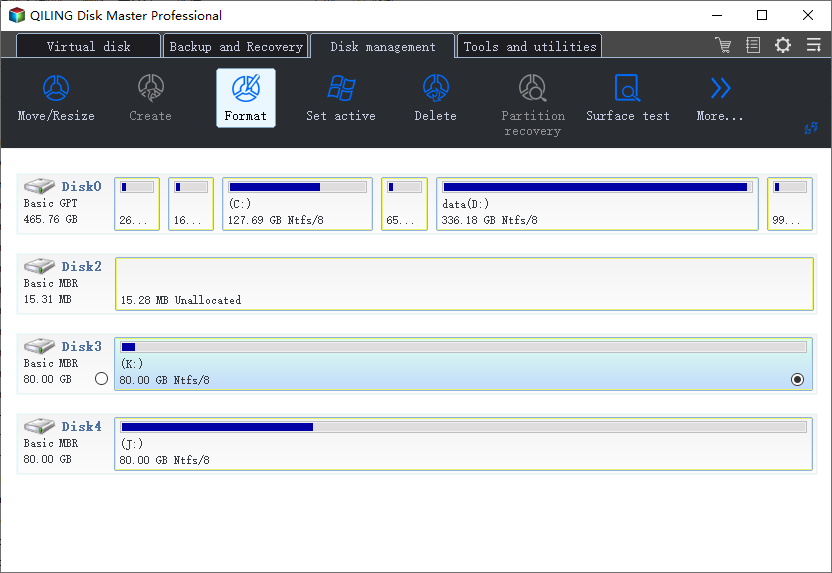
Step 1. Run Qiling Partition Master, right-click the hard drive partition you intend to format and choose "Format".
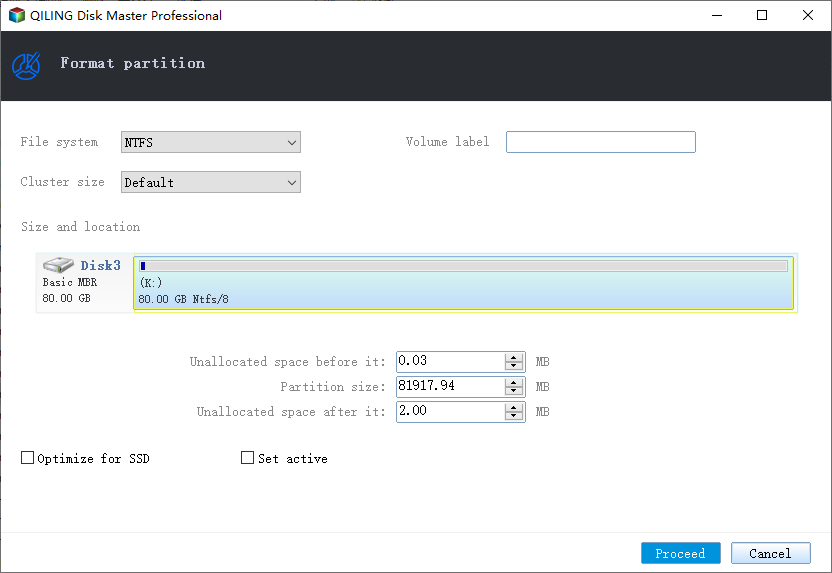
Step 2. To format a partition, open the new window, set the Partition label, File system (NTFS/FAT32/EXT2/EXT3/EXT4/exFAT), and Cluster size for the partition to be formatted, then click "Proceed".
Step 3. You will see a warning window, click "Yes" to start formatting the partition on your hard drive.
Qiling Partition Master offers benefits beyond just formatting a disk, including.
- Format USB to boot
- Delete and create a partition
- Convert MBR to GPT
- Clone (System) Partitions
- Convert to NTFS/FAT32
Method 2: Format Disk with Disk Management
To format a disk on a Windows system, you can use the built-in Disk Management tool. With it, you can easily format the disk by following these steps:
Step 1. Press Windows+R, type diskmgmt.msc, and click "OK."
Step 2. If it's a new drive, click on the drive and select "Initialize Disk" to initialize the drive.
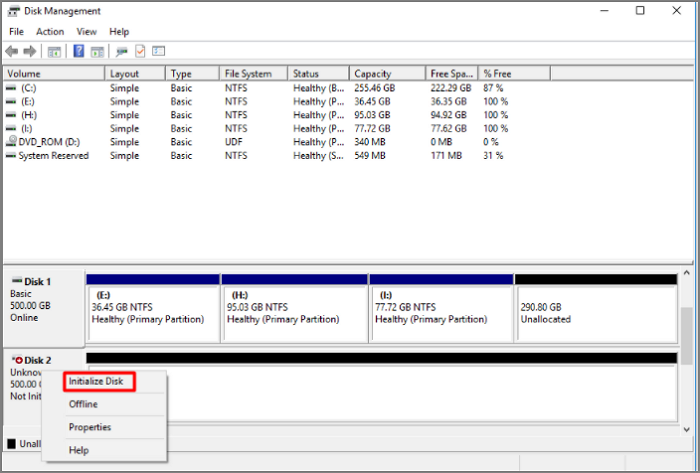
Step 3. Convert the drive to MBR or GPT and click "OK."
Step 4. If the drive isn't a new one, click on it and select "Format" from the options.
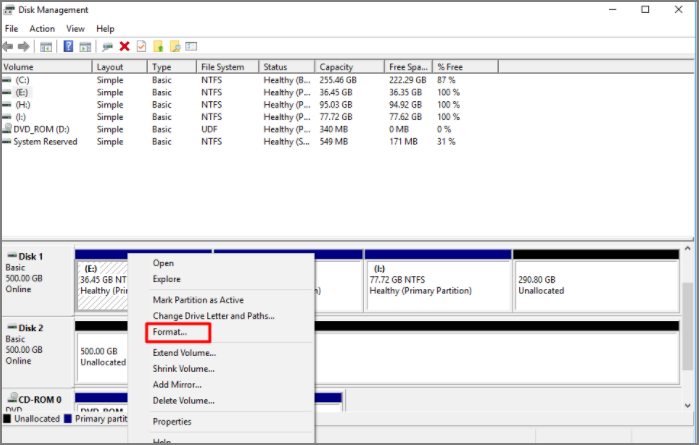
Step 5. Select the volume, file system, and size of the partition, then click "OK."
Step 6. Click "OK" to complete the formatting operation

Method 3: Format Disk with DiskPart
Diskpart is another utility in Windows to manage disks, which can be run using a command. To format a disk, follow the steps in Diskpart.
Step 1. Press Windows+R, type diskpart, and click "OK".
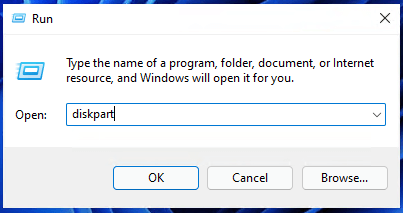
Step 2. To assign a drive letter to a partition or volume, use the command: `assign letter=drive_letter`. To delete a partition or volume, use the command: `delete partition=partition_number`. To clean a partition or volume, use the command: `clean`. To create a new partition or volume, use the command: `create partition=partition_size primary` or `create volume=volume_size`.
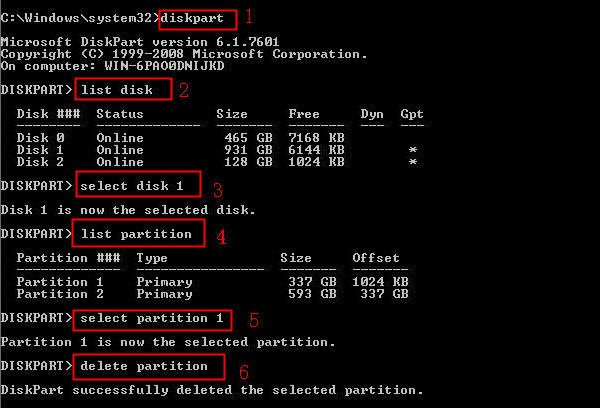
- list disk
- select disk N (N stands for the drive you want to format)
- list partition
- select partition N (N stands for the partition you want to format)
- format fs=ntfs quick
Formatting a disk using Diskpart can be complicated, and wrong commands can lead to severe problems. That's why I highly recommend utilizing professional disk management software. Qiling Partition Manager is a perfect choice. If you are interested in diskpart, click the link below to learn more.

Mastering Diskpart commands on Windows can be a game-changer for computer enthusiasts. With a command-line interface, Diskpart allows users to manage and manipulate disk partitions, including creating, deleting, and formatting partitions.
Formatting a drive does not erase data on the disk, but rather updates the file system's table of contents, making files inaccessible. This makes file recovery much more difficult, but not impossible. Formatting a drive is not the same as wiping, which involves intentionally erasing data from the disk. Formatting is a process that reinitializes the drive, making it ready for new data, but it does not remove existing data.
Conclusion
Formatting a disk refers to the process of preparing it for use by a computer, which involves deleting all data and reorganizing the disk's structure. This process can be achieved through various methods, including using software such as Qiling Partition Manager, which can be a convenient and efficient option. If you're looking to format a disk for your computer, you can choose one of these methods, and Qiling Partition Manager is a good choice to consider. You can download it to try it out and learn more about its features.
FAQs About What Does Format Disk Mean
Formatting a disk refers to the process of preparing a storage device, such as a hard drive, solid-state drive, or USB drive, for use by erasing all data and reorganizing the file system. This process can be done using built-in formatting tools, such as the built-in disk formatting utility in Windows or the Disk Utility app on macOS. To format a disk, users can follow the steps outlined in this article, which includes selecting the disk to be formatted, choosing the file system and format type, and confirming the formatting process.
1. What does format disk mean on USB?
Formatting a USB drive means deleting all data on it and creating a new file system, freeing up space to store new information and potentially organizing it in a way that maximizes storage capacity.
2. When should I format my disk?
When your file system format is incompatible or you need to reinstall the system, you can choose to format the disk, which will then be available for use.
3. Does the format delete everything?
The format does not delete everything on your computer. Instead, it erases the "index" that allows you to access the data, but it does not erase the actual data blocks around the disk.
Related Articles
- How to Fix IRQL_NOT_LESS_OR_EQUAL Error in Windows 10/8/7
- Your Complete Guide to Format Macintosh Hard Drive [Lately Upgraded in 2022]
- Back Up and Restore Outlook 2016 for Mac
- Mac Format SSD: How to Format SSD on Mac [Step-by-Step Guide]
- Computer Restarts When Playing Games | 10 Fixes🔥
The issue of computer restarts when playing games can be easily resolved if we understand the underlying reasons. This post explores the common causes and provides ten practical solutions to solve the problem, allowing you to enjoy gaming without interruptions. - Computer Shuts Down When Playing Games [Here's What to Do]
Do you know how to fix the computer shuts down when playing games issue? This article will explain the causes of a computer shutting down while gaming and offer 7 solutions to fix this problem. After reading this post, you can pick any method to help you fix this problem.
Products
Articles & Tutorials
- Data Recovery
- Data Backup
- File Recovery
- File Backup
- System Backup and Restore
- Disk and Partition Clone
- Technical articles
- Mobile articles
- Disk Master Help
- Windows Data Recovery Tutorials
- Windows Secure Delete Tutorials
- Windows Partition Management Tutorials
- Windows File Backup and Restore Tutorials
- Windows System Backup and Restore Tutorials
- Windows Disk Backup and Restore Tutorials
- Windows Clone Tutorials