How to Back Up Windows 10 Image to Cloud [Backup Strategy in 2022]
Many Windows users save their backup images on the cloud for its efficiency, security, and accessibility, ensuring they can access system files even if the local hard drive is corrupted or fails to boot.
This article will guide you in implementing a new backup strategy on your Windows 10 device in 2022, and also show you how to back up Windows 10 images to the cloud using Qiling Backup Free, a third-party tool.
What Is A Windows 10 Backup Image?
A Windows 10 backup image is a snapshot of the data within your computer's C: drive and comprises the operating system (OS), settings, and file history, also known as a system image.
- Full-system backup
- System image backup
- Whole-system backup.
The C: drive typically has at least four partitions. When making an image backup, it captures the entire contents of each partition, including bits and bytes. If you restore this backup image later, it will overwrite the existing contents on your C: drive, effectively replacing them with the new data from the backup. This means the contents of the backup image will be written fresh onto your target drive.
Tools to Create a Windows 10 Backup Image
To create a backup on Windows 10, you can use Windows Backup and Restore, which was initially meant for Windows 7 users but is also available for Windows 10 and 11, or consider using a dedicated windows backup and recovery software.
Windows 10 allows you to create system restore backup images, which can also be accessed from previous Windows versions, by creating a backup to a network shared folder or external drive. Alternatively, third-party software such as Qiling Backup can be used to quickly and conveniently make Windows 10 image backups.
What Makes cloud backup Popular?
Cloud backup is a secure way to store files, reducing the risk of data loss due to disasters, theft, damage, or fires, unlike local storage. It also saves time spent on manual file backups.
Cloud backup is popular because it happens automatically with a stable internet connection, providing a seamless transfer of data from local storage to the cloud. Additionally, cloud backup allows for easy data accessibility, enabling access to backed-up information anywhere, even if the local computer is damaged.
Cloud backup minimizes the risks of system downtime following a breach on your local backup, allowing you to automatically switch to cloud access without slowing down your system.
Cloud backup is cherished by most people because it allows for faster data restoration. In the event of a disaster, you won't have to waste time searching for data stored on an external drive, but can instead quickly recover it from the cloud.
Comparison between cloud backup and Local Backup
| Cloud backup | Local Backup |
|---|---|
| Easy to scale with no limit of storage | Has limited storage |
| You can access data remotely | You must be physically connected to your device to access data. |
| Data is saved on an off-site server | Data is saved on a disk-based hardware |
| Costly to store large amounts of data | Cheaper to store large amounts of data |
| Security is guaranteed due to end-to-end data encryption | Is sometimes prone to physical disasters and cyber attacks |
| Managed by the cloud service providers | Managed by your local IT staff |
Cloud backup and local backup are two popular methods for data preservation. While local backup involves storing data on a physical device, such as an external hard drive, cloud backup stores data on remote servers accessed through the internet.
Cloud backup and local backup are two different methods of backing up data, each with its own advantages and disadvantages. Cloud backup stores data on remote servers, providing accessibility and scalability, while local backup stores data on a physical device, offering faster restoration times and security. Ultimately, the best approach is often a combination of both, where critical data is backed up locally for quick restoration and additional data is stored in the cloud for added security and accessibility.
Is cloud backup Available in Windows 10?
Microsoft provides cloud storage through OneDrive on Windows 10, but it does not offer a cloud backup solution for full system backups. Additionally, OneDrive's limited storage capacity makes it difficult to store large files.
To fully back up your system files, you'll need third-party backup software installed on your computer. This software allows you to back up all data on your C: drive to the cloud, making it easy to recover in case of a system failure or other disaster.
The advantage of most third-Party Tools offers a generous free storage space for users to save their files, providing a convenient and accessible solution for managing digital content.
Best Free cloud backup Software for Windows 10
Qiling Backup Free is a highly recommended backup software for Windows 10 users. It offers disk imaging and cloud-based file saving, allowing users to create a bootable backup and recovery image in case of system crashes or malware attacks.
The application requires an internet connection to connect to the cloud and start saving system files, utilizing a secure, flexible, and cost-effective cloud storage service that provides up to 250GB of free storage space for every user.
Why Choose Qiling Backup Over OneDrive?
Qiling Backup for Windows 10 offers enhanced backup efficiency compared to OneDrive and Google Drive cloud storage services. It allows for differential or incremental backups based on a previous full backup, saving disk space by only backing up changed data.
Qiling Backup allows basic backup scheduling, enabling automatic backups on a daily, weekly, or monthly basis through its auto-backup feature. It also supports multi-path backup storage, allowing data to be backed up to a network, cloud, or external hard drive.
How to Back Up Windows 10 Image to Cloud with Qiling cloud backup
Qiling cloud backup allows you to save your Windows 10 image to the cloud using a WinPE bootable disk, which can be used to restore or reinstall your computer system in case of a failure or boot issue. To back up Windows 10 images to Cloud using Qiling Backup, follow these steps.
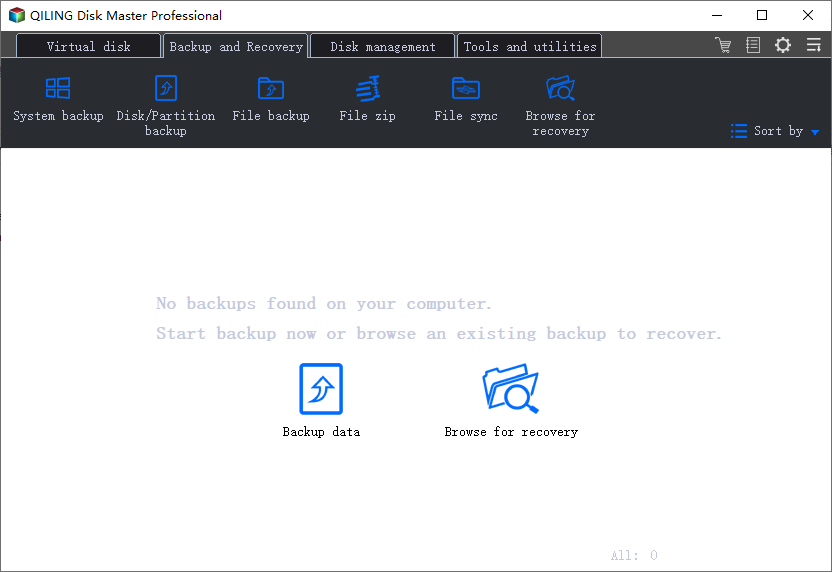
Step 1. Launch Qiling Backup on your computer, and click System Backup on the home screen to start the backup process.
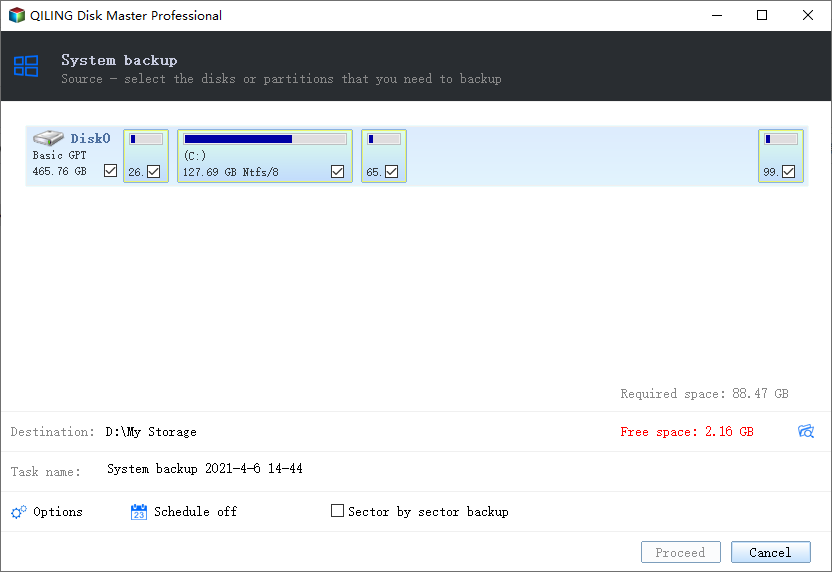
Step 2. To begin, your Windows operating system information and all system-related files and partitions will be automatically selected, eliminating the need for manual selection. Next, you'll need to choose a location to save the system image backup by clicking on the illustrated area.
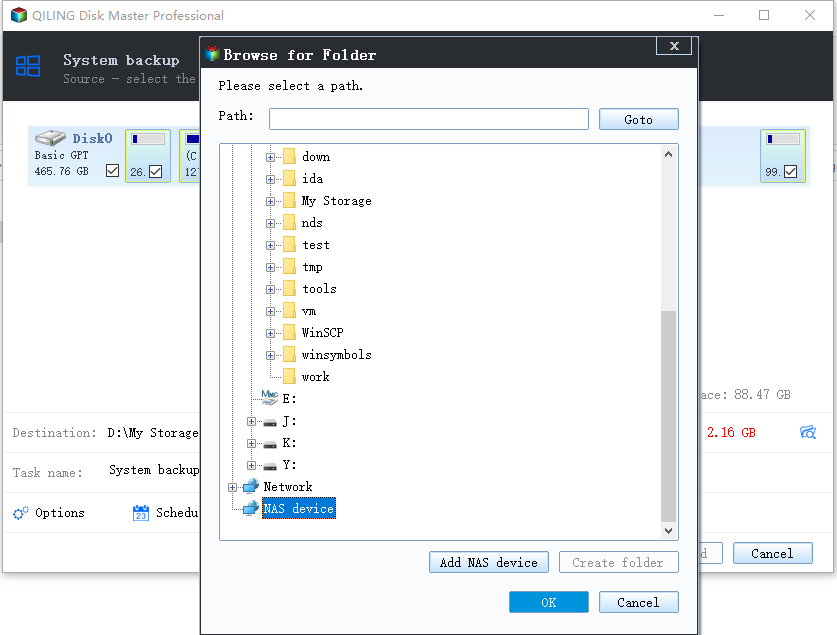
Step 3. The backup location can be another local drive, an external hard drive, network, cloud, or NAS. We recommend using an external physical drive or cloud to store system backup files, as they provide a safe and secure way to preserve your data.
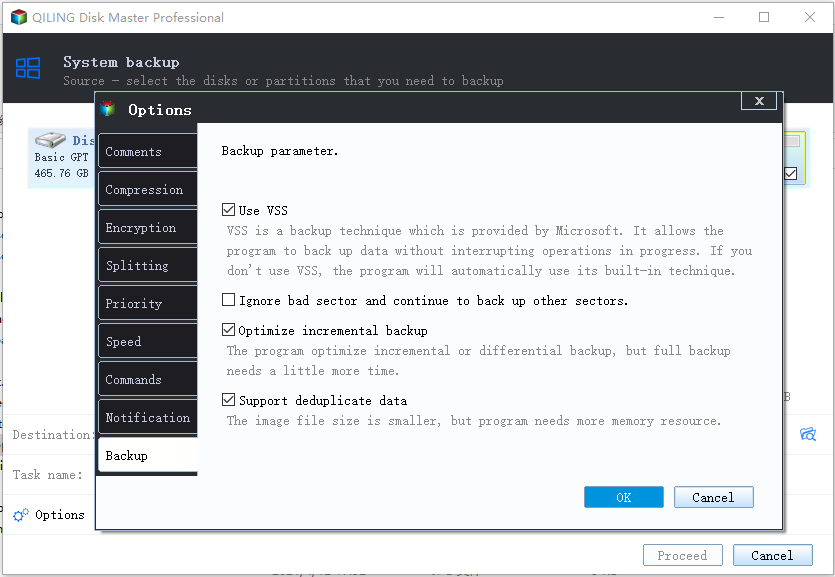
Step 4. To customize your Windows system backup, click on the Options button. Here, you can set up automatic backup schedules on a daily, weekly, or monthly basis, or even upon a specific event. You can also choose to make differential and incremental backups. Once you've set your preferences, click Proceed to initiate the backup process.
Conclusion
Backing up your Windows 10 image on the cloud is the best backup strategy in 2022, ensuring the safety of your system files in case of a malware attack or system failure. You can use Windows Backup and Restore (Windows 7) or third-party backup software to back up your Windows 10 image files, guaranteeing access to your OS settings and essential files.
The best software to back up your Windows 10 image to the cloud is Qiling Backup Free, which allows for backup scheduling, enhanced efficiency, and bootable backup and recovery. To get started, simply download and install Qiling Backup Free on your computer.
Related Articles
- Which One to Choose: What is the Best Gaming Laptop?
- How to Back up Windows 10 to Network Drive: 3 Ways Explained
- Two Ways: Encrypt Backup Drive to Protect Your Data
- How to Migrate Windows 11 to SSD
- Create Windows 10 Recovery USB (Including Windows 11, 8.1, 7)
A Windows 10 recovery USB is a helpful tool for repairing or reinstalling Windows 10 after a hardware failure or system crash. It's a guide for Windows 11/10/8.1/7 users to understand what a recovery USB is, how it differs from a repair disc or system image, and how to create one in Windows 10. - Ultimate Guide on Windows 10 Restore from Backup
This guide explains on restoring Windows 10 from a backup, with or without software. It recommends using Qiling Backup, which can back up everything and is easy to use.
Products
Articles & Tutorials
- Data Recovery
- Data Backup
- File Recovery
- File Backup
- System Backup and Restore
- Disk and Partition Clone
- Technical articles
- Mobile articles
- Disk Master Help
- Windows Data Recovery Tutorials
- Windows Secure Delete Tutorials
- Windows Partition Management Tutorials
- Windows File Backup and Restore Tutorials
- Windows System Backup and Restore Tutorials
- Windows Disk Backup and Restore Tutorials
- Windows Clone Tutorials