Find Recycle Bin on iPhone 13/12/11 and Restore All Lost Files [Resolved]
Summary
Many iPhone users struggle to find deleted files, such as photos, contacts, or messages, after accidentally deleting them on their iPhone or iPad. Unlike Windows or macOS, iPhone doesn't have a traditional Recycle Bin, leaving users wondering where deleted files go and how to recover them. This page aims to address these questions, providing information on where to find the equivalent of a Recycle Bin on iPhone and how to perform iPhone trash recovery.
To find the recycle bin on your iPhone, follow these steps: follow the steps below. Once you've located the recycle bin, you can use a powerful solution to restore your lost iPhone or iPad files.
| Workable Solutions | Step-by-step Troubleshooting |
|---|---|
| Is there a Recycle Bin iniPhone | Unlike Windows OS or macOS X, there is no Recycle Bin nor Trash on iPhone or iPad...Full steps |
|
Where Is Trash on iPhone |
Since there is no Recycle Bin on iPhone, then you'll have nowhere to find the recycle bin location...Full steps |
|
How to Empty Recycle Binon iPhone |
While the entire iPhone is not configured with a recycle bin, many apps have Deletedfolders that can be...Full steps |
| iPhone Recycle Bin Recovery Without Backups | If you want to recover permanently deleted files from recycle bin on iPhone, an iOS files recovery tool...Full steps |
|
Restore iPhoneFiles with iTunesBackup |
Connect your iPhone to your PC. Launch iTunes on your PC.Click the phone icon in the upper left corner...Full steps |
Is there a Recycle Bin iniPhone13/12/11/X/8/7
There is no Recycle Bin or Trash on iPhone or iPad. Instead, deleted files and apps are moved to the "Recently Deleted" album in the Photos app or the "Offload Unused Apps" section in Settings.
Unlike Windows and macOS, iPhone and iPad do not have a Recycle Bin or Trash Bin feature to store deleted files.
Where Is Trash on iPhone
There is no Recycle Bin on iPhone, so there is no location to find it. The iPhone has a "Recently Deleted" album in the Photos app, where deleted photos and videos are stored for 30 days before being permanently deleted. If you're looking for a location to find deleted files, you might be thinking of the "Recently Deleted" folder in the Files app, but this is not the same as a Recycle Bin.
If you deleted some files in an app on your iPhone, you may be able to recover some individual photos or other files from the app's cache, which can be accessed through the phone app.
How to Empty Recycle Binon iPhone/iPad
Many iPhone and iPad users have asked online for answers to this question.
iPhone and iPad users often experience a buildup of trash files, which can accumulate in the device's cache and recycle bin, even after deleting specific files or apps. This can lead to storage space issues and slow device performance.
The iPhone has a feature where many apps have a "Deleted" folder that acts as a recycle bin, allowing users to clean up files and free up memory by going to the corresponding recycle bin of these apps.
To empty the trash on an iPhone 13, 12, 11, X, 8, or 7, follow these steps: go to Settings, then scroll down to the "Files" section, tap on "Manage Storage," and select "Show All Files." Next, tap on "Recently Deleted" and select the files you want to delete permanently.
iPhone Recycle Bin Recovery Without Backups
If you've permanently deleted files on your iPhone, there's no straightforward way to restore them. However, if you had backed up your iPhone to iCloud or iTunes before deleting the files, you might be able to recover them from the backup.
- One way is to restore lost files from your iTunesbackups.
- If you've deleted iPhone data without backups, there are still ways to recover it. One method is to use a third-party recovery program that can scan your iPhone and recover deleted data, such as contacts, messages, and photos.
Qiling MobiSaver fully supports restoring deleted iPhone contacts, emails, photos, messages, and call history from iOS 13/12/11/X/8/7 devices.
You can download and install the iPhone software on your PC to recover deleted data from your iPhone even if you haven't backed up your device.
Plus: Please note that to fully utilize this software, you need to purchase a serial key to activate it. If the tool fails to meet your expectations, your purchase will be refunded.
Step 1. Choose the Recovery Mode
Connect your iPhone to your PC, then launch Qiling MobiSaver. Select the recovery mode as "Recover from iOS Device" and click "Start".
Step 2. Scan iPhone and Find Lost Data
Qiling MobiSaver will automatically scan your iPhone and find both present and lost data for you.
Step 3. Preview and Restore iPhone Data
You can recover lost data from your iPhone, such as photos, videos, contacts, messages, notes, voice mails, or other files, by selecting the type of data you want to recover, and then clicking "Recover" to save it to another location.
Restore iPhone Deleted/Lost Files with iTunesBackup
You can restore deleted files on your iPhone using either iTunes or third-party iOS data recovery software.
1. Howto Restore iPhone from iTunes Backup
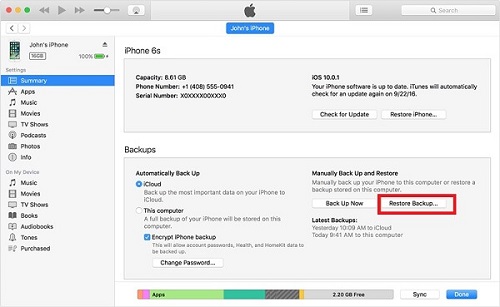
Step 1. Connect your iPhone to your PC using a USB cable, then launch iTunes on your PC.
Step 2. Click the phone icon in the upper left corner.
Step 3. Click "Restore Backup" under Backups in the right panel.
Step 4.Select an iTunes backup, then click "Restore" to restore your iPhone, and if the backup is encrypted, enter the password beforehand.
2. Howto Restore Lost Files from iTunes Backup with iOS Data Recovery Software
If you're having trouble restoring your iPhone using iTunes, consider using iOS data recovery software to help you recover your data.
Step 1. Run Qiling MobiSaver
To recover data from an iPhone or iPad, first download Qiling MobiSaver, then connect your device to your computer, start Qiling MobiSaver, select "Recover from iTunes Backup" and choose an iTunes backup.
Step 2. Unlock iTunes
If the iTunes backup is encrypted, you'll need to enter the password to unlock it. Once unlocked, Qiling MobiSaver will automatically scan the backup file to find the lost data.
Step 3. Preview and Recover Data from iTunes
After scanning, preview the contents of your lost photos, videos, contacts, messages, notes, and SNS data. Select the desired file and click "Recover" to save it on your computer.
The Bottom Line
Unfortunately, there is no traditional "Recycle Bin" on an iPhone, but many apps have a "Deleted" folder that can be used as a temporary storage for deleted files. If you need to recover deleted files, you can try restoring them from an iTunes backup.
If you don't have an iTunes or iCloud backup, don't worry. You can use Qiling iOS data recovery software to easily restore lost photos, videos, contacts, messages, and more files.
Related Articles
- [Solved] iPhone Messages Disappeared But Still Taking up Space
- Recover Deleted WhatsApp Photos and Videos on iPhone/iPad/iPod
- 5 Proven Ways to See Old Kik Messages on iPhone/Android
- How to Check Data Usage on iPhone [Full Guide]
- How to Open Password Protected Excel Files
If you're having trouble opening password-protected Excel files, Our guide can help with all the correct methods to unlock them. - Microsoft Outlook 2016/2013/2010 Not Responding in Windows 10/11 (5 Fixes)
When Outlook not responding in Windows 10, the first thing you should do is restoring the lost Outlook emails. Find effective methods here and you can restore all lost Outlook emails and repair not working Outlook with ease.
Products
Articles & Tutorials
- Data Recovery
- Data Backup
- File Recovery
- File Backup
- System Backup and Restore
- Disk and Partition Clone
- Technical articles
- Mobile articles
- Disk Master Help
- Windows Data Recovery Tutorials
- Windows Secure Delete Tutorials
- Windows Partition Management Tutorials
- Windows File Backup and Restore Tutorials
- Windows System Backup and Restore Tutorials
- Windows Disk Backup and Restore Tutorials
- Windows Clone Tutorials