Your Best Guide for SSD Speed Test on Windows 10 | Step-by-Step Guide 2024
Key Takeaways of SSD Speed Test on Windows 10:
- If you own or use SSD drives on your laptop or computer, you can check their speed on Windows 10. This step-by-step guide shows you how to run a speed test on your SSD, providing you with valuable information about its performance. By following these instructions, you can learn how to check your SSD speed on Windows 10 and optimize its performance for faster loading times and improved overall system responsiveness.
- This guide is specifically useful for Windows 10 users, but the methods described can also be applied to other Windows versions, such as Windows 11, 8.1/8, and older versions, to check SSD speed.

How Do I Check My SSD Speed on My Computer? SSD Speed Test on Widows 10
Checking SSD speed can be challenging for beginner users, but we've simplified the process. To check SSD speed on Windows 10, you can use one of the three easy methods listed, which are also applicable to other Windows versions, including Windows 11, 8.1/8, and older versions. These methods will enable you to easily check your SSD speed, even without extensive technical knowledge or experience.
The three methods to get a loan are a personal loan, a home equity loan, and a credit card cash advance. A personal loan is a straightforward loan that can be used for any purpose, such as consolidating debt or financing a large purchase.
The three methods have varying levels of technical skill required, complexity, and price. The first method is relatively simple and requires minimal technical skills, making it accessible to a wide range of users.
| SSD Speed Test Methods🎯 | Complexity Level🔢 | Price💰 | Target Users👔 |
|---|---|---|---|
|
To test the speed of your SSD, you can use Qiling Disk Master, a software specifically designed for this purpose. This tool will help you measure the read and write speeds of your solid-state drive, providing you with a detailed report on its performance. By using Qiling Disk Master, you can determine whether your SSD is working at its optimal speed and identify any potential issues that may be affecting its performance. |
Very easy to perform | $0 | For beginners, suitable for everyone |
| 2. Run CMD to Test SSD Speed | Medium | $0 | For experienced users |
| 3. Use Task Manager | Medium | $0 | For experienced users |
To test SSD speed on Windows 10, we'll go through each method's detailed operational steps. We'll move on to the next step, where we'll examine each method's specific procedures to assess SSD performance. This will provide a comprehensive understanding of how to evaluate SSD speed on Windows 10.
Guide 1: Qiling Disk Master
- ⏲ Duration: 2-4 minutes
- 🧰 Tools: SSD, connection cable, Windows 10, Qiling Disk Master
- 🚩 Applies to: Test SSD speed, generate and export speed test report.
For beginner Windows 10 users, Qiling Disk Master is a simple and easy method to test SSD drive speed. Its new DiskMark feature allows you to quickly test your SSD drive speed, making it a convenient option for those unfamiliar with Windows technology.
Don't wait - download Qiling Disk Master now and follow the operational steps to quickly test SSD speed.
Step 1. Launch Qiling Disk Master, then click the download button to activate the DiskMark feature under the Discovery section.
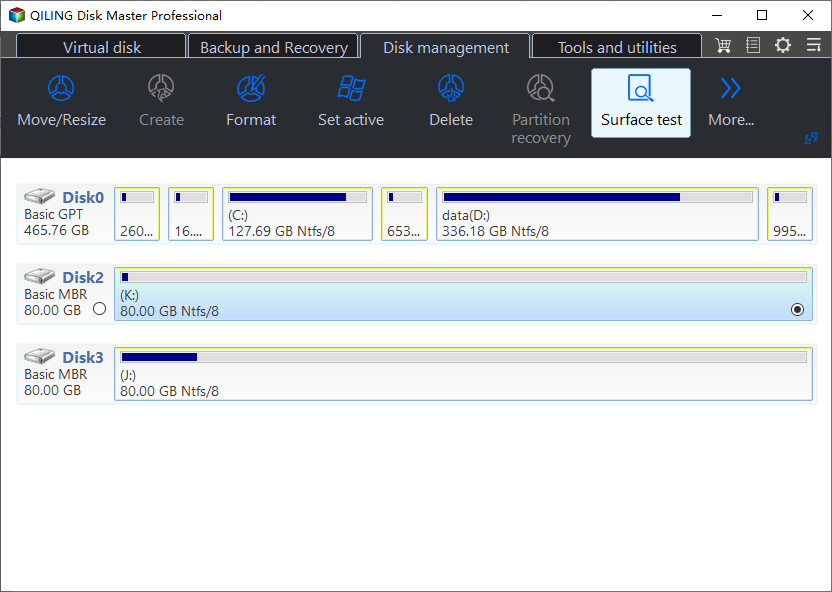
Step 2. To select the target drive, test data, and block size, click on the drop-down box and choose the desired options.
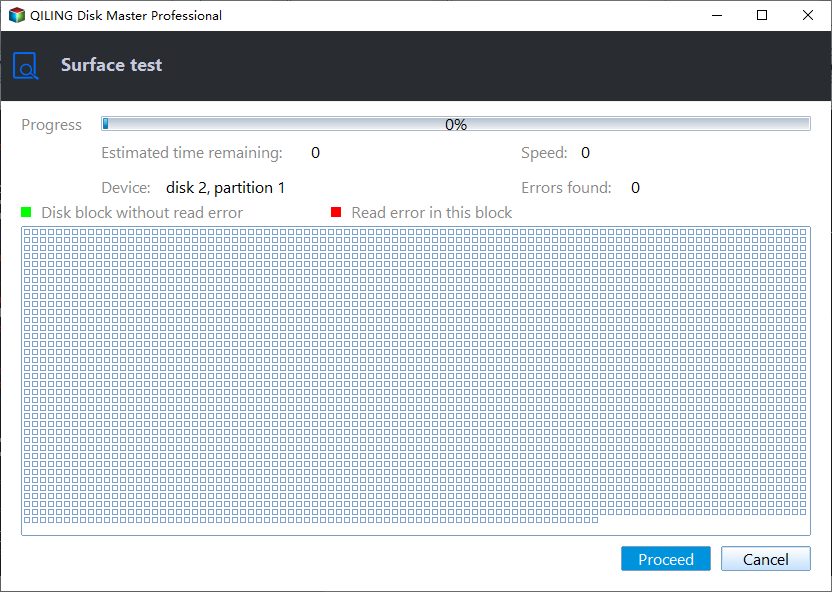
Step 3. Once everything is configured, click "Proceed" to begin the disk test, and then view the Sequential read speed, I/O, and Delay data.
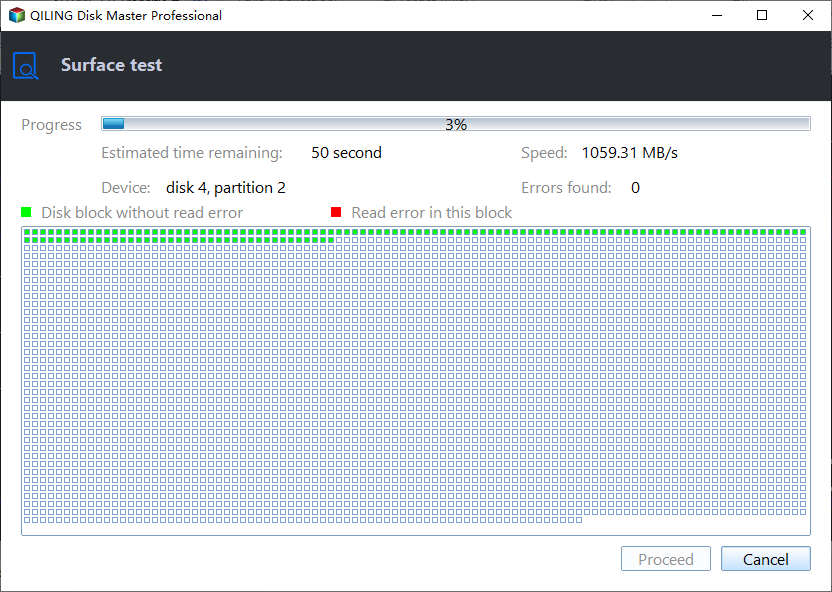
100% free and efficient method to test SSD disk speed, easy to use, and useful for testing NVMe speed, monitoring SSD, HDD, or external disk speed.
Qiling Disk Master is an incredible tool that offers several other features beyond disk cloning. It completely manages hard drive partitions, allowing you to create, delete, resize, move, and merge partitions. Additionally, it enables you to convert between MBR/GPT and NTFS/FAT32 formats.
#SSD Speed Test Software#Qiling#Free
Guide 2: Run CMD
- ⏲ Duration: 3-5 minutes
- 🧰 Tools: SSD, connection cable, Windows 10, CMD
- 🚩 Applies to: Test SSD speed, generate a smple SSD speed test result.
To test SSD speed on Windows 10, you can easily use the Command Prompt. Note down the accurate command prompt lines as they are crucial for the test.
To test SSD speed with CMD on Windows 10, follow these operational steps: Open the Command Prompt as an administrator, type "wmic diskdrive get status" and press Enter to verify the SSD is recognized, then run the command "wmic diskdrive get size status" to check the drive's size and status, after that, type "fsutil behavior query performance" and press Enter to see the drive's performance, finally, use the command "fsutil fsinfo drives" to verify the SSD's performance and capacity.
Step 1. To run the Command Prompt as an administrator, type "cmd" in the search box of the taskbar, right-click on the search result, and select "Run as administrator" from the drop-down menu.
Step 2. Type this command: "winsat disk -ran -write -drive (name)".
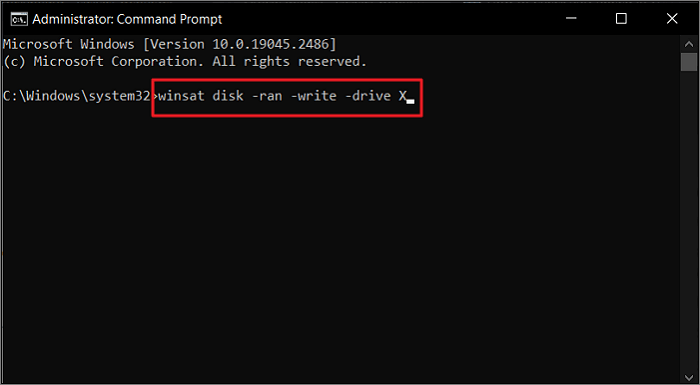
#SSD Speed Test#CMD#Free
Guide 3: Run Task Manager
- ⏲ Duration: 3-5 minutes
- 🧰 Tools: SSD, connection cable, Windows 10, Task Manager
- 🚩 Applies to: Test SSD speed, generate a smple SSD speed test result.
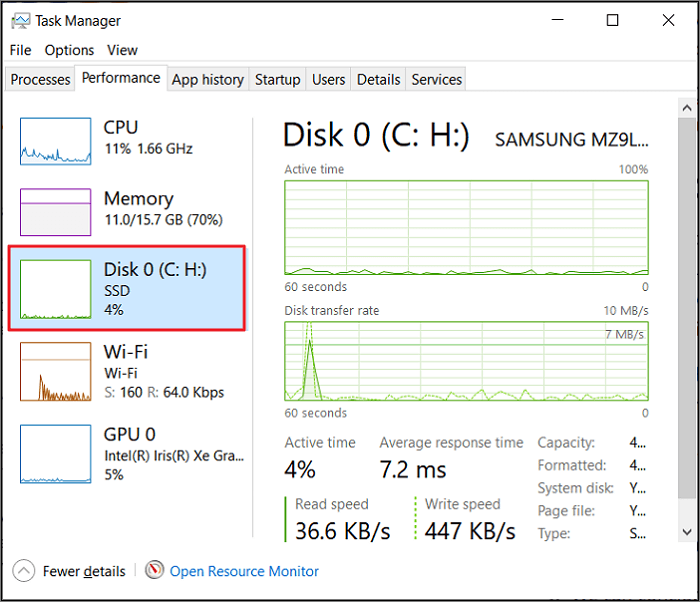
You can test SSD speed through Task Manager on Windows 10, but keep in mind that read and write speeds are not the actual speeds, as other factors also influence SSD performance, as data is dynamic.
To test your SSD speed using Task Manager on Windows 10, follow these steps: Open Task Manager by pressing the Ctrl + Shift + Esc keys simultaneously, or by right-clicking on the taskbar and selecting Task Manager. In the Performance tab, click on the Disk section to view the disk usage graph.
Step 1. Right-click on the "Taskbar" and click "Task Manager" from the appeared menu.
Step 2. Click "More details" from the bottom left corner in the pop-up window.
Step 3. Click "Performance".
Step 4. Click on the "Disk C" option to view the read and write speed of your Solid-State Drive (SSD).
SSD Speed Test on Windows 10, What Need to Be Aware Of? All You Should Know?
SSDs outperform traditional HDDs in terms of read and write speeds. Measuring SSD speed involves various metrics, but it's essential to note that they consume low power and offer high durability. In contrast, HDDs have higher power consumption and lower durability. The average read and write speed of an SSD is a crucial factor, and understanding its significance will help users make informed decisions when choosing an SSD.
1. What Is Read/Write Speed? And Why Should People Care About It on SSD?
The speed at which an SSD can read and write data is its most crucial factor, impacting various functions on a laptop or computer. This speed directly influences the overall performance of the device.
- The reading speed of your SSD drive measures how quickly it can read or access stored files.
Opening a heavy file of many gigabytes on a system with an SSD drive will result in quick opening times, improved PC boot times, and fast reading of large files.
- Write speed, also known as write throughput, measures how quickly files can be written onto a drive. This metric is crucial for applications that involve frequent data writing, such as video editing, gaming, and virtual reality.
The read/write speed of an SSD is its ability to quickly transfer or copy files and data from one location to another, making it ideal for tasks like copying huge files. However, several other factors also impact the overall speed of an SSD, in addition to its read/write speed.
2. What Is the Average SSD Speed?
The average speed of an SSD depends on the specific model and type, which can vary significantly. Some high-end models can reach speeds of up to 7000 MB/s, while more budget-friendly options may top out at around 500 MB/s.
A few general speed ranges for different kinds of SSDs:
| SSD Type❓ | Read Speed🚀 | Write Speed✈ |
|---|---|---|
| SATA SSD | Around 550 MB/s | Around 520 MB/s |
| NVMe/M.2 SD | Around 3,500 MB/s | Around 3,000 MB/s |
| PCIe/NVMe SSD | Around 7,000 MB/s | Around 6,000 MB/s |
The speed of an SSD can vary depending on its interface, controller, and NAND flash memory, among other factors, and can range from around 100-500 MB/s for older models to 500-2000 MB/s for newer ones, with some high-end models reaching speeds of up to 5000 MB/s.
Knowing the average speed of SSD disks allows you to compare it with your actual SSD reading and writing speed, helping you determine if your disk is slow or not. If your SSD is indeed slower than its average speed, following the tips provided in the next part can help optimize its disk speed performance.
Useful Tips to Optimize SSD Speed on Windows 10
Now that you've checked your SSD speed, you're probably wondering if it's slow and how to optimize it. If your SSD speed is slow, it's likely due to various factors such as fragmented files, incorrect settings, or outdated firmware. To optimize your SSD speed, you can try running a disk cleanup, checking for any disk errors, and updating your SSD's firmware to the latest version.
To optimize SSD speed on Windows 10, consider the following tips: enable TRIM, disable disk write caching, and set the disk as a system disk. You can also enable AHCI mode in the BIOS, check for and install SSD-specific drivers, and consider upgrading to a faster SSD model if your current one is outdated.
- Use 4K Alignment for SSD
- Disable Startup Programs
- Disable Fast Startup
- Confirm TRIM Is Enabled
- Ensure the SSD Firmware Is Up to Date
- Enable AHCI Mode
- Turn on Write Caching
- Schedule SSD Optimization
- Set Your Power Plan to High Performance
You may also want to follow the next tutorials for improving SSD performance.
Final Verdict
Running an SSD speed test on Windows 10 is easy, and for your convenience, we've listed three easy methods. Qiling Disk Master is a simple and efficient tool to check SSD speed, offering accurate and trustworthy results. If you feel your SSD is running slow, you can also try some useful tips to improve its speed.
FAQs About SSD Speed Test on Windows 10
Do you have any queries regarding the SSD speed test and optimization, or do you want to learn more? Don't worry. Here are a few frequently asked questions:
1. How do I check my SSD speed on my computer?
You can check your SSD speed on your computer through Task Manager. To do this, open Task Manager, navigate to the "Performance" tab, and click on "Disk C". This shows you the read and write speed of your SSD.
2. How do I know how fast is my SSD?
To check the speed of your SSD, open the Command Prompt and type `wmic diskdrive get name, size, status, total size, total usable size, status, status text` and press Enter. This command will display information about your SSD, including its speed. You can also check the speed of your SSD by looking at the specifications of your computer or SSD, which should indicate the speed of the drive.
To check your SSD speed, open the Command Prompt, type "winsat disk -ran -write -drive (name)" (replace "(name)" with the name of your SSD drive), and press Enter. This will display your SSD speed in the Command Prompt window.
3. Can I run SSD speed test on Mac?
There is no any built-To check the SSD speed on a Mac, you can use a reliable third-party app. These apps can assess the performance of your solid-state drive and provide detailed results, giving you a clear understanding of your SSD's capabilities. Some popular options include Blackmagic Design Disk Speed Test, CrystalDiskMark, and AJA System Test.
Related Articles
- 3 Ways: How to Increase C Drive Space in Windows 10/8/7
- Can I Install Windows 11 on Windows 10? Download Windows 11 Now
- How to Clone Only Used Space [Step-by-Step Guide]
- PS4 Storage Full? Learn How to Get More Storage on PS4
- Is There Any Way to Fix Google Play Insufficient Storage Error
Have you ever encountered the Google Play insufficient storage error? This page shows you how to fix Google Play's insufficient storage error in some reliable ways. - My Laptop is Showing Only C Drive Not Other Drives
Why is my laptop showing only C drive not other drives? How do I get the missing partitions back? If you are facing such problems on your Windows laptop, read this post, and we show you the solution to this troublesome issue.
Products
Articles & Tutorials
- Data Recovery
- Data Backup
- File Recovery
- File Backup
- System Backup and Restore
- Disk and Partition Clone
- Technical articles
- Mobile articles
- Disk Master Help
- Windows Data Recovery Tutorials
- Windows Secure Delete Tutorials
- Windows Partition Management Tutorials
- Windows File Backup and Restore Tutorials
- Windows System Backup and Restore Tutorials
- Windows Disk Backup and Restore Tutorials
- Windows Clone Tutorials