3 Best Free Partition Manager For Windows 7/8/XP 32 Bit and 64 Bit
Microsoft ended support for Windows 7 on January 14, 2020, prompting users to upgrade to Windows 10. However, some users with older computers may still prefer to use Windows 7, making a reliable partition manager essential to keep their computer running smoothly.
On this page, you'll learn about three Windows 7 partition managers: Qiling Partition Master, Windows Disk Management, and Diskpart CMD. You can choose any one and follow its tutorial steps to reallocate your Windows 7 disk and optimize your computer's performance without any issues.
Quick Access to Resizing a Windows 10/8.1/8/7 Disk
How Do I Resize a Partition in Windows 7
"Does anyone know if Windows Disk Management will work on Windows 7 after Windows 7 support ended? I recently got a notice from Windows, warning that my Windows 7 computer C drive is out of space. I have assigned 30GB for my C drive. Now I want to extend C drive. How do I resize a partition in Windows 7? The total capacity of my hard disk is 180 GB. Please help!"
Why Need to Resize Partition on Windows 7, Windows 8 or Windows XP
Having a Windows 7/8/XP partition manager is essential to effectively manage your disk space. With the ability to create, delete, and resize partitions, you can optimize your disk usage, improve system performance, and ensure data safety.
- The "C drive is out of space" or "low disk space error on C drive" occurs when the available free space on the C drive falls below a certain threshold, usually around 10-20%. This can happen when the drive is almost full, causing issues with system performance, slowing down the computer, and preventing new files from being saved.
- Windows 7/8/10 requires more space on the C drive to reinstall the Windows OS, install applications, and store application data, making it essential to have sufficient free space available on the C drive to ensure smooth performance and prevent potential errors.
- Some Windows 7 users prefer to keep the old system and spare some space to create a new partition to install Windows 7/8/10 and have a dual-boot system.
What Is the Best Free Partition Manager in Windows 7
Some users may recommend Windows Disk Management or the Diskpart CMD command for managing Windows 7 partitions, while more experienced users may suggest using a third-party partition manager software like Qiling Partition Master.
Third-party partition manager software is the best option for managing Windows 7 partitions, according to our recommendation.
Best Free Partition Manager for Windows 10/8/7/XP
Many people seek a reliable free partition manager to manage their hard disk, including resizing partitions. Qiling Partition Master is a suitable option, offering features such as dual-boot support for Windows 8 and Windows 7. Users can download and try the software to experience its capabilities.
Pros:
- This software allows you to resize partition, extend, shrink, and merge partitions for free using its "Resize/move" or "Merge partition" feature.
- Supports to format, delete, create partitions for free.
- Supports to delete all partitions on a disk by one-click.
- The software supports converting a disk to MBR or GPT, converting a partition to primary or logical, and converting FAT32 to NTFS, all for free.
- Supports conversion of disk from Basic to Dynamic or vice versa.
- Supports to wipe data on disk in one click.
Cons: It only supports disk and partition management on Windows OS.
Qiling Partition Master Free can be used as a free Windows 10 partition manager to manage partitions in Windows 10.
Tutorial - How to Manage Partition on Windows 7/8/XP with Qiling Partition Manager
Qiling Partition Master Free is a safe and easy-to-use tool that allows you to extend or shrink partitions on Windows operating systems, including Windows 7/8/10 and Windows XP/Vista.
To extend or shrink Windows partitions using Qiling Partition Master in Windows 7, follow these steps: download and install the software, launch it and select the partition you want to extend or shrink, choose the "Resize" option and specify the new size, and click "OK" to confirm the changes. Be careful when resizing partitions, as it can lead to data loss if not done properly, and always backup your data
Step 1: Free up unallocated space for C drive.
If there is no unallocated space on the system disk, click on a partition next to the C: drive and select "Resize/Move" to free up space.
Drag the left partition to shrink it, leaving unallocated space behind the system C: drive, and then click "Proceed".
Step 2: Increase C drive space.
1. Click on C: drive and select "Resize/Move".
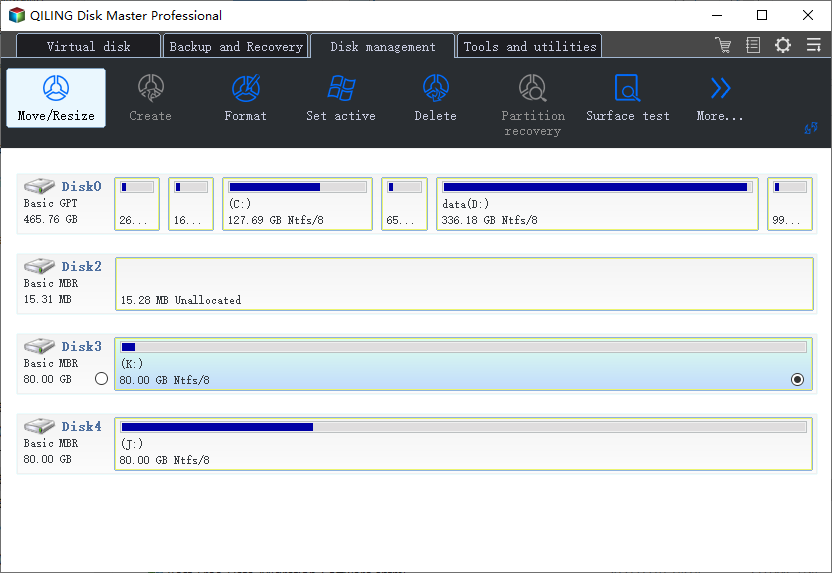
2. To add space to the C: drive, drag the system partition end into the unallocated space. This will expand the C: drive and utilize the available space.
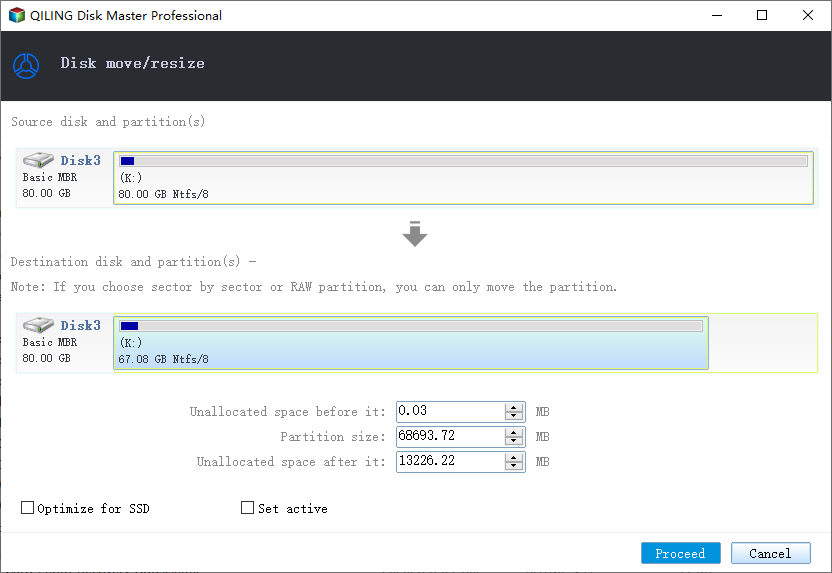
Step 3: Keep all changes to extend C: drive.
Click the "Proceed" to keep all changes so to extend the system C: drive.
Windows 7 Built-in Free Partition Manager - Disk Management
For most Windows 7 users, Disk Management is a familiar tool that's been pre-installed in the operating system. It allows users to manage partitions for free, making it a convenient option for those who need to create, delete, or resize partitions on their computer.
Pros:
- A software that allows users to resize, extend, shrink, and merge partitions without any cost.
- Supports to format, delete, create partitions for free.
- Supports to convert the disk to MBR/GPT.
Cons:It cannot extend a partition when the unallocated space is not located behind the target partition.
If you try to extend partition E using the unallocated space before it, you'll see a warning, indicating that doing so would convert the basic disk to a dynamic disk.
If you want to extend partition E using the "Extend Volume" feature of Windows 7 built-in disk management, there must be unallocated space behind partition E. If there is no unallocated space, Qiling Partition Master can help.
Tutorial: Extend Windows 7 Partition with Unallocated Space using Disk Management
Step 1. To access Disk Management, right-click on "My Computer" and select "Manage". From the resulting window, navigate to "Storage" and then click on "Disk Management".
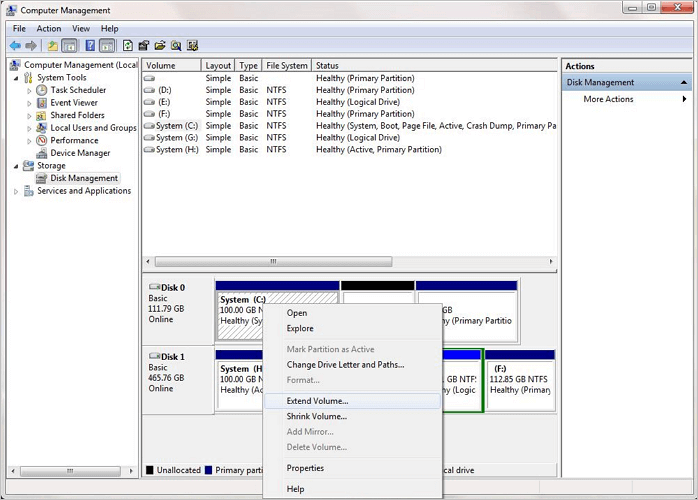
Step 2. Right-click on the partition you want to extend and select "Extend Volume" to proceed.
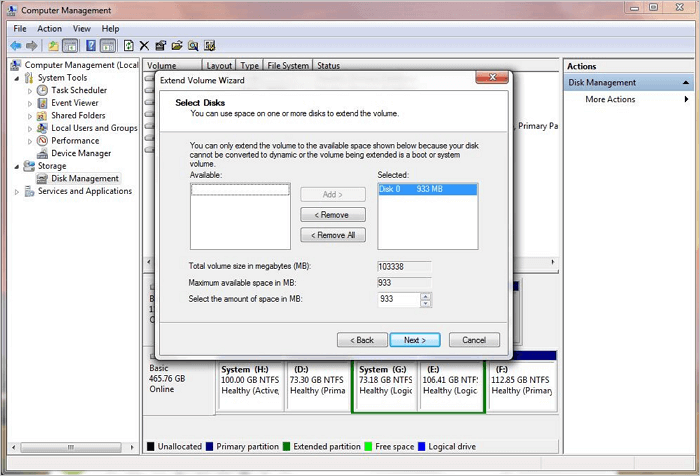
Step 3. Set the size of your target partition to a larger size and click "Next" to proceed.
Step 4. Click "Finish" to complete the process.
You can extend, delete, or shrink partitions using Disk Management, which is a built-in tool in Windows. Besides extending partitions, you can also delete or shrink a partition to free up space or modify the partition layout.
- To delete partition: Right-click target partition and select "Delete Volume" > Follow the onscreen guideline to finish.
- To shrink partition: Right-click target partition and select "Shrink Volume" > Follow onscreen guideline to finish.
- To change the drive letter of a partition, right-click on the target partition and select the option "Change Drive Letter and Paths...". Then, follow the on-screen guidelines to complete the process.
Windows 7 Free Partition Manager - Diskpart CMD
Diskpart is another built-For Windows 7 users, MiniTool Partition Wizard is a free tool that allows them to apply and manage disk partitions. However, executing partition management operations through the command line can be insecure for beginners, as any incorrect action can lead to serious consequences.
Pros:
- Free to manage partition.
- Supports to format partition, extend partition, delete, and create partition for free.
- Supports to convert disk to GPT/MBR, NTFS to FAT32.
Cons:
- Not for beginners.
- Any false operation would cause serious results.
- The software doesn't allow extending a partition if the unallocated space is not behind the target volume.
Tutorial: Extend Windows 7 Partition Volume using Diskpart CMD
Step 1. Press Windows + X keys and choose "Command Prompt (Admin)".
Step 2. Type diskpart and hit Enter.
Step 3. Type list volume and hit Enter.
Step 4. Type select volume x and hit Enter. In my case, the target drive is Volume 1.
Step 5. Type extend size =number and hit Enter.
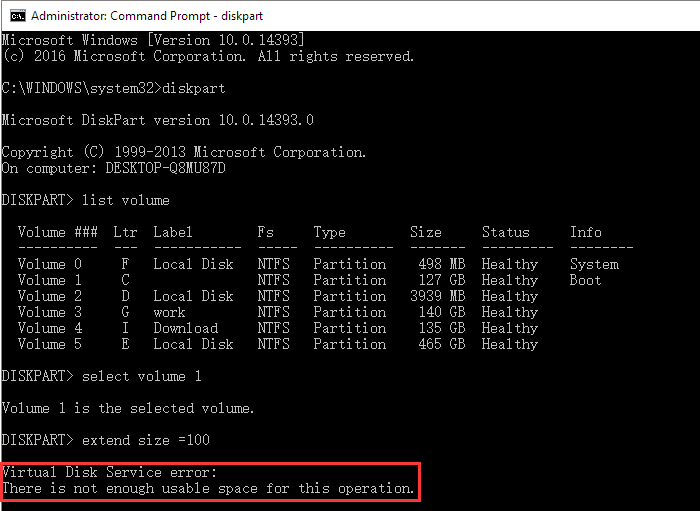
If there's no unallocated space next to the system drive partition, Qiling Partition Master can help with the issue.
If you're experiencing partition issues, you can use Diskpart CMD to resolve them. For example, you can use Diskpart to delete a partition, clean a disk, create a new partition, assign a drive letter, and more.
Conclusion
For Windows 7 users, there are three reliable free partition managers available to manage partitions. If you're looking for an advanced partition manager, Qiling Partition Master is a recommended option.
Free Windows 7 Partition Manager FAQs
If you have concerns or questions about Windows 7 partition manager, check out the Q&A section below for answers to your specific queries. You'll likely find the information you're looking for there.
1. How do I open partition manager in Windows 7?
- To use Windows 7 Disk Management, right-click My Computer, select Manage, and then click Disk Management to open it.
- If you choose to use Qiling Partition Master, install and launch the software.
- To use Diskpart, type "cmd" in Search, right-click Command Prompt and select to Open as Administrator, then type "diskpart" and hit Enter.
2. How many partitions can Windows 7 have?
- If your disk is with MBR style, you can have up to 3 primary partitions and one extended partition.
- If your computer has a GPT disk, you can create and have unlimited partitions.
3. How do I see hidden partitions in Windows 7?
If you mistakenly hide a partition on your computer, you have two ways to show the hidden partition in Windows 7/8/10: you can either use the built-in Disk Management tool or a third-party software like Qiling Partition Master.
For a detailed guide, refer to Find Hidden Partition for help.
Related Articles
- 2 Best Disk Manager for Windows Server Free Download [Free & Paid]
- Do I need EFI System Partition? Can I Delete the EFI Partition?
- How to Figure Out if You Have a 32 or 64-bit Operating System on Your PC or Laptop
- How to Expand RAID 5 Array Partitions in 2026 [New]
- How Often Should PC Be Cleaned?
Most PC users know that cleaning their PC is important, but only a few of them know how often should PC be cleaned. So in this post, we will provide you the answer and 2 easy ways to clean your PC. - How to Delete System Junk Files in Windows 10 (Available for Windows 11)
Learn how to delete system junk files in Windows 10/11 with Total PC Cleaner, Disk Cleanup, Storage, or Qiling Disk Master.
Products
Articles & Tutorials
- Data Recovery
- Data Backup
- File Recovery
- File Backup
- System Backup and Restore
- Disk and Partition Clone
- Technical articles
- Mobile articles
- Disk Master Help
- Windows Data Recovery Tutorials
- Windows Secure Delete Tutorials
- Windows Partition Management Tutorials
- Windows File Backup and Restore Tutorials
- Windows System Backup and Restore Tutorials
- Windows Disk Backup and Restore Tutorials
- Windows Clone Tutorials