How to Convert MBR to GPT Without Reinstalling Windows
The Partition Table is a master table that describes a disk's layout on disk. If it's lost, users can't read or write data on the disk. There are two types of Partition Tables supported by Windows: Master Boot Record (MBR), an older format, and GUID Partition Table (GPT), a newer format that's more secure and flexible.
What is MBR?
The Master Boot Record (MBR) is a 512-byte boot sector present in all partitioned media using the Master Boot Record partitioning scheme. It supports up to 4 major partitions, but if more are needed, the Extended Partition is used, providing users with flexibility and not limiting them to just four partitions.
Pros:
- MBR is simple and easy to maintain
- Works on all the systems
- Useful when you need a limited number of partitions.
Cons
- The data integrity check is not possible.
- Less Secure
- Not supported by most of the modern OS.
What is GPT?
The GUID Partition Table (GPT) is a modern partition table that surpasses the capabilities of the Master Boot Record (MBR). Unlike MBR, which is limited to 4 partitions, GPT supports up to 128 partitions, making it a more versatile option. Additionally, GPT is more secure than MBR, as it conceals important data. The latest versions of Windows and most modern motherboards support GPT, making it a reliable choice for managing disk partitions.
Pros
- Secure
- Data integrity check
- Supports more number of partitions.
Cons
- The software cannot be used on an older system due to compatibility issues.
- Needs UEFI for complete support.
Why do you convert to GPT?
Here are the advantages of GPT:
- GPT (GUID Partition Table) is more robust than MBR (Master Boot Record) and can support up to 128 partitions, making it a more efficient and reliable partitioning system.
- Stores a value that makes sure data is intact, using a cyclic redundancy check (CRC).
- Compatible with old MBR tools.
- GPT stores multiple copies of this data across the disk.
The primary reason to convert MBR to GPT is to meet the Windows 11 upgrade requirements, as it demands a GPT partition table.
To upgrade to Windows 11, you need a UEFI-based system, TPM 2.0 support, and a GPT partition table. In the future, you'll need to switch from MBR to GPT, which can be challenging without reinstalling Windows.
Windows 10 support will end in a couple of years, and with Windows 11, you will eventually need to upgrade from Master Boot Record (MBR) to GUID Partition Table (GPT) to ensure compatibility. It's a good idea to stay prepared for this transition.
Is there a way to convert MBR to GPT without reinstalling OS?
Installing Windows is time-The process of converting a Master Boot Record (MBR) to a GUID Partition Table (GPT) can be time-consuming and labor-intensive. It requires deleting the existing partition, recreating it with GPT, reinstalling Windows, and reactivating all software, which can be a significant hassle for many users.
Qiling Partition Master is a software that allows for the conversion of a MBR (Master Boot Record) to a GPT (GUID Partition Table) without deleting or formatting the partition, making it a convenient tool for users who want to upgrade their partition table without losing any data.
- Easily Resize or Move Partition using the slider feature
- Create, Format, Merge, Wipe and Delete Partitions.
- Clone, Rebuild MBR, Convert to GPT.
- Surface Test and 4K alignment.
When converting from MBR to GPT, keep in mind that it's a disk-level operation, not a partition-level one. This means that if you need to make the switch, you'll have to convert the entire disk to GPT.
Step 1. Download and launch Qiling Partition Master on your Windows computer.
Step 2. To convert a disk from MBR to GPT, select the MBR disk you want to convert, click the "More" button, and then choose the option to convert it from MBR to GPT. This will initiate the conversion process.
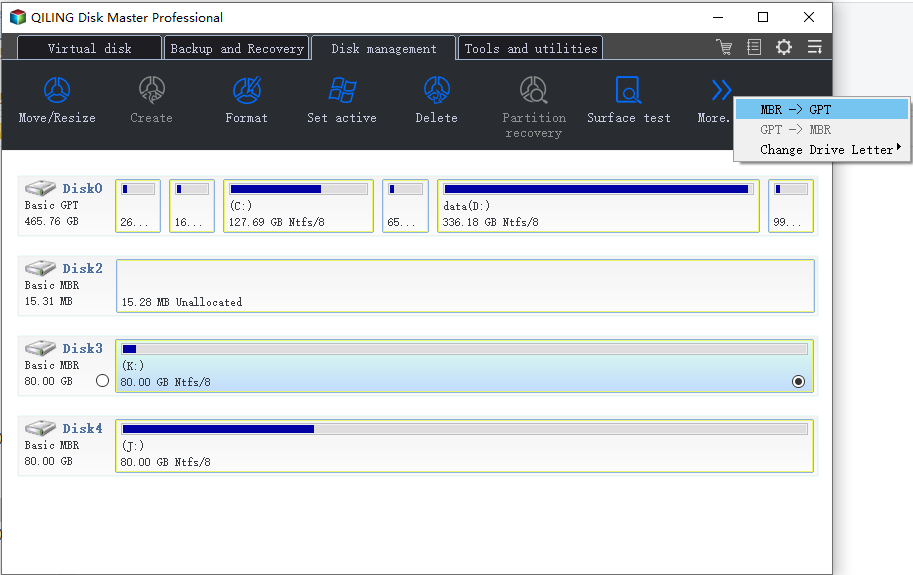
Using Qiling Partition Manage is easy, and all you need to do to convert a disk is right-click on the disk and then choose to convert into GPT, making sure the disk is not already converted to GPT. The label next to its listing in the software can help identify if it's already converted.
Conclusion
While MBR (Master Boot Record) still has its place, GPT (GUID Partition Table) is becoming increasingly popular due to its advantages, such as supporting large hard disk sizes, allowing for more partitions, and providing enhanced security features. As security implementations become mandatory, the adoption of GPT is expected to accelerate, potentially making MBR less relevant in the long run.
Qiling Partition Manager allows for easy upgrading or converting from MBR to GPT, making it possible to avoid reinstalling Windows and other software, but it's still a good idea to have a backup in place.
The software offers complete disk management tools, comparable to Windows built-in tool, with the added feature of using a slider to increase or decrease disk drive size, saving time.
Related Articles
- How to Fix System and Compressed Memory 100 Disk Usage (7 Fixes)
- How Do I Open/Access Disk Management In Windows 11? All Methods You Can Get
- How to Format WD Passport for Mac and PC (3 Ways)
- There Is Not Enough Space on C Drive to Extract This Package [Solved]
- Does Deleting a Partition Erase All the Data? | Solid Way to Recover
Deleting a partition can indeed erase all the data stored on that partition, as it essentially removes the file system and formatting associated with it. However, the data itself is not immediately lost and can often be recovered using specialized software or techniques. - How to Download Windows 11 23H2 Update from Microsoft✅
Recently, Microsoft released the Windows 11 23H2 version, and many users wonder if they can get this update. This post contains a full guide on how to download Windows 11 23H2 Update.
Products
Articles & Tutorials
- Data Recovery
- Data Backup
- File Recovery
- File Backup
- System Backup and Restore
- Disk and Partition Clone
- Technical articles
- Mobile articles
- Disk Master Help
- Windows Data Recovery Tutorials
- Windows Secure Delete Tutorials
- Windows Partition Management Tutorials
- Windows File Backup and Restore Tutorials
- Windows System Backup and Restore Tutorials
- Windows Disk Backup and Restore Tutorials
- Windows Clone Tutorials