How to Extend System Partition in Windows 11/10
Solutions for extending system C drive can also be applied to increase other partitions on your Windows 11/10/8/7/XP PCs.
To extend a system partition with adjacent unallocated space, there are three methods to consider: using the built-in Disk Management tool in Windows, employing a third-party partition manager like Qiling Partition Master, or utilizing a live Linux distribution to resize the partition. Each method has its own advantages and disadvantages, and the choice ultimately depends on the user's specific needs and preferences. For instance, the Disk Management tool is a simple and straightforward approach, but it may not work for all scenarios, while Qiling Partition Master offers more advanced features and flexibility, but requires a purchase.
Part 2. Extend System Drive without Unallocated Space
Can I extend my C drive partition in Windows 11/10
When the C drive runs out of space, many Windows users need to extend the system C drive. This is a common issue that can be resolved by extending the system partition, which can benefit users by freeing up space and improving overall system performance.
Extending your system volume or C: partition can make full use of free or unallocated space, allowing your computer to utilize unused space. This process can lead to improved performance and faster speeds, as your computer will be able to optimize its use of available resources.
If you're wondering if you can extend your C drive partition in Windows 11/10, the answer is yes. With the help of powerful partition manager software like Qiling Partition Master, or using Windows Disk Management and DiskPart, you can increase your system volume in 4 ways, making it easy to extend your system partition.
Part 1. Extend System Partition with Adjacent Unallocated Space
When there is unallocated space next to your system C drive, you can use a reliable partition manager software like Qiling Partition Master, Disk Management, or Diskpart to extend your Windows 11/10 system volume. Simply check and follow the easiest method to get the job done.
You don't need to worry if the unallocated space is not located directly behind your C drive. To fix this, you can use the Resize & Move feature in Qiling Partition Master and move the unallocated space next to your system drive by right-clicking on partitions between the C drive and the unallocated space, one by one.
[Automated] Extend system partition with Qiling Partition Master
Qiling Partition Master is a comprehensive hard disk partition management software that supports extending system partition on Windows operating systems, protecting data throughout the process.
Tutorial 1. Extend Windows 11/10 System Partition with Qiling Partition Master
If your disk has unallocated space next to the C drive, you can increase the size of the C drive by moving the unallocated space into it. If the C drive has low disk space, you can follow another tutorial for assistance.
Option 1. Extend System C drive with unallocated space
- 1. Click on the System C: drive and select "Resize/Move".
- 2. Drag the system partition end into the unallocated space so to add it to the C: drive. Click "Proceed" to execute the operations and extend the C drive. This will allow the system to continue running smoothly, and you can then safely remove the USB drive.
Option 2. Extend System C drive without unallocated space
- 1. To resize a partition, click on a large partition with sufficient free space on the system disk and select "Resize/Move".
- 2. To resize the partition, drag the end of the partition towards the start of the partition, effectively shrinking its size, and then click "Proceed".
- 3. Select the system drive at the Allocate Space, and select "Resize/Move".
- 4. To extend System C drive, drag the end of System C drive into the unallocated space. Click "Proceed" to save the changes and extend the C drive.
Tutorial 2. Extend System C Drive with Low Disk Error in Windows 11/10
If you're experiencing a low disk space error on your C drive, ! You can easily extend it by following these steps. First, you'll need to free up some space on your C drive by deleting unnecessary files and programs.
Step 1. To resize a partition, click on a big partition with enough free space on the system disk, then select the option "Resize/Move".
When your C drive is out of space, you will see the Low Disk Space alert on Qiling Partition Master. To resolve this, click the resize button to extend it.
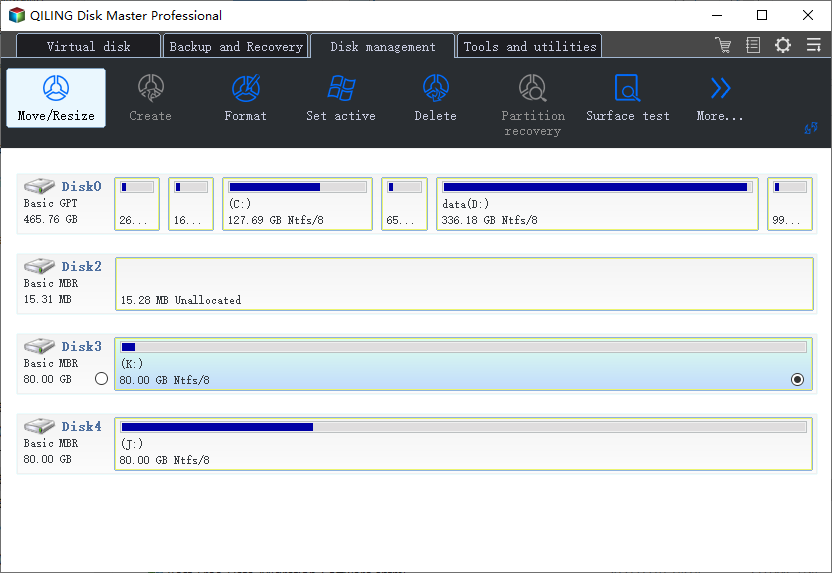
Step 2. Click "Proceed" to extend C drive automatically.
To resolve the low space issue, drag the target partition's dots into the unallocated space and click "Proceed".
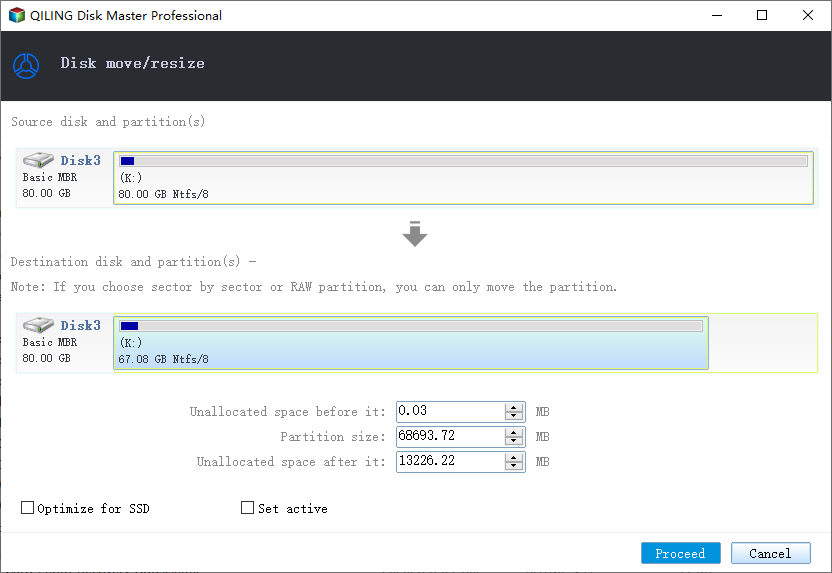
Qiling Partition Master allows users to extend the C drive by directly moving space from the D drive to the C drive, making it easier to manage disk space.
[Manual] Extend Windows 11/10 system partition with Disk Management
- Warning
- To extend a Windows 11/10 system partition using Disk Management, there must be contiguous free space behind the system partition. Without this contiguous space, you cannot extend the system partition.
- You can use third-party partition manager software like Qiling Partition Master to help with the partitioning process.
To extend your Windows 11/10 system partition in Disk Management, follow these steps:
Step 1. To open Disk Management, right-click the Windows icon in the bottom left corner of the screen and select "Disk Management" from the menu.
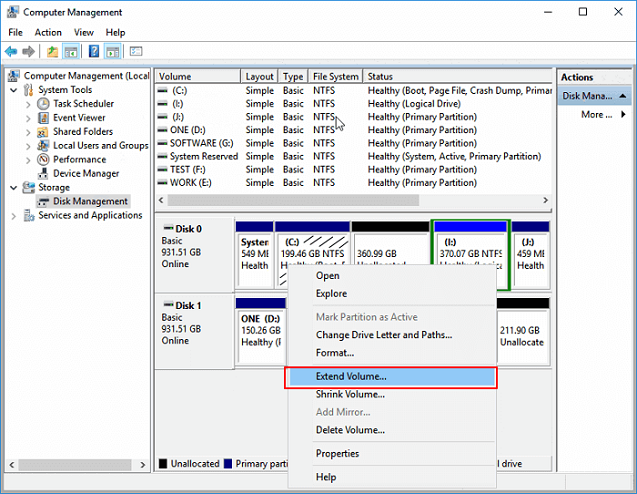
Step 2. Right-click on the system partition that you want to extend, and select "Extend Volume" from the menu.
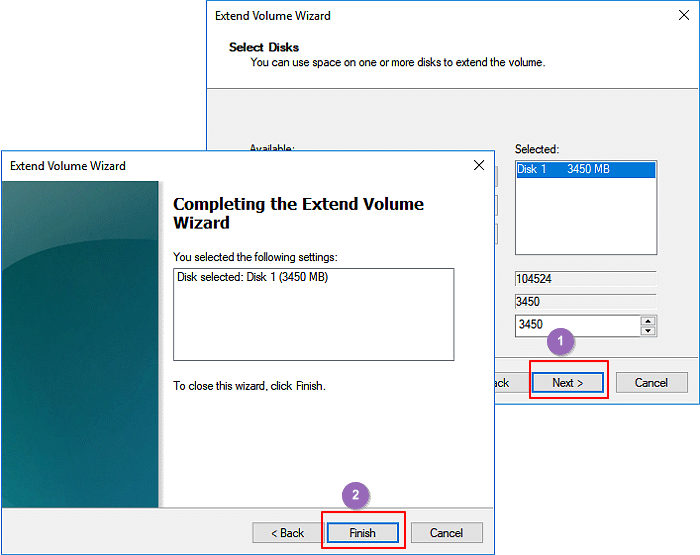
Step 3. Click "Next" and specify the size of the unallocated space that you want to add to the C drive, then click "Next" to continue.
Click "Finish" to complete.
[Manual] Extend C drive on Windows 11/10 with DiskPart
Apart from Disk Management, another Windows built-in tool DiskPart provides powerful partition management features to help extend the system C drive in Windows 11/10.
The DiskPart utility only functions properly when the unallocated space is located behind the system C drive on your PC.
Here are the detail steps:
Step 1. To open the Command Prompt on Windows, right-click on the Windows icon and select "Search", type: cmd and hit Enter.
Step 2. Type: diskpart and hit Enter. Click "Yes" to open DiskPart.
Step 3. Type the following command and hit Enter each time:
- list volume
- select volume 1 (Replace 1 with the volume number of your system C drive.)
- extend
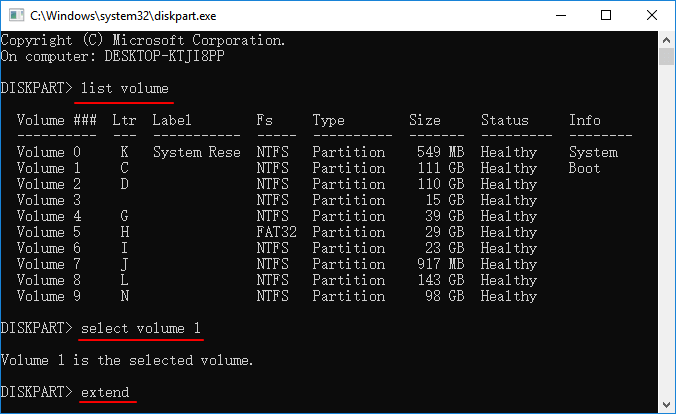
or the following command:
- list disk
- select disk N (Replace N with the disk number of your system disk.)
- list partition
- select partition 2 (Replace 2 with the number of your system partition.)
- extend size=X disk=N The command to create a new partition on the unallocated space of 500 MB on disk N is `diskpart`, then `list disk`, select disk N, then `create partition primary size=500MB`, and finally `format fs=ntfs label="label" quick`.
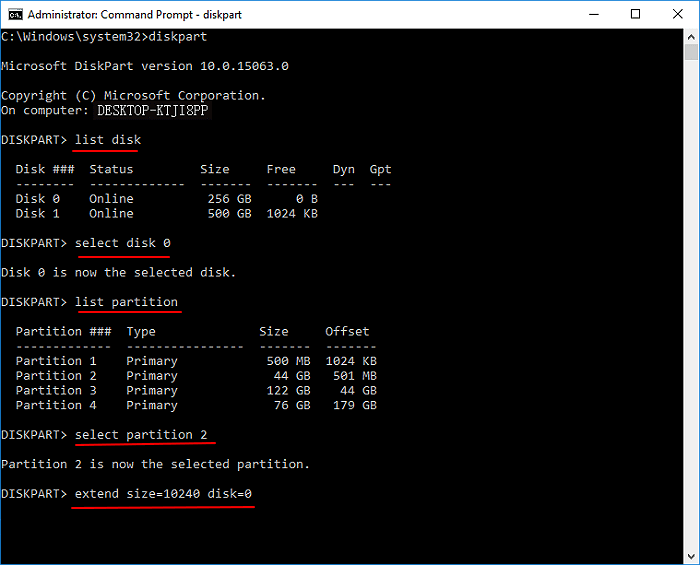
Step 4. To extend the C drive, you can use the DiskPart command-line utility. First, open the DiskPart window by typing "DiskPart" in the Command Prompt and pressing Enter.
Part 2. Extend Windows 11/10 System Drive without Unallocated Space
You can consider removing some unnecessary files or programs to free up some space, or you can consider upgrading your system disk to a larger one. You can also consider using cloud storage to store some of your files.
If you're using Disk Management or DiskPart, you can shrink or delete the volume behind your C drive, then follow the methods in Part 1 to add space to your C drive.
If you have unused space on your system disk, you can use Qiling Partition Master's Allocate Space feature to extend your system drive without needing to move any partitions. This feature allows you to utilize the free space on your system disk to expand your system drive, making it a convenient option for those who don't want to relocate any partitions.
To extend the system drive without deleting or shrinking partitions, you'll need to upgrade Qiling Partition Master to its Pro version, which currently offers this feature.
Step 1. Locate the Target Partition.
To extend a partition, you should first locate the target partition and select the "Resize/Move" option.
Step 2. Extend the Target Partition.
To add unallocated space to your current partition, drag the partition panel to the right or left, depending on the desired direction, and then click "Proceed" to confirm the action.
Extra Option: Get Space from Another Drive
If there's not enough unallocated space on your disk, you can resize a larger partition to free up space. To do this, click on a big partition with enough free space, then select the "Resize/Move" option.
Step 3. Execute Operations to Extend Partition.
To resize the target partition, drag the dots on its left and right sides into the unallocated space. Once you've made the desired adjustments, click "Proceed" to apply the changes and keep the partition intact.
Conclusion
To extend the C drive on Windows 11/10, 8, or older systems, you can use partition management tools such as Qiling Partition Master, Disk Management, or DiskPart. These tools can help you effectively manage your partitions, including extending the C drive with or without unallocated space.
If you have more questions about extending partition, you may check top concerned FAQs below to find direct answers:
1. Can I extend my C drive partition Windows 11/10?
Yes, you can extend your C drive partition in Windows 11/10. There are four ways to do this: using Qiling Partition Master, Windows Disk Management, or DiskPart. You can check the detailed steps on the provided page to easily increase your system volume.
2. How do I extend my Windows partition?
Open Disk Management and right-To shrink a partition next to your target drive, click on the partition next to your target drive, select "Shrink Volume" from the context menu. Then, adjust the size you'd like to shrink and add to the target partition, click "Next" and "Finish" to complete the process.
Then right-To extend the volume, click on the target drive and select Extend Volume. Select to add all the unallocated space, click Next, confirm, then click Next and Finish to complete the process.
3. Why is Extend Volume disabled in Windows 11/10?
The Extend Volume option may be greyed out due to one of three reasons: lack of unallocated space on the hard drive, the target partition being formatted with a file system other than NTFS, or the absence of contiguous unallocated space next to or behind the target partition.
To resolve the issue, you'll need to free up unallocated space and place it next to your target partition, then convert the FAT partition to NTFS.
For more concerned questions, you may use the search option on the right top corner of our website at https://www.idiskhome.com to search and find solutions.
Related Articles
- Solutions to Wsappx Takes High Disk and CPU Usage on Windows 11/10
- 2 Best Disk Manager for Windows Server Free Download [Free & Paid]
- What Is USB Format for PS3 | How to Format PS3 USB
- How to Move Partition in Windows 11/10/8/7? [New]
- How to Fix PS4 Can't Read USB [Quick & Easy]
If your PS4 can't read your external USB drive, ! We've got solutions for you to try and fix the issue. - [New] Get 2024 Official Qiling Disk Master License Code, Serial Key Here!
If you're looking for a Qiling Disk Master license code, we offer official access to get a genuine license code to upgrade to the full edition and enjoy all features at a low cost.
Products
Articles & Tutorials
- Data Recovery
- Data Backup
- File Recovery
- File Backup
- System Backup and Restore
- Disk and Partition Clone
- Technical articles
- Mobile articles
- Disk Master Help
- Windows Data Recovery Tutorials
- Windows Secure Delete Tutorials
- Windows Partition Management Tutorials
- Windows File Backup and Restore Tutorials
- Windows System Backup and Restore Tutorials
- Windows Disk Backup and Restore Tutorials
- Windows Clone Tutorials