How to Fix New Simple Volume Greyed Out Error in Windows Disk Management
| Workable Solutions | Step-by-step Troubleshooting |
|---|---|
| Fix "New Simple Volume" |
Method 1. Convert MBR Disk to GPT Disk without Losing Any Data...Full steps Method 2. Manually Change MBR to GPT with Disk Management...Full steps |
| Fix New Simple Volume Greyed Out |
Solution 1. Add Unallocated Space to the Existing USB Partition...Full steps Solution 2. Manually Try: Make New Simple Volume Available on USB...Full steps |
New Simple Volume Greyed Out on Hard Drive and USB Drive
Here are two typical cases where the "New Simple Volume" option is greyed out in Disk Management:
Case 1. Can't create a new partition with unallocated space on a 3TB hard drive
You have a 3 TB hard drive with 4 parts: system reserved, system, and 2 unallocated spaces. You want to use the unallocated space to create new partitions for game data, but the "New Simple Volume" option is grayed out when you right-click the last unallocated space.
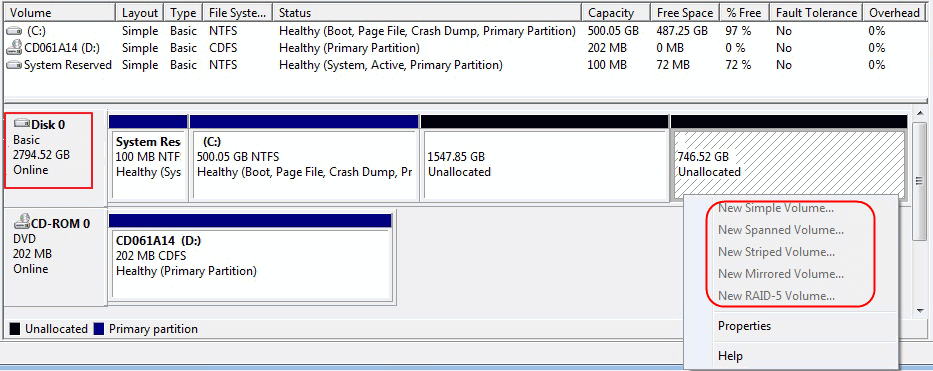
Case 2. USB drive has unallocated space, but the new simple volume is unavailable
You're trying to add unallocated space on your USB drive to an existing partition, but the "Expand Volume" option is greyed out in Disk Management. Can I help you troubleshoot this issue?
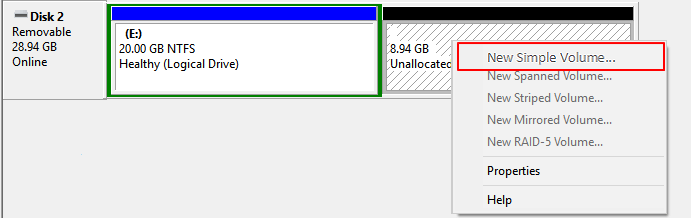
when you tried to use Disk Management to create a new partition on your PC, but it wouldn't allow you to do so since the New Simple Volume option is greyed out. In the following, you'll find practical solutions on resolving this issue on your computer hard drive or external USB.
Part 1. Fix New Simple Volume Greyed Out on Windows 11/10/8/7 Local Hard Drive
To make the New Simple Volume option work again on your Windows 11, 10, 8, or 7 local drive, the best solution is to convert MBR to GPT, which allows the creation of more than four primary partitions on a single disk. You can achieve this by using the built-in Disk Management tool or a third-party utility like Qiling Partition Master. By converting your disk from MBR to GPT, you can regain the functionality of the New Simple Volume option and create additional partitions as needed.
Method 1. Convert MBR Disk to GPT Disk without Losing Any Data
Qiling Partition Master is a professional partition manager software that allows you to convert MBR to GPT without deleting any partitions or losing any data, among other great features.
- To adjust the partition size, simply slide it left and right to suit your needs, allowing for flexible and customizable space allocation.
- Clone an entire disk to another wanted disk
- Merge Windows partitions easily to enlarge partition space
- Correctly align partitions on SSDs
Get this easy-to-use software and convert MBR to GPT without data loss.
- Important
- Qiling Partition Master can convert an MBR disk containing Windows to GPT, but to successfully boot from the GPT disk, you need to be aware of certain requirements.
- 1. UEFI mode should be supported and enabled.
- 2. Your operating system is 64-bit.
Method 2. Manually Change MBR to GPT with Disk Management
This method only works for non-system disks, requiring deletion of all partitions or volumes before conversion to GPT. It's not suitable for system disks. If the target disk is a system disk, Method 1 should be used instead. Additionally, if there are important files in the existing partitions, they should be backed up to an external hard drive before proceeding.
Step 1. Open Disk Management by right-clicking on This PC/My Computer and selecting "Manage", then click on "Disk Management".
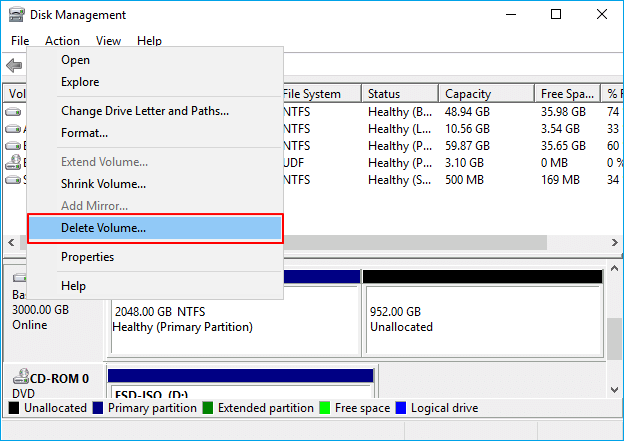
Step 2.To delete a partition on an MBR disk, right-click the partition and select "Delete Partition" or "Delete Volume", then confirm by clicking "Yes".
You will need to delete all existing partitions on your MBR disk, then repeat this step to ensure that the disk is completely clean and ready for a new installation. This will involve using a tool like `fdisk` or `parted` to delete any existing partitions.
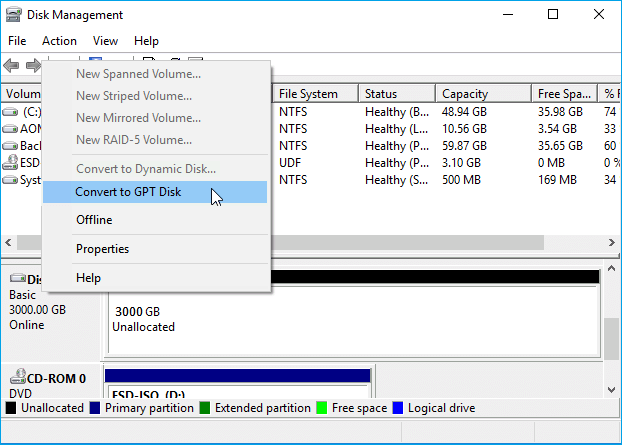
Step 3.Right-click the MBR disk, which is now a whole empty disk, and select "Convert to GPT disk" in one step.
After resizing your disk, you can reuse Disk Management to create new volumes on your disk again, allowing you to create as many partitions as needed on a GPT disk without encountering the "New Simple Volume greyed out" issue.
Part 2. Fix "New Simple Volume" Greyed Out on USB Drive
Applies to all removable devices
If the Windows OS or the USB device itself doesn't support two partitions, the "New Simple Volume" option will be greyed out. To resolve this, you have two choices: either accept the situation and add unallocated space to the existing partition, or try manual methods to make the "New Simple Volume..." option available to create a second partition on the USB.
Solution 1. Add Unallocated Space to the Existing USB Partition
When USB and Windows OS don't support two partitions, adding unallocated space to the existing partition is the best choice. However, if the Extend Volume option is also unavailable in Disk Management, it may be necessary to use a third-party tool or a different operating system to achieve the desired partition configuration.
The Extend Volume feature in Disk Management is greyed out for USB flash drives due to their unique structure, and can be resolved using the Resize/Move feature in Qiling Partition Master to add unallocated space to the existing partition.
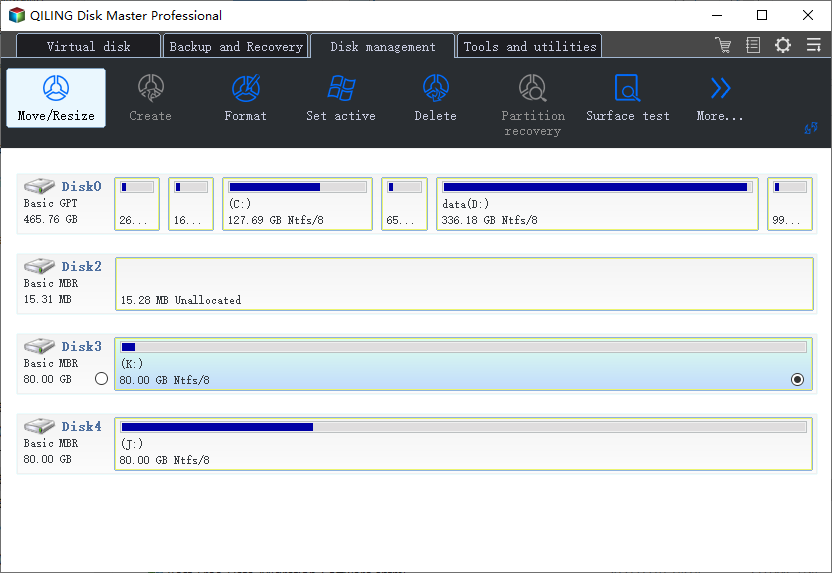
Step 1. Shrink partition to free up space to extend partition.
If the hard drive has enough unallocated space to extend the target partition, proceed to Step 2. Otherwise, free up space first by deleting unnecessary files or resizing other partitions to make room for the extension.
- To resize or move a partition, click on the partition next to the target partition and select "Resize/Move".
- To free up space, drag the partition ends, leaving enough unallocated space behind the target partition, and then click "Proceed".
Step 2. Extend target partition.
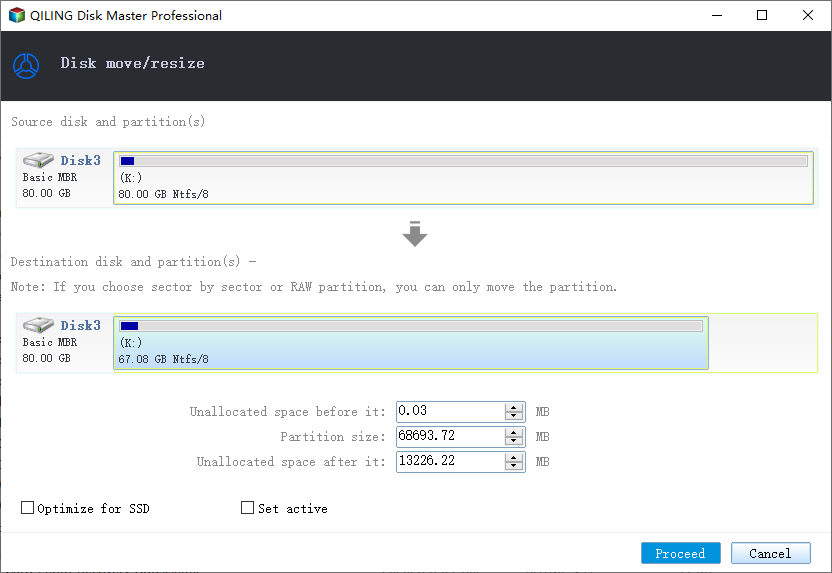
Click on the target partition and select "Resize/Move".
To extend the target partition, simply drag the partition handle into the unallocated space. This will increase the size of the target partition by utilizing the available free space.
Step 3. Keep all changes.
Click the "Proceed" to keep all changes.
Solution 2. Manually Try: Make New Simple Volume Available on USB
Step 1. Update your Windows system to the latest version or new versions after Windows 10 1703.
Since Windows 10 version 1703, all new versions of Windows 10 have supported multiple partitions on removable disks, such as external hard drives or USB flash drives.
Step 2. Format the USB to NTFS first.
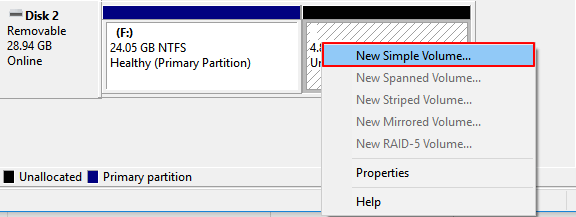
Step 3. Open Disk Management, right-click on the unallocated space, and select "New Simple Volume" to create a new partition.
Step 4. To set up a new partition on a USB drive, follow these steps: Assign a new drive letter, choose a file system, and set the desired size for the new partition. Follow the on-screen instructions to complete the process.
If you're still having trouble, it's possible that your USB drive itself can't handle multiple partitions. In that case, you might want to try merging all the space into one partition, which can be a good option for storing data.
Part 3. Why Does the New Simple Volume Show Up as Greyed Out
The "New Simple Volume" option is greyed out in the Disk Management tool when trying to create a partition on unallocated space on a local hard drive or external USB drive.
If you are having the same questions as listed below, read on to find the answers and apply the right solutions to get rid of this issue.
Why does the New Simple Volume option show as greyed out on your computer hard drive
The basic reason is that your disk is MBR disk. Generally, due to the two limitations on MBR disk, it stops you from creating a new volume in Disk Management:
- There are already 4 primary partitions on the disk.
- The MBR (Master Boot Record) disk capacity is limited to 2 TB, meaning you cannot create new partitions beyond this size. This is a limitation of the MBR system, which is why larger disks often use GPT (GUID Partition Table) instead.
To create more than 4 primary partitions on a MBR disk, you can convert a primary partition to a logical partition. This can be done by following the steps on the link provided. Alternatively, to overcome the 4-partition limit altogether, you can convert the MBR disk to a GPT disk, which allows for more partitions.
Why is the "New Simple Volume" greyed out on USB drive in Disk Management
Due to Windows system and USB device limitations, users are often unable to create two partitions on a USB external hard drive or USB flash drive. Even if a second partition is created, Windows may not display it in File Explorer.
Nowadays, only Windows 10 (1703 or later versions) and a few new USB drives support creating two partitions. Solutions to issues where the "New Simple Volume" option is not available on two different devices can be easily solved in Part 1 and Part 2.
Conclusion
If you're experiencing the "New Simple Volume greyed out" issue on an internal hard disk or external device like a USB flash drive or SD card, the solutions above can help. By fixing the unable to create a new simple volume error, you can make full use of your hard drive or USB drive using the Disk Management tool. With it, you can create a partition, merge unallocated space, and more.
New Simple Volume Greyed Out FAQs
In addition to the solutions and instructions, many people want to know more about New Simple Volume not working. Here are some hot topics on New Simple volume. Read on if you want to get additional help.
Will creating a new simple volume erase data?
If you delete the partition, you will lose all the data on it. To recover the partition, you can use a software like Qiling Partition Master. It can help you recover the partition and get back your data.
Why is extend volume greyed out?
Here are the reasons:
- The MBR (Master Boot Record) disk capacity is limited to 2 TB, meaning you cannot create new partitions beyond this size.
- Users are unable to create two partitions on a USB external hard drive or USB flash drive due to limitations in USB and Windows.
What is a simple volume partition?
Simple volumes are the dynamic-The disk equivalent of primary partitions and logical drives found on basic disks is called extended partitions. Extended partitions are a feature of dynamic disks, which are a type of disk that allows for more than four primary partitions to be created.
How do I create a new hard drive volume?
Step 1. Install and launch Qiling Partition Master.
Step 2. Shrink the partition size.
Step 3. Create a new partition.
Step 4. Set the size, partition label, drive letter, file system, etc.
Step 5. Click "Proceed" button to create the partition.
Related Articles
- How to Use Driver Easy | Is It Safe to Use Driver Easy
- How Do I Open/Access Disk Management In Windows 11? All Methods You Can Get
- How to Force Delete A File on Windows 11/10/8/7? [Can't Delete File Solutions]
- How to Fix SSD Full for No Reason
- Your Best Guide for SSD Speed Test on Windows 10 | Step-by-Step Guide 2024
The performance of the operating system mainly depends on the speed of the disk drive that is installed in the computer. In this short tutorial, we will show you how to check the speed of SSD and HDD drives on Windows 10 through your laptop or computer. - Steam Deck SSD Speed Test? Yes, Your Guide Here
Hey, Steam Deck users, have you ever wondered how to test the Steam Deck SSD speed? If yes, then a question pops up in your curious mind, what are the easy methods to test Steam Deck SSD speed? Well, in this blog post, we'll discover ways to test the Steam Deck SSD. So, read thoroughly to learn.
Products
Articles & Tutorials
- Data Recovery
- Data Backup
- File Recovery
- File Backup
- System Backup and Restore
- Disk and Partition Clone
- Technical articles
- Mobile articles
- Disk Master Help
- Windows Data Recovery Tutorials
- Windows Secure Delete Tutorials
- Windows Partition Management Tutorials
- Windows File Backup and Restore Tutorials
- Windows System Backup and Restore Tutorials
- Windows Disk Backup and Restore Tutorials
- Windows Clone Tutorials