SSD Not Showing Full Capacity After Clone: Fix It
After cloning a smaller disk to a larger SSD, Windows may show only the old disk size. Usually the remaining space is unallocated, or the main partition was not expanded during cloning.
Check Disk Management
Open Disk Management and look for unallocated space after the cloned partitions. If the free space is adjacent to C drive, Windows may extend it. If a recovery partition blocks it, use a partition manager.
Common Causes
- The clone kept the same partition size as the old disk.
- Unallocated space is behind a recovery partition, so C drive cannot extend directly.
- The disk uses MBR and is larger than 2TB, so Windows cannot use all space until it is converted to GPT.
- The clone copied sector by sector and did not resize partitions automatically.
Try Windows Disk Management First
- Right-click Start and open Disk Management.
- Check whether the missing space appears as Unallocated.
- If the unallocated space is next to the target partition, right-click the partition and choose Extend Volume.
- If a recovery partition sits between them, do not delete it casually. Move or resize partitions with a partition tool instead.
- If the SSD is larger than 2TB and initialized as MBR, convert it to GPT after backing up important data.
Extend the Cloned SSD with Qiling Disk Master
Step 1. Open Qiling Disk Master and select the partition that needs more space.
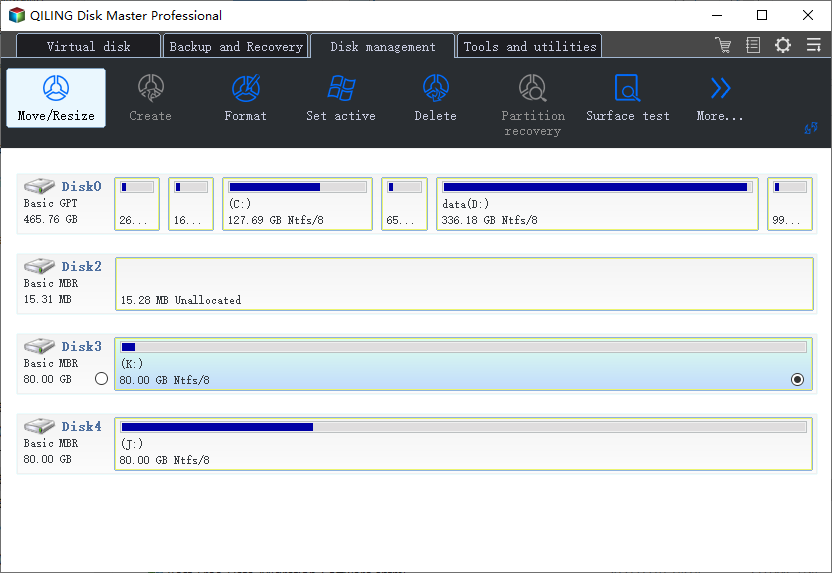
Step 2. Move or resize partitions so the unallocated space is next to the partition you want to extend.
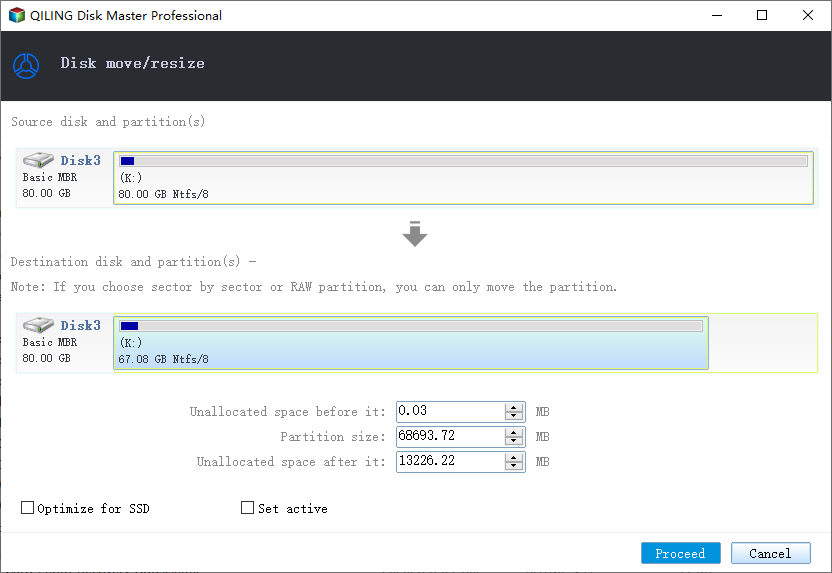
Step 3. Drag the partition edge to use the available space, then preview the final layout.
Step 4. Click Proceed. Restart if the program asks to complete changes before Windows loads.
Conclusion
A cloned SSD showing the old capacity usually needs partition adjustment. Check Disk Management first, then extend or move partitions carefully.
A cloned drive that still shows the old capacity may need a different fix when a recovery partition blocks the free space; see the cloned-drive capacity troubleshooting guide.
Related Articles
Products
Articles & Tutorials
- Data Recovery
- Data Backup
- File Recovery
- File Backup
- System Backup and Restore
- Disk and Partition Clone
- Technical articles
- Mobile articles
- Disk Master Help
- Windows Data Recovery Tutorials
- Windows Secure Delete Tutorials
- Windows Partition Management Tutorials
- Windows File Backup and Restore Tutorials
- Windows System Backup and Restore Tutorials
- Windows Disk Backup and Restore Tutorials
- Windows Clone Tutorials