Two Useful Disk Utilities in Windows 11/10/8/7/Vista/XP
This page recommends two top-notch free disk utilities for Windows 11/10/8/7/Vista, allowing you to arrange your partitions for optimal performance and speed up your system with improved performance.
- #1. Qiling Disk Utility - Partition Master
- 1. Extend, Shrink, Delete, Create Volume
- 2. Convert Disk to Dynamic or Basic, GPT or MBR
- 3. Clone Partition, Clone Hard Drive
- More...
- #2. Windows Disk Utility - Disk Management
- 1. Extend, Shrink, Delete, Create Volume
- 2. Defrag Partition
- 3. Convert Disk to Dynamic
Have you received the warning "Sorry, you are running out of space"? When you want to install games or system programs, a little blue frame may confuse you. This article introduces two useful and simple disk utilities, Qiling Partition Master and Windows built-in tool, to help you manage your disk space.
Disk Utility is a system utility for performing disk and disk volume-related tasks, while Qiling Partition Master is a free Windows partition software that offers a range of functions, including creating, resizing, cloning, moving, merging, and formatting partitions. Both tools can help with various disk-related tasks, making them useful for users who need to manage their computer's storage.
Contents
- How to Use Disk Utility in Windows with Qiling Partition Master
- How to Use Disk Utility in Windows with Windows Built-in Tool
- Other Disk Utilities
- FAQ
1. Qiling Disk Utility in Windows - Qiling Partition Master
Qiling is a user-friendly tool that allows beginners to easily clean up and optimize their computer without risking data loss, and it has more features than the standard Disk Management tool, making it more effective in improving computer speed.
Qiling Partition Master offers advanced features beyond basic disk management, including migrating the OS, cloning disks, and more, to help users effectively manage their disks.
How to Use Qiling Disk Utility - Partition Master:
- Partition Hard Drive
Step 1. Check for free space
To divide a disk partition into multiple ones, ensure there is sufficient free space available to allocate.
Step 2. Shrink a disk partition to create unallocated space
To resize a partition, start by clicking on the "Resize/Move" feature, then select a partition with ample free space and choose the "Resize/Move" option.
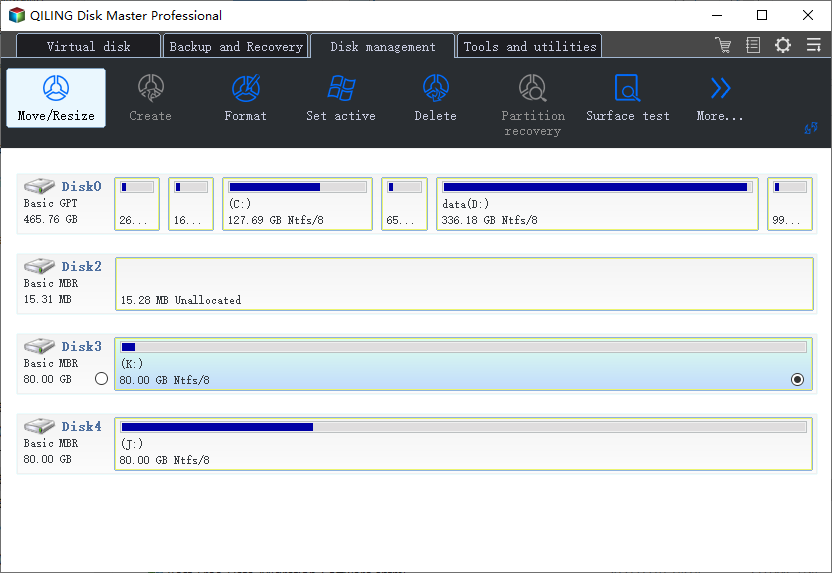
To free up space, drag the partition to the right or left to reduce its size, allowing for more unallocated space. This can be monitored in the "Partition size" area, and when ready, click "Proceed" to confirm the changes.
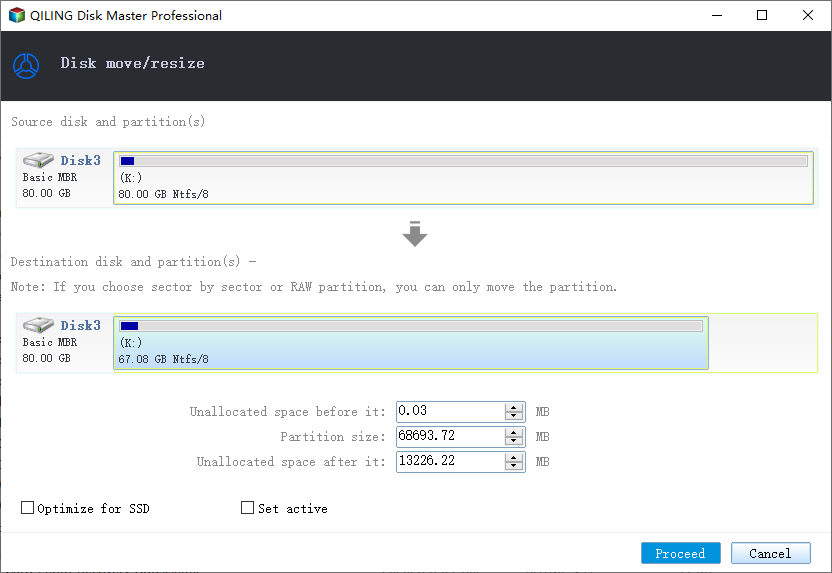
The app saves all changes, and upon returning to the main window, unallocated space appears under the same disk where the space was shrunk.
Step 3. Create a new partition on unallocated space
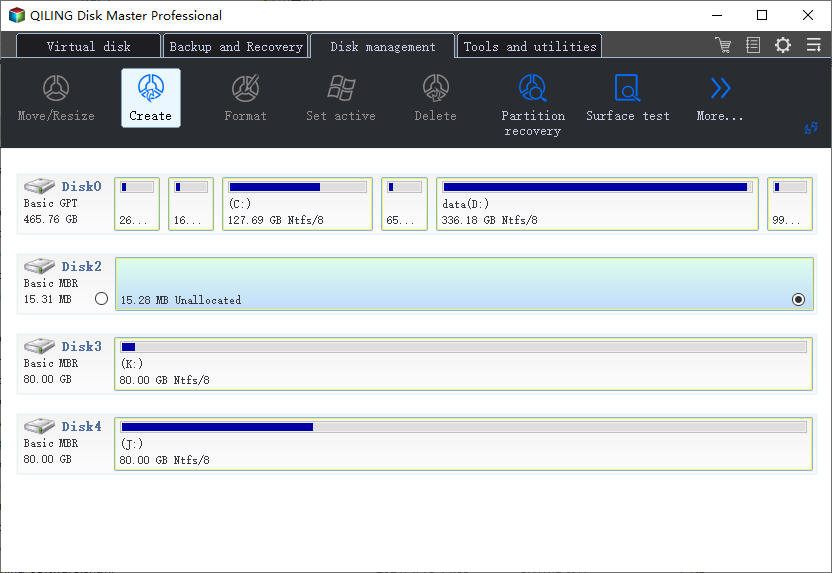
The last step is to turn the unallocated space into a usable partition drive with a recognized file system. To do this, right-click on the unallocated space and choose "Create".
To customize the partition information, select a drive letter, partition label, file system (such as NTFS, FAT32, EXT2/3/4, or exFAT), and other settings in the Advanced Settings, then click "Proceed".
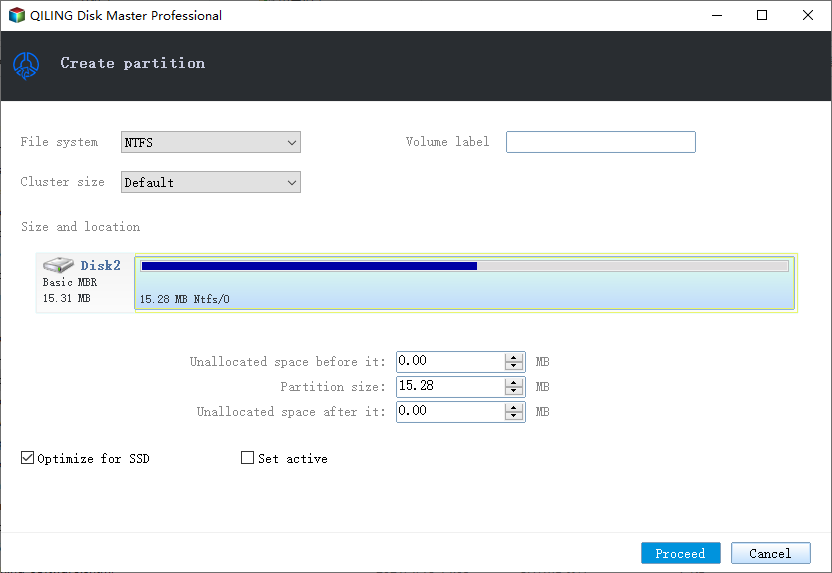
The app creates a partition on the unallocated space, then repeats the process to create multiple partitions on the hard drive.
- Migrate OS to HDD/SSD
This software helps users avoid the hassle of reinstalling their operating system and hard drive by migrating the OS and copying disk/partition.
You can transfer Windows 10 to a new hard drive (HDD/SSD) without any data loss or the need for a Windows reinstallation. To do this, follow the instructions on how to transfer Windows 10 to a new hard drive and migrate Windows 7/10 to SSD.
- Clone HDD to SSD - Upgrade Hard Drive
If your hard drive is running low on space, you can easily upgrade by using the disk/partition copy feature to clone your existing drive onto a larger one. This allows you to keep all your files and programs intact while expanding your storage capacity.
As a guide, you may follow clone 1TB HDD/SSD to 512GB SSD. This feature can also be applied to clone SD cards in Windows 10.
- Partition Recovery
It provides a quick solution to help you recover a deleted partition and its data, saving you from potential data loss and hassle.
2. Disk Utility in Windows - Disk Management
Your computer already has a Windows disk utility - Disk Management. It enables you to perform advanced storage tasks, including initializing a new disk, shrinking essential volume, extending a primary size, formatting a volume, deleting a basic volume, and changing drive letters and paths.
How to Use Disk Management
Step 1. Open Disk Management
- On Windows 8/10: Right-click on the Windows start button and choose "Disk Management."
- To access the Disk Management tool, press the Win+X keys on your keyboard, then select "Disk Management" from the menu that appears. This will open the Disk Management window, where you can view and manage your computer's disk drives and partitions.
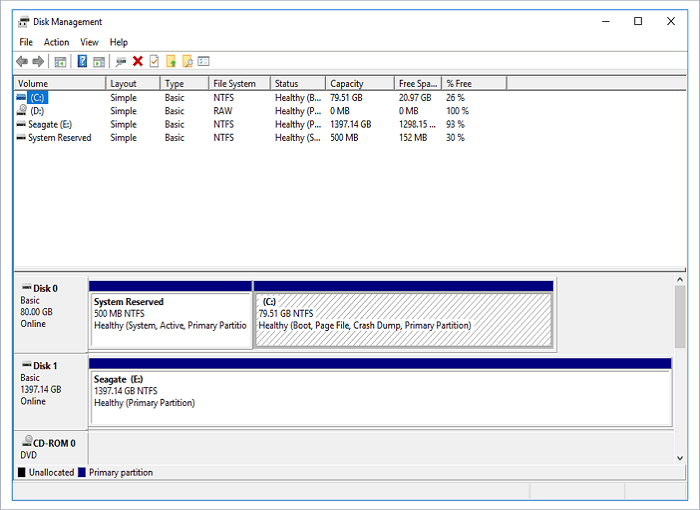
On Windows Vista/7: Right-click on Computer and choose "Manage," then click "Disk Management."
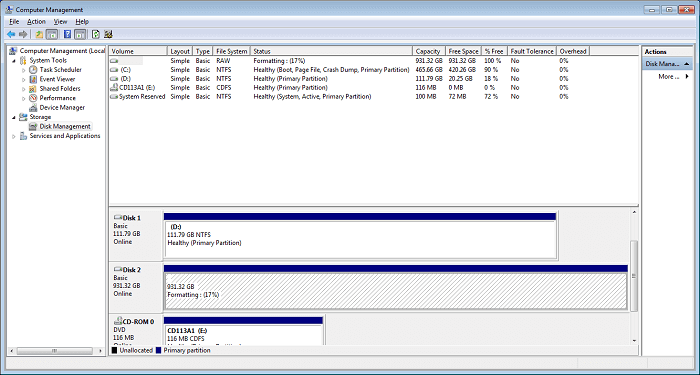
Step 2. Manage Hard Drive Disk in Disk Management
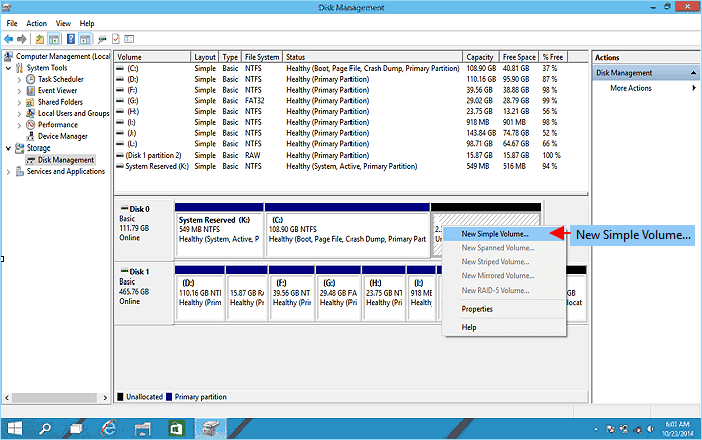
- Create New Partition: Right-click on the unallocated space and select "New Simple Volume" to create a new drive and complete the process.
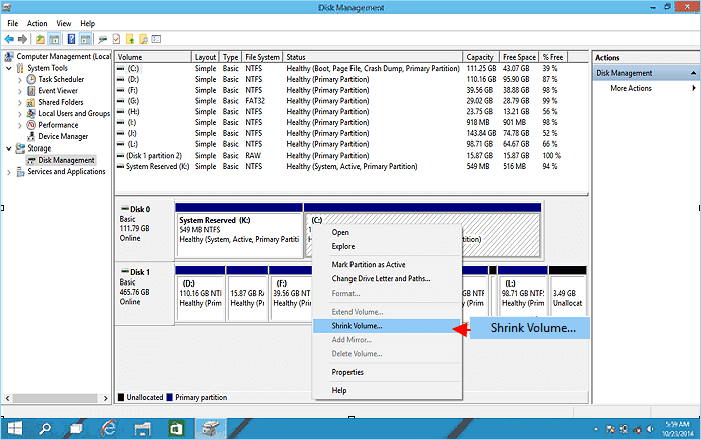
- Shrink Volume: To shrink a target volume, right-click on it and select "Shrink Volume" from the context menu. Then, you can adjust the size to the desired amount.
- Extend Volume: To extend the target volume, right-click on it and select the option to extend the volume, which will then allow you to add unallocated space to the target partition.
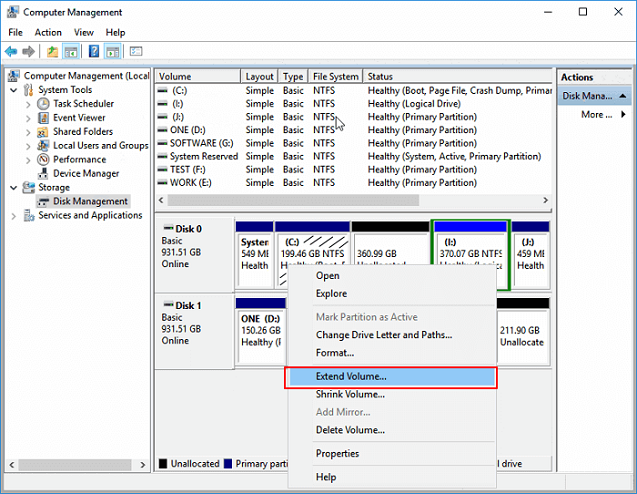
- Format Volume: To format a target partition, right-click on it and select the "Format" option. This will allow you to set a new file system and assign a drive letter to the partition. Once you've made these selections, click "OK" to confirm the changes.
- Initialize New Disk: To initialize a disk, right-click on it and select "Initialize Disk." Choose the partition style as either "MBR" or "GPT" and confirm by clicking "OK."
- Convert Disk to MBR/GPT: To erase all volumes, right-click and select "Delete all volumes." Then, right-click on the disk and choose "Initialize Disk," selecting either "MBR" (Master Boot Record) or "GPT" (GUID Partition Table) as the disk type.
7 Best Free Partition Manager Software for Windows 2023
Other Disk Utilities in Windows
The free Windows application is designed to defragment files and folders on a hard drive, consolidate free space, and optimize file placement. Its interface features a large contrast in color. For more information, click the links provided.
Disk Space Fan 4 is a software that analyzes disk space and helps remove duplicate files, freeing up disk space. It scans and displays the used space with a pie chart, taking just 1 minute, and allows users to delete large files and reclaim disk space.
This software has features for disk management, defragmentation at system boot time, and game optimization, which improves the game experience by saving time on long load times.
WinDirStat is a tool for Windows that displays disk usage statistics and allows for file cleanup. Its main window is similar to the built-in Computer tool, but with a key difference: each file is represented by a colored rectangle, with the rectangle's size proportional to the file's size.
UltraDefrag is a disk fragmentation tool for Windows that can defrag locked system files during the PC boot process.
6. Extra Subst
Extra Subst is a tool that allows users to easily access common folders, create, edit, and delete virtual drives on their PC, and create virtual drives based on selected folders.
FAQ
1. How to wipe the disk with Qiling Partition Master?
You can use Qiling Partition Master's Wipe feature to securely erase a disk, which overwrites the entire disk to prevent data recovery. This method is effective in most cases, rendering the original data unrecoverable.
2. What does disk utility do?
Disk Utility is a tool used to manage and organize storage devices, including internal disks and external storage devices. It can be used to erase, format, and manage these devices, as well as add and control volumes, making it easier to organize data into partitions. Additionally, Disk Utility can be helpful when working with RAID sets.
3. How do I know if disk utility is working on Mac?
- Open Disk Utility.
- Select the device that you are having problems with from the sidebar.
- Click on First Aid.
- The Disk Utility will check the partition maps on the disk and examine each volume.
4. Is there a disk utility for Windows?
Disk Management in Windows allows you to perform advanced storage tasks, such as setting up a new drive or extending a volume into unallocated space on the same hard drive.
Related Articles
- How to Remove SD Card Notification in Samsung S7/S7 Edge
- Recover/Create EFI Partition Windows 11/10 When EFI Boot Partition Missing
- Home Office Setup: Setting Up Home Office for Remote Work
- 4 Solutions To Fix Bootmgr Is Missing Windows 11
- How to Merge C Drive with Unallocated Space Directly in Windows 10 or 11?
You can merge the C drive with unallocated space directly on your hard drive to extend the C drive using Qiling Disk Master. - 2 Ways to Merge Unallocated Space to System Partition in Windows 10
Want to know how to merge unallocated space to system partition Windows 10 when the C drive space is not enough? You will find 2 pragmatic methods from here.
Products
Articles & Tutorials
- Data Recovery
- Data Backup
- File Recovery
- File Backup
- System Backup and Restore
- Disk and Partition Clone
- Technical articles
- Mobile articles
- Disk Master Help
- Windows Data Recovery Tutorials
- Windows Secure Delete Tutorials
- Windows Partition Management Tutorials
- Windows File Backup and Restore Tutorials
- Windows System Backup and Restore Tutorials
- Windows Disk Backup and Restore Tutorials
- Windows Clone Tutorials