Fix Corrupted or Damaged SD Card and Recover Data
If your Micro SD card is corrupted or not reading, you can try fixing it on your own. Start by checking the card's physical condition, ensuring it's not physically damaged. Next, try using a different card reader or computer to see if the issue is with the reader or the card itself. If the problem persists, you can try formatting the card, which may recover some data.
The SD card, also known as a memory card, is a small, portable device used to extend storage capacity in various devices like digital cameras, Android phones, and tablets.
Due to frequent plugging in and out, especially without safe ejection, SD cards are likely to experience file system corruption or bad sectors.
Don't worry if your SD memory card becomes inaccessible or corrupted, as there are fixes available. If your SD card is unreadable, check for symptoms such as distorted data, system crashes, or error messages. For advanced solutions, consider the five tips provided in this video to repair your damaged or corrupted SD card.
Common Signs of Corrupted or Damaged SD Card
Apart from improper handling of the SD card, other factors such as virus infections, interrupted data transfers, and removing the card while writing files to it can also cause SD card malfunctions.
Here, we collect a list of SD card corruption or damage symptoms to help you directly identify whether the SD is corrupted or damaged. Check the following signs: the card is physically damaged, it's not recognized by your device, it's full and won't let you delete files, it's showing as read-only, it's showing as empty when it's not, or you're getting an error message when trying to access it.
Check if your SD card is corrupted or damaged:
|
SD Card Is Corrupted |
SD Card Is Damaged |
|---|---|
|
|
|
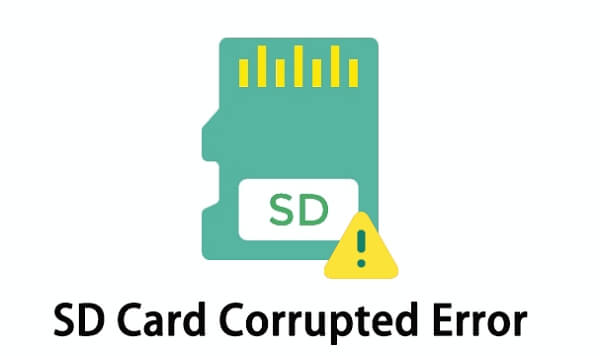
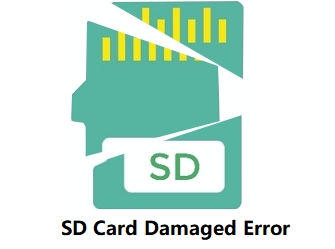
If your SD card is corrupted or damaged, try to recover data from it first, and then follow the methods outlined in this tutorial to fix the issue.
How to Recover Data from Corrupted SD Card
When an SD card becomes corrupted, the first step is to recover files from it, ideally before attempting any repair, as data may be lost during the process.
Here are 3 corrupted SD card file recovery solutions for you to try:
- 1. Turn to Powerful SD Card Recovery Software
- 2. Show Hidden Files
- 3. Try Manual Data Recovery Service
#1. Recover SD Card Data with Qiling Data Recovery Software
If your SD card becomes RAW or Windows prompts you to format it, don't panic - the files are still on the card. Take immediate action to recover SD card data using data recovery software to a safe location, ensuring the files are preserved.
Deep Data Recovery is a professional service that specializes in recovering deleted, formatted or inaccessible data from various devices in cases of data loss.
The best choice to recover your data from a corrupted SD card is a tool with powerful data recovery capacity and an intuitive user interface.
This software can recover data from various storage devices, including computer hard drives, formatted USB drives, and other media like SD cards and CF cards, as well as recover data from damaged or corrupted storage devices.
Step 1. Select file type to scan
- Download and install Deep Data Recovery on your Windows PC.
- To properly connect your SanDisk/Lexar/Transcend SD card to a computer, use an SD card reader that plugs into the computer's USB port.
- Open Qiling SD card recovery software. A list of all file types will be displayed. Select the desired file type and click "USB/SD Scan" to proceed.
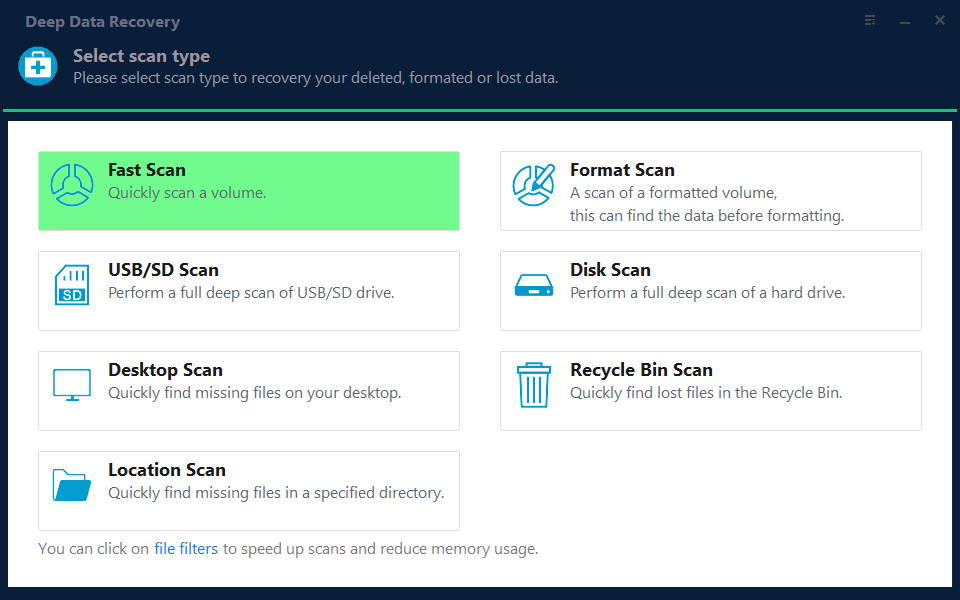
Note: You can choose different search modes based on where and why the data was lost.
Step 2. Select the SD card to scan
- In the next window, all connected drives will be displayed. Select your SD card and click "Scan" to proceed.

Step 3. Check for scan results
- Wait for the scanning process to complete.
- To filter files, click the "Filter" button and select one or multiple file types to display, such as Pictures, Word documents, Excel files, PDFs, Videos, and more.
- Click "Preview" to check if they are the wanted files.

Step 4. Recover SD card data
- Choose desired files and click "Recover".
- To prevent overwriting the original files, it's recommended to save the recovered files to a different location, such as a computer, an external hard drive, or another SD card. This ensures that the files are safely stored and can be accessed without risking the original data.
#2. Show Hidden Files on SD Card
If your SD card suddenly shows empty or displays partial files error, try removing it and then reinserting it to see if the issue resolves itself. If not, try using a different USB port or computer to rule out any issues with the current device.
If your SD card suddenly shows empty or only displays partial data after fixing the corruption error, the data might be hidden. To show hidden files on the SD card, you can try to unhide them by going to the File Explorer settings, selecting the View tab, and checking the box next to "Hidden items." This should reveal any hidden files or folders on the SD card.
Step 1. Connect your SD card to your PC and then press the Windows key + E on your keyboard to open Windows Explorer. This will allow you to view the contents of your SD card on your computer.
Step 2. Right-click on the SD card and select "Properties".
Step 3. To access hidden files and folders, go to the View tab in File Explorer, click on "Hidden files and folders", and select the option "Show hidden files, folders, and drives".
Step 4. Then click "Apply", then "OK".
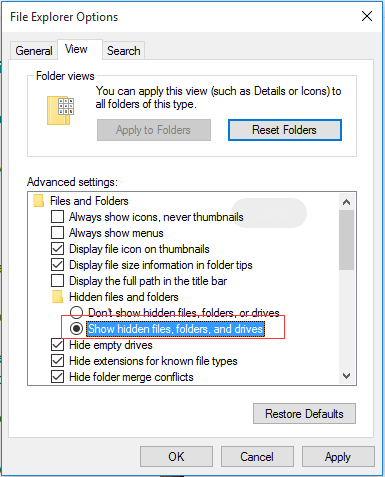
You'll see the files showing up on the SD card.
#3. Turn to Manual Data Recovery Service
If Qiling SD card recovery software fails to scan and find your lost data on the SD card, don't worry. You can still try a manual data recovery service.
Consult with Qiling Data Recovery Experts for one-on-one manual recovery service, which includes the following services after a FREE diagnosis:
- Repair corrupted RAID structure, unbootable Windows OS, or damaged virtual disk files (.vmdk, .vhd, .vhdx, etc.)
- Recover/repair lost partition and repartitioned drive
- Unformat hard drive and repair raw drive(Bitlocker encrypted drive)
- Fix disks that become GPT protected partitions
How to Fix Corrupted SD Card in Windows 10/8/7 [9 Ways]
To fix a corrupted, not reading, not detected, or not recognized SD card, try the following methods: reconnect the SD card, assign a new drive letter, run CHKDSK, use Error Checking, run Windows Troubleshooter, reinstall the SD card driver, run DiskPart commands, format the SD card, or contact the manufacturer.
To fix SD card corruption, try these methods one by one, starting from simple to complex. For minor issues, try formatting the SD card, checking for file system errors, and running a disk check.
- #1. Reconnect SD Card or Try Another Device
- #2. Assign a New Drive Letter to SD Card
- #3. Fix Corrupted SD Card File System with CHDKSK Command
- #4. Repair Corrupted SD Card With Error Checking
- #5. Run Windows Troubleshooter
- #6. Reinstall or Updated SD Card Driver
- #7. Run DiskPart Attributes Command
- #8. Format SD Card
- #9. Turn to Manufacturer
The 9 ways of SD card repair solutions not only work to fix corrupted SD cards, but also apply to other storage devices such as USB, external, and internal hard drives.
Fix 1. Reconnect SD Card - Change SD Card Reader, USB Port, or New Computer
To fix an SD card that is not readable or not detected by a computer, camera, or other devices, first, ensure the card is properly inserted into the device. If using a camera, check the card slot for any debris or dust. If the issue persists, try using a different SD card reader or adapter to rule out any issues with the current reader.
Connection issues or power issues can cause SD card unreadable problems. These issues can often be resolved with simple fixes, such as checking the SD card's connection, restarting the device, or ensuring the power source is stable.
Step 1. Unplug and reconnect your SD card to the PC.
Step 2. If your SD card fails to show up, try the following 3 tips:
- 1. Change a new SD card reader, insert the SD card to it, and connect it to the PC.
- 2. Switch the USB port and reconnect the SD card to your computer.
- 3. Connect your SD card to another new computer.
If your SD card is not showing up or is not readable, try to resolve the issue by checking the card reader, the SD card itself, and the computer's USB ports. If the problem persists, you may need to format the SD card, which will erase all data. If you have a backup of your data, you can simply format the card and use it again.
If nothing shows up, continue with the following fixes.
Fix 2. Change or Assign A New Drive Letter to SD Card
Applies to: SD card not readable, not showing up error.
If your computer can't detect your SD card, it's likely because the drive letter is conflicted with other drives, causing the computer to not recognize the SD card. In this case, the SD card may appear as corrupted or unreadable. To resolve this, you can connect your SD card to your computer, and then check if the drive letter is conflicted with other drives in Disk Management.
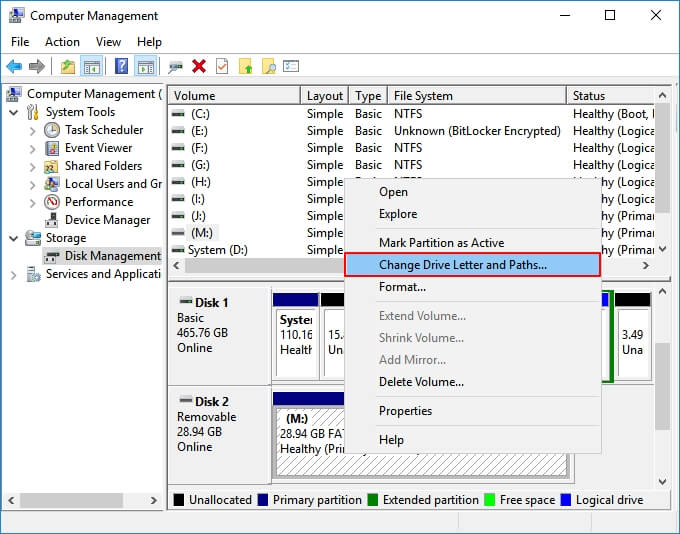
Changing or assigning a new drive letter to the SD card in Disk Management will resolve this error. Add a new drive letter to your card with the following steps:
Step 1. Press Win + X keys and click "Disk Management".
Step 2. Right-click on your SD card, and select "Change Drive Letter and Paths...".
Step 3. Click "Add" or "Change", select a new drive letter for the SD card. Click "OK" to confirm.
Fix 3. Run CHKDSK to Fix and Repair Corrupted SD Card File System
To fix SD card file system corruption or bad sectors issue, you can try using a card reader to transfer files from the SD card to a computer, then use a tool like Chkdsk or Disk Cleanup to scan and repair the file system. Alternatively, you can format the SD card, which will erase all data on it, or use a specialized tool like PhotoRec or Recuva to recover deleted files.
The SD card has a limited lifespan and can develop bad sectors or file system corruption over time due to prolonged use.
CHKDSK command can repair a corrupted SD card without formatting by finding and removing bad sectors, making it the most applicable method to fix the issue.
- Warning
- Running chkdsk can hopefully fix the corrupted file system, however, it can also result in total data loss. So, perform data recovery in advance, and then continue with the CMD method.
Step 1. To access your SD card, plug it into your computer using a card reader. This will allow you to transfer files from the SD card to your computer and vice versa.
Step 2. Type cmd in the search box, right-click Command Prompt and select "Run as Administrator" to open the Command Prompt as an administrator.
Step 3. Type chkdsk F: /f /r /x and hit Enter.
- "F:" means the drive letter of the corrupted SD card you want to repair.
- "/f" is to fix any found errors.
- The command `/r` in a command prompt is used to locate bad sectors and recover any readable information.
- "/x" is used in the command line to force the volume you're about to check to be dismounted before the utility begins a scan.
Step 4. Type exit when the checking and fixing process completes.
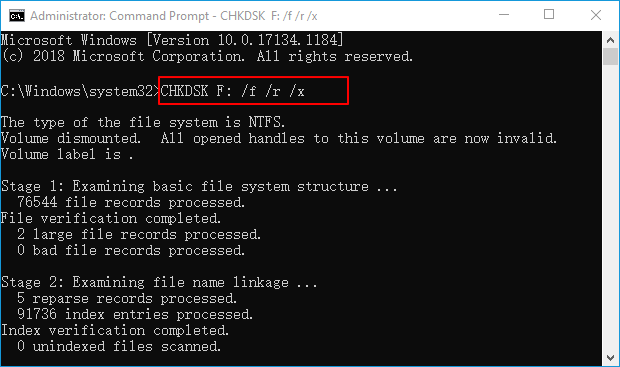
If you complete all the steps, you'll see "Windows has made corrections to the file system" in the command window, indicating that the corrupted SD card has been successfully fixed, and you can access and use your data again.
Fix 4. Repair Corrupted SD Card With Error Checking
To fix the issue of an SD card being inaccessible or inaccessible due to device error, you can try resetting the device, checking the SD card for physical damage, and updating the device's software. Additionally, you can try removing the SD card and then reinserting it, or formatting the SD card to its original factory settings.
To fix a corrupted SD card, you can run Windows Error Checking. To do this, first, insert the SD card into your computer, then go to "This PC" or "Computer", right-click on the SD card, and select "Properties". Next, click on "Tools" and then "Check" to run the error checking tool.
Step 1. Connect the SD card to your PC.
Step 2. Press Windows + E to open Windows Explorer.
Step 3. Right-click the SD card and open its Properties.
Step 4. Go to the Tools tab, and click the Check button.
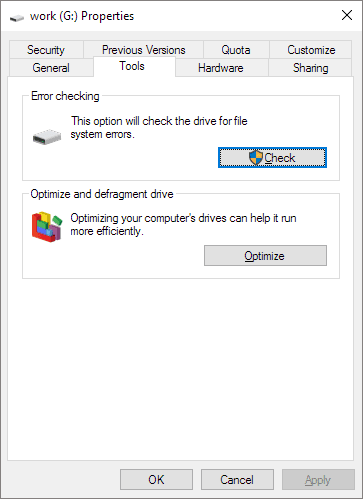
Once the scan process is complete, the scan window will automatically close, ending the scanning process.
If the SD card is not showing up, you may need to try a different method. You can try to recover your data by using a data recovery software, which can scan the SD card and retrieve any lost files. This method may take some time and requires a computer or laptop with a working SD card slot.
Fix 5. Run Windows Troubleshooter
The SD memory card driver issue fixer is a tool that helps to resolve problems related to hardware and drivers on the SD memory card. It is designed to identify and correct issues that may be causing the card to malfunction or not function properly.
Windows Troubleshooter can find and fix problems that are related to hardware and drivers, but it may not be able to address issues specific to the SD card, such as formatting or data corruption.
Step 1. Connect the SD card to your PC.
Step 2. Go to Windows Settings > Update & Security > Troubleshoot.
Step 3. Under the Hardware and Devices section, click "Run the troubleshooter".
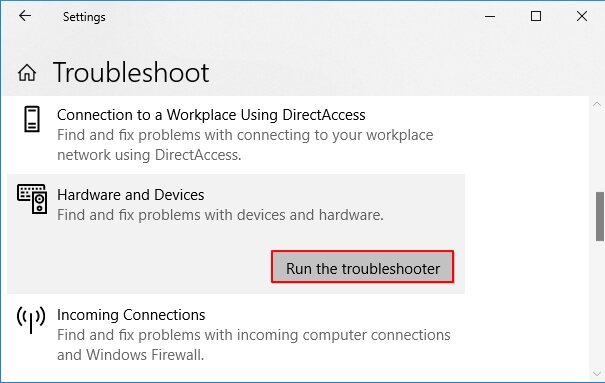
Wait for the troubleshooting to complete, and then restart the PC. This should resolve the SD card not openable or unreadable error.
Fix 6. Reinstall the SD Card Driver and Make SD Card Detectable
To resolve the issue of an SD card not being detected or recognized due to an outdated drive driver, you can update the drive driver to the latest version. This can be done by going to the Device Manager, selecting the drive, right-clicking on it, and choosing to update the driver.
If the SD card is not recognized by Windows at all, it's likely due to outdated SD card drivers, which prevents it from being seen in Windows Explorer or Windows Disk Management.
Reinstall the driver to see if it reappears in the Windows Device Manager, which may resolve the issue.
Step 1. Press Windows + X keys and click "Device Manager".
Step 2. To remove an SD card, Expand Disk Drives, right-click on the name of your SD card, and click "Uninstall".
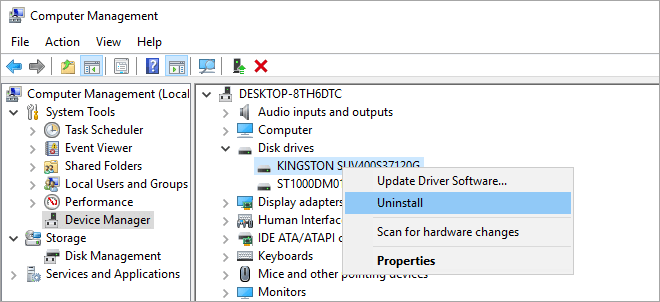
Step 3. Click "OK". Restart your computer.
Step 4. Disconnect and reconnect the SD card to your computer.
Windows will automatically install the latest driver and make the SD card detectable again.
Fix 7. Run DiskPart Attributes Disk Clear Read-Only Command to Unlock SD Card
If your SD card is locked, read-only, or write-protected, you can try to fix the issue by safely ejecting it from your computer, then physically removing it and waiting for 30 seconds before reinserting it. Alternatively, you can try using a different USB port or card reader to rule out any issues with the current connection. If the problem persists, you can try formatting the SD card, but be aware that this will erase all data on the card.
Sometimes, your SD card may become write-protected or encrypted by third-party software, making it read-only or locked.
Here are the steps to run the DiskPart clear read-only command:
Step 1. Connect your SD card to your PC, then press the Windows key and the X key at the same time to open the Start menu. From there, click on "Command Prompt (Admin)" to open the Command Prompt as an administrator.
Step 2. Type diskpart and hit Enter in the command prompt window.
Step 3. Type the following command lines and hit Enter each time:
- list disk
- select disk 1
- attributes disk clear readonly
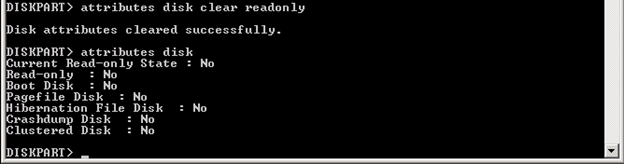
Replace 1 with the disk number of your SD card.
Step 4. Type exit to close the DiskPart window when the process completes.
The SD card will be automatically ejected from the device, and you can safely remove it. Once you've done that, you can insert the SD card back into the device and access the saved files again.
Fix 8. Format SD Card to FAT32 or exFAT
This process resets the SD card file system to FAT32 or exFAT, and can also repair a raw SD card.
If your SD card shows up as RAW in Windows Disk Management or its file system isn't supported by your computer or camera devices, you'll need to change the file system to a supported one.
Formatting the SD card to NTFS, FAT32, or exFAT can be the best way out, and also works to restore SD card full capacity if it only shows partial or half capacity.
You can use File Explorer to format the SD card as shown below or apply an SD card formatter for help.
Step 1. Connect the SD card to PC, open File Explorer.
Step 2. Right-click on the corrupted SD card, and select "Format".
Step 3. Select a proper file system among NTFS, FAT32, or exFAT.
Tick "Quick Format" and click "Start".
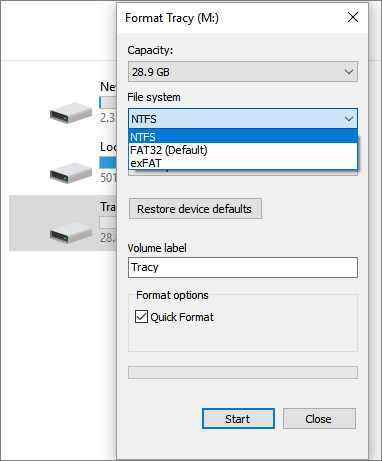
Formatting data will lead to data loss, but you can recover it with the help of SD card recovery software.
Fix 9. Turn to SD Card Manufacturer for Help
To resolve SD card malfunction errors, contact the SD card manufacturer directly, as they are the best source for troubleshooting and resolving issues specific to their products. This is especially relevant for resolving errors related to SD cards, as the manufacturer's technical support team can provide detailed guidance on fixing the problem.
SD card manufacturers such as Seagate, WD, Sony, and Samsung offer services to help users resolve SD card corruption or malfunction errors, providing support for users who need assistance with their devices.
If your SD card is showing a similar error, and you've tried the previous 9 fixes, contacting the SD card manufacturer may be your last resort to resolve the issue.
Other Useful Tips to Fix Damaged SD Card
Applies to: Repair damaged SD card in Windows 10/8/7.
Note When an SD card is partially or totally broken or damaged, it's often a lost cause and there's usually nothing that can be done to revive it.
If your SD card is damaged, try using a card reader and computer to recover data, or use a data recovery software to scan the card and recover lost files. You can also try using a SD card repair tool or a data recovery service to help repair the card.
- #1. Use an SD card adapter, try a new USB port on the PC, or connect the SD card directly to the PC using a card reader.
- #2. Wipe dust off the SD card chips and reconnect it to your PC.
- #3. Contact Manufacture for Help if It's Under Warranty.
- #4. Take Damaged SD Card for Repair at A Local Repair Center.
Mostly, tips 3 and 4 are the most effective in repairing a physically damaged SD card.
Conclusion
If your SD card is corrupted, there are several symptoms that can help you identify the issue. Fortunately, you don't need to worry about losing data on the corrupted SD card.
10+ methods to fix a corrupted SD card were presented, along with 3 reliable SD card data recovery solutions to help recover lost data after repair, with Deep Data Recovery being a recommended option for a fast and secure process.
Don't worry about losing your data. If your SD card is corrupted, take action to restore it to its original state. You can try using a data recovery software, formatting the card, or taking it to a professional for repair.
Related Articles
- Fix Saved Game Corrupted Error on Xbox 360
- How to Recover Data from Corrupted or Scratched CD/DVD
- 3+ Solutions: Cannot Format Raw Drive Error in 2026
- SD Card Showing Wrong Size: Restore Full Capacity on SD Card Without File Loss
- How to Restore Desktop Background/Wallpaper in Windows 10/11
If your desktop wallpaper has disappeared or been lost on your Windows 10/8/7 laptop or computer. You can recover it using two methods: by using file recovery software to restore the lost background, or by changing your Personalization settings to bring it back. - A Complete Guide to Recover Deleted Files
If you're looking to recover deleted files on Windows 10, use this guide. It provides a comprehensive solution for recovering deleted files not only on Windows 10 but also on Windows 11, Mac, iPhone, Android, SD cards, USB flash drives, and even Google Drive.
Products
Articles & Tutorials
- Data Recovery
- Data Backup
- File Recovery
- File Backup
- System Backup and Restore
- Disk and Partition Clone
- Technical articles
- Mobile articles
- Disk Master Help
- Windows Data Recovery Tutorials
- Windows Secure Delete Tutorials
- Windows Partition Management Tutorials
- Windows File Backup and Restore Tutorials
- Windows System Backup and Restore Tutorials
- Windows Disk Backup and Restore Tutorials
- Windows Clone Tutorials