How to Recover Formatted BitLocker Encrypted Hard Drive
BitLocker Drive Encryption is a data protection feature that integrates with the operating system to safeguard data by encrypting entire volumes. This helps prevent data theft and leaks, and only the owner has access to the decryption code, ensuring that sensitive information remains secure.
BitLocker provides the most protection when used with a Trusted Platform Module (TPM), which is a hardware component that helps protect user data and ensures the computer has not been tampered with. Without a TPM, BitLocker can still be used with software-based encryption, but it requires additional authentication steps.
Why You Lost Data from Bitlocker HDD
BitLocker, a full-disk encryption feature, safeguards data from unauthorized access, but it can also lead to data loss if not properly managed. Common issues include:
- Mistakenly deleted files from BitLocker encrypted hard drive.
- Deleted Bitlocker encrypted partition.
- You formatted your hard drive and lost data.
- Your hard drive was infected with a virus.
- Your hard drive corrupted and you cannot access it.
How to Recover Data from BitLocker Encrypted Hard Drive
If your encrypted hard drive suffers from severe data loss, you'll need to recover data using the best data recovery software. To do this, you'll first need to decrypt your hard drive, and then use a disk drive data recovery software to recover your data. This software is the best choice for the job due to its effectiveness in recovering lost data.
Easy Operation
The new interface makes it extremely easy to start a recovery session, requiring no technical background to use it.
Wide Compatibility
Deep Data Recovery supports almost all Windows systems, including Windows 10/8/7/Vista/XP, and Windows Server 2019/2016/2012/2008/2003.
High Quality
This software offers high-quality data recovery, scans the drive thoroughly without causing any damage to the original data.
Now follow the steps to retrieve data from BitLocker encrypted hard drive:
Step 1. Choose the file type to start
To begin the deep data recovery process, launch the Deep Data Recovery tool and select the type of file you want to recover. Once you've made your selection, click "Fast Scan" to initiate the recovery process.
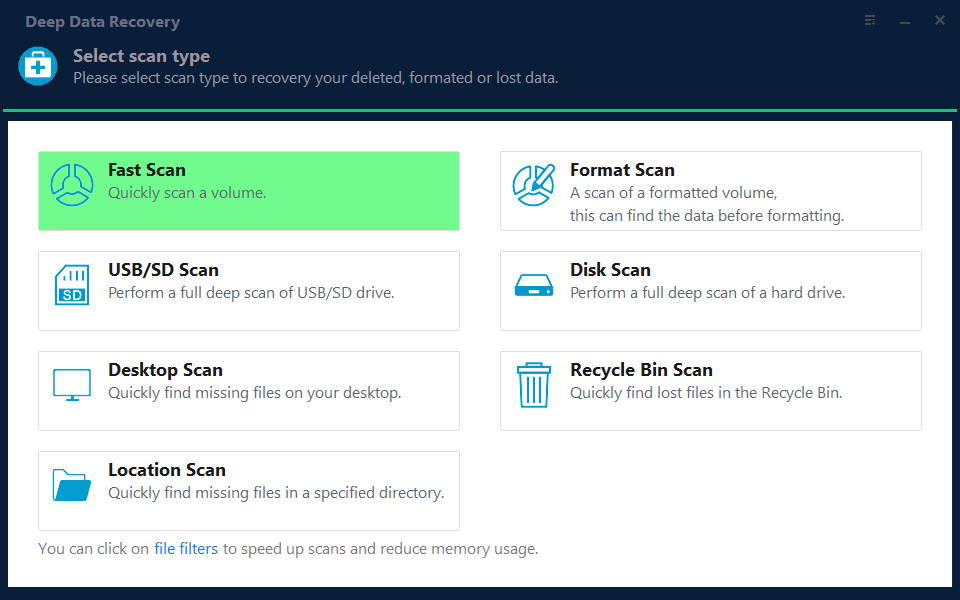
Note: You can choose different search modes based on where and why the data was lost.
Step 2. Choose the encrypted drive to scan
You will see the BitLocker encrypted drive displayed there.
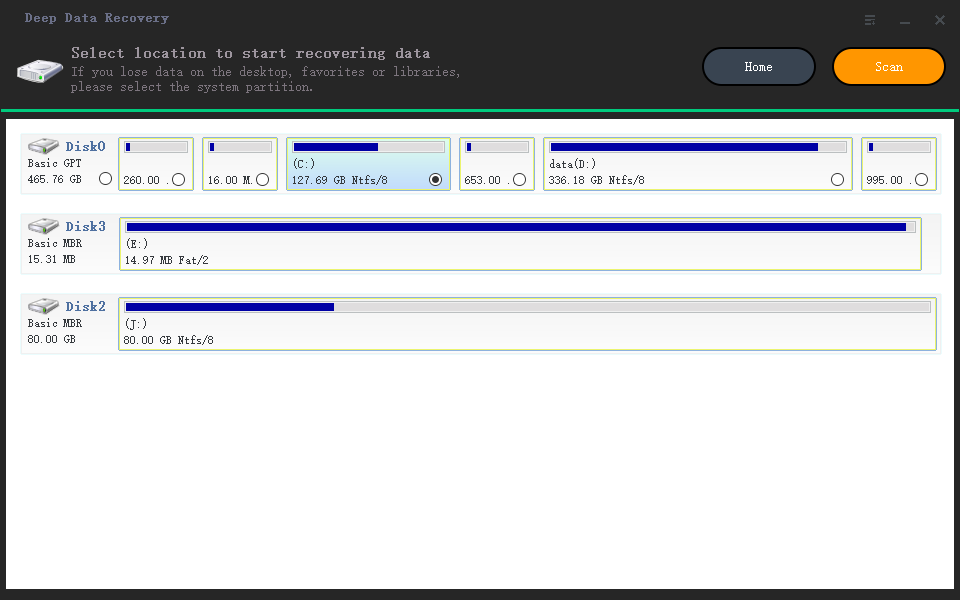
When you click on the encrypted partition, a pop-up window will remind you to enter a password to unlock it. After inputting the key and clicking the "Scan" button, the program will start searching for lost files.
Note: If you forget the key, you can try using "Try Automatically Decrypt" which might help decrypt the drive, but it may not work. If it fails, this program can't scan the drive.
Step 3. Select and preview scanned files
The software initiates a quick scan to find deleted files and a more in-depth scan for additional lost files. Once the process is complete, users can utilize the "Filter" feature or click the "Search files or folders" button to efficiently locate the lost files.
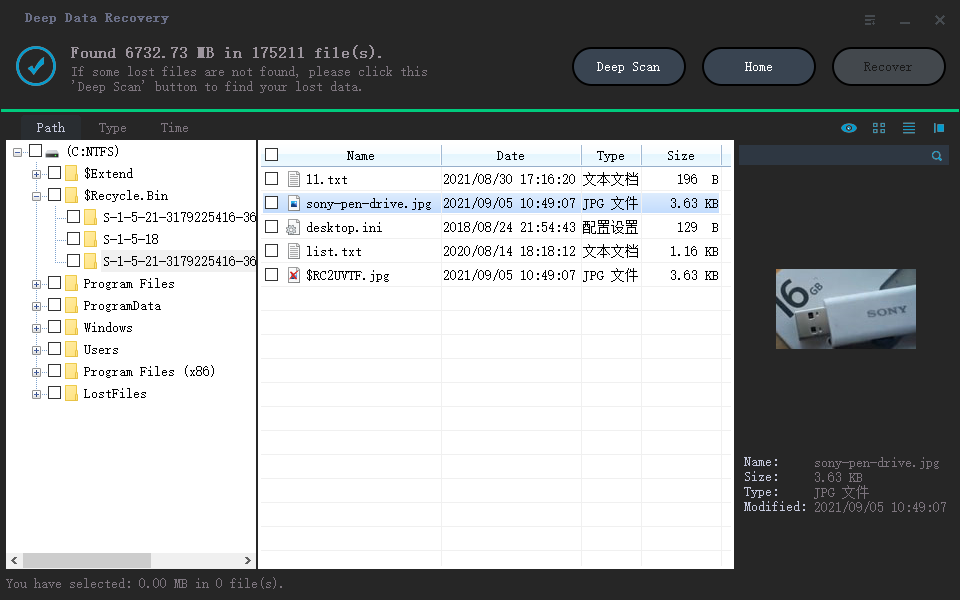
Step 4. Recover lost files from BitLocker encrypted hard drive
After previewing the file, click the "Recover" button to restore deleted or lost files from a BitLocker encrypted partition on Windows.
Extra Tips - How to Disable BitLocker Encryption
BitLocker can be disabled by the following modes:
1. Through Windows GUI mode
To disable BitLocker encryption, ensure you have administrator credentials. Then, follow these steps in GUI mode:
Step 1: To access BitLocker Drive Encryption, go to Start, then click on Control Panel, followed by System and Security, and finally click on BitLocker Drive Encryption.
Step 2: To turn off BitLocker, look for the drive on which you want BitLocker Drive Encryption turned off, and click on the "Turn Off BitLocker" option.
A message will be displayed, stating that the drive will be decrypted and that decryption may take some time.
Step 3: To disable BitLocker on the drive, click on "Turn off BitLocker / Decrypt the drive".
2. Using Windows Powershell
Windows PowerShell must be installed on your system. If it's not, download the correct version from the Microsoft website.
Disable BitLocker for all volumes
Step 1: To execute a command in Windows Powershell in Administrator mode, open Powershell and right-click on the Powershell icon in the taskbar. Select "Run as administrator" from the context menu.
PS C:\>$BLV = Get-BitLockerVolume PS C:\>Disable-BitLocker -MountPoint $BLV
Step 2: Verify the decryption process.
Execute this command: PS C:\> Get-BitlockerVolume
Check the decryption progress by looking at the "Volume Status" and "Encryption Percentage" values, which should both be "FullyDecrypted".
Disable BitLocker for a single volume
Step 1: Open Windows Powershell in Administrator mode and disable-BitLocker -MountPoint "C:"
Step 2: Verify the decryption process by executing the command:
PS C:\> Get-BitlockerVolume -MountPoint "C:"
Check the decryption progress in the "Volume Status" and "Encryption Percentage" sections. The value should be "FullyDecrypted".
Related Articles
- Windows.old Restore: Restore Files from Windows.old Folder
- [Fixed] Laptop Screen Black but Still Running
- Is It Possible to Recover Data After Windows 11 Reset
- Easily Recover Files Larger than 4GB in Size
- How to Open a Corrupt Word File on Mac and Recover Deleted Word
When a Word document is deleted or corrupted on a Mac, users may encounter the error message “This document is either deleted or not currently accessible.” To resolve this issue, users can employ a professional data recovery tool to retrieve deleted Word files or utilize the provided methods to o. - Accidentally Erased Hard Drive in Disk Utility
If you've accidentally erased a hard drive using Disk Utility on your Mac. You can use the powerful Mac data recovery software - Deep Data Recovery to recover your files with simple steps. This software can help you get back your lost data quickly.
Products
Articles & Tutorials
- Data Recovery
- Data Backup
- File Recovery
- File Backup
- System Backup and Restore
- Disk and Partition Clone
- Technical articles
- Mobile articles
- Disk Master Help
- Windows Data Recovery Tutorials
- Windows Secure Delete Tutorials
- Windows Partition Management Tutorials
- Windows File Backup and Restore Tutorials
- Windows System Backup and Restore Tutorials
- Windows Disk Backup and Restore Tutorials
- Windows Clone Tutorials