How to Hide Files with Encryption on Windows
Windows can hide files from view, but a hidden file is still an open file to anyone who knows where to look. Real hiding means encryption: the file exists, but its contents are unreadable without a password.
This guide explains why hiding alone fails, how encryption makes files truly invisible, and how to do both with Qiling Safe Disk.
PAGE CONTENT
- Why Hiding Files Alone Is Not Enough
- How Encryption Hides Files for Real
- Methods to Hide Files on Windows
- Hide and Encrypt Files with Qiling Safe Disk
- Keep Hidden Files Backed Up
- FAQs About Hiding Files
- Back Up Windows Before You Change Settings
Why Hiding Files Alone Is Not Enough
Windows has a built-in "hidden" attribute, and it is not security.
- One click reveals them. File Explorer's "Hidden items" toggle shows every hidden file immediately.
- Search still finds them. Windows Search indexes hidden files unless you exclude the folder.
- Command line ignores the attribute. Anyone can list hidden files with a simple command.
- Recuva and similar tools. Recovery software can find "deleted" files that were never overwritten.
- No password. Hiding does not ask for a password, so anyone using your account can open the file.
Hiding is a convenience for reducing clutter, not a protection measure. To keep files private, you must encrypt them.
How Encryption Hides Files for Real
Encryption changes the file itself. Instead of readable data, it stores ciphertext, and the only way back is the password.
- Unreadable contents. Even if someone opens the file, they see random characters, not your document.
- No metadata leak. The encrypted container does not reveal file names, types, or sizes inside.
- Password required. No password means no access, regardless of who is using the computer.
- Survives copying. Copy the encrypted file anywhere and it stays encrypted.
- Combined with hiding. You can store the encrypted container as a hidden file, so it is both out of sight and unreadable.
Qiling Safe Disk stores all your files inside one encrypted container. The container can be placed in a hidden folder or given an innocent name, and only the password unlocks it.
Methods to Hide Files on Windows
There are several ways to reduce visibility, and encryption is the one that actually protects.
- Hidden attribute. Right-click a file, choose Properties, and tick "Hidden". This is the weakest method.
- Hidden folder. Put files inside a folder with the hidden attribute. Still revealed by Explorer's toggle.
- System attribute. A stronger hide that also requires showing protected system files, but still not encryption.
- Renaming. Giving a file an unremarkable name makes it less noticeable but does not protect its contents.
- Encryption. The only method that protects the file's contents. Combined with any of the above, it gives real privacy.
The best practice is to encrypt the files and then hide the container. That way, even if the hidden attribute is removed, the data is still unreadable.
Hide and Encrypt Files with Qiling Safe Disk
Qiling Safe Disk creates an encrypted container that you can hide anywhere on your disk. Download and install it first.
Step 1. Open Qiling Safe Disk and click Create to make a new encrypted container.
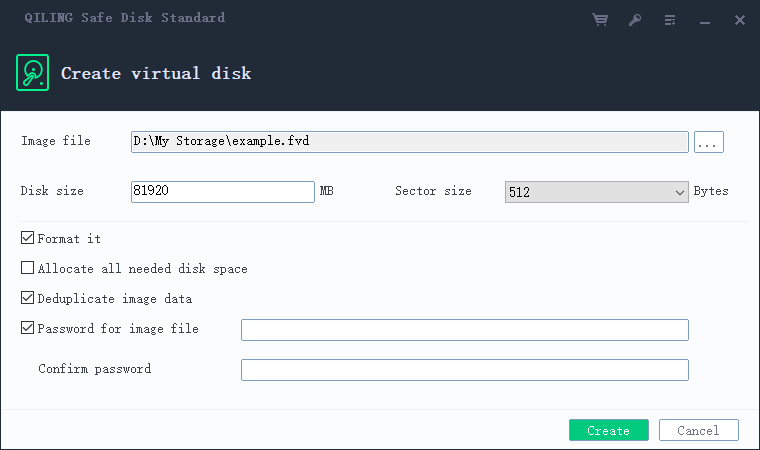
Step 2. Save the container file in a location that is easy for you to remember but not obvious to others, such as a folder with an ordinary name.
Step 3. Set the container size, choose AES-256 encryption, and set a strong password. Click Create.
Step 4. After creation, select the container and click Mount. Enter the password and choose a drive letter.
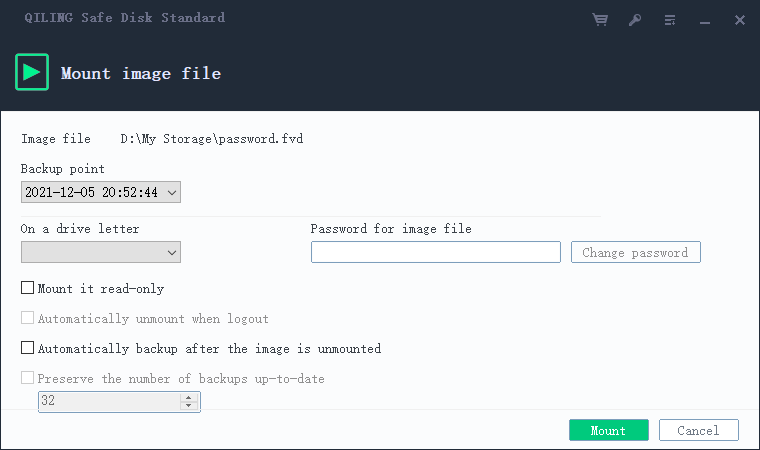
Step 5. Copy the files you want to hide into the mounted drive. They are encrypted automatically as you copy them.
Step 6. Click Unmount to lock the drive. The files are now invisible inside the container.
Step 7. Optionally, right-click the container file, choose Properties, and tick "Hidden" so the file itself does not appear in normal browsing.
Keep Hidden Files Backed Up
A hidden and encrypted file can still be lost. Back it up so you do not lose access forever.
- Copy the container file. The container is a single file, so copying it backs up everything inside.
- Use Safe Disk's auto-backup. Enable automatic backup on unmount to keep recent versions automatically.
- Store backups separately. Keep a copy on an external drive or cloud storage, not on the same disk as the original.
- Encrypt the backup location. If you store the backup on a USB stick, encrypt that stick too.
- Test the backup. Mount the backup copy once to confirm it opens with your password.
Remember that the password is the only key. If you lose it, the backup is just as unreadable as the original.
FAQs About Hiding Files
Can hidden files be recovered after deletion?
Yes, unless the space is overwritten. If the files were encrypted, recovery gives only the encrypted container, which is useless without the password.
Is it safe to hide files in a system folder?
It is less obvious, but system folders can be affected by Windows updates. Use a normal folder with an ordinary name instead.
Will encryption hide my file names?
Yes. Inside a Safe Disk container, file names and contents are both encrypted. Only the container file itself is visible.
Can I hide the container from search results?
Yes. Mark the file as hidden, or exclude its folder from Windows Search indexing.
What if someone finds the container file?
They cannot open it without the password. The file appears as random data and cannot be decrypted by brute force in any practical time.
Back Up Windows Before You Change Settings
Before installing encryption software or adjusting file settings, create a full Windows backup. Qiling Disk Master creates a system image you can restore from.
Step 1. Open Qiling Disk Master and select "System Backup" to include Windows and the boot partitions.
Step 2. Save the backup to a drive other than the Windows disk and start the process.
Step 3. If a change causes issues, restore from the image to return Windows to its working state.
Conclusion
Hiding files is not the same as protecting them. Windows hidden files are revealed with one click, and deleted files can often be recovered. The only reliable way to keep files private is encryption. Qiling Safe Disk stores your files in a single encrypted container, and you can hide that container file itself so it is both out of sight and unreadable. Combined with automatic backups and a strong password, this gives real privacy without relying on the weak hidden attribute. Encrypt first, hide second, and back up always.
For more on data protection, see How to Create an Encrypted Virtual Drive, How to Encrypt a USB Flash Drive, VeraCrypt vs Qiling Safe Disk, and How to Use Qiling Safe Disk.
Related Articles
- How to Encrypt a Folder with Password on Windows
Password-protect an entire folder with an encrypted container, then hide it for extra privacy. - EFS: What is Encrypting File System?
Understand Windows' built-in file encryption and why a container hides files more reliably. - Ransomware: The PC Virus You Must Fight Against!
Learn why hidden but unencrypted files are still at risk from ransomware encryption. - Is Encryption Enough to Protect Your Data?
Learn why hidden encrypted files still need backups, antivirus, and strong passwords. - What is Disk Imaging
Back up the hidden container with a disk image so it can be recovered if the original is lost.
Products
Articles & Tutorials
- Data Recovery
- Data Backup
- File Recovery
- File Backup
- System Backup and Restore
- Disk and Partition Clone
- Technical articles
- Mobile articles
- Disk Master Help
- Windows Data Recovery Tutorials
- Windows Secure Delete Tutorials
- Windows Partition Management Tutorials
- Windows File Backup and Restore Tutorials
- Windows System Backup and Restore Tutorials
- Windows Disk Backup and Restore Tutorials
- Windows Clone Tutorials