How to Encrypt a Folder with Password on Windows
You have a folder full of sensitive files and you want to lock it with a password. Windows Home editions do not include BitLocker, and the built-in EFS has limits. The reliable way to password-protect a folder on any Windows version is to put it inside an encrypted container.
This guide explains the options, why a container is the strongest choice, and how to encrypt a folder with Qiling Safe Disk.
PAGE CONTENT
- Why Windows Cannot Simply Password-Protect a Folder
- Options for Encrypting a Folder
- Why an Encrypted Container Is Best
- Encrypt a Folder with Qiling Safe Disk
- Open the Encrypted Folder Later
- FAQs About Folder Encryption
- Back Up Windows Before You Change Settings
Why Windows Cannot Simply Password-Protect a Folder
Windows does not have a built-in "right-click and add password" option for folders, and there are good reasons for that.
- Home vs Pro. BitLocker, the full-disk encryption tool, is only available in Windows Pro and Enterprise editions.
- EFS limits. The Encrypting File System works on Home editions, but it ties encryption to your Windows account. Other users cannot open the files, but anyone using your account can.
- No per-folder password. Windows does not store a separate password for individual folders. Security is based on your user account, not a folder password.
- Third-party tools fill the gap. Software like Qiling Safe Disk adds the missing feature: a password-protected folder that works on any Windows edition.
If you want a folder that asks for a password every time, you need a third-party encryption tool.
Options for Encrypting a Folder
There are several ways to protect a folder, and not all of them are equal.
- EFS (Encrypting File System). Built into Windows, but tied to your account. If someone logs in as you, the files are open.
- BitLocker. Encrypts the whole drive, not a single folder. Available only in Pro and Enterprise.
- Password-protected ZIP. You can zip a folder with a password, but you must re-zip every time you change a file. Inconvenient and less secure.
- Third-party folder lockers. Many tools claim to lock folders, but some just hide them, not encrypt. Read the fine print.
- Encrypted container. A single encrypted file that mounts as a drive. Put your folder inside, and everything is protected by a password. This is what Safe Disk does.
The container method is the strongest and most convenient because it encrypts every file inside automatically and lets you work normally while mounted.
Why an Encrypted Container Is Best
A container solves the problems that other methods leave behind.
- Real encryption, not hiding. Every byte inside the container is encrypted. The files are not merely hidden from view.
- A separate password. The container has its own password, independent of your Windows account. Even someone using your PC cannot open it without the password.
- Works on any edition. Safe Disk runs on Windows Home, Pro, and Enterprise, so you are not limited by your Windows version.
- Normal workflow. While mounted, the container appears as a drive letter, so you can open, edit, and save files without re-encrypting manually.
- Portable. The container is a single file you can move to a USB stick or another PC.
A container is the closest thing to a true password-protected folder on Windows.
Encrypt a Folder with Qiling Safe Disk
Qiling Safe Disk creates an encrypted container. You put your folder inside it, and the whole folder is protected. Download and install it first.
Step 1. Open Qiling Safe Disk and click Create to make a new encrypted container.
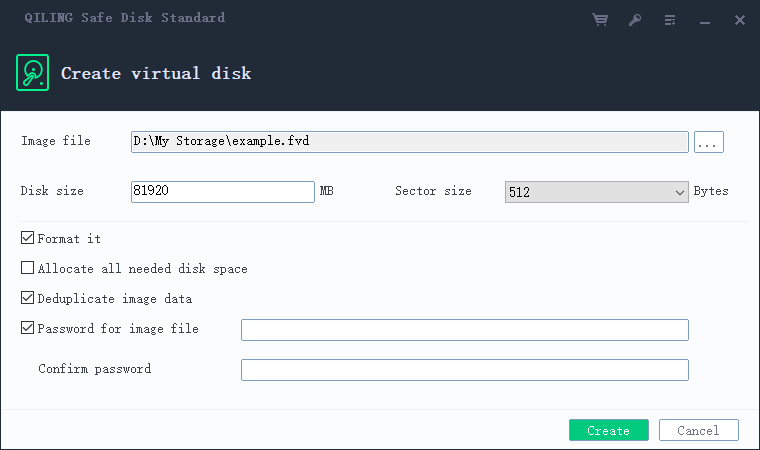
Step 2. Choose a location for the container file and set a size large enough for the folder plus future files.
Step 3. Select AES-256 encryption, set a strong password, and click Create.
Step 4. Once created, select the container and click Mount. Enter the password and choose a drive letter.
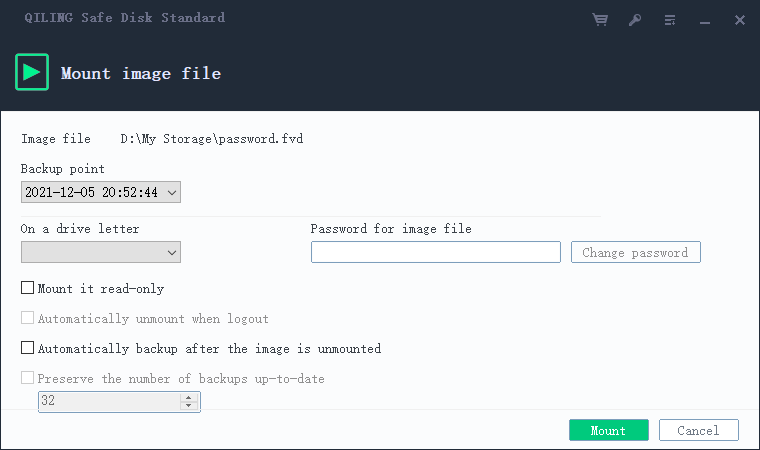
Step 5. Copy your folder into the mounted drive. Every file inside is now encrypted automatically.
Step 6. Click Unmount to lock the folder. The drive letter disappears, and the folder is protected by the password.
Step 7. Optionally, delete the original unencrypted folder from its old location. The only copy now lives inside the encrypted container.
Open the Encrypted Folder Later
To work with the folder again, remount the container.
- Open Safe Disk. The container should still be in the image list.
- Click Mount. Enter the password and choose a drive letter.
- Open the drive. Your folder appears inside the mounted drive, ready to use.
- Work normally. Open, edit, and save files. They are encrypted and decrypted automatically.
- Unmount when done. The folder locks again as soon as you unmount.
If you want the folder to open automatically, you can set Safe Disk to mount the container at Windows startup, but this means the folder is unlocked whenever you are logged in. For sensitive data, mount manually only when needed.
FAQs About Folder Encryption
Can I password-protect a folder without third-party software?
Windows has no native per-folder password option on Home editions. EFS ties to your account, and BitLocker requires Pro. For a true folder password, you need third-party software.
Is a password-protected ZIP enough?
It works, but you must re-zip the folder every time you change a file, and some ZIP encryption is weak. A container is more convenient and stronger.
Will the encrypted folder work on another PC?
Yes. Copy the container file to another Windows PC with Safe Disk, mount with the password, and your folder is there.
Can I share the encrypted folder with someone else?
Yes, if you share the container file and the password. Use a secure channel to send the password, not the same one you used for the file.
What if I forget the password?
The folder cannot be recovered. Store the password in a password manager or a safe physical location.
Back Up Windows Before You Change Settings
Before installing encryption software or moving files, create a full Windows backup. Qiling Disk Master creates a system image you can restore from.
Step 1. Open Qiling Disk Master and select "System Backup" to include Windows and the boot partitions.
Step 2. Save the image to a drive other than the Windows disk and start the backup.
Step 3. If a change causes issues, restore from the image to return Windows to its working state.
Conclusion
Windows cannot natively password-protect a single folder on Home editions, and even EFS ties encryption to your user account rather than a separate password. The most reliable solution is an encrypted container: a single file that mounts as a drive, holds your folder inside, and protects everything with a password you choose. Qiling Safe Disk makes this simple on any Windows edition, with AES-256 encryption and a normal drive-letter workflow. Put your sensitive folder inside, unmount when done, and the folder is locked until you enter the password again.
For more on folder and file protection, see How to Create an Encrypted Virtual Drive, How to Hide Files with Encryption, Best Encryption Algorithm for Files, and How to Use Qiling Safe Disk.
Related Articles
- How Do I Password Protect My Files and Folders
Compare folder-level protection methods and see why an encrypted container is strongest. - How to Mount an Encrypted Drive on Another Computer
Open the password-protected folder on another PC by mounting the container there. - How to Backup an Encrypted Drive or Container
Back up the container that holds your folder so the folder is never lost. - How to Share Encrypted Files Securely
Share the password-protected folder by sending the container and the password separately. - What is Disk Imaging
Back up the encrypted container that holds your folder so the folder is never lost.
Products
Articles & Tutorials
- Data Recovery
- Data Backup
- File Recovery
- File Backup
- System Backup and Restore
- Disk and Partition Clone
- Technical articles
- Mobile articles
- Disk Master Help
- Windows Data Recovery Tutorials
- Windows Secure Delete Tutorials
- Windows Partition Management Tutorials
- Windows File Backup and Restore Tutorials
- Windows System Backup and Restore Tutorials
- Windows Disk Backup and Restore Tutorials
- Windows Clone Tutorials