6 Ways to Fix C Drive Keeps Filling Up for No Reason
This page provides step-by-step solutions to fix your C drive filling up automatically. Here is an overview of the solutions to get your drive back to normal.
| Workable Solutions | Step-by-step Troubleshooting |
|---|---|
| 1. Run Disk Cleanup | To free up space on your computer, open the "Start" menu, search for "Disk Cleanup", and select the top result to open the Disk Cleanup tool. This will allow you to remove temporary files, system files, and other items that are no longer needed, helping to free up space on your computer.Full steps |
| 2. Disable Hibernation | Run Command Prompt as administrator. Input powercfg.exe /hibernate off...Full steps |
| 3. Delete System Restore Points | Right-click "This PC" and choose "Properties" among the listed results...Full steps |
| 4. Transfer Large Files/Apps | You can move large files and applications to another drive without much effort, freeing up space on your primary drive and improving your computer's performance. This process is often referred to as "partitioning" or "relocating" your files, and it can be done using built-in tools or third-party software. By moving less frequently used files to a secondary drive, you can keep your main drive organized and running smoothly, making it easier to find and access the files you need. Additionally, this can also help extend the lifespan of your primary drive by reducing the wear and tear on it.Full steps |
| 5. Extend C Drive Space | Launch Qiling Partition Master, shrink a partition to leave unallocated space, and then extend the C: drive with the unallocated space.Full steps |
| 6. Migrate OS to a Bigger SSD/HDD | If the disk itself has less space, you can migrate Windows 10 to a bigger SSD, which will free up space on the smaller disk and allow you to keep your current setup.Full steps |
Real Case - C Drive Keeps Filling Up
Your C: drive is filling up rapidly despite having limited programs and files, and you've freed up space without resolving the issue. This suggests that the problem might be related to system maintenance, temporary files, or other background processes. You might want to check for any scheduled tasks or maintenance scripts running on your system, and also consider running a disk cleanup and disk defragmentation to see if that resolves the issue. It's also possible that there's a specific program or process consuming a lot of space, so you might want to investigate that further. If the problem persists, you may want to consider consulting with your IT department or a system administrator to help identify the root cause.
Many computer users experience C drive full problems despite not storing files on the drive, even after deleting some files. This issue arises due to various reasons, including system files, Windows updates, and temporary files consuming space. Additionally, the presence of system restore points, hibernation files, and other hidden files can also contribute to the full C drive. These files often remain undetected and continue to accumulate, leading to the C drive being filled up automatically.
Reasons - Why C Drive Is Getting Full Automatically
Many factors can cause insufficient C drive space. Here I will list some of the most common reasons.
- Virus attacks
- File system corruption
- Enabled Windows restore points
- Too many temporary and cached files
- Little free space on C drive...
Before You Start - Back Up Your System and Files
Now that you know the reasons behind the "C drive getting full automatically" issue, you can take action to fix it. To do so, try the tried-and-true solutions that can solve your problem effectively. Before starting, it's a good idea to create a system backup, as some file deletion and cleaning operations may be involved on the system partition. This precaution will ensure your system is safe in case something goes wrong.
A system backup is a process that saves the operating system, files, and system-related data, allowing for a complete restoration of the operating system at any time, using software like Qiling backup and recovery.
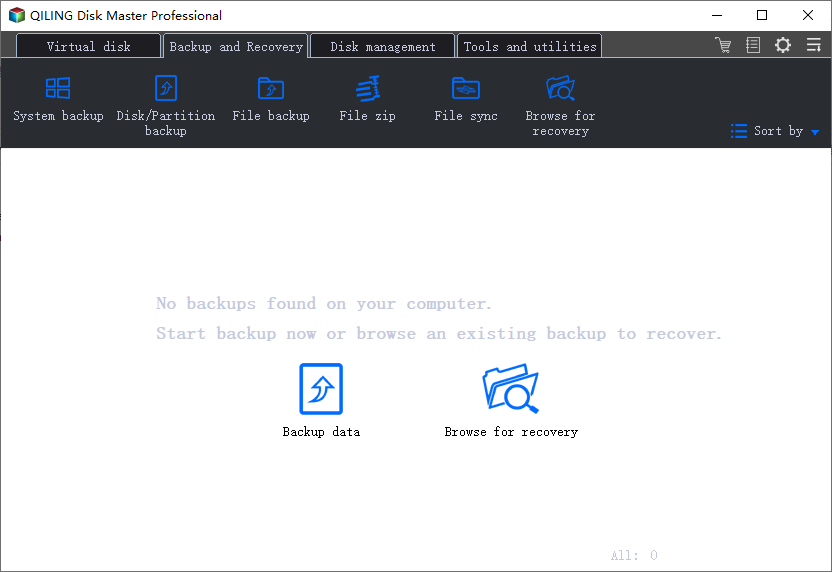
Step 1. Launch Qiling Backup on your computer, and click System Backup on the Backup and recovery page.
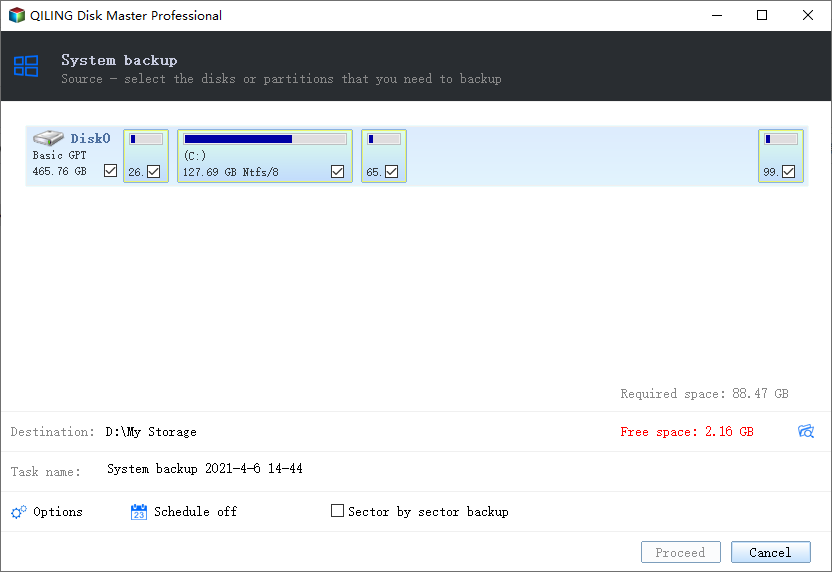
Step 2.You'll automatically select your Windows operating system information and all system-related files and partitions, so no manual selection is needed at this step. Next, choose a location to save the system image backup by clicking on the illustrated area.
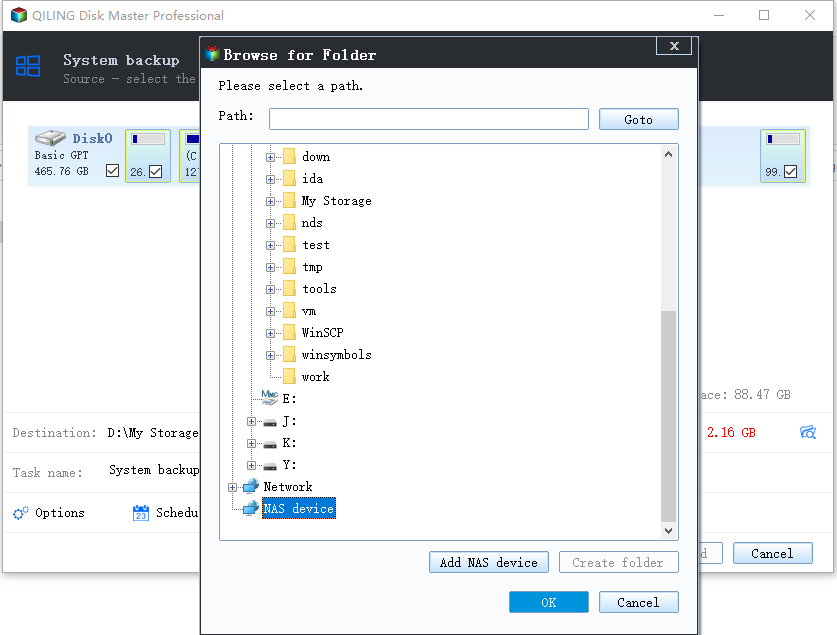
Step 3. The backup location can be another local drive, an external hard drive, network, cloud, or NAS. We recommend using an external physical drive or cloud to store system backup files, providing a safe and secure way to preserve them.
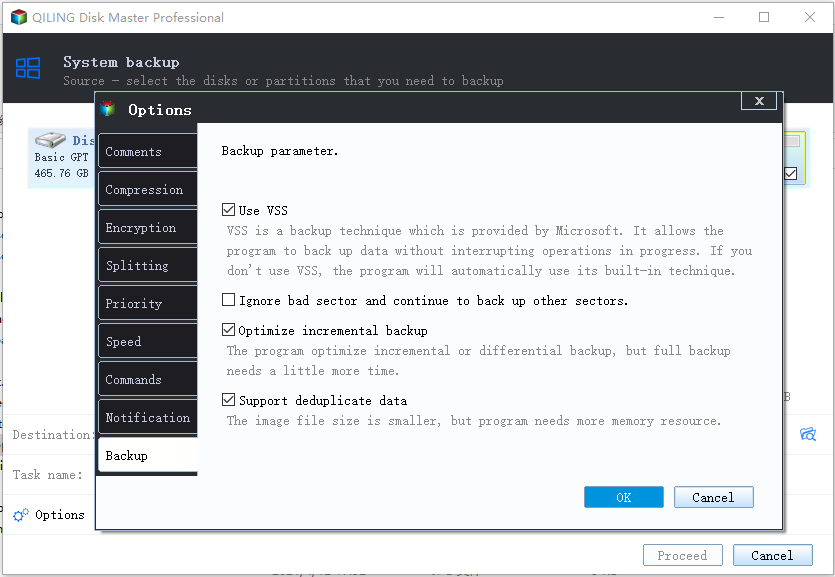
Step 4. Customization settings, such as scheduling daily, weekly, monthly, or event-based backups, and enabling differential and incremental backups, can be accessed through the Options button. Upon clicking Proceed, the Windows system backup process will begin, with the completed task displayed on the left side in a card style.
Fix 1. Run Disk Cleanup to Fix C Drive Filling Up Problem
After making a system backup, you can safely perform the following operations. To address the issue of the C drive filling up, run antivirus software to remove any malware, and then clean up temporary files and other junk files to free up space.
- To run Disk Cleanup, open the "Start" menu, search for "Disk Cleanup" and select the top result to open it.
- To delete files from the C drive or other drives, select the files you want to delete. This can be done by navigating to the specific drive or folder where the files are located, and then clicking on the files to highlight them. Once the files are selected, you can proceed with the deletion process by following the instructions provided by your operating system.
- Click the "OK" button.
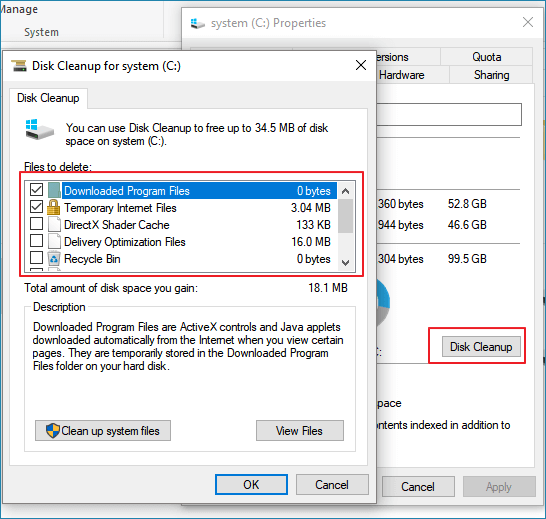
If you don't have advanced technical knowledge, you can use a free tool called Qiling CleanGenius to clean up system files with ease, following simple steps.
Step 1. Download and install Qiling Partition Master Suite on your PC, and then click to download PC Cleaner from the panel.
Step 2. Install Qiling CleanGenius on your PC. To begin with, navigate to "Cleanup" and click "Scan."
Step 3.Qiling CleanGenius will immediately start scanning all useless files, selecting system junk files and invalid entries, and then clicking "Clean" to thoroughly clean your PC.
Step 4.Once you've completed the cleaning process, you can see the total amount of data cleaned in MBs or GBs. To finalize, click the "Done" button.
Fix 2. Disable Hibernation If C Drive Keeps Filling Up
Generated hibernation files often take up much space on your hard drive. The Hiberfil.sys is a hidden system file located in the drive's root folder where Windows is installed. To turn off hibernation mode, follow the steps below.
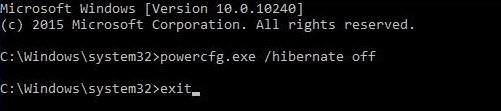
- Run Command Prompt as administrator.
- Input powercfg.exe /hibernate off and hit "Enter"
- To close the Command Prompt window, type exit, and then press the "Enter" key. This will terminate the current Command Prompt session and return you to the operating system's desktop.
Fix 3. Delete System Restore Points in Windows 10
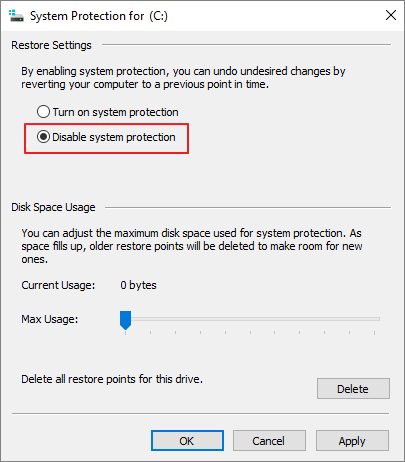
Windows Restore Points, which are essentially mini 'backups' of the operating system, can be created when installing a driver or using Windows Update. While they're helpful for disaster recovery, they can also consume a significant amount of disk space, potentially leading to a full C drive. To address this issue, disabling Windows System Protection can be a solution.
- Right-click "This PC" and choose "Properties" among the listed results.
- On the left pane, choose "System Protection".
- In the small pop-up window, select "C drive" and click "Configure".
- To disable system protection and free up disk space, select "Turn off system protection" and click "OK", or click "Delete > Continue" to delete all system restore points.
Fix 4. Transfer Large Files/Apps to Another Drive
If you have installed large games like Steam or Blizzard on your C drive, you might be experiencing C drive full problems. To resolve this, you can easily move large files and applications to another drive without much effort. With Qiling Disk Master, you can move applications, files, and accounts between computers in just one click.
How to Move Large Files From One Drive to Another?
You can transfer files, programs, and games to another drive with simple clicks.
Fix 5. Extend/Increase C Drive Space
If your C drive has limited space initially, you can use a third-party partition manager software like Qiling Partition Master to extend the C drive without losing any data.
Option 1. Extend System C drive with unallocated space
- 1. Click on the System C: drive and select "Resize/Move".
- 2. Drag the system partition end into the unallocated space so to add it to the C: drive.
- Click "Proceed" to execute the operations and extend the C drive.
Option 2. Extend System C drive without unallocated space
- 1. To resize a partition, click on a large partition with sufficient free space on the system disk, then select the "Resize/Move" option.
- 2. To free up space, drag the end of the big partition to the left to shrink it, making room for the unallocated space. Then, click "Proceed" to confirm the changes.
- 1. Select the system drive at the Disk management page, and select "Resize/Move".
- 2. Drag the end of System C drive into the unallocated space.
- 3. Click "proceed" to save the changes and extend the C drive.
Fix 6. Move/Migrate OS to a Bigger SSD/HDD
If the disk itself has less space, you can migrate Windows 10 to a bigger SSD or HDD, following a guide or video on how to migrate Windows 10 to an SSD.
Conclusion
To fix the C drive automatic full problem, the best solution is to use Fix 5, which allows for allocating more space to your drive without losing data.
Related Articles
- How to Fix SD Card Unexpectedly Removed Error on Your Phone
- Adobe Illustrator AutoSave, Backup and Protect Illustrator from Crash Error
- Fixed: SFC (SFC / SCANNOW) Is Not Working on Windows
- Solved: PS3 System Storage Not Enough, Not Found or Corrupted
- [Solved] How to Fix Windows Update Error Code 0x8024402c
Are you receiving error 0x8024402c when updating in Windows 11? Then follow this easy guide to fix Windows update error 0x8024402c on Windows 11. It can be because of pending updates, corrupt system files, or even incorrect times on your PC. - How to Fix the Windows Key Not Working on Windows 10/11
Windows keys not working is an issue that can be frustrating. This article will explore common causes and methods to fix the problem on Windows 10/11.
Products
Articles & Tutorials
- Data Recovery
- Data Backup
- File Recovery
- File Backup
- System Backup and Restore
- Disk and Partition Clone
- Technical articles
- Mobile articles
- Disk Master Help
- Windows Data Recovery Tutorials
- Windows Secure Delete Tutorials
- Windows Partition Management Tutorials
- Windows File Backup and Restore Tutorials
- Windows System Backup and Restore Tutorials
- Windows Disk Backup and Restore Tutorials
- Windows Clone Tutorials